
A Tribe Called Red Remixes Sonic Stereotypes


Welcome back to “The Wobble Continuum,” a three part series here on Sounding Out!. When we last left you, Mike D’Errico had brought us to the intersection of patriarchal cultural norms, music production practices and aesthetics, and the Military Entertainment Complex. His particular focus was on the sounds and practices of brostep (be sure to check out D’Errico’s SO! Comment Klatsch from last week on gendered sounds, too), and some of those sounds leak through to today’s post from Christina Giacona. Giacona turns her ear to the group A Tribe Called Red in order to hear how they reappropriate and redress the sounds of colonization and racism.
As the series’ title suggests, her essay entails another journey to the low end, where things will once again get wobbly.
Guest Editor Justin D. Burton
—
Since first contact, Native Americans have consistently needed to combat the European stereotypes that portray them as inferior and uncivilized. Barraged with echoes of the same handful of Native tropes since Buffalo Bill’s Wild West Shows, contemporary American society often treats the stereotypical Native American princess, chief, and savage as historical truths, represented recently in Johnny Depp’s portrayal of Tonto in The Lone Ranger. But it is not just the visual image of the Native American that has been stereotyped, so has their sonic sensibility. As documented in the film Reel Injun, Native languages and musics have consistently been “faked” by Hollywood with tricks like backwards English, pig-Latin, and Westernized imaginings of a ubiquitous Native music based on a pan-Indian society that never actually existed. Hollywood often uses Native American music to show a “primitive” society where music’s sole function is to prepare for war. However, the “Indian” drumbeat that accents the first beat of a group of four cannot be found in any traditional Native American or Aboriginal music.
While Native American-directed motion pictures such as Smoke Signals, Powwow Highway, and Atanarjuat: The Fast Runner finally gave agency to Natives in film, it was the all-Native DJ collective A Tribe Called Red’s self-released album and popularization of the Electric Powwow that directly challenges the perception of Native American music in modern society. In this post, I analyze the sonic composition of ATCR’s song “Braves,” exploring how A Tribe Called Red challenges North American stereotypes of Native Americans through the cultural re-appropriation of racist sounds.

“A Tribe Called Red – Hall 4 (1)” by Flickr user Trans Musicales, CC BY-NC 2.0
After World War I, intertribal powwow gatherings served as a place to celebrate newfound unity among Native Nations returning home from the war. By the 1950s intertribal powwows had spread throughout North America. With the continued strength and importance of the powwow in contemporary Native society, urban Natives in locations like New York City and Ottawa, Canada, have begun to search for ways to create the same sense of unity in urban venues. In 2008, DJs NDN and Bear Witness formed the DJ collective “A Tribe Called Red” and began curating performances in Ottawa the second Saturday of every month called the Electric Powwow: a “wild party” focused on showcasing native talent and aboriginal culture. ATCR’s website describe the music as “ the soundtrack to the contemporary evolution of the powwow.“ Bear elaborates in an interview with NOW magazine, “[the Electric Powwow] was also about creating a space for our community within the club environment.” Hip-hop DJ and turntable champ DJ Shub was invited to join the group in 2010, and the trio spent the next two years evolving the sound of the Electric Powwow into a mash-up of powwow and First Nations music with contemporary club sounds including hip-hop, dubstep, and dance hall.

“Tribe Called Red” by Flickr user Dav Yaginuma, CC BY-NC-SA 2.0
Much like Fela Kuti’s popularization of Afrobeat in the 1970s, made up of a combination of traditional Nigerian Yoruba polyrhythms with a blend of Western jazz and funk, and Reggaeton’s fusion of Caribbean rhythms with the aesthetics of American hip-hop in the 1990s, the Electric Powwow merges a historically traditional and non-syncretic music with popular and cosmopolitan music in a way that both honors cultural heritage and makes it relevant to a new generation. As NDN points out on Noisey, even their name follows this trend, simultaneously referencing the introduction of Nations at powwows and famous Afrocentric hip-hop group A Tribe Called Quest. The Electric Powwow events are not just about the creation of a new genre of music, but they also serve as a site for ATCR to speak publicly about aboriginal issues and represent themselves as a contemporary face for the urban Native youth renaissance. ATCR’s music videos and live-show projections extensively sample racist imagery from movies and cartoons including old westerns, Back to the Future III, Bugs Bunny, and Disney’s Peter Pan. As a result of their audio-visual activism, the group has become the unofficial soundtrack for the Idle No More movement, which is attempting to reassert Indigenous sovereignty rights and previously signed treaties in Canada.
By taking both visual and sonic symbols that depict racist stereotypes out of their cultural contexts, ATCR draws attention to both the specific racism of each individual image and the ubiquity of racist stereotypes. In their track “Braves,” A Tribe Called Red takes on the U.S. baseball team the Atlanta Braves by remixing the baseball organization’s Tomahawk Chop anthem, itself adopted from Florida State University.
ATCR’s version transforms the innocuous-sounding chant by showcasing its core as a Hollywood-esque stereotype of Native American song. By re-contextualizing the anthem, “Braves” prompts listeners to reinterpret this facet of American sports culture as a racist pageantry of “savage violence.”
The association of the “war chant,” the motion of the Tomahawk Chop, and the fact that these actions call for one team to attack all make it clear that American sports culture appropriates Native Culture as an example of “savagery” and “uncivilized” behavior. The Tomahawk Chop also forgoes the use of a language-based text entirely and instead chooses to use vocables that cannot be attributed to any particular Native nation, ceremony, or meaning. Like Hollywood’s use of backwards English and the war drumbeat to represent “Indians,” the Tomahawk Chop bears no resemblance to any real Native Nation’s music, acting as yet another imagined primitive stereotype that marginalizes actual Native American music.
On A Tribe Called Red’s SoundCloud page, “Braves”’s description reads, “We wanted to make a song for all the racist and culturally inappropriate sports teams that are still used today!” The group accomplishes this by creating dissonance between contemporary electronic drumbeats and the “traditional” paramilitary marching band arrangement of the “Tomahawk Chop.” “Braves” utilizes a standard dubstep song structure in 4/4 at 140 beats per minute that includes an intro, two main sections that include melodic materials, a breakdown/buildup section, a vocal “drop” which announces and is followed by the climax of the piece, and an outro that brings the track to a close. However, “Braves” does differ from other dubstep songs in the marked separation and interaction between the Tomahawk Chop samples performed by voices and marching band and the composed elements of the song performed as the Wub—a deep, wobbly synthesized sound—and accompanied by a HiHat cymbal pecking away at syncopated rhythms. Even though all the melodic content of “Braves” is based on variations of the Tomahawk Chop melody, ATCR never fully integrates actual samples of the Tomahawk Chop into the composition. The marching band and chant samples are treated as an unwanted and unexpected visitor to a party; they seem important at the entrance, but they are given an increasingly diminished role until they finally exit with a whimper.
Written as a protest against racist sports organizations to help convince them to stop using characterized ceremonies and mascots, “Braves” contains that struggle within the composition itself: dubstep, sounded as the Wub and HiHat, eventually renders the Tomahawk Chop sonically impotent. The “Tribe” drop, when ATCR marks the song by saying “tribe,” acts as the turning point in “Braves.” After this point the Wub and HiHat consistently overwhelm the sampled material. In a standard dubstep song, the tribe drop would be followed by the climax: the strongest, most complex musical section of the piece. However, the Tomahawk Chop sample that follows this drop is immediately swallowed up by a low-pass filter that rubs out the tune, starting with the highest pitched sounds, over the course of sixteen measures, heightening the lower end of the sonic spectrum. Only then does the true climax occur. The Wub and HiHat appear here for the first time without the sample band or vocalizations. After the “Tribe” drop, the samples of the Tomahawk Chop are either dominated by the Wub or swallowed up by low-pass filters and fades.

“Tomahawk” by Flickr user Lorianne DiSabato, CC BY-NC-ND 2.0
In this way, “Braves” acts as a three-minute sonic story of reappropriation. The marching band arrangement and vocables represent the common stereotypes of Native American music perpetuated by Western Culture. The Wub and HiHat act as disapproving commentary on these stereotypes. “Tribe,” the only word used in the entire song, not only sounds ATCR as a group, but also marks the point in the song when ATCR begins to create their own image of Native music while simultaneously disempowering the strength of the marching band.
Just like the rebel American marching band’s reappropriation of the song Yankee Doodle in the Revolutionary War, A Tribe Called Red employs irony: in order to get the song the audience has to understand the racism, and while that sort of understanding seems to represent a steep learning curve for a culture so saturated in racist stereotypes, it is also exactly the sort of understanding a multicultural nation needs in order to thrive. Like Afrobeat, Reggaeton, and the more recent alternative hip-hop group Das Racist, ATCR is an underground voice within American popular culture that speaks with reverence for its own traditions while challenging the popular perception of race relations and breaking new ground in contemporary art. “Braves” proves that the reappropriation of sonic space is a powerful tool in the fight for cultural agency.
—
Featured image: “ATCR 4” by Flickr user MadameChoCho, CC BY-NC-SA 2.0
—
Christina Giacona is the Director of the Los Angeles New Music Ensemble and Instructor of Music at the University of Oklahoma. Dedicated to performing and researching the music of her generation, Christina teaches courses in Native American, World, and Popular Music. Since founding the Los Angeles New Music Ensemble in 2007, Christina has commissioned and premiered over twenty new works for the ensemble; run an international composers competition, recorded three albums, and collaborated with DJs, MCs, animators, choreographers, projectionists, and film producers.
—
 REWIND!…If you liked this post, you may also dig:
“One Nation Under a Groove?: Music, Sonic Borders, and the Politics of Vibration”-Marcus Boon
“Live Electronic Performance: Theory and Practice”-Primus Luta
“Remixing Girl Talk: The Poetics and Aesthetics of Mashups”-Aram Sinnreich
Share this:

“HOW YOU SOUND??”: The Poet’s Voice, Aura, and the Challenge of Listening to Poetry
This post is dedicated to the memory of Amiri Baraka, who passed away on January 9, 2014 in Newark, New Jersey.
I began writing this post while my wife, Sarah, was at a conference on writing curriculum for high school literature. Over the phone one night she asked how to help students better understand the language of Shakespeare, and at a loss for suggestions (not only because I don’t study early modern drama), I recalled my own adolescent struggles with Macbeth, Hamlet, and Julius Caesar. I recalled well-intentioned teachers who gave me recordings, telling me that they would help me get an “ear” for Shakespeare’s language—yet all I remember, maybe all I learned, while listening to the Caedmon recording of Macbeth on vinyl, was that, to my mid-1990s ear, Shakespeare (anachronistically) sounded like Star Wars (which appeared 15 years after the 1960 Caedmon album).
My high school confusion has not completely faded when it comes to the sound of recorded poetic language, even more so when the notion of the poet’s voice is thrown into the mix. As opposed to verse recited by actors (the Caedmon Macbeth featured Anthony Quayle), or the sound of the syllables when we read a poem silently to ourselves, I find it tough to parse the idea of the sound of the poem in terms of the poet’s voice because “voice” is a slippery category—a constructed one, contingent upon the given historical moment of inscription and reception. It is tough because this idea of the sound of the poem, located in the voice of the poet, gets complicated with sonic technologies where voice is subject to the shifting conditions of fidelity.
“Record Player” by DeviantArt user SomeAreLove, CC-BY-NC-ND-3.0
The act of listening to recorded poetry thus poses particular analytic challenges, which become more complex when the politics of identity are brought to bear on these questions of voice and poetry. As a site for identity production, the recorded poetry performance projects a mediated voice that is a potential self. The “sound” of this poetic subjectivity is different from recording to recording, even of the same poem. In an effort to work through these complexities, this post takes up three different recordings of Amiri Baraka’s poem “Black Dada Nihilismus,” which offer variations in delivery and performance that each depend upon the social, political, and aesthetic dimensions of the soundscape that each recording is embedded within.
“Black Dada Nihilismus” is an excellent opportunity to consider the overlapping challenges of voice, performance and the politics of identity in recorded poetry. Published in the early 1960s, this poem was written before Baraka’s shift in politics, which was precipitated by the assassination of Malcolm X in 1965, yet the poem anticipates the intersection of aesthetics and politics during the Black Arts Movement in the late 1960s into the 70s. This shift can be tracked in the sonic details of the first two recordings, made in 1964 and 1965. In the third version, a 1993 remix by DJ Spooky, we can hear how this shift reverberates beyond its historical moment.
In a statement of poetics included in Donald Allen’s classic 1959 anthology The New American Poetry, Baraka (then Leroi Jones) asked: “HOW YOU SOUND??” How a poet’s poem sounded mattered most for him: “you have to start and finish there … your own voice … how you sound” (425). Primarily referencing the poem on the page, he wasn’t whistling in the dark: often thought of as a vocal performance of language, poetry has a long history with sound. One thread of this history is the Homeric tradition of an “oral poetics,” a tradition where, as Albert Lord notes in The Singer of Tales, socialized performances of poetry were simultaneously modes of composition. The feel of language in the body remained inseparable from the poetry that relayed the heroic tales of the ancient world. In The Sounds of Poetry, Robert Pinsky offers a similar account of sound and voice, suggesting that the “sound” of language, the sensuous play of speech, is the material for poetic composition. Or as Charles Bernstein has it in Close Listening, “poetry needs to be sounded” because it is a way to understand it better (7).
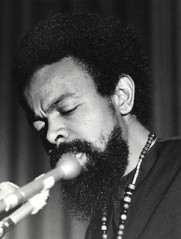
“Le Roi Jones” by Flickr user UIC Digital Collections, CC BY-NC-ND 2.0
Poetry is often said to be difficult—but how would a poet’s “sounding” of a poem help a listener better understand it, as Bernstein suggests? How is the recorded voice resonating in air different from inert marks on a page? What is the status of that difference? Why or how would the sound recording signify differently than the poem on the silent page? In short, is listening easier than reading? My answer to the final question is a resounding “no.” For me, the challenge is how to consider the recorded poetry performance in both formal and aural terms so as to remain tuned in to the aesthetic and the poetic as well as the social and historical dimensions of a particular poet’s work. This is not easily done.
“Black Dada Nihilismus” was first published in The Dead Lecturer (1964) and later included in Transbluesency (1995). Written in two parts, it asserts a black aesthetic by critiquing the dominance of (white) light in Western art and suggesting a connection between this light, ethnic violence, and religious ideology. This is how the poem opens:
.Against what light
is false what breath
sucked, for deadness.
Murder, the cleansed
purpose, frail, against
God, if they bring him
Bleeding, I would not
forgive, or even call him
black dada nihilismus.
The protestant love, wide windows,
color blocked to Modrian, and the
ugly silent deaths of jews […]
(Transbluesency 97)
Through critique the poem develops the connections between aesthetics and racial dominance and violence. These connections take on different inflections in each recorded version of the poem, and with each inflection another aspect of them is amplified.
The first version is a bootleg of a reading at the Asilomar Negro Writers Conference that was held in Pacific Grove, California, in early August, 1964.
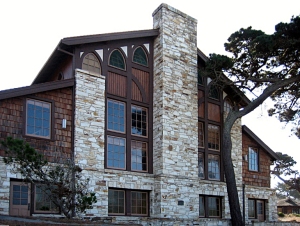
Asilomar Conference Grounds, site of 1964 Negro Writers Conference
In addition to the preamble, where Baraka explains some of the poem’s key terms such as Dada, which he describes as a movement in France (rather than Germany or Switzerland), another sonic detail that marks this as “live” is at the 2:59 minute mark when we hear the flap of a turning page, reminding us that Baraka is treating the poem as a script in these recordings. In this version, the opening lines are sharply delivered, the voice fully pausing at the linebreaks and acutely pronouncing the hard vowels (e.g. “sucked”). Against the continuous background hush of the original reel-to-reel recording, Baraka punches his words into the air, as if trying to find a rhythm between these harder vowels and the softer ones that often denote the poem’s object of critique (e.g. “light”).
The next version is off the A side of New York Art Quartet and Imamu Amiri Baraka (ESP Disk 1965), where the poem’s rhythm is immediately established by the musical accompaniment.
Between the first recording and this one a shift began in Baraka’s development as a poet. The assassination of Malcolm X pushed him to think even more about race, politics, and art. In this version the opening lines, delivered with punch and pause in the bootleg, take on a different register when juxtaposed with the smooth coolness of the quartet. Overall, though, the poem is delivered more militantly here. In the first version the opening lines are delivered forcefully, but ultimately this forcefulness subsides over the course of the reading. The opposite is the case in this studio version that slowly builds to the apex of the poem, the point of most force, this stanza:
Black scream
and chant, scream,
and dull, un
earthly
hollering.
(Transbluesency 99)
In the bootleg, the turn of the page—between “earthly” and “hollering”—interrupts this stanza, and Baraka hesitates and slowly finds his way toward the poem’s close, while in the studio version, the musical accompaniment reaches a fevered pitch here, making it feel as if it is at the edge of the scream that it names. This prepares us for the closing litany of names of black figures of “black dada nihilismus,” which goes like this:
For tambo, willie best, dubois, patrice, mantan, the
bronze buckaroos.
For Jack Johnson, asbestos, tonto, buckwheat,
billie holiday.
(Ibid.)
In the final version, which is DJ Spooky’s remix of the second one, included on the CD Offbeat: A Red Hot Soundtrip (TVT Records 1996), this litany feels more like the outro (that is meant as) against Spooky’s beats and moody reverb.
An aspect of the poem amplified in the remix is the stanzas leading up to the apex stanza of the “black scream.” In a series of tercets that open the second section, the speaker addresses the experience of racial oppression and a growing need to strike back:
The razor. Our flail against them, why
you carry knives? Or brutaled lumps of
heart? Why you stay, where they can
reach? Why you sit, or stand, or walk
in this place, a window on a dark
warehouse […]
(Transbluesency 98)
The “why” is significantly amplified in the remix, forcing us to hear the ironic indictment of the oppressive “light,” not as audible in the other two tracks, explicit in Baraka’s tercets.
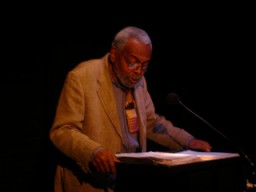
“IMG_0433″ by Flickr user Beyond Baroque, CC-BY-NC-SA-2.0
The original recordings of these versions of “Black Dada Nihilismus” are each in a different format: vinyl LP, tape-to-tape reel, and CD. I have been working with digitized versions, so the way I am hearing these recordings—through a smooth digitized MP3 file or Youtube clip—is not the same as the crackle of a needle running an LP’s groove or a nearly noiseless laser tracing a CD. These variations in format mean that the different ways these versions individual signify—their respective “sounds”—are flattened out by compression. Despite this loss of material context, Baraka still sounds different in each of these tracks. Each version of Baraka’s poem offers us another iteration of his “voice,” and the poem, but listening to each of them does not necessarily provide a better understanding of it. We are, though, given different sonic experiences that depend upon the purpose of Baraka’s performance, the listener imagined during the reading, and the voice enunciated through the mediated environment.
Some of the voice details do remain consistent across these recordings. For example, the delivery of one of the poem’s most memorable phrase—“Hermes, the/the blacker art”—that occurs toward the close of the poem’s first section is steadily delivered in a lower register, in the hush of an aside, and might be taken as the motif of each of these variations.
“Stage Microphone TTV” by Flickr user Keith Bloomfield, CC-BY-NC-ND-2.0
A vast archive of recorded poetry exists. Mid-century recording projects by Caedmon and Folkways made “voices” of well-known poets, such as Robert Frost and Dylan Thomas, available for mainstream consumption. More recent anthologies and series like Poetry Speaks and The Voice of the Poet suggest that the “voice of the poet” still holds appeal. The proliferation of online sound archives such as Penn Sound and From the Fishouse further attest to an ongoing investment in recording, storing, and making available sound files of poets reading their work. And this fascination with the “sound” of poetry is not limited to mainstream cultural spheres or web-based archives. Several scholarly collections on this convergence of sound, voice, and poetry such as Bernstein’s already-mentioned Close Listening, Adelaide Morris’s Sound States, and Marjorie Perloff’s and Craig Dworkin’s The Sound of Poetry/The Poetry of Sound have appeared over the last decade.
The idea of the sound of the poem, located in the mediated voice of the poet, therefore remains relevant today. In many of these instances, however, the poet’s voice falsely takes on an authoritative “aura,” as Walter Benjamin used that word in his (recently re-translated) “The Work of Art in the Age of Its Technological Reproducibility.” Benjamin uses “aura” to talk about authenticity in art and how that is lost when images (or sounds) can be reproduced and widely distributed, and this is not a bad thing: “technological reproducibility emancipates the work of art from its parasitic subservience to ritual. To an ever-increasing degree, the work produced becomes the reproduction of work designed to be reproduced” (24). When Benjamin’s concept is applied to recorded poetry, two key points emerge. First, the “sound” of a poet’s voice is the product of technological conditions. Second, just as a book editor makes aesthetic judgments based on a perceived audience, a listener is imagined when a poetry performance is recorded. Too bad I didn’t know this in high school.
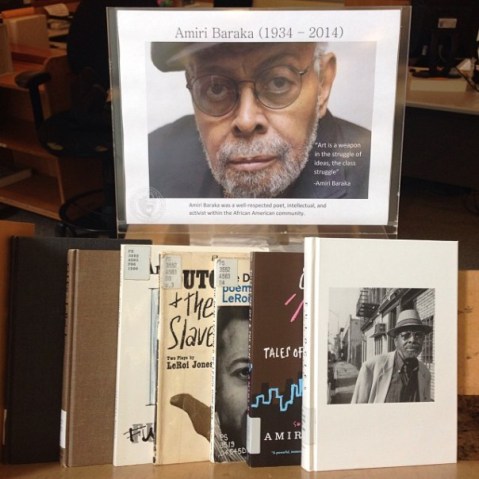
“A Poem for Speculative Hipsters by Amiri Baraka” by Flickr user Shawn Calhoun, CC-BY-NC-2.0
—
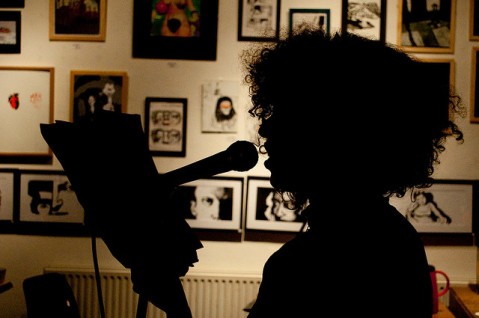
Featured image: “Paula Varjack” by Flickr user Very Quiet, CC-BY-SA-2.0
—
John Hyland recently completed his dissertation on sound, poetics, and the black diaspora, titled “Atlantic Reverberations: The Sonic Performances of Black Diasporic Poetries,” at the University at Buffalo, SUNY. His poems, essays, and reviews have appeared (or are forthcoming) in a range of journals, such as The Journal of Postcolonial Writing, College Literature, and Borderlands. Recently, he has enjoyed performing with the Buffalo Poets Theater and co-edited a special issue of the poetry journal kadar koli on the relationship between violence and the expressive arts.
—
REWIND! . . .If you liked this post, you may also dig:
Hearing the Tenor of the Vendler/Dove Conversation: Race, Listening, and the “Noise” of Texts-Christina Sharpe
Pretty, Fast, and Loud: The Audible Ali–Tara Betts
The Sounds of Anti-Anti-Essentialism: Listening to Black Consciousness in the Classroom-Carter Mathes
Share this:


Current Top Posts





April 2021

January 2020

November 2019

October 2019

August 2019

April 2014

November 2017

March 2015

December 2017

October 2015
 Sounding Out!


Recent Comments