
And you will know us by the sound of vuvuzelas

DOI: https://doi.org/10.59350/sxsjy-mps85
Despite some stunning matchups, the news story of the 2010 World Cup has undoubtedly been the vuvuzela. While there have been valiant efforts to the contrary (see Jennifer Doyle’s article in The Guardian about homophobia and sexual violence), not a newscycle goes by without some reference to this small plastic horn.
Designed in South Africa in the 1960s as a more portable facisimile of traditional kudu horns —and now mass-produced by the thousands in Chinese factories—the vuvuzela’s drone has been broadcast across the globe to the thrill of some and the annoyance of others. Non-African players have complained of headaches and difficulty playing because of the constant, loud sound; the BBC has created a special filter to block out some of the horn’s buzzing tones for at-home viewers. An oddly virulent backlash against the rising popularity of the horn outside of South Africa has effected bans against the vuvuzela at events as distant from South Africa and FIFA as one can get: the U.S. based Ultimate Fighting Championship, the Scottish T music festival, and, most recently, Nathan’s Coney Island Eating Competition, lest the horn “damage the competitive eating aesthetic.” The language used by many of these bans is that of contagion, like the sound of the vuvuzela is the herald of an infectious disease or a plague of locusts.
There have been many critiques of the horn at the level of decibels and hearing damage—the vuvuzela is reportedly 127 decibels, louder than a rock concert—although by that same logic the entire sport of NASCAR should be banned outright, as the New York Times reports it at a whopping 140 decibels. The pointed Nathan’s ban targeting “aesthetics” cuts to the quick of this heated debate. As an African instrument with its own particular history and cultural protocols, the vuvuzela seems to bother some people—namely members of Western and European nations—much more intensely than others, and for different reasons. Two of my husband’s coworkers, from the Ivory Coast and Grenada respectively, described the vuvuzela as a symbolic African diasporic sound of celebration that makes many white people uncomfortable; banning it outright would be not only an obvious pander to Western sensibilities—especially a preference for song over more random outbursts of sound—but also offensive, especially as South Africa is hosting the event. Or as the Botswana Voice Newsblog broke it down: “Hands Off the Vuvuzela!”
Dissenting voices have described the horn as annoyingly loud at best and disturbingly disruptive at worst. John Leicester, sports columnist for the Associated Press, managed to describe the sound of the horn as both “mindless” and “brainless” in his blog “Vuvuzela drone killing World Cup atmosphere,” as opposed to what he calls “football’s aural artistry”: the “ooohs,” “ahhhs,” and stadium chants of the “inventive” English who are “usually among the best-drilled noisemakers in football” but have been tragically drowned out by the “brainless” horns. After cultural comparisons like this—along the lines of the old racialized mind/body split concocted during the Enlightenment—it is difficult not to read Leicester’s closing plea, “Please, South Africa, make them stop. Give us a song, instead,” as a latent desire to control African people, not just their sonic output. At the very least, it is a tacit acknowledgement that the world is still divided along the lines of “us” and “them” and that sound plays a much larger role in facilitating these uneven power dynamics than previously thought.
It has also shown the world that struggles over the shifting border between sound and noise are rarely just that. It is precisely in such battles where sound studies can make an important intervention. . .so drop us a comment on the vuvuzela and the intense reactions it has elicited. What do you think? Has the vuvuzela been racialized? Is it a case of noise just being noise? Or is this phenomenon something else altogether? At the very least, blow one for yourself here and get a taste of what all the fuss is about.
JS
—
Share this:

Re: Chuck Klosterman – “Tomorrow Rarely Knows”
DOI: https://doi.org/10.59350/nfrmg-ngz64
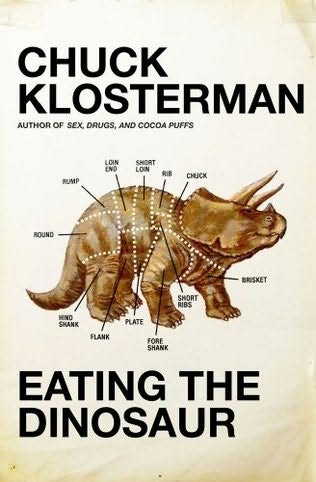
In Chuck Klosterman’s latest compilation of essays, Eating The Dinosaur, he pens an article entitled “Tomorrow Rarely Knows.” It is somewhat of a refresher course in time travel critique; geek-bait, essentially, designed to engross and compel sci-fi aficionados like myself. Although Klosterman is a critic of pop-culture, he is always at his best when writing about music. Therefore the most salient question posed by Klosterman here, is embedded within a footnote about Chuck Berry’s “Jonny B. Goode” halfway through the essay. Considering Back to the Future, Klosterman writes about how Michael J. Fox refers to “Johnny B. Goode,” as an “oldie.” Riffing on this idea he explains that in 1985 a twenty-seven year old rock song did qualify as an “oldie,” where paradoxically now no one would dare refer to Back to the Future, a twenty-four year old movie, an “oldie.” From this logic, Klosterman synthesizes:
“What seems to be happening is a dramatic increase in cultural memory: As culture accelerates, the distance between historical events feels smaller. The gap between 2010 and 2000 will seem far smaller than the gap between 1980 and 1970, which already seemed far smaller than the gap between 1950 and 1940.” (pg. 58)
Klosterman articulates two premises here, (1) There exists a cultural phenomenon in which people remember time in the past moving more slowly than it does in the present, and (2) This phenomenon occurs because culture accelerates. I take issue with the second premise – although I am uncertain of exactly what Klosterman means when he claims that culture is “accelerating,” I am confident that every possible explanation carries within it a set of presuppositions which are by their very nature determinist, teleological and ethnocentric. Most troubling is the idea that culture is ‘going’ somewhere, all progress is good progress. Culture is a metaphor used to describe a forever malleable set of material phenomenon, by constructing it as a quantifiable thing, Chuck projects a number of contemptible perspectives upon it.
Premise one however, is a much more interesting site for contemplation. Re-articulated: Why do some people remember time in the past as moving more slowly than it does in the present? My gut instinct is to argue that there is now a peculiar regime of nostalgia which delights in the rapid re-appropriation and re-articulation of all tangible media artifacts. Because recent changes in technology have made it so much easier to record, edit, splice, erase, duplicate, and distribute all media forms, we now live in a world where we are inundated by representations of the past all the time. This constant inundation is indicative of a growing cultural familiarity with past media ephemera and the subsequent changes in cultural bias. Do people even use the term “oldie,” anymore? Instead, descriptors like “retro” are used to accentuate the “cool” in instances of convergence-necromacy.
It is interesting that Klosterman constructs cultural memory through the ways that people remember music. It is therefore important to historicize the practice of listening within the history of audio technology. The 1980s historically mark the widespread dissemination of recording technology to the consumer market. This denotes a mnemonic shift, akin to the invention of writing or the printing press (Although I would argue that the printing press has more in common with the popularization of the Internet as a DIY publishing outlet). The cultural shift in language from “oldies” to “retro” has more to do with the sense of audio empowerment consumers have gained in the last twenty-four than Klosterman’s theory of cultural acceleration. It’s a shame also, Eating the Dinosaur contains Chuck’s best writing since Sex, Drugs and Cocoa Puffs.
Aaron Trammell
Share this:




Current Top Posts





April 2021

January 2020

November 2019

October 2019

August 2019

April 2014

November 2017

March 2015

December 2017

October 2015


Recent Comments