
Out of Sync: Gendered Location Sound Work in Bollywood

co-edited by Praseeda Gopinath and Monika Mehta
Our listening practices are discursively constructed. In the sonic landscape of India, in particular, the way in which we listen and what we hear are often normative, produced within hegemonic discourses of gender, class, caste, region, and sexuality. . . This forum, Gendered Soundscapes of India, offers snapshots of sound at sites of trans/national production, marketing, filmic and musical texts. Complementing these posts, the accompanying photographs offer glimpses of gendered community formation, homosociality, the pervasiveness of sound technology in India, and the discordant stratified soundscapes of the city. This series opens up for us the question of other contexts in India where sound, gender, and technology might intersect, but, more broadly, it demands that we consider how sound exists differently in Pakistan, Sri Lanka, the Maldives, Bangladesh, Bhutan, Nepal, and Afghanistan. How might we imagine a sonic framework and South Asia from these locations? —Guest Editors Praseeda Gopinath and Monika Mehta
For the full introduction to the forum, click here.
To read all of the posts in the forum, click here.
—
“Indian traffic tends to be one of the noisiest, but that is true of all third world countries…What doesn’t make sense is when you try to remove it from that context. Two people can’t be whispering to one another in the middle of a bench by the sea in Bandra. Will you hear someone sitting next to you on that bench?,” asks sound designer Dileep Subramaniam indignantly. We are discussing the Indian film industry’s norm of looping (or “dubbing”) sound and dialogue at the post-production stage, which has traditionally given India cinema’s sound track an unrealistic degree of clarity. For a loud country, Indian films have been in the habit of incorporating remarkably few ambient sounds into their sound track, until the practice of synchronized sound recording began to infiltrate Hindi film aesthetics in the late 1990s.
The break from post-synchronized sound occurred over a relatively brief period of time in India, as a majority of the commercial films moved away from MOS (motor only sound or no sync sound) to synchronized sound, which refers to the recording of sound alongside image during a film shoot. Industry professionals argue that sound technologies underwent revolutionary changes in comparison to image technologies in India between 1995 and 2002, as the introduction of digital editing platforms weaned the Bombay film industry away from its reliance on mono-tracks and primitive stereo-tracks, directly to Dolby digital multi-tracks. Hindi cinema almost entirely skipped the intermediary technological stage of stereo ultrasound, used for several years in Hollywood. Today, an amalgam of sync sound and Automated Dialogue Replacement (ADR) characterize Bollywood cinema’s soundscapes.
We have been more attuned to Hindi cinema’s soundscapes than to the production and pre-production practices of sound recording and the composition of sound crews, which follows a disciplinary habit in film studies of prioritizing film aesthetics over other aspects of film’s materiality and production. This lopsided emphasis has meant that we have missed out on the complex ways in which the story of film sound is part of a larger story of social change in India, wherein formal shifts are of a piece with new employment opportunities and a realignment of India’s middle class. These social and professional changes have impacted Indian class and gender relations in disparate ways.

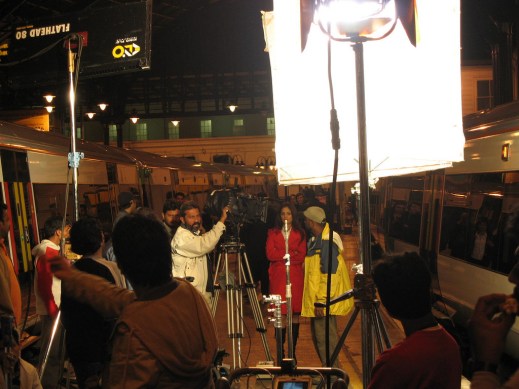
On the set of Bhagum Bhag filmed on Brighton Station, image by Flickr User Simon Pielow,(CC BY-SA 2.0)
Based on conversations that I conducted in Bombay (now Mumbai) in 2009 and 2013 with sound professionals working on Bollywood’s location shoots, I comment on sociological aspects of Bollywood’s increasing adoption of sync sound recording in location shoots, particularly with regard to its implications for class and gender relations within the film industry. My point will be two-fold. One, as the Hindi film form gravitates toward internationally recognizable codes of aural and visual realism, an expanding social range of skilled and unskilled workers are attracted to professions related to location sound recording. Two, despite the diversifying social profile of these professionals, women remain structurally excluded from all levels of the profession.
The change from non-sync to sync sound in Hindi films has created a demand for trained creative technicians and sound engineers, and equally for those who can work as bouncers and sound-security personnel on the field. Security personnel are crucial to recording location sound in a high-decibel country. According to Line Producer Raj Hate (with commercials and the location-heavy Miss Lovely to his credit, the practice of “sound lock ups” started with television commercials in India during the late 1990s before it was adopted by film shoots. “Sound lock” is a phrase used by Bollywood professionals to describe the practice of securing an area to ensure silence, in order to get the best location sound. Many of those working in this pool of unskilled labor in Bollywood today come from Mumbai’s economically depressed migrants who have traveled to the city in search of employment.
For instance, Security Provider Narendra Baruah started with security work on the film Lagaan (2001), the first big-budget film shot with sync sound, although it was preceded by the smaller scale Bombay Boys (1998), which also recorded in sync. Baruah created Active Squad Security while working on sound security for the location shoot of Veer Zaara (2004). He has provided security protection to stars (such as Madhuri Dixit Nene, Shah Rukh Khan, Aamir Khan and Preity Zinta), but his primary employment is in sync sound security. He retains a small group of men on a monthly salary with additional per diem top-ups during assignments, which may range between INR 5,000 to 10,000 to over 20,000 a day, depending on the nature of the shoot. Additionally, he hires men on a temporary basis from a pool of local Mumbaikars and immigrants seeking employment in the big city. Baruah’s company is in competition with actor Ronit Roy’s security company ACE and movie star Salman Khan’s Tiger Security. Although he lacks their star profile and their facility with English, he has made a name for himself through his entrepreneurial practice and expertise in shooting at “jhopad pattis” (slums) for films such as Slumdog Millionaire (2008) and Barah Aana (2009).

Bollywood Film Set, Image by Flickr User Rhys Tom, (CC BY-NC-ND 2.0)
Shot in Dharavi, Barah Aana required twenty men because of the high sound levels of the urban slum. As Baruah points out, jhopad pattis are the hardest places in which to secure sound for location shoots because “A pressure cooker’s whistle goes off somewhere, or a TV starts up, or a child starts crying” (“Kahien cooker ki seeti bajti hai to kabhi TV chalu hai aur bacchha rota hai.”). Open locations for films with smaller budgets also do not require ID cards for film crews, so Baruah finds that one of his greatest challenges is teaching his staff to memorize faces and manage crowds with diplomacy rather than violence. The phenomenon of Baruah and his crew working on a contract-basis with a range of films is what philosopher and sociologist Maurizzio Lazaratto discusses as the reconfigured “anthropological realities of work” in the new global work space, where “polymorphous self-employed autonomous work has emerged as the dominant form” of global labor.
The social range of Baruah’s crew reveals a disparity between Bollywood blockbusters’ onscreen transnational and cosmopolitan backgrounds, and the class diversity of those involved in producing them. As Hagen Koo argues in relation to the shrinking middle class in America and Western Europe against the expanding middle class of India and China, representations of the global middle class that narrowly refer to “the upper segments…in developing countries, whose members are affluent and globally oriented in their lifestyle and mobility pattern” are woefully inadequate (“The Global Middle Class”). Without rendering Bollywood professionals into mere representatives of their class, I can confirm based on my conversations on the field that the assorted workers enabling sync sound shoots in India today come from a range of social classes, which reveals a negotiation and redistribution of work across different classes of professionals, particularly when we consider the work of sound security personnel in conjunction with the work of sound engineers on site. On-the-ground compositions of production crews are more complex and hybrid than what is suggested by a Bollywood blockbuster’s flat image of urbane cosmopolitanism, by Mumbai’s segregated urban spaces, or by the hostile monocultures of Hindutva pushed by Shiv Sena’s divisive politics.
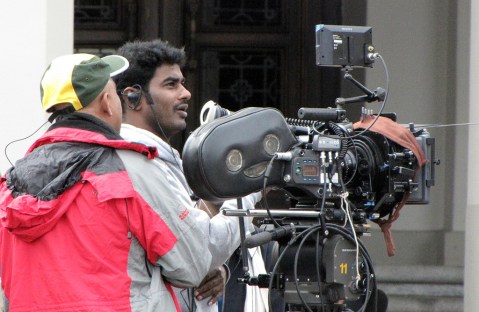
Filming of Bollywood movie “Agent Vinod” on set in Riga, Latvia, August 2010, (CC BY-SA 2.0)
At the other end of the social spectrum and hierarchy of labor among people involved in Bollywood’s revolution in sound are highly skilled sound artists and engineers. Early experimenters in sync and location sound (such as Shyam Benegal and Govind Nihlani) provided opportunities to Bollywood’s new generation of creative audio technicians, who have become key players in the industry’s innovations in sync sound recording, digital sound editing and audio mixing. Dileep Subramaniam worked in sync sound for Nihlani’s television features during the 1980s, and for BBC’s Channel 4 nature documentaries, which made it easier for him to work with transnational productions such as Merchant Ivory’s Deceivers (1988) and Shekhar Kapoor’s Bandit Queen (1995).
Location recordist, production mixer and sound designer Baylon Fonseca edited sound on the digital workstation Audio Vision from Avid for Nihlani’s Sanshodhan (1995) at a time when most Hindi film producers and directors “considered it almost witchcraft.” With Sanshodhan, he initiated methods for digital sync sound recording and mixing that are standard practice in India now. The integration of trained sound engineers into the Hindi film industry has made a palpable difference to its cinema’s sound quality, even as Hindi cinema’s increasing social legitimacy with white-collar workers allows Bollywood to seem like a valid career choice for Indians from the middle and upper middle classes. Nevertheless, high net-worth engineers have to buck traditional social norms—ranging from familial expectations to cultural notions of respectability—to consider sound work in the film industry as a valid career path.
All this is assuming that the engineers are men. Indian women face a double burden in entering such a profession: they must work against social prejudice to pursue careers in science and technology, and then apply that training to the field of media production, which does not possess the social legitimacy of most jobs in engineering. Effectively, new opportunities created by the use of sync sound in Hindi cinema does not bring much promise to women. Women are entirely omitted from the unskilled end of the location sound spectrum because of the incipient threat of violence and aggression against women in India’s public spaces. Under the strain of Hindutva’s India and Shiv Sena’s Mumbai, wherein the concept of protecting women’s honor becomes the violent pretext to restrict their freedom of movement, women are presumptively excluded from sound security work. Women are also largely absent from sound engineering because of the gendering of the hard sciences. In proportion to men, few Indian women are encouraged to enter the sciences, and fewer can choose to use it as the path into film work, so that they are structurally sidelined from high-end work in sound technologies.
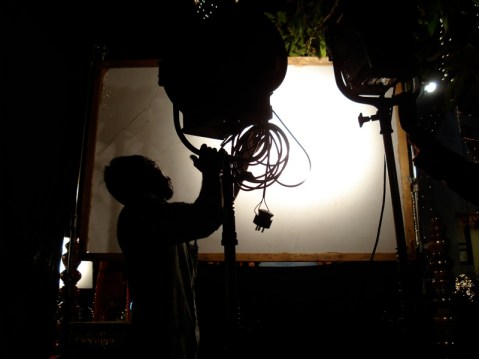
Bollywood Film Set, Image by Flickr User Dani Venn, (CC BY-NC 2.0)
Strong female characters on screen and strong female voices incorporated into the timbre of a film’s soundscape can be cause for celebration. But such inclusions rarely change the social and professional make-up of a film’s production crew. Further, merely adding women to the ranks of security personnel or sound engineers will not presumptively result in a more feminist or inclusive film text. On-screen representations do not reflect pre-production and production practices in simple ways. Despite these cautionary notes, is worth our while to invest some time and thought to how gender relations are impacted along different tiers of film production, as production practices shift in response to Hindi-cinema’s post-globalization aesthetics. Considering the gendered make up of professionals in Hindi cinema’s shift to sync sound recording on location shoots reveals several things. It demonstrates that professional opportunities, social norms and political pressures accompany formal changes in cinema. It allows us to consider what professional shifts in film sound recording in the wake of globalization look like in relation to men as opposed to women, providing an embodied perspective to abstract discussions of social change. And it chastens us against making naïve assumptions about inclusiveness.
—
Featured Image:On the set of Salaami Ish, filmed on Brighton Station,, image by Flickr User Simon Pielow, (CC BY-SA 2.0)
—
Priya Jaikumar is Associate Professor at the Department of Cinema and Media Studies at University of Southern California’s School of Cinematic Arts. She is the author of Cinema at the End of Empire, and several articles and book chapters in publications such as Screen, Cinema Journal, The Moving Image, World Literature Today, Hollywood Abroad, Transnational Feminism in Film and Media, Postcolonial Cinema Studies, Silent Cinema and the Politics of Space, The Slumdog Phenomena, Empire and Film and Routledge Companion to Cinema and Gender.
—
 REWIND! . . .If you liked this post, you may also dig:
Sounding Out! Podcast #49: Sound and Sexuality in Video Games— Milena Droumeva and Aaron Trammell
As Loud As I Want To Be: Gender, Loudness, and Respectability Politics –Liana Silva
SO! Reads: Roshanak Khesti’s Modernity’s Ear–Shayna Silverstein
Share this:

Gendered Soundscapes of India, an Introduction

**This post was co-authored by forum co-editors Praseeda Gopinath and Monika Mehta
A note on the collection: Our original Call For Posts was for “Gendered Sounds of South Asia,” as we hoped to use this de-center India and explore terrain beyond cinema. However, the submissions that we received compelled us to recalibrate the framing of this forum, which will now focus on cinema and sound in India. It occurred to us once we received the pitches that there were structural reasons for the paucity of submissions on both South Asia and sound beyond cinema. The listservs on which the CFP circulated as well as the ways in which the CFP framed sound shaped the submissions. Intersecting sound with gender immediately invokes the female voice, since gender still signals the female. This invocation leads to the next term, “Indian film,” which dominates the region. That said, it is also possible that gender may not be a key lens for analyzing sound in current work on South Asia; noise regulation, caste, religion, ethnicity, and region might be more salient at the moment. We curated the current forum, “Gendered Sounds of India” to expand the terrain of what constitutes sound and voice in India, and through this means, these articles also offer new modes of listening.

Bow Bazar Area, Kolkata, West Bengal, 2011, Image by Flickr user Lorenzo, (CC BY-NC 2.0)
—
Praseeda Gopinath: My childhood is lived soundscapes. It’s revelatory to think about memory and self through the paradigm of sound, because it is only now that I realize that some of my abiding memories are shaped by sound, film, and voice. Urban Indian childhood meant inhabiting layers of sound, and learning to separate and parse the various layers in order of situational importance: the call of the ice-cream man from the call of the peanut-seller, depending on what you were in the mood for; raucous playful yelling of friends from your mother yelling to check on where you were; and of course, the ubiquitous sound of radios and televisions from various homes in your neighborhood. Your ear heard the professional cadences of the radio announcer or television announcements, but you were waiting for the film’s songs you liked, or the dialogue delivery of your favorite actor. If we heard Amitabh Bachchan’s distinctive baritone—the undisputed and worshipped Hindi film star of 70s-80s—we immediately stopped whatever we were playing at and listened to his voice as it drifted out on to the aether. He was the gendered voice of power and glamor emanating from invisible radios or televisions and seeping into our childish brains, defining sound, stardom, and most importantly, cool.
—
Our listening practices are discursively constructed. In the sonic landscape of India, in particular, the way in which we listen and what we hear is often normative, produced within hegemonic discourses of gender, class, caste, region, and sexuality. Today’s entry in the forum, Claire Cooley’s entry on the The Lor Girl (1933)–a film collaboration between Iranian expatriates and The Imperial Film Company–unpacks the ways in which the gendered voice and accent of the female protagonist become symptomatic of modernity in Bombay and Tehran. Class and modernity are rendered through the transformation of her voice and accent. In the process, gendered modernity is also produced and circulated through the film’s soundscape; The Lor Girl offers a lesson in listening, what and how to listen to gendered voice, sound, and accent. It reveals how the ear is trained to identify class, region, and the modern, discourses that continue to shape listening practices in contemporary India.
Similarly, Pavitra Sundar’s article on Falguni Pathak, a sought-after vocalist for heternormative and religiously-inflected Navaratri celebrations, reveals how Pathak’s vocalic body challenges heteronormative ideas about sexuality and gender and consequentially heteronormative listening practices. Sundar asks us to think about how “queerness” might sound in Indian public culture, and indeed, how this aural queerness might not necessarily align with the “queer timbre” theorized in Euro-American queer theory. Perhaps what seems most intriguing about Sundar’s analysis of Pathak is not just her elusive queer voice, but that it is this elusiveness, Pathak’s ability to slip between and across heteronormative aural spaces, that makes her vocal queerness both pervasive and difficult to label.

Women’s Radio Listening Group, Bhubaneswar, Odisha, India, Image by Flickr User UK Department for International Development, (CC BY-NC 2.0)
—
Monika Mehta: When I think of sound, an image surfaces of my mama (maternal uncle) reclining on a bed and cradling a transistor by his ear. The time is the late 1970s and the location, Railway Colony, Kishan Ganj, New Delhi, my maternal grandparents’ home. Thinking back, the transistor must have provided a sense of privacy, perhaps, even facilitated cultivation of a private self in a middle-class, bustling joint family; in such a family, home was not a private place. For better or worse, most things were shared. These shared objects included the radio, and later, the television, both of which were ensconced in the living room and functional, bulky, and ornamental, signaling middle-class status.
Unlike the radio and television, the transistor and the two-in- one were portable; they could be moved and held. The two-in- one was often transported to a grill-window of a bedroom where another mama (maternal uncle) loved listening to Talat Mahmood songs on it. While most Hindi song aficionados were fans of the playback singer Mohammed Rafi, he preferred Mahmood’s voice. For him, the cassette player enabled the cultivation of pleasure and fandom. What appears curious now was that it was mostly, if not exclusively, the male members of the family who were attached to the transistors and the two-in- ones. Similarly, in bazaars, on sidewalks, nears shops, men would cluster around these audio technologies, riveted by a cricket commentary, or at times, enjoying film songs. These technologies produced a sense of male privacy at home, and homosociality outside.
—
Technology is often imagined as a neutral entity, unaffected and unrelated to socio-economic divisions. Priva Jaikumar and Ronit Ghosh’s posts challenge this normative assumption by examining the relations amongst sound technology, gender, and the public.

Bengaluru, Karnataka, India, 2008, Image by Flick user Paul Weller (CC BY-NC 2.0)
Jaikumar discusses how the adoption of sync sound recording by Bombay filmmakers in the 1990s generates new forms of labor that are divided along lines of class and gender. Bouncers and sound-security personnel are drawn from lower-class migrant men, whereas the sound artists and engineers are recruited from the middle and upper classes. In both cases, women are excluded from working with or on sound. Ghosh demonstrates how the introduction of new recording technology in India in the 1930s privatizes listening experiences. If the consumption of live music occurred in public spaces, which could only be accessed by male audiences, then this new technology, not only provided a new listening experience, but made music available to middle-class female audiences. Both Ghosh and Jaikumar’s posts show that consumption, or the labor of sound in public, is masculinized whereas private sounds, or ones that require private labor, are feminized.
On a closing note, the posts offer snapshots of sound at sites of trans/national production, marketing, filmic and musical texts. Complementing these posts, the accompanying photographs offer glimpses of gendered community formation, homosociality, the pervasiveness of sound technology in India, and the discordant stratified soundscapes of the city. This series opens up for us the question of other contexts in India where sound, gender, and technology might intersect, but more broadly, it demands that we consider how sound exists differently in Pakistan, Sri Lanka, the Maldives, Bangladesh, Bhutan, Nepal, and Afghanistan. How might we imagine a sonic framework and South Asia from these locations?
To read all of the posts in the forum, click here.
—
Praseeda Gopinath is an associate professor of English at SUNY Binghamton and author of Scarecrows of Chivalry: English Masculinities after Empire (University of Virginia Press, 2013).
Monika Mehta is an associate professor of English at SUNY Binghamton and author of Censorship and Sexuality in Bombay Cinema (University of Texas press, 2011).
—
 REWIND! . . .If you liked this post, you may also dig:
Sounding Out Tarima Temporalities: Decolonial Feminista Dance Disruption–Iris C. Viveros Avendaño
Lokananta: Sounds of Crisis and Recovery from Indonesia’s National Record Company–Ian Coss
Tape Hiss, Compression, and the Stubborn Materiality of Sonic Diaspora–Chris Chien
Share this:




Current Top Posts





April 2021

January 2020

November 2019

October 2019

August 2019

April 2014

November 2017

March 2015

December 2017

October 2015
 Sounding Out!
Recent Comments