
Listening to Robots Sing: GarageBand on the iPad

DOI: https://doi.org/10.59350/7g546-ctw32
I recently had the opportunity to fool around with the iPad2’s new GarageBand suite. Enticed by the intuitive touch interface I soon found myself lost within the device’s labyrinthine architecture. Every poke, prod and press brought me to a new screen with a bevy of exciting options. A touch to create a drum loop, a tickle to evoke some reverb, and a brush to strum a guitar. I was one with the machine; it was a truly cybernetic, kinesthetic moment. This may sound naïve, but I had never realized how many tools were available to electronic musicians, or how intuitive using these tools could be. As digital tools to create music become more accessible and more intuitive, what is the role of the human in understanding their use? Further, what strategies can we adopt when listening to these creations?
This question may seem a bit outdated to those who have been researching post-humanist phenomena since the digital boom in the mid-nineties. Often conflicting perspectives regarding the negotiation of the human and the digital have been considered in the last decade or so. Some like Donna Haraway, Pierre Lévy, and even Ray Kurzweil offer particularly optimistic readings of the post-human (although for radically different reasons). While scholars like Nancy Baym and Jaron Lanier have offered decisively more sober readings of the problematic. They argue that splits between the human and post-human, or analog and digital are false dichotomies. Truth be told, none of the theorists above adequately address my feelings on this topic. Producing music with a digital audio suite makes me defensive of my humanism and it is by its very nature a project of preservation.
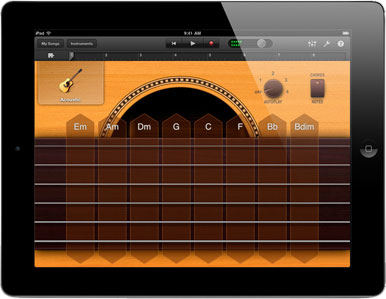
The algorithmic tools packaged within digital audio suites encourage a sense of aesthetic preservation. Tools like GarageBand’s Smart Guitar, Smart Drums, Smart Bass, various arpeggiators and Appleloops encourage the user to program music on a high level where the nuance of serendipity and improvisation play second fiddle to the overall sonic contours of a piece. Although the user is provided the tools to intervene and program music in a very specific way, it is by default a distinctly different experience than that of playing a guitar or piano. The ghost of the algorithm haunts such performances; reminding the user that these acts of spontaneous creation are no longer the default but deliberate…. This sense of deliberate improvisation forces me into a reflexive space where I am acutely aware of the mediations occurring within my performance. Succinctly, I must defend a sense of self within my creation. If I yield to the algorithms that seek to help me compose, I destroy all sense of the human within my work. Simply turning on robots and watching them sing.
For this reason, I propose an aesthetic of preservation as a way to understand the ways in which we listen to works created by digital audio suites. As algorithmic aids become more advanced and commonplace in music, the human becomes a less essential aspect of the form. Understanding what has been deliberately included in spite the seductive algorithmic environment is ultimately a project that seeks to recover the human in the machine; perhaps even, a project doomed from the start, as we grow ever closer to the means of our artistic production.
—
Aaron Trammell
Magnasanti – Check out the results of my collaboration with Colin Germain on GarageBand!
—
Share this:

Can You Hear Me Now?

DOI: https://doi.org/10.59350/zc0jb-kgr76
And Gil-Scott Heron thought the revolution would not be televised.
The past few weeks the world has been watching the protests in Egypt. We have not just watched, but we have also tuned in. This is history in the making, especially considering that many of the information we are getting of this protest movement come from the ground, from the protesters themselves, and their requests have gone viral on Youtube and Twitter.
Earlier this week, I was watching CNN and its coverage of the protesters at Tahrir Square after Mubarak’s statement that he would not step down. On several occasions the broadcasters on CNN asked viewers to listen to protesters. The grainy images of the mobile crowds had been playing in the background all afternoon, a reminder of what was going on while the broadcasters offered information and analysis. But at times the broadcasters stopped speaking so viewers could listen to the crowds. The grainy images emitted a dull roar, the combination of all of the cries and statements from the protesters. The cameras followed people down streets, but the roar was constant. It struck me how often the plea to listen came up during the broadcast. On Friday, when Mubarak resigned, I tuned in online (from work) to CNN, MSNBC, and BBC America. The broadcasters made the same requests: let’s tune in to the crowds at Tahrir Square. See early in this MSNBC video where Brian Williams encourages viewers to listen to the protesters:
The newsmedia seemed to offer the sounds to its viewers, but what is at stake when that happens? How are the sounds being coded? Mark Branter’s post on sound and sanity in the context of the Rally to Restore Sanity (which took place on October 30th 2010), reminds us that oftentimes noise and screaming is connected to “irrationality and fear.” He points out, “Public noise is senseless sound, while rational debate is meaningful sound.” In this context, the constant plea from newscasters for the American public to “listen in” to the crowds at Tahrir Square takes a different spin. Are we insiders looking at the Other scream and shout? When the newscasters ask us to tune in to the pleas and screams coming from the Egyptian crowds I wonder if the newscasts frame them as senseless crowds because of the way that they present these sounds. In any instance, this presentation of sound is not innocent. Some may argue that it is just a request from Western media to pay attention to what the crowds are saying, but I believe that we cannot truly listen to their cries on Tahrir Square when we still hold in place this analogy of “sound/noise::rationality/irrationality.” Many agreed that Mubarak should listen to the pleas of the crowds, but are we listening to them as well?
The coverage of the Egyptian protests shows us how complicated listening is. The protesters are not just seen but heard (only when the network wants the viewers to listen, mind you) by viewers. The sonic aspect of this movement is reinforced when we think of the “Speak-to-Tweet” service, set up to allow Egyptian protesters to tweet when the Egyptian government turned off all internet communication. We could read AND hear what the protesters were saying.
When media outlets choose to tune in to the protests in Egypt, this is an example of how important sound is to narratives. Visuals are not the only story, is what I get from the protest coverage. (And letting the world hear the protesters is a step in the right direction.) The coverage and its inclination toward the audio of the protesters tells me that it’s not just a matter of shock value but it’s also a statement of the role of audio in the news. It’s supposed to be a reflection of what is going on at the moment, like taking the temperature of the crowds. As others have said on this blog (for example, Priscilla Peña Ovalle) sound is usually linked to the visual, and the hierarchy of senses in our society always has the visual as the most important. Listening is important, but we must also think about how we listen, and what filters the sounds we listen to.
Liana Silva
Share this:




Current Top Posts





April 2021

January 2020

November 2019

October 2019

August 2019

April 2014

November 2017

March 2015

December 2017

October 2015


Recent Comments