
Sound at IASPM-US 2014

For the second weekend in March, the U.S. chapter of the International Association for the Study of Popular Music (IASPM-US) will be holding its annual meeting at the University of North Carolina, Chapel Hill. Like sound studies, popular music studies is fueled by an interdisciplinary spirit, and many of the questions that currently occupy the popular culture corner of sound studies have much in common with those of us who take the study of music seriously. This year’s conference offers a unique theme, “Music Flows,” that centers around questions of water, flows, and liquidity. The conference theme also offers more expansive ideas to flows, including mobility, embodiment, sonic materialities, and ecology. While the theme may strike some as unconventional, it ends up being an excellent metaphor for those of us who study musical flows in fields that prefer static works and communities over transient ones.

The James Taylor Bridge over Morgan Creek in his native city of Chapel Hill, North Carolina
Since this is a popular music conference, many of the papers at this meeting take musical texts as their focus (including mine); however, there are still many panels and individual papers that might interest scholars from a sound studies perspective. After all, sound travels better in water than in air, and following that logic, water and sound both feature waves. Indeed, there are papers that take the water waves and sound waves as their inspiration. Compare, for example, SO! guest writer Mack Hagood’s discussion of an early popular recording of water waves against Robin James’s philosophical theorizing about sound waves and Neo-Liberalism in the music of Ludacris. Similarly, many papers take their inspiration from the sounds that come from water or are performed in it: Peter Schultz specifically tackles the sound-design of watery environments in video games, while SO! guest writer Josh Ottum investigates the sounds from the floating garbage island in the middle of the ocean. These papers offer attendees the opportunity to consider the large theoretical consequences of changes to the water and waves in recordings.
Some papers approach water from a perspective focused on materiality and mediation. Craig Eley’s paper offers a historically grounded study of the hydrophone and underwater recording. Peter McMurray’s paper analyzes the problem of making music for watery environments and the challenges of water’s sonic conduciveness. For an athletic perspective on hearing music in the water, Niko Higgins talks about the music that swimmers use in their athletic training. These perspectives on liquid mediation offer a tremendous opportunity to expand sound studies beyond its general dependence on sounds that happen in the open air.
Beyond the more literal takes on the water in music flows, a large portion of the papers have taken their inspiration from the metaphor of social mobility, liquidity, and trade. There are panels and papers that emphasize transnational sonic flows, such as the panel “In and Out of Africa,” and Jason Robinson’s work on recording challenges in a transatlantic jazz collaboration. Two papers in particular deal with the role of African Americans in U.S. diplomatic relations: Darren Mueller’s paper on Dizzy Gillespie as a jazz ambassador, and Kendra Salois’s work on hip-hop diplomacy. Along a similar vein, Yvonne Liao specifically considers ports and their relationship to musical trade in Shanghai’s jazz scene. There is also a paper on the role of music as a social lubricant by Luis-Manuel Garcia that promises to be a real treat.
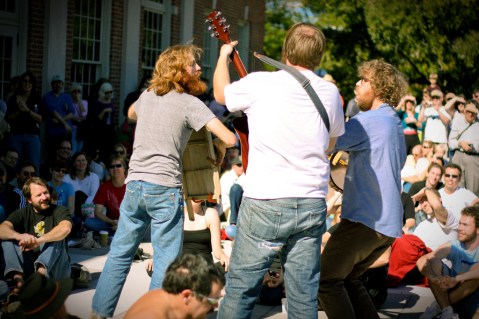
Megafaun serenades a Chapel Hill, North Carolina crowd, Image by Flickr user abbyladybug
Finally, it is worth mentioning how many papers address sound studies’ long-standing relationship with soundscapes, ecomusicology, and the environment. There is a panel called “Ecologies of Place” with papers on ecologically-minded music from places as far flung as India, Iceland, Appalachian Ohio, and Canadian parks. There is also a panel on “Urban Soundscapes,” including Robert Fry’s paper on sound, music, and branding at a hot spring resort and Mathew Robert Swiatlowski’s paper on the boom box and the Walkman in urban space.
Many in sound studies cite Jonathan Sterne’s critiques of ocularcentrism in cultural criticism. This conference encourages us to think beyond the air and stasis and shift our focus to the possibilities of liquid metaphors in cultural change.
—
Featured Image: One of Chapel Hill’s many ponds, at the Outdoor Education Center, Image by Flickr User Kat St Kat
—
Kariann Goldschmitt is an Adjunct Assistant Professor at New College of Florida and Ringling College of Art and Design. She holds a Ph.D. in Musicology from UCLA (2009) and was the 2009-2011 Mellon Fellow of Non-Western Music at Colby College in Maine. Her scholarly work focuses on Brazilian music, modes of listening, and sonic branding in the global cultural industries. She has published in The Journal of Popular Music Studies, American Music, Yearbook for Traditional Music, and Luso-Brazilian Review and contributes to the South American cultural magazine, Sounds and Colours.
—
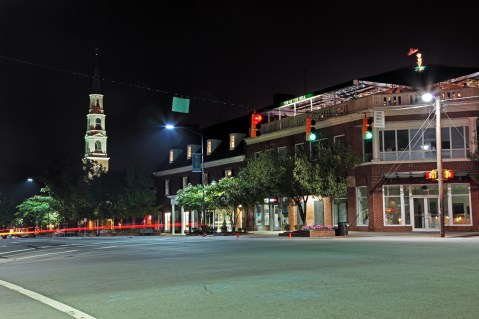
“Franklin Street, Chapel Hill” by Wikimedia user Caroline Culler, CC BY 3.0
Friday, March 14

So nice we put it twice, The James Taylor Bridge, Public Domain
.
Saturday, March 15

“Cheerleaders, UNC, 1989” by Flickr user North Carolina Digital Heritage Center, CC BY-NC-ND 2.0
.
Sunday, March 16
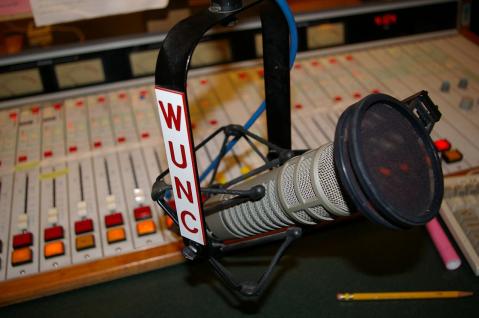
Chapel Hill’s finest, WUNC, image by Flickr user Keith Weston
Share this:

Tomahawk Chopped and Screwed: The Indeterminacy of Listening

 I’m happy to introduce the final post in Guest Editor Justin Burton‘s three part series for SO!, “The Wobble Continuum.” I’ll leave Justin to recap the series and reflect on it a little in his article below, but first I want to express our appreciation to him for his thoughtful curation of this exciting series, the first in the new Thursday stream at Sounding Out!. Thanks for getting the ball rolling!
Next month be sure to watch this space for a preview of sound at the upcoming Society for Cinema & Media Studies meeting in Seattle, and a new four part series on radio in Latin America by Guest Editor Tom McEnaney.
— Neil Verma, Special Editor for ASA/SCMS
—
I’m standing at a bus stop outside the Convention Center in downtown Indianapolis, whistling. The tune, “Braves,” is robust, a deep, oscillating comeuppance of the “Tomahawk Chop” melody familiar from my youth (the Braves were always on TBS). There’s a wobbly synthesizer down in the bass, a hi hat cymbal line pecking away at the Tomahawk Chop. This whistled remix of mine really sticks it to the original tune and the sports teams who capitalize on racist appropriations of indigenous cultures. All in all, it’s a sublime bit of musicality I’m bestowing upon the cold Indianapolis streets.
Until I become aware of the other person waiting for the bus. As I glance over at him, I can now hear my tune for what it is. The synthesizer and hi hat are all in my head, the bass nowhere to be heard. This isn’t the mix I intended, A Tribe Called Red’s attempt at defanging the Tomahawk Chop, at re-appropriating stereotypical sounds and spitting them back out on their own terms. Nope, this is just a guy on the street whistling those very stereotypes: it’s the Tomahawk Chop. I suddenly don’t feel like whistling anymore.
*****
As we conclude our Wobble Continuum guest series here at Sounding Out!, I want to think about the connective tissues binding together the previous posts from Mike D’Errico and Christina Giacona, joining A Tribe Called Red and the colonialist culture into which they release their music, and linking me to the guy at the bus stop who is not privy to the virtuosic sonic accompaniment in my head. In each case, I’ll pay attention to sound as material conjoining producers and consumers, and I’ll play with Karen Barad’s notion of performativity to hear the way these elements interact [Jason Stanyek and Ben Piekut also explore exciting possibilities from Barad in “Deadness” (TDR 54:1, 2010)].
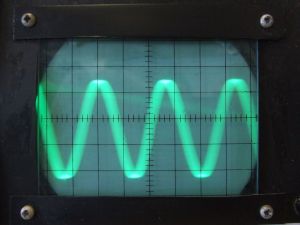
“Sound Waves: Loud Volume” by Flickr user Tess Watson, CC BY 2.0
Drawing from physicist Niels Bohr, Barad begins with the fact that matter is fundamentally indeterminate. This is formally laid out in the Heisenberg Uncertainty Principle, which notes that the more precisely we can determine (for instance) the position of a particle, the less we can say with certainty about its momentum (and vice versa). Barad points out that “‘position’ only has meaning when a rigid apparatus with fixed parts is used (eg, a ruler is nailed to a fixed table in the laboratory, thereby establishing a fixed frame of reference for establishing ‘position’)” (2003, 814).
This kind of indeterminacy is characteristic of sound, which vibrates along a cultural continuum, and which, in sliding back and forth along that continuum, allows us to tune into some information even as other information distorts or disappears. This can feel very limiting, but it can also be exhilarating, as what we are measuring are a variety of possibilities prepared to unfold before us as matter and sound become increasingly unpredictable and slippery. We can observe this continuum in the tissue connecting the previous posts in this series. In the first, Mike D’Errico tunes into the problematic hypermasculinity of brostep, pinpointing the ways music software interfaces can rehash tropes of control and dominance (Robin James has responded with productive expansions of these ideas), dropping some areas of music production right back into systems of patriarchy. In the second post, Giacona, in highlighting the anti-racist and anti-colonial work of A Tribe Called Red, speaks of the “impotence” visited upon the Tomahawk Chop by ATCR’s sonic interventions. Here, hypermasculinity is employed as a means of colonial reprimand for a hypermasculine, patriarchal culture. In sliding from one post to the other, we’ve tuned into different frequencies along a continuum, hearing the possibilities (both terrorizing and ameliorative) of patriarchal production methods unfolding before us.

“Skrillex at Forum, Copenhagen” by Flickr user Jacob Wang, CC-BY-SA-2.0
Barad locates the performative upshot of this kind of indeterminacy in the fact that the scientist, the particle, and the ruler nailed to the table in the lab are all three bound together as part of a single phenomenon—they become one entity. To observe something is to become entangled with it, so that all of the unfolding possibilities of that particle become entwined with the unfolding possibilities of the scientist and the ruler, too. The entire phenomenon becomes indeterminate as the boundaries separating each entity bleed together, and these entities only detangle by performing—by acting out—boundaries among themselves.
Returning to Giacona’s discussion of “Braves,” it’s possible to mix and remix our components to perform them—to act them out—in more than one way. Giacona arranges it so that ATCR is the scientist, observing a particle that is a colonizing culture drunk on its own stereotypes. Here, “Braves” is the ruler that allows listeners to measure something about that culture. Is that something location? Direction? Even if we can hear clearly what Giacona leads us to—an uncovering of stereotypes so pernicious as to pervade, unchallenged, everyday activities—there’s an optimism available in indeterminacy. As we slide along the continuum to the present position of this colonialist culture, the certainty with which we can say anything about its trajectory lessens, opening the very possibility that motivates ATCR, namely the hope of something better.
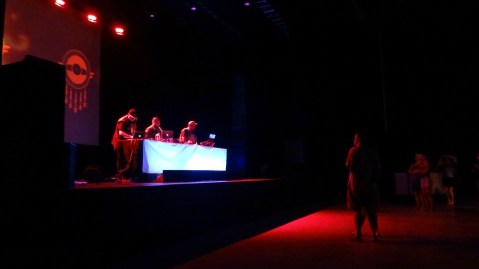
“ATCR 1” by Flickr user MadameChoCho, CC BY-NC-SA 2.0
But listening and sounding are tricky things. As I think about my whistling of “Braves” in Indianapolis, it occurs to me that Giacona’s account is easily subverted. It could be that ATCR is the particle, members of a group of many different nations reduced to a single voice in a colonial present populated by scientists (continuing the analogy) who believe in Manifest Destiny and Johnny Depp. Now the ruler is not “Braves” but the Tomahawk Chop melody ATCR attempts to critique, and the group is measured by the same lousy standard colonizers always use. In this scenario, people attend ATCR shows in redface and headdresses, and I stand on the street whistling a war chant. We came to the right place, but we heard—or in my case, re-sounded—the wrong thing.

“Knob Twiddler” by Flickr user Jes, CC BY-SA 2.0
Jennifer Stoever-Ackerman’s “listening ear” is instructive here. Cultures as steeped in indigenous stereotypes as the United States and Canada have conditioned their ears to hear ATCR through whiteness, through colonialism, making it difficult to perceive the subversive nature of “Braves.” ATCR plays a dangerous game in which they are vulnerable to being heard as a war chant rather than a critique; their material must be handled with care. There’s a simple enough lesson for me and my whistling: some sounds should stay in my head. But Barad offers something more fundamental to what we do as listeners. By recognizing that 1). there are connective tissues deeply entangling the materiality of our selves, musicians, and music and 2). listening is a continuum revealing only some knowledge at any given moment, we can begin to imagine and perform the many possibilities that open up to us in the indeterminacy of listening.
If everything sounds certain to us when we listen, we’re doing it wrong. Instead, for music to function productively, we as listeners must find our places in a wobbly continuum whose tissues connect us to the varied appendages of music and culture. Once so entangled, we’ll ride those synth waves down to the low end as hi hats all the while tap out the infinite possibilities opening in front of us.
—
Featured image: “a tribe called red_hall4_mozpics (2)_GF” by Flickr user Trans Musicales, CC BY-NC-ND 2.0
—
Justin Burton is a musicologist specializing in US popular music and culture. He is especially interested in hip hop and the ways it is sounded across regions, locating itself in specific places even as it expresses transnational and diasporic ideas.He is Assistant Professor of Music at Rider University, where he teaches in the school’s Popular Music and Culture program. He helped design the degree, which launched in the fall of 2012, and he is proud to be able to work in such a unique program. His book-length project – Posthuman Pop – blends his interests in hip hop and technology by engaging contemporary popular music through the lens of posthuman theory. Recent and forthcoming publications include an exploration of the Mozart myth as it is presented in Peter Shaffer’s Amadeus and then parodied in an episode of The Simpsons (Journal of Popular Culture 46:3, 2013), an examination of the earliest iPod silhouette commercials and the notions of freedom they are meant to convey (Oxford Handbook of Mobile Music Studies), and a long comparative review of Kanye and Jay Z’s Watch the Throne and the Roots’ Undun (Journal for the Society of American Music). He is also co-editing with Ali Colleen Neff a special issue of the Journal of Popular Music Studies titled “Sounding Global Southernness.” He currently serves on the executive committee of the International Association for the Study of Popular Music-US Branch and is working on an oral history project of the organization. From June 2011 through May 2013, he served as Editor of the IASPM-US website, expanding the site’s offerings with the cutting edge work of popular music scholars from around the world. You can contact him at justindburton [at] gmail [dot] com.
—
 REWIND!…If you liked this post, you may also dig:
“Musical Encounters and Acts of Audiencing: Listening Cultures in the American Antebellum”-Daniel Cavicchi
“Musical Objects, Variability and Live Electronic Performance”-Primus Luta
“Further Experiments in Agent-based Musical Composition”-Andreas Duus Pape
Share this:


Current Top Posts





April 2021

January 2020

November 2019

October 2019

August 2019

April 2014

November 2017

March 2015

December 2017

October 2015
 Sounding Out!

Recent Comments