
Toward A Civically Engaged Sound Studies, or ReSounding Binghamton

 I want to enable my students to mobilize sound studies not just as an analytic filter to help them understand the world, but as a method enabling more meaningful engagement with it. This post, an abbreviated version of the paper I recently gave at the Invisible Places, Sounding Cities Conference in Viseu, Portugal on July 18, 2014, explores my pedagogical efforts to move my sound studies work from theory to methodology to praxis in the classroom and in my larger community. In particular, I am working to intervene in the production of social difference via listening and the process by which differential listening practices create fractured and/or parallel experiences of allegedly shared urban spaces.
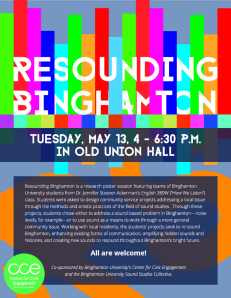
Click for flyer, designed by Peter Liu
Inspired by ongoing efforts such as ReBold Binghamton–the visual arts group alluded to by my assignment’s title– Blueprint Binghamton, and the Binghamton Neighborhood Project, I wanted to articulate sound studies methods with long-term community engagement interventions. I decided to task the upper-level undergraduate students in my Spring 2014 “How We Listen” course with designing community engagement projects that identified and addressed an issue in Binghamton, the de-industrialized town in upstate New York housing our university. My students’ proposals ranged from rain-activated sound art, to historical sound walks that layered archival sounds with current perceptions, and a “noise month” sound-collection and remix project designed to challenge entrenched attitudes. They then presented the projects via a public poster session open to faculty members, administrators, community representatives, and peers.
Working with local residents and using asset-based theories of civic engagement, the students’ projects sought to re-sound Binghamton, enhancing existing forms of communication, amplifying hidden sounds and histories, and creating new sounds to resound throughout Binghamton’s future. While the students initially set out to “fix” Binghamton—bringing year-round residents into the world as their largely 18-21 selves heard it—the majority opened their ears to alternative understandings that left them questioning the exclusivity of their own listening practices. Students realized that while they may have been inhabiting Binghamton for the past few years, they hadn’t been perceptually living in the same town as year-round residents, and, conversely, that the locals’ tendencies to hear students as privileged nuisances had historical and structural roots.
The historical, theoretical, and methodological groundwork that scholars of sound have laid in recent decades toward heightened social and political understandings of sound—fantastic in volume, quality, AND reach—have equipped sound studies scholars with powerful critical tools with which to build a more directly, civically engaged sound studies, one as much interested in intervention and prevention as continued reclamation and recovery. Scholar-artists such as Linda O’Keeffe have begun to fuse audio artistic praxis with the more social science-oriented field of urban studies. O’Keeffe’s community project, highlighted in “(Sound)Walking Through Smithfield Square in Dublin,” set out to solve an audio- spatial problem at the very heart of the city: why did the city’s efforts to “rehabilitate” the landmark Smithfield Square—which had been a public market for hundreds of years—bring about its demise as a thriving public space rather than its rejuvenation? Equipping local students with recorders, O’Keeffe documented the students’ understanding of the space as “silent,” even though it was far from absent of sound. She noted local teenagers felt repelled by the newly wide-open square; the reverberation of their sounds as they grouped together to chat made them feel uncomfortable and surveilled—so it remained an isolating space of egress rather than a gathering place.

The Smithfield square in 2009, Image by Linda O’Keeffe
Importantly, O’Keeffe’s conclusion moved beyond self-awareness to political praxis; she presented her students’ self-documentation to Dublin city planners, intervening in Smithfield’s projected future and attempting to prevent similar destruction of other thriving city soundscapes unaligned with middle-class sensory orientations. O’Keeffe’s work sparked me to think of listening’s potential as advocacy and agency, as well as the increasing importance of reaching beyond the identification of diverse listening habits toward teaching people to understand the partiality and specificity of their sonic experience in combination with the impact listening—and the power dynamics it is enmeshed in—has on the lives, moods, and experiences of themselves and others. Listening habits, assumptions, and interpretations do not just shape individual thoughts and feelings, but also one’s spatial experience and sense of belonging to (or exclusion from) larger communities, both actual and imagined. Learning to understand one’s auditory experience and communicate it in relation to other people enables new forms of civic engagement that challenge oppression at the micro-level of the senses and seeks equitable experiences of shared space to counter the isolating exclusion compelled by many urban soundscapes.
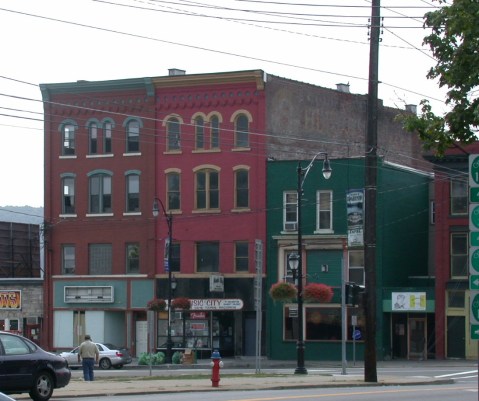
Corner of Front and Main Street, Binghamton, NY, Image by Flickr User Don Barrett
O’Keeffe’s project also made me rethink how space-sound is shaped through social issues such as class inequity, particularly in my community of Binghamton, a small town of approximately 54,000 currently facing profound economic challenges. The end of the Cold War devastated Binghamton’s economy—then primarily based in defense—and the economic downturn of the early-1990s provided a knock-out punch, severely impacting the region in ways it has yet to recover from: the behemoth local IBM relocated to North Carolina, manufacturing jobs permanently decreased by 64%, and the population shrank almost by half. Recent climate-change induced disasters have also left their mark; massive floods in 2005 and 2011—on a geographic footprint historically flooding only 200-500 years—displaced thousands of low-income residents, destroyed many businesses, and collectively caused close to 2 billion dollars in damage. The global recession of 2008 left over 30% of Binghamton’s residents below the poverty line, including 40% of all children under 18.
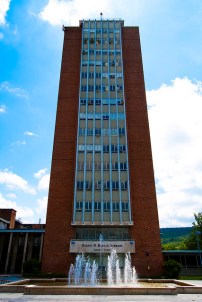
Library Tower, Binghamton University, Image by Flickr User johnwilliamsphd
The campus, 12,000 undergraduate students strong, often seems remote from the city I just described. Only 6% of BU students are drawn from its surrouding Broome County. The vast majority (60%) of BU’s students hail from the New York City metro area, a site of racialized economic tension with the rest of the state, evidenced by campaigns such as “Unshackle Upstate.” Indeed, Binghamton’s student body is more racially diverse than Binghamton the city (Vestal, where the university is located, is 88% white), and even though the relatively low-cost public university–approximately eight thousand dollars a year for in-state tuition– serves many first-generation college students, students with generous financial aid packages, and students employed while matriculating, the city’s poverty amplifies even slight class privilege.
These long-term structural fissures have led to tensions between the university students—whom some Binghamtonians problematically peg as wealthy outsiders and/or racially target—and full-time residents, dubbed “Townies” by many students and dehumanized as the backdrop to their college experience. While students and year-round residents inhabit the same physical spaces in Binghamton, they are not in fact living the same place and they often experience, interpret, and act on the same auditory information in drastically different ways. Binghamton sounds differently to each group, in terms of the impressions and interpretations of various auditory phenomena as well as the order of importance an individual gives to simultaneous sounds at any given moment.
Embodied aural perceptions shaped by class, race, age, and differing regional experience may in fact drive many of the “town and gown” conflicts—noise complaints most obviously—and exacerbate others, particularly mutually distorted perceptions that students bring Binghamton down and that residents are, as one student cruelly stated in the campus newspaper, “creatures” from “an endless horror movie.” So how to address this divide? And how to use sound studies to do it? I knew I did not want to impose a community project on my students that did not have their buy in and creative energy behind it. I decided on a group-sourcing project that asked students to work together to design a sound-studies based community project. I envisioned the assignment as the first phase of a longer-term project, with the most workable idea serving as the basis for a full-blown service learning experience in future courses. However, the assignment proved to be pedagogically valuable in its own right, not just as a prelude to future work.
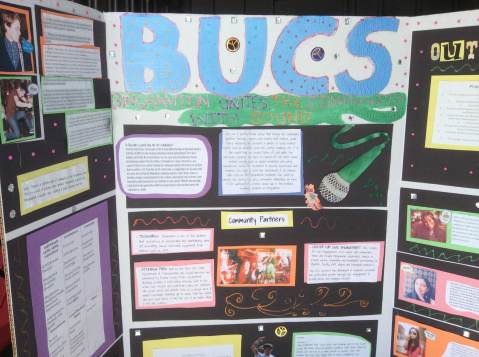
“Binghamton Unites Community Through Sound” Poster Project, Image by Author
I arranged my course around the proposal assignment, providing students with the critical thinking skills to imagine a project of this type. We began with theoretical and methodological materials that would introduce them to sound studies—none of my students were familiar with the field and its assumptions—and ground their thinking in the idea that listening is a complex sociocultural, political, and critical practice. While we read and discussed multitude of pieces on listening, the students reported four scholars as especially inspirational to the project: Yvon Bonenfant’s theorization of “queer listening” as a listening out (rather than the more normative taking in), Regina Bradley’s work on race and listening in American courtrooms that focused on how white lawyers discredit witnesses speaking patois and African American Vernacular English, Maile Costa Colbert’s artistic imagining of a “wayback sound machine,” and Emily Thompson’s work on noise and time/space/place, particularly in her new interactive “Roaring Twenties” project. Student Daniel Santos reported in a survey following the project,
The relationship between sound and time was very useful to our project; we understood the concept that no city ever sounds the same after a long period of time, and we sought to take advantage of this fact. Through our residents’ stories, we learned that Binghamton was once booming with sound from numerous, lucrative industries. Walking into a factory brought an industrial cacophony: card punchers thudded as steel was pounded against steel. However, today, a walk into these factories results in an eerie silence. We wanted our soundwalk participants to realize and become affected by this lack of and difference in sound, and raise pertinent questions: what happened to these sounds? Why is there such a large difference in sound levels? Where do I place myself within this soundscape?
I worked with Binghamton’s Center for Civic Engagement—a model program founded in 2010—and in particular with Assistant Director Christie Zwahlen, to equip students with basic-but-solid knowledge that would enable a new understanding of community work. Zwahlen brought home two major principles to students: 1) service learning has a pedagogical component; it is important to a project’s success that students learn something through their work rather than merely donating time or skills, 2) Community engagement works best when based on identifying and mobilizing a community’s assets rather than implementing an external project addressing perceived deficits. These two concepts meshed especially well with the students’ evolving understanding of listening as multifaceted, political, and deeply impacted by temporal and spatial contexts, because it required the students to engage directly with community members and learn how to listen to their voices, histories, and needs.
For both civic engagement and sound studies, Zwahlen and I introduced students to the various methods used to solve problems and answer our most important questions. For civic engagement, Christie focused on the asset map, which forced students to think of the surrounding community in terms of its strengths rather than the weaknesses they could already readily list. This exercise not only flipped their perspective but also helped them imagine and hone their project by identifying community stakeholders who would be receptive to their inquiries.
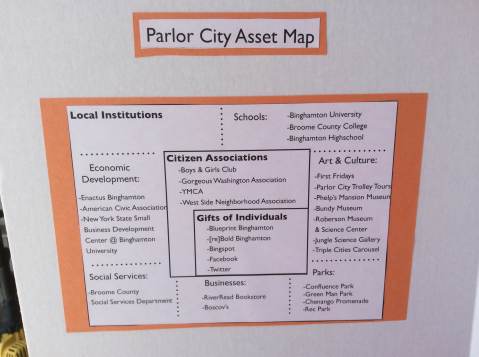
ReSounding Binghamton Project, Image by author
In terms of sound studies, I introduced them to a multiplicity of methods through readings, experiential activities, and process writing, in particular sound provocations and sound walks. According to student Hannah Lundeen’s post-project survey, the sound walks she performed proved especially fruitful:
Initially, solving a community issue through sound seemed next to impossible. It wasn’t until sitting down and thinking about the sound studies methods of soundwalks that it became clear. I liked soundwalks because they are a way to engage anyone in sound studies. They are an easy concept to explain to people who may not have thought much about their soundscape previously. They are an active and fun way to engage all community members in listening well.
As Lundeen relates, interweaving these methods formed the foundation of their community projects, enabling their inquiries regarding understanding differences in listening, how to enable people to recognize and discuss aspects of their listening, and to provoke some kind of impactful social change.
The final third of the semester was devoted to working on the final project [Click these links for the Rubric for Final Poster Presentation we used to assess the projects as well as the assignment sheet with Tips for Successfully Completing this Project both of which I handed out on day one! ]. Following an initial period of research and discussion, students narrowed down their project ideas, identified and met in person with potential community partners–ReBold Binghamton, Binghamton’s Center for Technology & Innovation, the Parks Department and several City Council members were especially helpful– and put together their proposals, emphasizing their new understandings of listening and its relationship to space and place via community mobilization. Students prepared a 7-minute gloss of their projects for public presentation that
- identified an issue (supported by research)
- described how project addressed the issue
- presented community asset map as a foundation
- shared list of potential community partners
- discussed sound studies methodologies supporting the project
- estimated benchmarks for the project’s completion
- projected the project’s long-term outcomes
- prepared personal reflections on the process.

ReSounding Binghamton Student Presentation, Image by Shea Brodsky
Here is a sampling from the rich palette of student project pitches:
- Restoring the Pride: A public art initiative building rain-activated sound sculptures.
- BUCS: Binghamton Unites Community with Sound: A public group karaoke project.
- Safe and Sound: A “kiosk walk” of 10-interactive electronic sound art pieces that increase downtown destination traffic by day and operate as a “blue light” safety system by night.
- Blues on the Bridge Junior: A children’s music stage at one of Binghamton’s most popular yearly events.
- Happy Hour: A weekly campus radio show designed to combat seasonal depression.
- Listen Up!: Sound Month Binghamton: An annual themed digital “sound collection month” in March with accompanying “sounds of Binghamton” remix project. This project fosters community habituation to “Others’” sounds while also tracking long-term changes in the soundcape and in residents’ ideas of noise.
- A Sound Walk Through Binghamton: Historical soundwalks through several areas in Binghamton, where archival sounds of the past (some compiled from recordings, some performed) are placed in continuity and contrast with contemporary soundscapes.
Zwahlen and I understand that this iteration of the project does not constitute civic engagement as of yet. Certainly, the students raised more questions than solutions: how to work with—and equitably solicit contributions from—community members rather than organize classroom-first? How to increase community involvement on a campus that is a foreboding maze at best—and how to increase student traffic in the many sites not reached by Binghamton’s limited public transportation? Most importantly, How to share sound studies epistemology beyond the classroom, creating listening experiences that not only take differences into account but potentially re-script them?

ReSounding Binghamton Student Project, Image by Author
As we move forward with long-term development, we will undoubtedly encounter more questions. However, even at its earliest stages, I believe guiding my students to integrate sound studies methodologies with asset-based service learning provided them with a transformative experience concerning the powerful resonance of applied knowledge and sparked the kind of self-realization that leads to civically engaged citizens. It created meaningful connections between them and a local community suddenly made significantly larger. For my students, listening became more than a metaphor or an individualized act of attention, rather they began to understand its role as a material conduit of location, outreach, and connection. As an anonymous student shared in my teaching evaluations: “This class was different, but in a very good way. It has been so involved with the human experience, more so than with other classes.” In the middle of the so-called “humanities crisis,” this response points to the potential power of a civically engaged sound studies, a branch of the field combining research with praxis to reveal the role of listening in the building, maintenance, and daily experiences of diverse communities in the city spaces they mutually inhabit but often do not fully and equitably share.
—
Featured Image by Shea Brodsky, (L to R) Binghamton University Students Robert Lieng, Daniel Santos, and Susan Sherwood, Director of Binghamton’s Center for Technology & Innovation (CT&I)
—
Jennifer Stoever is co-founder and Editor-in-Chief of Sounding Out! She is also Associate Professor of English at Binghamton University and a recipient of the 2014 SUNY Chancellor’s Award in Teaching.
—
 REWIND!…If you liked this post, you may also dig:
Sounding Out! Podcast #13: Sounding Shakespeare in S(e)oul– Brooke Carlson
Deejaying her Listening: Learning through Life Stories of Human Rights Violations– Emmanuelle Sonntag and Bronwen Low
Audio Culture Studies: Scaffolding a Sequence of Assignments– Jentery Sayers
Share this:

“Sound Studies: A Discipline?”: Sound Signatures Winter School, Amsterdam, January 2014
Has the ever-nascent field of sound studies finally “grown up”? After years of intellectual development and a constantly growing body of work, including quite a few classic texts and books, it has been rapidly establishing an identity of its own, independent from the many “parent” disciplines from which it originated. As with any teenager, this process of maturation comes with a dose of self-searching and, indeed, some navel-gazing. But are we ready to acknowledge sound studies as its own discipline?
At the first conference of the European Sound Studies Organization (ESSA) in Berlin in October 2013, a heated debate followed an otherwise routine announcement. The preliminary title for the second installment of the conference: “Sound Studies: A Discipline?” was not going to make it to Copenhagen in June 2014. Although the question mark suggested playfulness, many audience members either did not like the idea of an entire conference devoted to the meta-discussion on the pros and cons of interdisciplinarity or were not prepared to consider sound studies as a discipline at the first place.
Eventually, the Copenhagen conference was safely re-named “Sound Studies: Mapping the Field.” The discussion in Berlin however, continued at the opening session of the Sound Signatures Winter School in Amsterdam in early 2014. Co-organizer Mara Mills asked whether the publication of such anthologies as The Sound Studies Reader in 2012 and The Oxford Handbook of Sound Studies in 2013 meant that sound studies was a proper discipline. Is it, she asked, moving away from its roots as an interdisciplinary field consisting of displaced scholars formerly unable to tackle questions of sound within the confines of their traditional disciplines? The ensuing five days of the Winter School answered Mill’s question in a rather fittingly ambiguous way. The question remains: “Sound Studies: A Discipline?” Well, yes and no.

Hearing, public domain
One of the most significant conclusions of the Winter School’s thought-provoking workshops, keynotes, performances and debates was phrased by co-organizer Carolyn Birdsall during the final discussion on Friday afternoon; she had come to realize that sound studies and its older, more distinguished, but often somewhat stale brother musicology are not the adversaries one is often led to believe. A musicologist by training, I have always found sound studies’ habit of explicitly not dealing with music (in conjunction with its sometimes disproportionate focus on sound art) a little tiresome; and what these five intensive days in Amsterdam convincingly showed, among other things, was that the older brother and its younger sibling can be rather complimentary.

Manuscript of Bach’s Lute Suite in G minor, public domain
Of course, the traditional objects and methods of the discipline of musicology—in its most dusty and clichéd form studying black dots written on paper by great men—have long been what sound studies scholars avoided. In the late 1980’s, however, musicology already started moving away from this stereotype by incorporating more critical methodologies and broadening its scope. Moreover, ethno- or cultural- musicologists have been breaking the armor of Eurocentrism in mainstream musicology. Now, with the steady rise of sound studies’ academic momentum, musicology is even giving up its intellectual monopoly on determining what does and what does not count as relevant research on music. The highly interdisciplinary body of knowledge developed in this mature sound studies can indeed be very useful in more conventional musicological research; likewise sound studies benefits from work conducted within the disciplinary confines of musicology.
At the Winter School, a prime example of such an exchange was Julia Kursell’s keynote lecture “Motor Media: On Aural Feedback in the History of Musical Instrument Playing.” Focusing on the experiments of nineteenth-century French pianist and teacher Marie Jaëll, Kursell showed how, prior to the advent of recording technology, musical instruments like the piano offered valuable points of entry into the world of sound and hearing. The piano-keyboard, Kursell argued, was not just a site of aesthetic, musical development, but was also employed as an epistemological tool in itself. Moreover, studying such historical cases also opens the door for broader questions engaging musicology, sound studies and science and technology studies.This interdisciplinary overlap allows for discussions of the body politics of music teaching as well as the didactics of a specific aesthetic regime in a particular social milieu.

Frances Densmore recording Mountain Chief, 1916, public domain
Other sessions that explicitly dealt with music included Stephen Amico’s lecture combining sound studies, media studies and the “discipline formerly known as ethnomusicology” to discuss ethical difficulties facing ethnographic sound archivists. This discussion about the ownership and right of use of the recordings in such archives was among the most refreshing and timely raised through the week. On a much lighter note, Ashley Burgoyne’s Workshop “What Can You Learn from a Music Game?” represented yet another rapidly developing interdisciplinary field of music research: the study of music cognition.
Recently, after returning from the aforementioned ESSA conference in Copenhagen, Marcel Cobussen predicted in a Facebook update that “in 10-15 years from now, musicology will be a subspecies of sound studies.” He might be right, but rather than a “sub-discipline,” why not envision a continuum from “old-fashioned” musicology, via the much broader field of music studies towards the broader field of sound studies. As such, sound studies would maintain its interdisciplinary status as a field, rather than a discipline, allowing for engagement with the knowledge that has been produced and is still produced in musicology proper and music studies more generally.
It is up to a new generation, raised as sound studies natives, to further the developments toward such an exchange of scholarship. Judging by the presentations, workshops, performances, and most tellingly, student presentations, during these five days in Amsterdam, this will undoubtedly happen. Notwithstanding the very broad scope of topics and approaches, backgrounds and interests, among participants and presenters there was the tacit acknowledgement of communality in the one thing they all shared: a profound interest in sound in the broadest sense of the word that needed very little justification. Initiatives like this Winter School and its upcoming second installment in the form of a Summer School in Berlin leave one with an optimistic outset of the intellectual potential of the young field of sound studies; it forges interdisciplinary connections by virtue of the common interest in an object–sound–that is simultaneously a very specific and seemingly endless scope of scholarly possibilities.

“Sound Scape” by Flickr user Kent Yoshimura, CC BY-NC-SA 2.0
Perhaps the most telling example of this bright future was the fact that the keynote by Jonathan Sterne, without question the week’s big star, author of one of the founding books in the field, was a nice historical overview of the concept of the “soundscape,” although offering few new insights or questions. If anything, this unusually low-key performance from a very impressive scholar, underlined the most inspiring aspect of the Sound Signatures Winter School: there is still much to be done, and, as this very blog has been consistently showing since 2009, a new generation of sound scholars is already doing it. Therefore, I am looking forward to hearing our next generation of scholars weighing in on the question: “Sound Studies: A Discipline?” in the forthcoming discussion in Berlin. With an impressive, diverse and exciting program I’m sure I won’t be disappointed.
—
Melle Jan Kromhout is PhD-Fellow at the Amsterdam School for Cultural Analysis, University of Amsterdam. His research project entitled “Noise Identities” focuses on the revaluation of noise in recorded sound and music. The project aims to develop noise identities as a concept for assessing the relation between recording media and musical significance. He presented his work at conferences around the globe and published several articles including “‘Over the Ruined Factory There’s a Funny Noise’: Throbbing Gristle and the mediatized roots of noise in/as music” (2011), “As Distant and Close as Can Be. Lo-fi Recording: Site-specificity and (In)authenticity” (2012), “An Exceptional Purity of Sound: Noise Reduction Technology and the Inevitable Noise of Sound Recording” (2014) and “’Antennas Have Long Since Invaded Our Brains’: Listening to the ‘Other Music’ in Friedrich Kittler” (forthcoming, 2015). More information on www.mellekromhout.nl
—
Featured image: Carla Müller-Schulzke opening the first ESSA conference in Berlin, October 2013, by Jennifer Stoever, CC BY-SA 3.0
—
 REWIND! . . .If you liked this post, you may also dig:
Functional Sound (Studies): The First European Sound Studies Association Meeting— Erik Granly Jensen
“Once the word ‘sound’ was in the title, it opened up a kind of door”: A Conversation with Eric Weisbard— Liana Silva-Ford
“Sound at AMS/SEM/SMT 2012”— Bill Bahng Boyer
Share this:


Current Top Posts





April 2021

January 2020

November 2019

October 2019

August 2019

April 2014

November 2017

March 2015

December 2017

October 2015
 Sounding Out!
Recent Comments