
On Whiteness and Sound Studies

 This is the first post in Sounding Out!’s 4th annual July forum on listening in observation of World Listening Day on July 18th, 2015. World Listening Day is a time to think about the impacts we have on our auditory environments and, in turn, their effects on us. For Sounding Out! World Listening Day necessitates discussions of the politics of listening and listening as a political act, beginning this year with Gustavus Stadler’s timely provocation. –Editor-in-Chief JS
—
Many amusing incidents attend the exhibition of the Edison phonograph and graphophone, especially in the South, where a negro can be frightened to death almost by a ‘talking machine.’ Western Electrician May 11, 1889, (255).
What does an ever-nearer, ever-louder police siren sound like in an urban neighborhood, depending on the listener’s racial identity? Rescue or invasion? Impending succor or potential violence? These dichotomies are perhaps overly neat, divorced as they are from context. Nonetheless, contemplating them offers one charged example of how race shapes listening—and hence, some would say, sound itself—in American cities and all over the world. Indeed, in the past year, what Jennifer Stoever calls the “sonic color line” has become newly audible to many white Americans with the attention the #blacklivesmatter movement has drawn to police violence perpetrated routinely against people of color.

“Sheet music ‘Coon Coon Coon’ from 1901” via Wikimedia, public domain
Racialized differences in listening have a history, of course. Consider the early decades of the phonograph, which coincided with the collapse of Reconstruction and the consolidation of Jim Crow laws (with the Supreme Court’s stamp of approval). At first, these historical phenomena might seem wholly discrete. But in fact, white supremacy provided the fuel for many early commercial phonographic recordings, including not only ethnic humor and “coon songs” but a form of “descriptive specialty”—the period name for spoken-word recordings about news events and slices of life—that reenacted the lynchings of black men. These lynching recordings, as I argued in “Never Heard Such a Thing,” an essay published in Social Text five years ago, appear to have been part of the same overall entertainment market as the ones lampooning foreign accents and “negro dialect”; that is, they were all meant to exhibit the wonders of the new sound reproduction to Americans on street corners, at country fairs, and in other public venues.
Thus, experiencing modernity as wondrous, by means of such world-rattling phenomena as the disembodiment of the voice, was an implicitly white experience. In early encounters with the phonograph, black listeners were frequently reminded that the marvels of modernity were not designed for them, and in certain cases were expressly designed to announce this exclusion, as the epigraph to this post makes brutally evident. For those who heard the lynching recordings, this new technology became another site at which they were reminded of the potential price of challenging the racist presumptions that underwrote this modernity. Of course, not all black (or white) listeners heard the same sounds or heard them the same way. But the overarching context coloring these early encounters with the mechanical reproduction of sound was that of deeply entrenched, aggressive, white supremacist racism.

“66 West 12th Street, New School entrance” by Wikimedia user Beyond My Ken, CC BY-SA 4.0
The recent Sonic Shadows symposium at The New School offered me an opportunity to come back to “Never Heard Such a Thing” at a time when the field of sound studies has grown more prominent and coherent—arguably, more of an institutionally recognizable “field” than ever before. In the past three years, at least three major reference/textbook-style publications have appeared containing both “classic” essays and newer writing from the recent flowering of work on sound, all of them formidable and erudite, all of great benefit for those of us who teach classes about sound: The Oxford Handbook of Sound Studies (2012), edited by Karen Bijsterveld and Trevor Pinch; The Sound Studies Reader (2013), edited by Jonathan Sterne; and Keywords in Sound (2015), edited by David Novak and Matt Sakakeeny. From a variety of disciplinary perspectives, these collections bring new heft to the analysis of sound and sound culture.
I’m struck, however, by the relative absence of a certain strain of work in these volumes—an approach that is difficult to characterize but that is probably best approximated by the term “American Studies.” Over the past two decades, this field has emerged as an especially vibrant site for the sustained, nuanced exploration of forms of social difference, race in particular. Some of the most exciting sound-focused work that I know of arising from this general direction includes: Stoever’s trailblazing account of sound’s role in racial formation in the U.S.; Fred Moten’s enormously influential remix of radical black aesthetics, largely focused on music but including broader sonic phenomena like the scream of Frederick Douglass’s Aunt Hester; Bryan Wagner’s work on the role of racial violence in the “coon songs” written and recorded by George W. Johnson, widely considered the first black phonographic artist; Dolores Inés Casillas’s explication of Spanish-language radio’s tactical sonic coding at the Mexican border; Derek Vaillant’s work on racial formation and Chicago radio in the 1920s and 30s. I was surprised to see none of these authors included in any of the new reference works; indeed, with the exception of one reference in The Sound Studies Reader to Moten’s work (in an essay not concerned with race), none is cited. The new(ish) American Studies provided the bedrock of two sound-focused special issues of journals: American Quarterly’s “Sound Clash: Listening to American Studies,” edited by Kara Keeling and Josh Kun, and Social Text’s “The Politics of Recorded Sound,” edited by me. Many of the authors of the essays in these special issues hold expertise in the history and politics of difference, and scholarship on those issues drives their work on sound. None of them, other than Mara Mills, is among the contributors to the new reference works. Aside from Mills’s contributions and a couple of bibliographic nods in the introduction, these journal issues play no role in the analytical work collected in the volumes.

“Blank pages intentionally, end of book” by Wikimedia user Brian 0918, CC BY-SA 3.0
The three new collections address the relationship between sound, listening, and specific forms of social difference to varying degrees. All three of the books contain excerpts from Mara Mills’ excellent work on the centrality of deafness to the development of sound technology. The Sound Studies Reader, in particular, contains a small array of pieces that focus on disability, gender and race; in attending to race, specifically, Sterne shrewdly includes an excerpt from Franz Fanon’s A Dying Colonialism, as well as essays on black music by authors likely unfamiliar to many American readers. The Oxford Handbook’s sole piece addressing race is a contribution on racial authenticity in hip-hop. It’s a strong essay in itself. But appearing in this time and space of field-articulation, its strength is undermined by its isolation, and its distance from any deeper analysis of race’s role in sound than what seems to be, across all three volumes, at best, a liberal politics of representation or “inclusion.” Encountering the three books at once, I found it hard not to hear the implicit message that no sound-related topics other than black music have anything to do with race. At the same time, the mere inclusion of work on black music in these books, without any larger theory of race and sound or wider critical framing, risks reproducing the dubious politics of white Euro-Americans’ long historical fascination with black voices.
What I would like to hear more audibly in our field—what I want all of us to work to make more prominent and more possible—is scholarship that explicitly confronts, and broadcasts, the underlying whiteness of the field, and of the generic terms that provide so much currency in it: terms like “the listener,” “the body,” “the ear,” and so on. This work does exist. I believe it should be aggressively encouraged and pursued by the most influential figures in sound studies, regardless of their disciplinary background. Yes, work in these volumes is useful for this project; Novak and Sakakeeny seem to be making this point in their Keywords introduction when they write:
While many keyword entries productively reference sonic identities linked to socially constructed categories of gender, race, ethnicity, religion, disability, citizenship, and personhood, our project does not explicitly foreground those modalities of social difference. Rather, in curating a conceptual lexicon for a particular field, we have kept sound at the center of analysis, arriving at other points from the terminologies of sound, and not the reverse. (8)
I would agree there are important ways of exploring sound and listening that need to be sharpened in ways that extended discussion of race, gender, class, or sexuality will not help with. But this doesn’t mean that work that doesn’t consider such categories is somehow really about sound in a way that the work does take them up isn’t, any more than a white middle-class person who hears a police siren can really hear what it sounds like while a black person’s perception of the sound is inaccurate because burdened (read: biased) by the weight of history and politics.

“Pointy Rays of Justice” by Flickr user Christopher Sebela, CC BY-NC 2.0
In a recent Twitter conversation with me, the philosopher Robin James made the canny point that whiteness, masquerading as lack of bias, can operate to guarantee the coherence and legibility of a field in formation. James’s trenchant insight reminds me of cultural theorist Kandice Chuh’s recent work on “aboutness” in “It’s Not About Anything,” from Social Text (Winter 2014) and knowledge formation in the contemporary academy. Focus on what the object of analysis in a field is, on what work in a field is about, Chuh argues, is “often conducted as a way of avoiding engagement with ‘difference,’ and especially with racialized difference.”
I would like us to explore alternatives to the assumption that we have to figure out how to talk about sound before we can talk about how race is indelibly shaping how we think about sound; I want more avenues opened, by the most powerful voices in the field, for work acknowledging that our understanding of sound is always conducted, and has always been conducted, from within history, as lived through categories like race.
The cultivation of such openings also requires that we acknowledge the overwhelming whiteness of scholars in the field, especially outside of work on music. If you’re concerned by this situation, and have the opportunity to do editorial work, one way to work to change it is by making a broader range of work in the field more inviting to people who make the stakes of racial politics critical to their scholarship and careers. As I’ve noted, there are people out there doing such work; indeed, Sounding Out! has continually cultivated and hosted it, with far more editorial care and advisement than one generally encounters in blogs (at least in my experience), over the course of its five years. But if the field remains fixated on sound as a category that exists in itself, outside of its perception by specifically marked subjects and bodies within history, no such change is likely to occur. Perhaps we will simply resign ourselves to having two (or more) isolated tracks of sound studies, or perhaps some of us will have to reevaluate whether we’re able to teach what we think is important to teach while working under its rubric.
—
Thanks to Robin James, Julie Beth Napolin, Jennifer Stoever, and David Suisman for their ideas and feedback.
—
Gustavus Stadler teaches English and American Studies at Haverford College. He is the author of Troubling Minds: The Cultural Politics of Genius in the U. S.1840-1890 (U of Minn Press, 2006). His 2010 edited special issue of Social Text on “The Politics of Recorded Sound” was named a finalist for a prize in the category of “General History” by the Association of Recorded Sound Collections. He is the recipient of the 10th Annual Woody Guthrie fellowship! This fellowship will support research for his book-in-progress, Woody Guthrie and the Intimate Life of the Left.
—
 REWIND! . . .If you liked this post, you may also dig:
Reading the Politics of Recorded Sound — Jennifer Stoever
Hearing the Tenor of the Vendler/Dove Conversation: Race, Listening, and the “Noise” of Texts — Christina Sharpe
Listening to the Border: “‘2487’: Giving Voice in Diaspora” and the Sound Art of Luz María Sánchez — Dolores Inés Casillas
Share this:

Black Mourning, Black Movement(s): Savion Glover’s Dance for Amiri Baraka
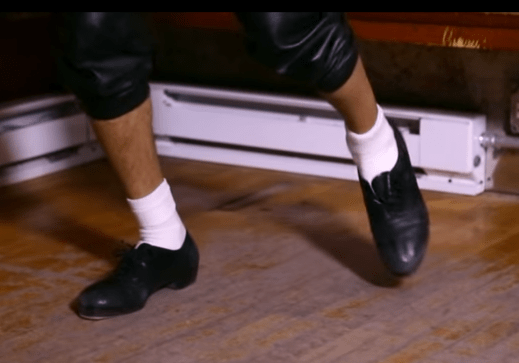
I don’t worry about the look of it so much. Choreography comes later, when I’m putting together a piece. I’m into the sound; for me, when I’m hittin’, layin’ it down, it’s all about the sound. –Savion Glover, My Life in Tap
It has been a little over a year since Amiri Baraka passed, and still I hear the echoes of his presence. I am especially attentive to the ways his work has been carried on by those involved in recent black uprisings in Ferguson, New York City, and Baltimore. Powerful political poetics that have emerged from these events include work by Danez Smith, Claudia Rankine and the many contributors to blackpoetsspeakouttumblr.com.
And yet, part of what I’ve witnessed in the streets, actual physical spaces of public protest against police violence and systemic racial oppression, is an example of what Thomas DeFrantz has termed “corporeal orature,” or the ability of bodies to resonate throughout public space and shift political discourse. In these moments, the body talk of protesters is not simply the sound of clattering feet through city streets, but a commitment to the ways in which physical gestures can speak truth to power. I am especially interested in connecting Baraka’s legacy to the larger conversation about the aural kinesthetic that Imani Kai Johnson has proposed, and in teasing out the various dimensions and potentials embedded in that category.
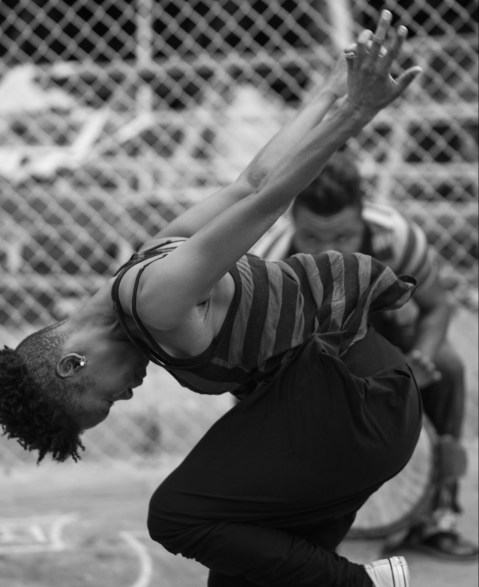
Dance at Ferguson Protests, 2014, Image by Shawn Semmler
For me, Savion Glover exemplified the lingering sound of Baraka’s spirit in his tap dance at his memorial service. Whenever I listen to the recording—which still brings tears to my eyes—I am reminded of the abundant sense of joy, sadness, and love that characterized Baraka’s service. Listening to Glover’s dance is an aural kinesthetic experience, like watching a comet pass across the night’s sky. I am reminded, too, of the way I clamored to record that moment, to keep a piece of the poet alive on my iPhone even after his public passing. And indeed, that performative sound of feet tapping, that measured excess of the body produced through movement, has kept Baraka alive for me; like his groundbreaking work, it is powerfully resistant to the proper rubrics of any one discipline except, perhaps for the study of sound itself.
So, this post then, is about tap dance and its ability to sound out Baraka’s name and life. But in a larger context, the intricate vibrations of Glover’s performance facilitate a deeper understanding of the relationship between sound and mourning, and a kind of mourning that is particularly African American, that is to say, American. It is a mourning that exists beyond the word, written text, or image and a sound practice that enables the bereaved to make a joyful noise and a mournful one at the very same time. So I ask, how do you write a eulogy with the body? How do you perform an embodied love? What does Black love and a reverence for Black life sound like? Sometimes, the answer is tap.
Audio Clip of Savion Glover’s Dance at Amiri Baraka’s Funeral, 18 Jan 2014
The dance explodes on stage like a burst of light. It begins with something approximating a drum roll – and then hard slow taps, hammering away like someone at a typewriter, I imagine, or a train gaining steam.
It is coming.
Slow, insistent and strong, with a little riff now and then, a little picking up of speed here and there. It is coming on louder now, that explosive thing, the tension you are noticing. He is doing the thing. And then there is that skillful, smooth, strong tap. Glover is at work, y’all.

Savion Glover at Work, Image by Flickr Users Raquel and Soren
As a tribute to Baraka, Glover’s dance bears numerous stylistic implications. Among them, I understand the rhythm of Glover’s tap as the rhythm of writing, an aesthetic that complicates the way his dance can be understood as a manifestation of the black vernacular. Sketching out the early connections between her son’s artistry and the percussive taps of the keyboard, Yvette Glover says. “‘I was working for a judge, as an assistant, when I was pregnant with Savion…And when I would type, and the carriage would automatically return, he’d walk, he’d follow it, in my stomach. You could see him move” (39). He does it still. In the audio clip, Glover’s footwork evokes the dexterity of Baraka’s language, all the while telling a story of its own.
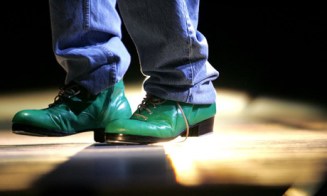
Savion Glover’s Shoes, Sadler’s Wells, 2007, Image by Tristram Kenton
But what about the intensity of the dance, its crescendo toward the end of the service, a flurry of percussive steps beside Baraka’s coffin? Baraka himself reminds us this particular musicality is so necessary here. In his discussion of “Afro-Christian Music and Religion” in Blues People, Baraka notes that in Black diasporic religious services, “the spirit will not descend without a song” (41). Glover’s dance takes place at a moment in the service when emotion exceeds the power of language, but not sound. He uses his body as an instrument of sound in its fullest sense. His performance is a choreography of embodied sound: full-on and at-once body poetry, mourning and tribute.
Elucidating the use of his body as an instrument of sound, Glover declares:
It’s like my feet are the drums and my shoes are the sticks[…]My left heel is stronger, for some reason, than my right; it’s my bass drum. My right heel is like the floor tom-tom. I can get a snare out of my right toe, a whip sound, not putting it down on the floor hard, but kind of whipping the floor with it. It get the sounds of a top tom-tom from the balls of my feet. The hi-hat is a sneaky one. I do it with a slight toe lift, either foot, so like a drummer, I can slip it in there anytime. And if I want cymbals, crash crash, that’s landing flat, both feet, full strength on the floor, full weight on both feet. That’s the cymbals. So I’ve got a whole drum set down there (19).
Combining his body’s drumbeat with the tic of Baraka’s keystrokes, Glover embeds the pattern of Baraka’s life in this tap dance, communicating it with the kind of deep and reverential love you are taught to have for your elders when you are young, appropriate and deep.
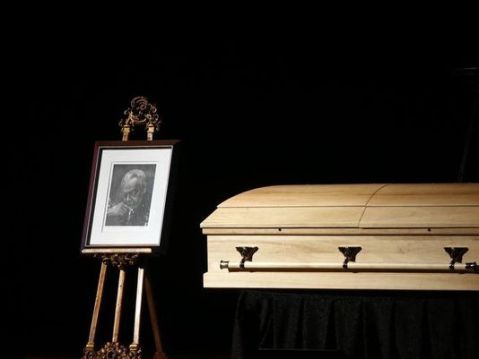 But as powerful as his body-poetry is, Glover’s silences are also key. In those inaudible spaces, Glover spreads out his arms, offering up the dance in a gesture of expansive love; the immensity of the silent gestures mirroring the immensity of Baraka’s life. He holds it out as a gift towards the audience, bows his head, too.
In moments of sound and silence, the audience calls out to Glover the way they would a preacher. At these moments, the dance becomes a call and response akin to the way Baraka’s life’s work was a call and response. A call to respond. A call to take what was given to you and make it mean. Listeners to the dance are called up out of themselves. We are changed by the dance and by the listening.
Tap tap tap.
Glover’s performance shows us how his specific blend of African and European dance traditions exists in a spiritual and artistic dimension. There is a religious explanation for this, too. In African Dance, Kariamu Welsh-Asante explains the function of the African funeral dance in definite terms:
All African dances can be used for transcendence and transformational purposes. Transcendence is the term usually associated with possession and trance. Dance is the conduit for transcendent activities. Dance enables an initiate or practitioner to progress or travel through several altered states, thereby achieving communication with an ancestor to deity and receiving valuable information that he/she can relate back to the community. Repetition is key to this process as it guides the initiates, or dancers, through the process of the ceremony. The more a movement is repeated, the greater the level of intensity and the closer a dancer gets to the designated deity or ancestor. Transformation means to change from one state, or phase, to another (16).
Glover certainly brought us close to Baraka. And yet, I would go a step further to suggest that this is, above all, blues dance. As such, it reveals continuing relevance of social dance and movement to Baraka’s political legacy. Baraka and Glover work directs us towards the propulsive nature of black social/percussive dance forms. These sonic gestures clarify the ways black life matters, impacts the public sphere and policy. The politicized nature of Black Arts Movement performances and the performative elements of contemporary Black protest are still linked through sound. Politicized Black aesthetics continue to offer us multiple opportunities to witness the convergence of sound and movement. Ras Baraka, affirms this in his own eulogy for his father:
Have you seen black fire it burns deep it never goes out you can try and extinguish it but it never goes out it never goes out it never goes out only up or out as in broad as in multiply as in blues black base of the fire dancing flickering at times but never all the way gone dancing flickering at times but never all the way gone…
The power of the dance, of the Black Movement to move is still with us.

Protestors dance to a community band, Baltimore, MD, 28 April 2015, Photo by Adrees Latif/Reuters
—
Featured Image, Screen Capture of Savion Glover dancing by JS
—
Kristin Moriah is the editor of Black Writers and the Left (Cambridge Scholars Press, 2013) and the co-editor of Adrienne Rich: Teaching at CUNY, 1968-1974 (Lost & Found: The CUNY Poetics Document Initiative, 2014). Her critical work can be found in Callaloo, Theater Journal, TDR and Understanding Blackness Through Performance (Palgrave Macmillan, 2013). Moriah is completing a dissertation on African American literature and performance in transnational contexts at the CUNY Graduate Center. Her research has been funded through grants from the Social Science and Humanities Council of Canada, the Freie Universität Berlin and the Graduate Center’s Advanced Research Collaborative. She is a 2014-15 @IRADAC_GC Archival Dissertation Fellow and spring 2015 Scholar-in-Residence at the NYPL Schomburg Center for Research in Black Culture. Sometimes she tweets via @moriahgirl.
—
 REWIND! . . .If you liked this post, you may also dig:
“HOW YOU SOUND??”: The Poet’s Voice, Aura, and the Challenge of Listening to Poetry-John Hyland
Pretty, Fast, and Loud: The Audible Ali–Tara Betts
The Sounds of Anti-Anti-Essentialism: Listening to Black Consciousness in the Classroom-Carter Mathes
Share this:


Current Top Posts





April 2021

January 2020

November 2019

October 2019

August 2019

April 2014

November 2017

March 2015

December 2017

October 2015
 Sounding Out!
Recent Comments