
Reflective Sound Gathering via the New England Soundscape Project

Beyond the confines of recording studios, stages, and music classrooms, a vast and shifting sonic canvas exists for field recorders. This personal essay explores my awakening to a new creative recording process through the New England Soundscape Project , an ongoing sound-gathering mission whereupon I use small digital recorders—paired with various microphones, an iPhone, and a genuine sonic curiosity—to record brief moments throughout New England’s rich coastal, urban, and rural landscapes across six U.S. states. I received a modest seed grant from my University to pursue some creative work in field recording and sound studies. Over the next year, my travels will take me to the National Parks, cities, and historic landmarks in Connecticut, Vermont, Rhode Island, Maine, New Hampshire, and Massachusetts.
While near limitless possibilities on where and how to produce sonic and electroacoustic musical compositions endure, starting theNew England Soundscape Project challenged me to hone my listening skills while simultaneously dealing with nature’s unpredictability. Moreover, as a budding sound artist, I had to contend with the cognitive and emotional issues affecting a brand-new and unexplored creative practice. I came to believe that a holistic method of field recording offered me certain advantages—enabling an emerging sound artist to detach from rigidly defined agendas and instead focus on reflection, deep breathing, environmental awareness, gratitude, and an observational spirit. The listening exercises I detail in this post made me a newly introspective practitioner—one capable of a heightened sensitivity that improved my production and composition skills across multiple media.
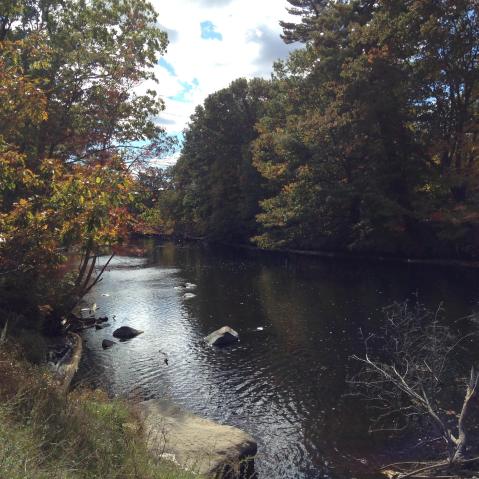
Merrimack River, New Hampshire, USA. All images by author.
Field Recording: An End Goal in Mind?
Field recording involves a delicate balance of technical skill, careful planning, and patience. Stepping away from a controlled environment, capturing audio on location presents many random and often erratic trials. From wind noise and poor site accessibility to recording malfunctions and user error—a host of issues arise once the recordist enters unfamiliar territory. Here, unfamiliar territory includes both new places and nascent approaches to research-based production and artistic data collection. Where do I situate a project like the New England Soundscape Project among new media production, sound studies, and music composition? Does that issue even matter?

Otter Brook Dam/Edward MacDowell Lake, Keene, New Hampshire, USA. All images by author.
The notion of practice-based work usually implies an end goal in mind. What if there is not an end goal in sight? What happens then? Would the New England Soundscape Project be “enough” of a contribution to creative scholarship when approached as a type of audio ethnography—much like the immersive storytelling recently curated by Leonardo Cardoso? The New England region is lush and robust, with many diverse landscapes. I hoped to document these in some way, but wondered how to continue. Truthfully, I had some hesitation on where to start.
Media artists and music composers learn the mechanics of their craft in colleges, universities, conservatories, at home, and on the job. Some of these techniques include audiovisual production, computer programming, coding, editing, and arranging using digital software. I am both self-taught and a product of an academic and Eurocentric, conservatory training system. This presents some tension, as I discuss below. Although traditional audio engineers and music composers often work towards completing a project without a predefined trajectory, how can budding sound artists develop and hone an inner acuity to find the “right” material during their creative processes?
While the process remains largely subjective, I found it helpful to begin by answering the following questions:
- What kind of project is this?
- How is the sound to be used?
- Where and how will the project be displayed?
- Who is the intended audience?
- What are the sound artist’s intentions?
- What tools are needed?
I draw inspiration from the Sound Studies Lab’s position that this type of work is diverse, fluid, and balances technical, artistic, and theoretical aims. The challenge is that the answers to the questions above are not immediately clear and require me to look inward at who I really am.

Boot Mill Threading Machine, Lowell, Massachusetts, USA. All images by author.
Following the Sonic Muse
Beyond the obvious technical and aesthetic factors affecting an expansive multisite recording project, we know little about how a nascent sound artist begins. Whom do they emulate? Should they take notes? pictures? What should they pay attention to onsite?
If the project is exploratory, the recordist may experience hesitation—as I did— and frustration that can block their creative process, especially because the pathways toward a finished sound project aren’t as established as those of a sound engineer, for example, or a songwriter. Nevertheless, my experiences have shown me that a nascent sound artist/recordist can also find intrinsic meaning and realize their mission—particularly by establishing a detached yet perceptive listening ethos, as I did to begin my work on the New England Soundscape Project.
For me, framing a detached and perceptive mindset involved:
- Remaining sensitive to my surroundings at each location;
- Focusing on stillness, deep breathing, and a quiet mind while recording;
- Adopting a respectful, unobtrusive manner at each site—taking care not to disrupt or distract others;
- Calmly monitoring my technology and its use;
- Trusting that I am intended to be in that exact moment at that exact time;
- Avoiding being overly concerned with the “end game” of their practice;
- Embracing the role of a sound gatherer and observer;
It is perhaps the final objective—adopting the philosophy of sound gatherer and observer—where truly sensitive listening begins. Here, the recordist aims to remove their personal goals and agenda from the field recording process. Before proceeding, the attentive recordist looks around them, focuses on quiet breathing, and views their microphones as lenses and without fear of what the result should be. To what or whom am I observing?
Here’s the problem. It dawned on me that I know little about who I am as a sound artist, and how my voice positively contributes to the world, if at all. I need to learn to listen—not just to the sounds in nature, but also to the sounds of the voices of the persons with whom I interact. Could solitude and introspective listening lead me to listen through a newly formed self, capable of deeper connections with my peers and environment? I found that my detachment involved investigating, acknowledging, and, whenever possible, setting aside my own biases, fears, and, importantly, my own agendas. By removing my ego and cluttered mind from the process, I could start to be an inclusive practitioner—one whom cultivates positive relationships daily and is capable of crafting a deeper sonic art that embraces rather than one that marginalizes.

Merrimack River, Lowell Massachusetts, USA. All images by author.
The Art of Meditative Listening
Rather than taking on a stringent approach with little flexibility, I practice observational recording by gathering audio as my muse and as environmental conditions dictate. By remaining attentive to my recording levels, I gather source materials up close, from afar, and for any length of time. Meanwhile, as this creative progression unfolds, I stay quiet—bringing almost meditative quality to my practice. Moreover, concentrating on deep breathing and stillness allows me to adopt a grateful mindset—one that is appreciative of my surroundings and for being present at that precise moment. It is then that the environment becomes the focus of sound gathering and not notions of a “final product.”

Scarborough State Beach, Newport, Rhode Island, USA. All images by author.
I found an artistic renewal—even healing—by adopting this meditative practice. As the New England Soundscape Project takes shape over the coming months and years, I hope to document the beauty of the Northeast through music, sound, and images. Yet, it is enough simply to be present in each location while aspiring to produce thoughtful and reflective sound art. Although there is no overarching method that best describes every aspect of a multisite field recording process, the “art” in the sound can truly emerge by striving to banish fear and doubt from the recording process. Addressing the “why” during each moment is just as important as addressing the “how” and the “why” in pre- and post-production. The recordist’s humanity plays a key role in determining how creative decisions are made, and the ability to remove the need for control determines how free—and freeing—the process can be.
This Thursday, SO! will feature my podcast on reflective listening with audio examples from the New England Soundscape Project thus far. I look forward to producing future episodes (and essays) on this project in the coming months. I hope you can tune in on Thursday and thank you for listening!
—
Featured Image: Scarborough State Beach, Newport, Rhode Island, USA. All images by author.
—
Acknowledgements
An Internal Seed Grant from the University of Massachusetts Lowell supports the New England Soundscape Project.
—
Daniel A. Walzer is an Assistant Professor of Composition for New Media at the University of Massachusetts Lowell. Walzer’s research and reviews appear in the Leonardo Music Journal, the Journal of Music, Technology & Education, the Journal of Radio & Audio Media and forthcoming articles in TOPICS for Music Education Praxis, and the Music Educators Journal. Walzer received his MFA in Music Production and Sound Design for Visual Media from Academy of Art University, his MM in Jazz Studies from the University of Cincinnati and his BM in Jazz Studies from Bowling Green State University. Walzer is currently pursuing doctoral studies in education at the University of the Cumberlands. Read more at http://www.danielwalzer.com
—
REWIND!…If you liked this post, you may also dig:
SO! Amplifies: Ian Rawes and the London Sound Survey–Ian Rawes
SO! L.A.: Sounding the California Story–Bridget Hoida
Sound-politics in São Paulo, Brazil–Leonardo Cardoso
Share this:

A Manifesto, or Sounding Out!’s 51st Podcast!!!

This week, Sounding Out! dropped its 51st podcast episode. As the curator and producer, I thought it necessary to commemorate the occasion with some fanfare. I want to shout from the hilltops about how proud I am that our little podcast has turned 51!
Erm…at least I’m posting about it.
Also, I want to clear the air a little about what it is that we do. I’ve received feedback here and there over the years about the sound of our podcasts, that we sound “different” and/or “inconsistent,” that we need to normalize the sound a bit: hello out there, audiophiles! Today, I want to say, once and for all, that our sound is intentional and that we are proud of it, hiss, distortion, and all! We think what some hear as “imperfections” are all part of what sets us apart from the ever-growing pack of podcasters. SO!’s podcast has sounded different since we MacGyvered our first episode from an epic talk, a few great ideas, and a rogue tape recorder at River Read Books in Binghamton, NY in April, 2011.
The Sounding Out! Podcast began as a series of conversations within the editorial team back in 2011. We knew that the blog was “talking the talk” in new, excellent, and often provocative ways, but that something was missing to keep pushing the form into the red, not just the content. We knew we needed something more—a little snap, crackle, and pop, if you will—a way to show how Sounding Out! was always listening, and a way for thinkers, artists, provocateurs, and more to engage with sound more directly. In 2011, podcasts were accumulating in the shadows waiting to lunge forth to center stage. They seemed really cool, but there were relatively few, and fewer still (if any at all) on the topic of sound studies. Even though we knew that podcasts were going to be a big thing eventually, we had no idea that they would blow up so quickly.
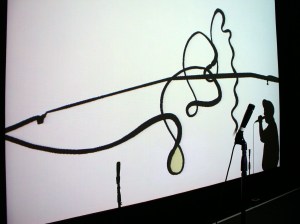
Image by Sandor Weisz @Flickr CC BY-NC.
While we flipped around many ideas, we decided to put our energies behind what was then an occasional series of podcasts that allowed us to capture important yet fleeting moments—too quick and dirty to really transcribe. While our our initial vision for the podcast was to capture these rare and powerful moments, over the past 5 years we have kept this mission consistent while evolving to better accommodate artists and theorists alike. During that time we have hosted mystics and librarians, shared fieldwork from São Paolo, Brazil to Lodi, Ohio, interviewed theremin players and visionaries. See the full list of episodes here. Even though our content has been wide ranging and eclectic, we’ve made it a point to privilege access and immediacy in all of our episodes.
As I listen back to the past five years, I realize that our contribution to the fields of sound studies and podcasting has not just been in terms of who we broadcast and what we amplify, but through the sound of our podcasts themselves. Our podcasts don’t sound perfect. They’re spiritually aligned by the raw production ethic of bands like The Minutemen, who always privileged the emotive qualities of immediacy, access, and intimacy over the brooding qualities of studio production. Particularly because we founded the podcast upon these same principles, I have strived to prioritize radical visions and ideas and to amplify new voices above all else. I want each podcast to arrive in your queue like a wrapped gift—topic, content, production, and sound all equally mysterious. Some of our podcasts were recorded on cellphones and others were recorded in high-end studios and recording booths. Our 51st anniversary isn’t the perfect occasion, either. But, hey, we’re proud of these audible distortions.
“The Minutemen: #1 Hit Song”
So what do I mean that our podcast sounds different? Well, I mean two things: First, we sound different than what episodic radio sounds like. Our DIY—or, more accurately, we will help you “Do It Yourself”—ethics deliberately dial back radio’s genre conventions: smooth identifiable hosts, heavy compression, sound-proof rooms with the latest in equipment. We encourage and construct our podcast with a deliberate sonic diversity, providing little sonic consistency from episode to episode in order to challenge regimes of production that threaten to make all recordings sound the same. We have many many different announcers and hosts; for this podcast to be the space of radical discourse that we intend, it’s important to cast our net wide. This isn’t to say that we don’t care about “quality,” but rather that we define quality differently. Rather than an audiophilic emphasis on the sorts of tone found most frequently in microphone technique, sound booths, and—when all else fails—postproduction, we believe that a “quality” podcast—particularly one about sound—should explore sounds that we rarely hear and allow its artists freedom over how they present their work.
I curate our podcast as a sonic refuge from the invisible regime of auditory production that has slowly constricted and strangled radio this past century. And I’m proud to share podcasts that have been recorded on in impromptu circumstances, Episode XXXIX: Soundwalking Davis, CA and New Brunswick, NJ, for example. We want artists to show more than they tell; Episode XII: Animal Transcriptions, Listening to the Lab of Ornathology is a perfect example of this. Here Jonathan Skinner’s brilliant exploration of animal sounds perfectly balances sound and interview and invites listeners to compare sounds to speech, and vice versa. Another example of this ethic is film professor Monteith Mccollum’s remix of the original War of the Worlds broadcast. Although Mccollum offers some commentary at the start of the recording, what follows is a unique and dazzling sonic experience. Giving radical ideas both the space and platform to be heard is this podcast’s mission. So far, so good!
The second way our podcast sounds different has to do with our deliberate curatorial resistance to consistency between our episodes. When programs bend to the whims of genre conventions, creativity is all but snuffed out. For our podcast to excel as a form for sharing visions, ideas, and experiments, we must allow our composers, authors, and auditors the freedom to explore sonic space. We celebrate Sounding Out!’s anniversary annually with a series of mixes hand-picked by our stable of authors (Listen to years 1, 2, 3, 4, 5, and 6 here!), we’ve entertained interviews, panels, and sound art alike. You may have missed it, but we even have an episode diving into the work of ambient sound in a Dungeons and Dragons game.
Behind the scenes, we look NOTHING like this. Image borrowed from fr4dd @Flickr CC BY.
While I do think about the sound of our podcast aesthetically—I used to run a music production studio out from the trunk of my car—we do not cultivate a DIY anything-goes ethic strictly for a “cool factor” or just for its own sake. Rather, we have calibrated our different sonic approach in deliberate defiance of styles of production which are all too frequently celebrated within the cultures of straight white men. (Check out SO! Editor-in-Chief Jennifer Lynn Stoever’s epic three-part treatise on the tape recorder in popular film to glean some sense of the tape-recorder’s role as an instrument of masculine control. Part 1, Part 2, Part 3). The standards of taste which have long governed the domain of radio production (and audio production, as a whole) are historically connected to the communities of practice which have occupied invisible yet powerful roles as audio producers, engineers, critics, and marketers.
As Jonathan Sterne explains in MP3, the science of audio fidelity has historical roots within a corporate logic that privileges sounds that are easily shared through telephone cables. “AT&T encountered hearing as an economic problem once its options for extracting additional profit through price were limited,” Sterne says, “Among other strategies, it sought to learn which frequencies could be excluded from the market for telephone signals” (14). In other words, the entire craft of audio engineering has historical roots in privileging sounds that make money above all else. Not only this, but the standards of fidelity cultivated by engineers allow them to gatekeep and demand money at the outset, blocking access to the means of production. These standards are more often than not embedded within the cultures of listening and sales fostered by the radio industry. Fortunately, podcasts have been able to challenge many of these genre tropes, We’re proud to contribute to this momentum and to propel it forward as we continue our series. And we’re not stopping! Up on deck in 2016 we have some amazing compositional sound art, more from Marcella Ernest’s trek to uncover lost sounds, and some notes on a forthcoming project in archiving one city’s local music scene.
BOOM!!!!! Image by Jamie McCaffrey CC @Flickr BY-NC.
So, in the spirit of Sounding Out!’s annual blog-o-versary we’re popping the cork for our podcast’s 50th episode with a few of the milestones we hit this past five years.
We found a theme song. This was a small but important step in our development. What would a podcast about sound be without some kind of awesome anthem representing it? (Nothing, that’s what!) We need to officially thank the members of Hunchback (Miranda, Mike, Jay, and Craig) for donating their song “Feeling Blind” to our podcast. Hunchback was a legendary horror-surf band from the NJ basement scene who endeavored to produce highly visceral sonic experiences of the highest caliber in their songwriting. You can still find a ton of their recordings on the internet. Thanks, crew!
 We got listed on iTunes and Stitcher. It bears mentioning that quite a bit of technical muscle is involved in establishing a podcast. We would have gotten nowhere without Andreas Duus Pape’s help and guidance during our earliest moments. Andreas was instrumental in opening up the hood of the podcast and making it purr. Not only did he donate his time to plug us into iTunes’ network of podcasts, but he also shared some excellent philosophical thoughts on the topic. You can listen here and read them here.
We went monthly. Originally we had conceived the podcast as more a haphazard, occasional treat for our readers. Slowly but surely as demand and interest grew, we began to carve out a more regular calendar space for our podcast. First we switched to a bi-monthly format, and then we started with monthly broadcasts. Can’t slow this beat down.
We are the sonic archive of a sound art conference. That’s right, we featured sonic mixdowns of the entire Tuned City of Brussels sound art festival. Over the course of the festivals three days, we featured daily mixdowns of the prior day’s key sounds and moments. Each mixdown is brilliant and a testiment to the raw passion of our podcast contributors. They worked round the clock to produce such an amazing series. Check out the night before, and days 1, 2, and 3.
 We produced a LOT of soundwalks. If you’re a listener you know that we love our soundwalks. We’re proud to be host to play host to a variety of soundwalks from cities around the world. Last month’s Yoshiwara soundwalk by Gretchen Ju challenged listeners to critically engage with the city’s fraught history of sex work. Other contributors in our soundwalk series like James Hodges have considered how the ambient music of big box stores and shopping malls are part of the architecture of commerce. Finally others like Frank Bridges have taken us to the edge of history and soundwalked the grounds of Thomas Edison’s workshop in Edison, NJ. No matter what the locale, our soundwalks are part of our podcast’s signature.
We found a regular contributor. Regular contributors are the heart and soul of Sounding Out! They lead the conversation on sound and work to bring you the best, most interesting content. For these reasons we’re proud to announce that Marcella Ernest will be joining our podcast as a regular contributor with her series “Searching for Lost Sounds.” Marcella will be interviewing a variety of sonic practitioners in an effort to give voice to the voiceless. Her most recent entry in the series was posted last Thursday. You can listen here.
We’re going to keep it coming. That’s our promise to you! We’ll be producing great content as long as you’re listening. Take a moment to subscribe to our iTunes or Stitcher accounts and also explore our Episode Guide to see if you missed anything this past 5 years. It’s been a rewarding adventure so far and we guarantee that we’ve already got some great content lined up in the coming months.
Image by Sandor Weisz @Flickr CC BY-NC.
–
Aaron Trammell is a Provost’s Postdoctoral Scholar for Faculty Diversity in Informatics and Digital Knowledge at the Annenberg School for Communication and Journalism at the University of Southern California. He earned his doctorate from the Rutgers University School of Communication and Information in 2015. Aaron’s research is focused on revealing historical connections between games, play, and the United States military-industrial complex. He is interested in how military ideologies become integrated into game design and how these perspectives are negotiated within the imaginations of players. He is the Co-Editor-in-Chief of the journal Analog Game Studies and the Multimedia Editor of Sounding Out!
–
Featured image is “Roscoe Considers Recording a Podcast” by zoomar @Flickr CC BY-NC.
—
 REWIND! . . .If you liked this post, you may also dig:
Sounding Out! Podcast #1: Peter DiCola at River Read Books – Peter DiCola
It’s Our Blog-O-Versary — Jennifer Lynn Stoever
Sounding Out! Podcast #51: Creating New Words from Old Sounds – Marcella Ernest
Share this:


Current Top Posts





April 2021

January 2020

November 2019

October 2019

August 2019

April 2014

November 2017

March 2015

December 2017

October 2015
 Sounding Out!
Recent Comments