
Sound Bites: Vampire Media in Orson Welles’s Dracula

 Welcome back to our continuing series on Orson Welles and his career in radio, prompted by the upcoming 75th anniversary of his 1938 Invasion from Mars episode and the Mercury Theater series that produced it. To help us hear Welles’s rich radio plays in new and more complicated ways, our series brings recent sound studies thought to bear on the puzzle of Mercury‘s audiocraft.
From Mercury to Mars is a joint venture with the Antenna media blog at the University of Wisconsin, and will continue into the new year. If you missed them, check out the first installment on SO! (Tom McEnaney on Welles and Latin America) and the second on Antenna (Nora Patterson on “War of the Worlds” as residual radio).
This week, Sounding Out! sinks its teeth into Orson Welles’s “Dracula,” the first in the Mercury series, and perhaps the play that solicits more “close listening” than any other—back in 1938, Variety yawned at Welles’s attempt at “Art with a capital A” and dismissed his “Dracula” as “a confused and confusing jumble of frequently inaudible and unintelligible voices and a welter of sound effects.” Here’s the full play, listen for yourself:
It’s a good thing that our guide is University of South Carolina Associate Professor and SO! newcomer Debra Rae Cohen. Cohen is a former rock critic, an editor of the essential text on radio modernism, and has also recently written a fascinating essay on the BBC publication The Listener, among other distinguished critical works on modernism. Below you’ll find the most detailed close reading of Welles’s “Dracula” (and of Welles as himself a kind of Dracula) ever done.
Didn’t even know Welles ever played Count Dracula? That’s just the first of many surprises you’ll discover thanks to Debra Rae’s keen listening.
So (to borrow a phrase), enter freely and of your own will, dear reader, and leave something of the happiness you bring. – nv
—

Orson Welles
It’s one of the best-known anecdotes of the Mercury Theater: Orson Welles bursts into the apartment where producer John Houseman is holed up cut-and-pasting a script for Treasure Island, the planned debut production, and announces, only a week before airing, that Dracula will take its place. At a time when Lilith’s blood-drenched handmaidens on the current season of True Blood serve as an analogue for our own cultural oversaturation with vampires, it’s worth recalling why, in 1938, this substitution might have been more than merely the indulgence of Welles’s penchant for what Paul Heyer calls “gnomic unpredictability” (The Medium and the Magician, 52).
In fact, 1938 was a good year for vampire ballyhoo; Tod Browning’s 1931 Dracula film had been rereleased only a month before to a new flurry of Bela Lugosi press. Welles’s last-minute switch was a savvy one, allowing him to capitalize on the publicity generated by the continuing popularity of the film (and the popular Hamilton Deane and John Balderston stage adaptation from which it largely drew), while publicly disdaining its vulgarity in favor of what he seemed peculiarly to consider the high-culture status of Stoker’s original novel. Here he is defending the book:
But more importantly, Welles’s production reclaimed and exploited the novel’s own media-consciousness, a feature occluded in the play and film versions, and one to which the adaptation into radio adds, as it were, additional bite. Dracula introduced several of the radio innovations we’ve come to associate with the Mercury Theater (and The War of the Worlds in particular)—first-person retrospective narration, temporal coding, the strategic use of media reflexivity—but Stoker’s novel may have made such innovations both alluring and inevitable.

Stoker’s Dracula is made up of a patchwork of documents—shorthand diaries, transcribed dictation cylinders, newspaper clippings—that do not simply serve as a legitimizing frame, as in Frankenstein. Instead, they are deeply self-referential, obsessively chronicling the very processes of inscription and translation between media by which the novel is built. Confronted with the terrible threat of Dracula free to prey on London’s “teeming millions,” Mina Harker vows thus: “There may be a solemn duty, and if it come we must not shrink from it. …I shall get my typewriter this very hour and begin transcribing.” Processes of ordering information serve, as critics since Friedrich Kittler have noted (see for example here, here, and especially here), as the way to combat the symbolic threat of vampirism that, as Jennifer Wicke argues, stands in for “the uncanny procedures of modern life,” and a threat that may have already colonized intimate spaces of the text itself (“Vampiric Typewriting,” 473).
That threat, in the novel, sounds oddly like . . . radio. Seeping intangibly through the cracks of door frames, invading domestic spaces, riding through the ether “as elemental dust,” materializing abruptly in intimate settings, communicating across land and sea while rendering his receiver passively malleable, Stoker’s Dracula is terrifying by virtue of his insidious ubiquity, a kind of broadcast technology avant la lettre.

A 1931 Grosset & Dunlap edition of Dracula, with images from Browning’s film.
In adapting Dracula for radio, then, Welles could play on the deep division in the novel between the ordered forces of inscription and the Count’s occult, uncanny transmissive force in order to exploit the anxieties connected with the medium itself. Even the double role Welles plays in the production—both Dracula and the doctor Arthur Seward—functions in this regard as more than bravura.
Seward’s primary role in the drama as compère, or advocate, threads together Dracula’s multiple documentary “narration,” through what became the familiar Mercury device of retrospect-turned-enactment. As Seward, Welles performs an argumentative and editorial function that’s nowhere in Stoker’s novel, where the various documents make up a file that is explicitly uncommunicated, because unbelievable, for a case no longer necessary to make. Shuffling the various documents that make up the “case,” Seward stands outside of definite place, but also outside of time, animating “the extraordinary events of the year 1891” by directly addressing an audience of a medium that does not yet exist. Here is part of Seward’s address:
Seward is our first “First Person Singular,” and yet his persona is unsettlingly thin. Though his voice at the outset is strong and urgent, it feels bland compared with the dense goulash of “Transylvanian” effects that competes for our attention through the first ten minutes of the production—hoofbeats, thunder, wolf howls, whinnies, the sound of a coach seemingly about to clatter to bits, the singsong of prayers muttered, perhaps, in some exotic foreign tongue. The “documents” on which Seward’s claim to the trust of the audience rides are overwhelmed by the sound that saturates them. Here is the scene:
It’s not until nearly 20 minutes into the production that Seward reveals his own connection with the story—as the lover of Lucy Westenra—and from this moment forward Welles allows Seward’s authority in the “present” to be eroded by his bland inefficacy in the scenes of the “past.” By Act II, he has ceded authority by telegraph to Dr. Van Helsing (Martin Gabel, in a brilliantly crafted performance):
Without the didactic authority of Van Helsing and with small claim on audience sympathy, Seward becomes, through the second half of the production, a strangely insecure advocate, whose claim on authentic first person experience often disrupts, rather than augments, his role as presenter.
The listener does not consistently “follow” Seward either narratively or sonically—indeed, he is often displaced to the sonic periphery by Dr. Van Helsing. In the final confrontation with Dracula, Seward is explicitly shooed to the outer margins of the soundscape to pray.

Orson Welles as The Shadow in a CBS promotional photo, 1937 or 1938
Here the technical exigencies of Welles’s double role support a subtext that his unmistakable voice has already suggested: that Seward is here the “other” to Dracula (as, later, his Kurtz would be to his Marlow), waning as he waxes. As Lucy is weakened through Dracula’s occult ministrations, so too is Seward sapped of vitality, his romantic passages voiced as strangely bloodless, while Dracula’s wring from Lucy an orgasmic sonic response. Penetrating the intimate chamber Seward ineffectively desires to protect, Dracula replaces him as the production’s central sonic presence—who even when silent, possesses the sonic space.
Contrast Seward’s feeble voice during his night-time vigil here,
to Dracula’s seductive visit here,
Welles needed to distinguish his Dracula from Lugosi’s, employing, rather than an accent, a kind of sonorous unplaced otherness. But his performance shares the ponderous spacing of syllables that, in Lugosi’s case, derived from phonetic memorization of his English script; in other words, Welles is “recognizable” as Dracula without “playing” him. As an analogue to Lugosi’s glacial movement, Dracula’s voice is here surrounded by depths of silence in an otherwise effect-busy soundscape.
From the beginning, Dracula is also sonically on top of the listener, uncomfortably intimate, as in this scene of a close shave:
And although Dracula’s voice is not heard for a full thirteen minutes after Lucy’s death, it nevertheless seems to inhabit all available silences, until he quietly seeps through the door frame of Mina Harker’s bedroom:
The closely-miked phrase “blood of my blood” is reprised throughout the second half of the production—it is repeated seven times, by both Dracula and Mina (Agnes Moorhead), though it occurs only once in the novel—underscoring the ineffable aurality of Dracula’s “transmission.” The line doesn’t present as meaning, but as a tidal echo, the pulse of a carrier wave. While it signals an action unrepresentable to the ear—Dracula’s literal bite or its resonances of memory and desire—it also functions as a “signal” in the sense that Verma describes, as a repetitive element that compels listenership like an incantation (Theater of the Mind, 106). This is the power against which the “documents” are marshaled, the power of “pure” radio—ironically the very power that allows them to be shared. And the hypnotic thrum of radio rips them to shreds.

A recent CD edition of Welles’s Dracula by CSI Word
Indeed, the closing minutes of the drama present the vampire hunters, the novel’s forces of inscription, as an array of anxious noises marshaled against this lurking silence. The frenzied pacing of the final chase back to Transylvania—an element of Stoker’s novel that both plays and film sacrificed—gathers momentum through ever-shorter “diary entries” delivered, breathlessly, over the sound effects of transport:
Welles exploits the familiarity of his audience with a mechanism that Kathleen Battles calls a “radio dragnet”; the forces of order deploy the ubiquity of radio itself to shore up social cohesion, enlisting the audience within their ranks (Calling all Cars, 149). But here that very process is, simultaneously, unsettled and undermined by the identification of Dracula himself with invisible transmission. As Van Helsing repeatedly hypnotizes Mina to tap in on her communion with Dracula—radio, in a sense, deploying radio—the listener is aware of being both eavesdropper and the sharer of rapport, a position that implicates her in Mina’s enthrallment. Here is part of the sequence:
This identification intensifies in the climactic sequence, completely original to Welles’s adaptation, in which Dracula, at bay before his enemies, weakened by sunlight, calls upon the elements of his undead network:

Cover art featuring the “undead network” from a 1976 vinyl pressing of Welles’s “Dracula”
This tour-de-force moment for Welles is also the point when radio shatters the documentary frame and undermines its logic. Though Mina hears Dracula, the others do not, and as Van Helsing’s “testimony” attests, even she does not remember it. This communication can’t, then, be part of Seward’s “evidence.” Rather, it is the radio listener—Dracula’s real prey—who who has received Dracula’s transmission, who has heard across time and space what no one else present can hear: “You must speak for me, you must speak with my heart.”
Although Mina refuses this rapport by staking Dracula at the last possible second—or does she refuse it? Is this not perhaps the Count’s secret wish?—the effect of the uncanny communion persists beyond Seward’s summation, beyond Van Helsing’s subsequent account of Dracula’s end. It renders almost unnecessary Welles’s famous playful post-credits epilogue, in which he abruptly adopts Dracula’s tones to tell us that, “There are wolves. There are vampires”:
But with the hypnotic reach of radio at your disposal, who needs them?

Orson Welles in The Third Man (Reed, 1949)
—
Featured Image Adapted from Flickr User Andrew Prickett
—
Debra Rae Cohen is an Associate Professor of English at the University of South Carolina. She spent several years as a rock & roll critic before returning to academe. Her current scholarship, including her co-edited volume Broadcasting Modernism (University Press of Florida, 2009, paperback 2013) focuses on the relations between radio and modernist print cultures; she’s now working on a book entitled “Sonic Citizenship: Intermedial Poetics and the BBC.”
—
 REWIND! . . .If you liked this post, you may also dig:
“The Sound of Radiolab: Exploring the ‘Corwinesque’ in 21st Century Public Radio”–Alexander Russo
“One Nation Under a Groove?: Music, Sonic Borders, and the Politics of Vibration”–Jonathan Sterne
“Radio’s ‘Oblong Blur’: Notes on the Corwinesque“– Neil Verma
Share this:

Soundscapes of Narco Silence
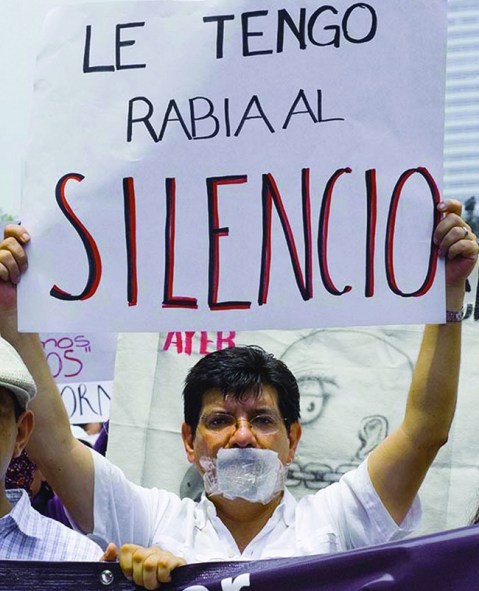
Journalists protest in silent march in Mexico City, Courtesy of the Knight Foundation
Since the drug war began, the lives of approximately 95,000 people have been claimed, with an estimated total of 26,000 disappearances (“Continued Humanitarian Crisis at the Border” June 2013 Report). At the University of Texas, Pan American – an institution located 25 miles north of Reynosa, Mexico (a Mexican city that has been hard hit by drug violence in recent years) – I teach students who have been dramatically impacted by drug war violence. Many have close relatives affected or hear horrific stories of those who have been kidnapped by the cartels; many fear traveling to Mexico to visit loved ones as a result and, in some cases, they report having relatives involved in the drug cartel business. Dinorah Guerra, psychotherapist and head of the Red Cross in Reynosa, describes the devastating psychological and physical toll: “There is a huge risk for people’s self esteem. They cannot speak about what they have seen or what they have heard. [They] lose [themselves] and lose [their] identity” (qtd. in Pehhaul 2010).
I name the space of the drug war and its resulting terror in the U.S.-Mexico border the “soundscape of narco silence.” This soundscape includes death and intimidation, from the brutal killings of news reporters by cartel members to the decapitation of citizen-activists who use online media to alert communities of narco checkpoints. It also consists of those powerful acts that call attention to silence as a tactic of terror. The Movement for Peace with Justice and Dignity, for instance, brought together tens of thousands of people in Mexico to speak out against drug violence through silent marches. Cultural productions, such as narcocorridos, or contemporary drug ballads that document the cross-border drug economy, also become part of the soundscape. The narcocorridos function as a powerful critical response to silence and fear because they enable those in Mexican society, as Jorge Castañeda, author of El Narco: La Guerra Falllida, explains, “to come to terms with the world around them, and drug violence is a big part of that world. The songs are born out of a traditional Mexican cynicism: This is our reality, we’ve gotten used to it” (Qtd. in Josh Kun 2010).
In this blog post, I focus on the role of U.S. Latina/o theater produced in the South Texas border region as it responds to the soundscape of narco silence. Building on David W. Samuels, Louis Meintjes, Ana Maria Ochoa, and Thomas Porcello’s definition of “soundscapes” in “Soundscapes: Towards a Sounded Anthropology” as “the material spaces of performance and ceremony that are used or constructed for the purpose of propagating sound” (330), I suggest that soundscapes of silence in theater function as material spaces of performance that focus the public’s attention on silence – with the intent of intervening in acts that propagate silence and fear. Soundscapes of narco silence are characterized not only by violence and terror, but by cultural productions that function as forms of critical resistance – those works that focus the publics’ attention on the economy of silence and fear that fuels the drug war, and in the process, enable communities to cope with narco violence.
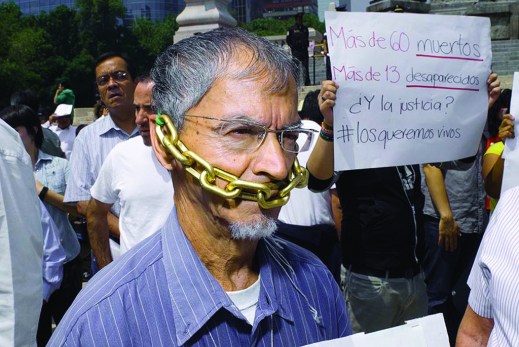
Journalists protest in silent march in Mexico City, Courtesy of the Knight Foundation
To closely listen to the soundscape of narco silence, I engage with the play script and production of Tanya Saracho’s play El Nogalar at South Texas College Theatre (STC) under the direction of Joel Jason Rodriguez in McAllen, Texas in June 2013. The play was first produced at the Goodman Theater in Chicago in April 2011, with a West Coast premiere at the Fountain Theater in Los Angeles in January 2012. I critically analyze the STC Theatre production’s incorporation of a multi-genre soundtrack that included narcocorridos, rancheras, and nortec (norteño + techno). I argue that this soundtrack focused audiences’ attention not only on the devastating effects of silence, but also the function of silence as a form of capital for those most excluded in society. I also offer a brief critical listening of the script’s rendering of silence through character dialogue and stage directions.
El Nogalar tells the story of an upper-class Mexican family comprised of three generations of women (Maité, Valeria, and Anita) whose land and home in the fictionalized estate of Los Nogales in Nuevo Leon, Mexico, and its adjacent nogalar (pecan orchard), are under threat by the maña (drug cartels) moving into the region. The play focuses on the women’s responses to the drug war economy as a result of their different relationships to home (both their estate and the space of Mexico). It also centers the experiences of Dunia, their maid, and López, a former field worker who now works for the maña.
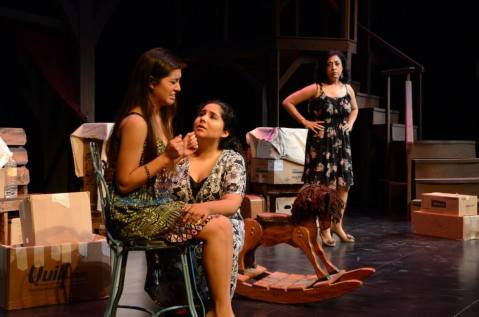
STC Theater Production of El Nogalar. Photo Credit: Miguel Salazar
Cecilia Ballí, in her article “Calderón’s War: The Gruesome Legacy of Mexico’s Antidrug Campaign,” explains the particular circumstances of marginalized men in this society: “The worst casualties of this ‘civil war’ were the estimated 7 million young men to whom society had closed all doors, leaving them the options of joining a drug gang or of enlisting in the military, both of which assured imprisonment of death” (January 2012, 48). With the characters López and Dunia, the play asks audiences then to listen to the impact of the drug war on the most vulnerable populations in Mexico and the US-Mexico border region.
The play script conveys how “narco silence” can be used by those who either seek to preserve traditional class hierarchies (the story of the matriarch Maité) or to survive and profit in the new drug economy (the story of López). “Narco silence,” a term coined by reporter Jonathan Gibler in his book To Die in Mexico, refers to “not the mere absence of talking, but rather the practice of not saying anything. You may talk as much as you like, as long as you avoid the facts. Newspaper headlines announce the daily death toll, but the articles will not tell you anything about who the dead were, who might have killed them or why. No detailed descriptions based on witness testimony. No investigation” (2011, 23). In an early exchange between López and Dunia, López defends “narco silence” as a strategy of survival:
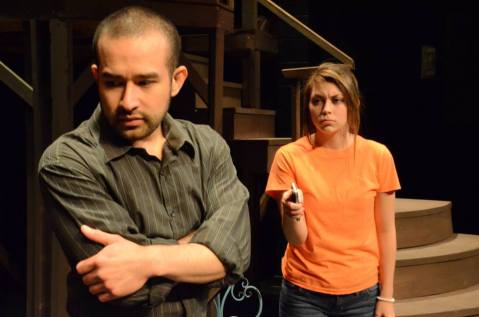
STC Theater Production of El Nogalar. Photo Credit: Miguel Salazar
DUNIA: Why are you the only one they leave alone, Memo?
LÓPEZ:….
DUNIA: All the men your age. Killed. Why Memo? (Beat).
LÓPEZ: Because I know when to keep my mouth shut which is not something I can say for you….
DUNIA: So that’s all it takes to be best of friends with the Maña? That doesn’t seem so hard to do? (American Theatre Magazine July/August 2011, 74).
Later in the play, Dunia, heeding López’s advice, offers a powerful observation of how “narco silence” enables her community to cope with death: “We all just walk around like we’re a movie on mute. You can see people’s mouths moving but all you hear is the static (my italics)” (American Theatre Magazine July/August 2011, 73-74).
The STC Theatre production enhanced the script’s soundscape of narco silence through its sound design, with a soundtrack that included rancheras, narcocorridos, norteño and nortec. This music provided audiences with a connection to the world of Los Nogales and captured each character’s process of coping with narco violence. For example, Maité’s soundtrack consists of several rancheras, such as Lola Beltran singing “Los Laureles” and Chavela Vargas’s powerful rendition of “Que te vaya Bonito.” Beltran’s “Los Laureles” – a cancion ranchera that includes Beltran’s powerful female vocals and mariachi orchestra instrumentation – invites audiences to hear Maité’s nostalgia and desire for an idealized Mexican society and her wish to preserve traditional class hierarchies.
.
Vargas’s powerful rendition of “Que te vaya Bonito” captures Maite’s pain and suffering as she loses her home to the cartels. In Vargas’s version of “Que te Vaya Bonito” – a song about love and abandonment – audiences hear Vargas’s choking and sobbing voice, accompanied by a single guitar.
.
Vargas’s voice conveys, what Lorena Alvarado powerfully argues, is “the body’s dilemma between the hysteria of sobbing and the intelligibility of words, between resignation and retribution” (2010, 4). Vargas’s powerful singing also conveys, as Alvarado further describes, “un nudo en la garganta,” a common expression in Spanish that describes “the knot in the throat, when one cannot speak because words will not come out, but the desperate, or quiet, breath of tears” (Alvarado 2010, 5).
To sonically register the drug cartel economy and lifestyle underlying the “new” Los Nogales, the soundtrack also included narcocorridos. The first sounds we hear in the play are from the narcocorrido “El Carril Número Tres” – which includes two acoustic guitars and an electric bass – by Los Cuates de Sinaloa.
.
“El Carril Número Tres” – tells the story of a secret “lane number three” that allows a Mexican drug lord to freely go back and forth between the US and Mexico because he makes a deal with the CIA and DEA. With this focus on the US government’s involvement in the drug trade, the song centers how silences north of the US-Mexico border have perpetuated drug violence.
The music also included nortec, with songs by the Mexican Institute of Sound, particularly the track “Mexico,” which is a critique of the Mexican government’s complicity with the narcos.
.
With “Mexico,” audiences hear a fusion of norteño, electronic, and hip-hop with lyrics that use the symbols of Mexican national identity and culture to focus the public’s attention on violence and terror. With the lyrics “green like weed, white like cocaine, red your blood” (referencing the Mexican flag) and “at the sound of the roar of the cannon” (alluding to the national anthem), the song powerfully invokes the visual and sonic soundscape of violence that terrorize Mexican residents. With this charged critique of government corruption, “Mexico” momentarily interrupts the soundscape of narco silence rendered in the play script and rest of the soundtrack.
Ultimately, the production’s combination of rancheras, narcocorridos, and nortec captured the class tensions in Mexican society and emphasized the play’s critique of class structures that have enabled drug war violence to persist. With this range of music, the director explains he wanted to “maneuver between the [various] aspects of [the story]: the nostalgia, the corridos, the narcocorridos, and also this fusion of saying ‘we want something more,’ and so that was the whole aspect of it; the blending of the old, the new, and what the present is” (Interview with author July 2013).
The production also deliberately incorporated the sound of silence, particularly in the final scene. By the end, López buys the Los Nogales estate, thereby increasing his class status and social power. Saracho’s stage directions in this final moment indicate “an interpretive sound of trees falling. Now don’t go cueing chainsaws because it’s not literal. Just make me feel trees are falling. Along with the upper class” (87). The play’s reference to the staging of “an interpretive sound of trees falling” brings to mind the philosophical question: “If a tree falls in a forest and no one is around to hear it, does it make a sound?” We might then interpret the final sounds of El Nogalar as inviting audiences to listen attentively to the soundscape of narco silence, implicating audiences as social actors in the politics of the drug war that continue to devastate Mexican society.
—
Featured Image: Journalists Protest against rising violence during march in Mexico, Courtesy of the Knight Foundation
—
Marci R. McMahon received her Ph.D. from the University of Southern California with affiliations in the Department of American Studies and Ethnicity. She is an assistant professor at the University of Texas, Pan American, where she teaches Chicana/o literature and cultural studies, gender studies, and theater and performance in the Departments of English and Mexican American Studies. She is the author of Domestic Negotiations: Gender, Nation, and Self-Fashioning in US Mexicana and Chicana Literature and Art published by Rutgers University Press’ Series Latinidad: Transnational Cultures in the United States (May 2013). Her essays on Chicana literature and cultural studies have been published in Aztlán: A Journal of Chicano Studies; Chicana/Latina Studies: The Journal of MALCS; and Frontiers: A Journal of Women’s Studies. Her second book project, Sounding Latina/o Studies: Staging Listening in US Latina/o Theater explores how contemporary Latina/o drama uses vocal bodies and sound to engage audiences with recurring debates about nationhood, immigration, and gender.
—

REWIND! . . .If you liked this post, you may also dig:
Listening to the Border: “’2487’: Giving Voice in Diaspora” and the Sound Art of Luz María Sánchez–D. Ines Casillas
Quebec’s #casseroles: on participation, percussion and protest–Jonathan Sterne
Deejaying her Listening: Learning through Life Stories of Human Rights Violations— Emmanuelle Sonntag and Bronwen Low
Share this:


Current Top Posts





April 2021

January 2020

November 2019

October 2019

August 2019

April 2014

November 2017

March 2015

December 2017

October 2015
 Sounding Out!
Recent Comments