
Tofu, Steak, and a Smoke Alarm: The Food Network’s Chopped & the Sonic Art of Cooking

On Sunday evening, Susan discovered the tofu had gone bad. Unfortunately, the entrée for the evening was to be tofu with sweet chili sauce. We connect on Skype at 3:30pm, as Susan is cutting up vegetables. Usually, she has classical music on while she cooks; it helps her concentrate. She’s cut up so many vegetables in her life, that she finds music sweetens the repetitive activity. However, today I hear only the rewarding sound of her knife bisecting baby bok choy.
Susan and I don’t talk about this sound, but it is certainly familiar. She says she cuts up the pieces small, as Mimi likes the chunks of bell pepper to be as little as possible.
My ethnographic work on cooking is birthed from a very personal place: Susan is my Aunt and Mimi my mother. They live together in Kingston, Massachusetts, where Susan’s cooking nourishes Mimi through her ongoing chemo and radiation treatments. Using Skype, I watched and asked questions remotely from Raleigh, North Carolina on three consecutive evenings during their dinner preparation in order to more deeply understand cooking as an art. From the first moment of preparation each night, Susan and I talked about the meal, the cooking techniques, and her feelings about cooking and eating–and I noted that sound emerged as central to her culinary process.
Opening my ethnographic practice up to sonic analysis enables new definitions of both chef and kitchen as lively, complex sites, constantly negotiating with each other. Taking the role of sound into account in the practice of cooking allows me to construct new interpretations of cooking artistry that considers everyday negotiations and embodied limitations not as “threats” to the cooking art, but, instead, as elements that enrich its artistry.
My sonic analysis specifically chafes against dominant formations of “cooking as art” in the contemporary moment, exemplified by reality television programs such as The Food Network’s Chopped, which constructs a static configuration of space with the cook as subject and the meal as art object. On Chopped, four chefs are given thirty minutes and four ingredients. Using these items, they must make a dish to be judged by a panel of food experts. These items are often strange or incongruous: on one episode, they had to make an appetizer out of frosted wheat cereal, baby red romaine lettuce, black garlic, and quahog clams. The success of a dish is measured by the chef’s ability to balance the necessary experimentation with an implied universal of good taste, texture balance, and pleasuring preparation. In other words, Chopped collapses art-making and capital into the “art object-meal,” reproducing a tired definition of “high art” that necessitates access to wealth and privilege, because the creation of “art” requires expensive foodstuffs, sophisticated kitchen technologies, and a highly controlled visual and sonic environment.
.
In my Aunt Susan’s kitchen, there are a number of sonic and spatial negotiations that preclude her cooking from the singular criteria of artistry perpetuated by Chopped. Specifically, my Aunt Susan’s cooking does not meet Chopped’s standards because it requires negotiations related to her personal mobility and my mother’s health. My Aunt uses a wheelchair to get around her house, and, as a result, some kitchen appliances are harder to reach. My mother’s chemo and radiation treatments mean that she has both complicated limitations to her diet and fluid culinary desires.
In seeking to understand the fluid challenges of Susan’s cooking, I designed my virtual sensory ethnography by combining two methods, defined respectively by Sarah Pink and Jenna Burrell. In Sensory Ethnography, Pink proposes that the ethnographer is immersed in smells, tastes, sights, and sound during the ethnographic process. Things that might seem mundane such as the sound of onions being chopped, for example, can actually reveal a complex set of relations about the cook and their process. The cook might be listening to the chopping as a rhythm in her process, like background music: the pleasing sound as it hits the cutting board. But if the onion isn’t fresh, the sound is less crisp, less crunch, the sounds changes to speak of a different type of knowledge, and she must act differently in response. In “The Field Site as a Network,” Burrell proposes an understanding of the ethnographic field site as a network rather than a singular object. The field site, in other words, is a heterogeneous set of connections, always expanding. Using a technology like Skype to do ethnography is not “ethnography at a distance,” she implies, rather it is the field site manifested through a multiplicity of connections. It simply reflects the ever-changing set of relations that comprise our world.

Tools for the sensory ethnography of the kitchen. Borrowed from Travelin’ Librarian @Flickr.
After Susan has cut up all the longer-cooking vegetables and set the chili sauce to simmer, we disconnect. At 5:15pm, we connect again. Susan unwraps the tofu, and something isn’t right. She calls Mimi into the kitchen, and, after some deliberation, they decide that steak will need to replace the tofu. It’s a disappointment as the tofu would have tasted best with the sweet chili sauce.
The sonic landscape of Susan’s kitchen has been, up to this, point, fairly solitary and controlled. When Susan welcomes Mimi in, the kitchen becomes a lively space of conversation, interaction, and negotiation. The production of the sonic space in the kitchen, from solitary preparation to lively interaction, is a crucial part of Susan’s art. The kitchen has undergone what Brian Massumi, in his essay “Floating the Social,” calls a “modulation of the dimension of perception [rather] than an encoding of separate pieces of data or a sequencing of units of meaning” (41). Such a sonic modulation challenges the narrative of lone artist-chef creating object-meal. Rather than segmenting the meal into a set of data blocks (chef, food, preparation time, and eater), Susan orchestrates the art of cooking as participatory with Mimi.
In the kitchen, Mimi also examines the tofu. She offers some information about it, and then joins Susan to figure out what other protein might work.
Once the steak is decided upon, Mimi exits and Susan works again at preparing dinner.
Susan’s sonic modulations, in this case conversation, allow for immersion and engagement in the lively sonic space of her kitchen. Mimi and Susan create a co-constitutive relationship between chef and eater. Unlike on Chopped, the eater is a participant rather than a judge.
Susan and I disconnect from Skype to give the steak time to thaw. We connect once again, at 6:20PM, once the steak has been properly thawed. As we discuss how Susan learned to cook, the smoke alarm suddenly comes to life.
An unplanned sonic intervention has occurred. The smoke alarm has its own desires; it insists on total control of the sonic space. Susan’s response is a necessary modulation. She counters the smoke alarm’s desire for sonic control with words, saying that it triggered accidentally because of the steak, sizzling in the pan. The interruption of the smoke alarm exemplifies how Susan’s cooking technique is not one of dominance. Rather than producing clear boundaries between chef and eater, the food and the preparation, the kitchen and its outside, Susan allows for fluid boundaries, welcoming chance and the unknown into her art.

Setting off the alarm image borrowed from Gwenaël Piaser @Flickr.
In the context of Susan’s kitchen, Massumi’s definition of modulation applies, however subtle. These domestic modulations are not a movement toward total control, but, instead, a lively negotiation with a set of partly unpredictable relations – an orchestration of the sonic space. The idea of sonic orchestration allows us to consider the complex set of possibilities existing between the choices made by the subject, here, the chef, and the presence of a set of potentialities, such as the smoke alarm. To Susan, the art of cooking is not the reduction or elimination of “threats”; her art is the negotiation of modulations. In contrast to Chopped, where careful boundaries are constructed in order to protect the privilege inherent in its definition of art, Susan’s art lies in her engagement with the lively potentialities of the sonic art of cooking.
—
Seth Mulliken is a Ph.D. candidate in the Communication, Rhetoric, and Digital Media program at NC State. He does ethnographic research about the co-constitutive relationship between sound and race in public space. Concerned with ubiquitous forms of sonic control, he seeks to locate the variety of interactions, negotiations, and resistances through individual behavior, community, and technology that allow for a wide swath of racial identity productions. He is convinced ginger is an audible spice, but only above 15khz.
—
 REWIND! . . .If you liked this post, you may also dig:
Sound-politics in São Paulo, Brazil–Leonardo Cardoso
Sounding Out! Podcast Episode #5: Sound and Spirit on the Highway–David Greenberg
Listening to Whisperers: Perfomance, ASMR Community and Fetish on YouTube–Joshua Hudelson
Share this:

Radical Listening and the People’s Microphony: A Conversation with Elana Mann
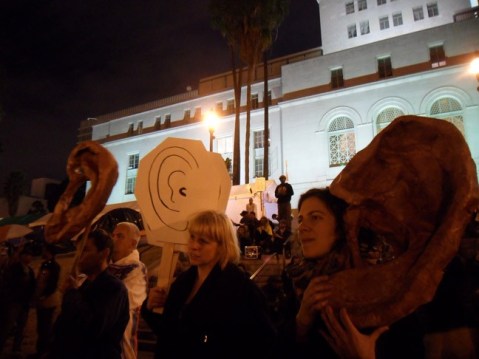
Members and collaborators of ARLA (Paula Cronan, Juliana Snapper, and Elana Mann) participating in a General Assembly at Occupy LA City Hall, November 11, 2011
Listen to everything all the time and remind yourself when you are not listening–Pauline Oliveros
“CAN YOU HEAR ME?!” “I CAN HEAR YOU!!” “IT’S A VAN GOGH PARADE!!” . . .were some of the enthusiastic replies when artist Elana Mann, musician Juliana Snapper, and other members of ARLA (Audile Receptives Los Angeles) arrived on the scene at Occupy LA with giant hand-made ears. Mann co-founded ARLA in the Spring of 2011 with Snapper, filmmaker Vera Brunner-Sung, and choreographer Kristen Smiarowski. After studying scores and techniques on listening developed by composer Pauline Oliveros, ARLA developed a workshop geared toward Occupy LA that included a listening parade in which they held up the giant ears and protest signs with ears on them. Snapper recalls, “The simple physical presence of people carrying large paper-mache ears was met with a kind of hungry recognition…recognition of what it meant that we were holding the symbols (giant ears).” They led workshops, listening sessions, and discussion groups. They performed Oliveros’ sonic meditation “Teach Yourself to Fly” and a composition written by Mann and Snapper entitled “People’s Microphony.” And a project was born. Through personal interviews and audio-visual examples, I document, contextualize, and analyze its work. 
Mp3=The People’s Microphony Camerata performing “Teach Yourself to Fly” Pauline Oliveros
I am happy that Elana Mann chose to use my Sonic Meditations for the People’s Microphony project. These pieces are meant for anyone that wants to perform them regardless of musical training.” –Pauline Oliveros
For Mann, active listening is “a process of tuning in simultaneously inward and outward. Active listening allows for an awareness of and an opening up to sounds around me and also a digestion of what is happening inside of me in relation to these sounds.” Much of the recent focus on this practice comes from the music and sound art worlds, as well as acoustic ecology, a field formed from the overlapping area between science and art that concentrates on the importance of experiencing and investigating our sonic surroundings with detailed care and respect to understand its importance on our world and our place within it. Mann’s work addresses a unique angle at the intersection of these fields: listening’s empathetic effect on those whom you are listening to, a consideration arising from a project she worked on between 2007-2010 with Iraq war veteran Captain Dylan Alexander Mack, called “Can’t Afford the Freeway.”
. “Can’t Afford the Freeway” highlights how her collaborations emerge as conversations between involved artists as well as the audience. Speaking to Mann about the project, she stated,Alex created some recordings for me and I kept listening to them over and over again trying to figure them out. I eventually produced more interviews with him and realized that he needed his story to be heard and I needed to try and understand his story. So I created a project in which I attempted to listen as best I could. Listening to his recordings made me feel close to him, but I also recognized that no matter how many times I heard his words they were still foreign to me. Still the very act of me struggling to listen was important for both of us, and I think this is true of many interpersonal/political and social situations. You can never experience what it is like to be someone else, but active listening opens up a space of empathy and connection. I also think we can see how a lack of active listening is affecting the political landscape in the United States so negatively, by producing a highly polarized and vitriolic environment.
And what about at Occupy LA?
At Occupy LA I was hopeful that there would be a place for listening to voices that had not been heard before and sometimes that happened. Other times people used the space for projecting, not receiving. I think that there needs to be strong voices making themselves heard, but I don’t want to lose the other part of that equation, which is those voices being quiet and listening to others, and themselves.

ARLA Ear Strengthening Workshop, Occupy LA site, November 11, 2011, Photo by Carol Cheh
Mann, thinking and researching about social, aesthetic, and political points of listening and voicing, felt there was something to be considered about the “radical receptivity and the core message of the OWS movement” and its global amplification of voices struggling to be heard. In the Spring of 2012, she formed The People’s Microphony Camerata with Snapper, a radical experimental choir based in Los Angeles exploring the process of the People’s Microphone. The exact history of the “People’s Microphone,” or “People’s Mic” is unclear, but its use in the Occupy Movement has already become iconic. Ted Sammons discusses the implications of the People’s Mic for communication in his October 2011 post, “‘I didn’t say look; I said listen’: The People’s Microphone, #OWS, and Beyond.” The human microphone is a way to deliver one person’s message to a large group of people in situations where amplification tools, such as bullhorns, are either not allowed or unavailable, or if the acoustics of a space distort amplification. The speaker calls, “mic check!” to alert their intentions. Those around them call back, “mic check!”, until the gathering understands something will be said. The speaker breaks their statement into short sentences, pausing to allow those around them, or the “first wave,” to repeat them in unison. They then pause for those further away, or the “second wave,” to repeat again…and so on until those in the back of the gathering have heard the statement.
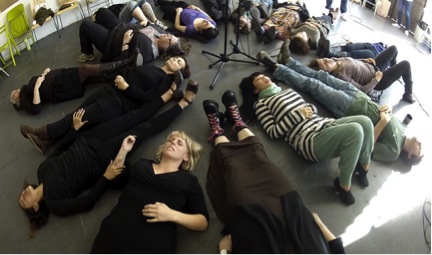
Members of People’s Microphony Camerata rehearsing in Los Angeles, April 15, 2012, Photo by Jean-Paul Leonard
The group’s trademark intensity sometimes carried over to the audience. Mann discovered such transference often had to do with prior associations with a location or context. Mann recalled a particular performance at the Occupy movement called “Chalkupy” that was formed in response to a protest running simultaneously with the LA Art Walk, in which activists had handed out chalk and told stories of police repression while chalk drawings were created on the walkways. The police shut down the art walk and a violent struggle ensued. The Occupy LA movement called for people globally to take to the street with chalk in protest, and the day was called “Chalkupy”. The audience of protestors was mixed and tense, and when the PMC began their performance of a highly emotive score called “Sob-Laugh” by Daniel Goode, people were either drawn to or repelled by the performance.
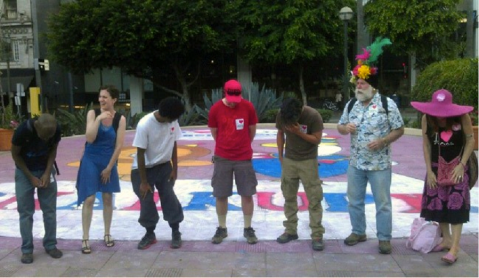
The PMC performing “Sob Laugh” at the “Chalkupy” protest in downtown Los Angeles, Image by Daniel Goode
I think there was some fear about the vulnerable revelation of emotions in the space of the protest. Many of the Occupy LA protests were so risky that everyone had to be extremely tough to exist in that activist space. I respect that. Still I think there are other things that can happen in a space of protest that bring out different feelings. Some activists wanted us to be more musically conventional, “why can’t you just sing some folk songs like normal protest choirs,” we were asked. But we really were not into that kind of thing. . .
In most protest situations, the audiences welcomed their activities. Many shared that it opened up a new space where people could meet each other as humans rather than adversaries or collaborators. Mann edited and published a monochromatic grassroots songbook with the various scores the PMC received for performance, opening up the circle for anyone and everyone to perform and feel that closeness.
Sometimes it was hard to translate a piece that worked during a group rehearsal to something for an audienceperformer situation. . .The PMC never fully developed how to deal with audience participation, but this is something I have been developing on my own in working with students on PMC materials. The scores from the People’s Microphony Songbook and the techniques Juliana and I developed when we first formed the PMC create an immediate closeness within a group, which is remarkable.

From the “People’s Microphony Songbook”: Many voices that were once silenced are now resonating through large crowds, not only of activists, but ordinary people all over the world, assisted by internet networks, and a simple technology called the People’s Microphone. The People’s Mic expressed the interrelated desires of collective and individual voices to speak and be heard, to hear one’s words spoken back through different mouths, and to digest someone else’s words through one’s own body. Beyond projecting an individual’s voice further then it can resonate on its own, the People’s Mic has implications for all of the bodies in its vicinity. It energizes listeners in ways the microphone or megaphone cannot by making listening active, vocal, and embodied. The project, like the Occupy movement, holds all the complexity, beauty, and drive of being human, whether you consider it “working” or not. When I asked Mann about how changes within and towards the Occupy Movement affected the choir, and whether they were winding down or taking a new form, she answered:
I think more than anything else, our group faced a lot of the same challenges that the Occupy Movement faced challenges in horizontality, in the push and pull between interior and exterior exploration, in the sometimes painful vulnerability of investigating the intimate personal and political space with others. I think the project is still developing. The choir still communicates, and some members are currently collaborating with composer Daniel Corral, but the PMC does not meet and rehearse like we used to I think it will continue to wax and wane. In the meantime, I am still working on ideas of active listening. I am currently creating a project called “Listening as (a) movement” within an under-served neighborhood in Pasadena, CA, exploring ideas of radical listening within a specific neighborhood.
In an age of constant bombardment of stimuli, our heads scream with thoughts, opinions, arguments, and expressions. With our current technology, our input and output can be a constant rush of snap reactions and impulses, which has a profound effect, of course, on our day-to-day lives, on our culture(s), on our politics. But these circles cannot be affectively complete without the other side. We need someone to hear us, and, more then that, we need someone to listen to us. And we, in turn, need to listen to them.
—
Maile Colbert is a multi-media artist with a concentration on sound and video who relocated from Los Angeles, US to Lisbon, Portugal. She is a regular writer for Sounding Out!
—
REWIND! . . .If you liked this post, you may also dig:
“Sensing Voice”–Nina Sun Eidsheim
“Within a Grain of Sand: Our Sonic Environment and Some of Its Shapers”–Maile Colbert
“Listening to #Occupy in the Classroom”–Travers Scott
Share this:


Current Top Posts





April 2021

January 2020

November 2019

October 2019

August 2019

April 2014

November 2017

March 2015

December 2017

October 2015
 Sounding Out!
Recent Comments