
(Re)Locating Soundscapes of Schooling: Learning to Listen to Children’s Lifeworlds

 Here at Sounding Out! we like to celebrate World Listening Day (July 18) with a blog series that focuses on the importance of listening. This year, we bring your attention to the role of listening when it comes to the sounds of the K-12 classroom, and by extension, the school.
Any day in a K-12 school involves movement and sounds day in and day out: the shuffling of desks, the conversations among classmates, the fire drill alarm, the pencils on paper, the picking up of trays of food. However, in many conversations about schools, teaching, and learning, sound is absent.
This month’s series will have readers thinking about the sounds in classrooms in different ways. They will consider race, class, and gender, and how those aspects intersect how we listen to the classrooms of our past and our present. More importantly, the posts will all inspire assignments that educators at all stages can use in their classrooms. Our first post came from Shakira Holt, a playlist of her black girl students’ songs as philogynoir. Our second post was penned by Caroline Pinkston, and in it she questions common classroom management strategies for quieting a classroom instead of listening to students. Today’s post comes from the point of view of a student, teacher, and now researcher, who reflects upon how we listen to the sounds (and students!) in our classrooms.
Time’s up, pencils down, let’s take our notebooks outside to the playground and listen along with Cassie J. Brownell. –Liana Silva, Managing Editor
—
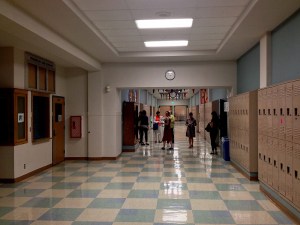
“Franklin High School, Seattle WA: Representative Hallway” by Flickr user Joe Wolf, CC BY-ND 2.0
I have spent much of my life listening in schools. I essentially grew up in the public elementary school in Montana where my mother taught for over 40 years. The sounds of my childhood are those of feet squeaking on the tile floor of the hallways, the bounce of a kickball in the gym, and the slam of desks opening and closing throughout the day.
Across my elementary school years, I spent many early mornings attempting to write my name in cursive with a squeaky dry erase marker on the whiteboard in her classroom. Other mornings, I rapidly clicked the keyboard as I played Oregon Trail alongside two friends whose guardians also worked at the school. After school, I chased these same friends across the schoolyard, shot hoops with them in the gym, or discovered new worlds in the stacks of the library. The whipping Montana winds on the open playground later gave way to new sonic experiences, as I transitioned from elementary student to classroom teacher and, eventually, educational researcher.

“School Supplies 02” by Flickr user Derek K. Miller, CC BY-NC 2.0
When I later became a teacher at an elementary school in post-Katrina New Orleans, Louisiana, the chorus of sounds from my childhood reverberated around me. The delightful shrieks of children on the playground and the sounds of trays being stacked after lunch were familiar. So, too, was the daily stacking of chairs. The frequencies of childhood, both my own and that of my students, informed my entrée into teaching. The familiar rhythms of pencil sharpeners and stapled butcher paper were welcoming waves as I settled into not only my new role, but my new school community in the neighborhood of Algiers Point. Yet, with the opening bells of the school year at this New Orleans elementary school, I began to hear schooling in new registers.
***
On my first day of teaching, I was acutely attuned to the “noise” the second-grade children in my classroom made—sounds I had not been aware of as a student. I quickly tried to “correct” their behavior with promises of external rewards if they could only make better “choices,” including quieting themselves to listen to me. Yet, few of the classroom management “tricks” I had learned in my educational training seemed to work. After the last child walked away from the schoolyard, I crumbled in the classroom of my mentor teacher. Crying, I told her I was not cut out for such work. She laughed as she told me that to be a teacher I must (re)learn to listen to the sounds of my classroom.
In time, I learned to listen. The day-to-day sounds of teacher-directed schooling, or what I now know as the banking model of education, quickly gave way to my listening to children. I slowly learned the value of listening to the whispers of children as they read, the scuffle of their feet as they sought a different color crayon from a child at another table, and the wise words they shared with one another about how they used an alternative route to solve a given math problem. I listened to them too when they found my hand to hold during recess and the high-fives before they departed each day. Rather than hearing their sounds as unruly chatter, I opened my ears to the excitement and learning children were sharing with one another.

“Reading%20Fun%20Day%202013%20Jun%2014,%202013%2010-20%20AM” by Flickr user K.W. Barrett, CC BY 2.0
That semester Hurricane Gustav appeared in the Gulf Coast. The impending arrival of the storm coincided with the three-year anniversary of Hurricane Katrina. As the whole city of New Orleans was encouraged to evacuate, I felt the resonances from Katrina’s devastating impact in the stories and questions of my second-grade students. As Gustav approached, many of the children shared In the final days before we evacuated, we commemorated Katrina and shared hopes for protection during Gustav.
While I listened to their words, I also learned to listen to their bodies. I could hear their worries about the storm in their hugs, the intonation of their voices, and in their reactions to thunderstorms shaking our classroom windows. As a bodily experience, multimodal listening quite literally moves beyond just what our ears can hear to how sound moves across/through/with bodies, materials, and contexts. Through multimodal listening, listeners can develop their skills as both critical consumers and producers of sound. Listeners are thus better positioned to reflect on and identify how sound informs other sensations and feelings. Although I have only recently put words to what it means to engage in multimodal listening, my body was already experienced with it.

“Gustav 038” by Flickr user Jim Hobbs, CC BY-NC 2.0
I returned to the city almost two weeks later, after the Gulf Coast suffered the one-two-punch of Hurricanes Gustav and Ike. Whispers of wind rustled art supplies by sneaking through fresh cracks in the windows. As my colleagues and I hurriedly re-vamped our classrooms, the traditional staccato sounds of schooling slowly echoed in my ears. In the quiet clean-up of the storm, new frequencies of the school soundscape could be heard. This soundscape was not new in and of itself, but rather it was the absence of the consistent beat that harmonized the everyday sounds to which I had become attuned. Without the slap of a jump rope on the ground or the cheers of children playing kickball to punctuate the silence, waves of emotion—despair, hope, and uncertainty—underlying the soundscape of schooling I thought I knew became apparent to me for the first time.
***
As an educational researcher in an urban, elementary classroom in the Midwest, I now find myself hearing other frequencies of schooling that remained unheard even in my early teaching. In my new role, my job is to engage in multimodal listening at all times as I participate in elementary classrooms. As a teacher in New Orleans, I was only just beginning to engage in the task of multimodal listening that Ceraso describes. Still today, I am often still attempting to hear and feel all the vibrations happening around me. Yet, as a researcher, I can attend more fully to the task of listening.
Unlike when I was teaching, I do not need to adhere to strict policies regarding the learning of a group of students, but I can instead take an exploratory approach to learning alongside children. Specifically, in collaboration with a culturally and linguistically diverse group of 3rd-grade children in Mr. Holiday’s classroom this past year, I started to earwitness the ambient soundscapes of children’s life spaces. Although I first began listening with the children at Community School J three years earlier, I entered in to Mr. Holiday’s class this year interested in considering the ways children were engaging with and drawing upon various cultural, linguistic, and modal experiences to communicate. I did so aware that, for many historically marginalized children, such communicative practices are often overlooked or unheard in standardized curricular materials.
Mr. Holiday challenged his students to think—and hear—beyond the standardized curriculum by considering how sound can be a tool to write with and through.
“You’re writing, but you can use words, pictures, you can sketch…anything you want to,” Mr. Holiday shared with his class of diverse 3rd graders one day. “Just remember to listen. When we come back inside, we will all share what we heard and then we will talk about how we could use this in our stories about our school.”
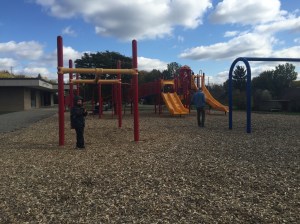
Photo courtesy of author
Outdoors, a low-flying plane could be heard. With little bodies quietly kicking them back-and-forth, swings creaked. On the playground, we listened to the whipping wind and felt the cool fall weather on our skin. From the slide, one child sounded out for his peers the word chilly, stretching the ls as long as he could. The mulch of the dry ground was kicked by one child as another, with her stomach on the seat of a swing, pushed the ground under her feet to glide back-and-forth.
Some children imagined the empty playground to be filled with the familiar sounds of their daily recesses. Others began to set strict boundaries for how they and their peers might begin to listen. In an attempt to control the bodies of her peers, one girl sent away her friend, suggesting that they could not hear together. Almost simultaneously, another child silently waved from the highest playground tower to the three boys from her class seated closely next to each other on a bench.
As Mr. Holiday called for all children to make a line outside his classroom door, a cacophony of cheers and groans lurched from the children as they sprinted from their observation sites.
“Look at how much I noticed!” one little boy shouted as he handed his notebook to me with a list of sounds. He included sounds heard in the moments we were outdoors like the airplane, but he also included imagined shrieks of children at play.
***
The sounds of elementary schooling have shown me that much of classroom teaching and learning needs to be grounded in listening. From the structured directions—like those presented by Mr. Holiday—to the daily screams of children racing across the school grounds. In other words, we must listen to children, to their experiences, and to their emotions in order to critically consider how schooling, as a space, informs and is informed by children’s bodies and sounds.

“Teachers” by Flickr user Jane Selomulyo, CC BY-NC-ND 2.0
I sometimes wonder what frequencies and rhythms are unheard. With each passing observation in a school, I question whether Western schooled notions of listening contaminate the uniquely trained ears of children. As I observed in the listening exercise with Mr. Holiday’s class, children were capable of engaging in multimodal listening: they not only heard, but felt the wind; they created and felt the vibrations of the swings. They imagined the movement of bodies across the playground and cacophony of sounds and emotions that accompanied them. All of these were embodied sounds I missed as an adult and classroom teacher.
At the same time, I remain hopeful. I am hopeful because the children I came to know in Mr. Holiday’s classroom took the task of listening seriously. They understood hearing as more than simply about the cars passing by or the birds in the nearby trees, but instead engaged in listening with their bodies. Throughout the year, I noticed they were acutely aware of the sniffles or the slow shuffle of feet of a peer who was having a rough day. Their eyes grew large as they danced along with their friends on brain breaks and they often cheered with the whir of a fidget spinner balanced on their teacher’s thumb.
This hope is also based in my various sonic experiences, across spaces and places that visually appear quite different. Teachers interested in learning to listen with their students might consider how they, like Mr. Holiday, might foreground sound as a mode of primacy within the perceived constraints of the mandated curriculum. Engaging in a multi-sensory experience may be as simple as Mr. Holiday’s listening task on the familiar grounds of the schoolyard. Or, perhaps, it is starting your curriculum with the children’s stories of their lived experiences as I did in New Orleans. As others have discussed, when it comes to listening, there is not a clearly defined beginning or end as there does not exist a “blink of an ear.” I am slowly becoming more attuned to the sonic possibilities of how children’s stories and experiences of schooling may be amplified if we, as Mr. Holiday shared, “Just remember to listen.”
—
Featured image: “listen” by Flickr user Ren:), CC BY-ND 2.0
—
Cassie J. Brownell is a doctoral candidate and Marianne Amarel Teaching and Teacher Education Fellow in the Department of Teacher Education at Michigan State University. A corecipient of a 2015 NCTE-CEE Research Initiative Grant, Cassie’s most recent collaborative project—#hearmyhome—explores how writing with and through sound might help students and teachers attune toward literacies and communities of difference.
—
 REWIND!…If you liked this post, you may also dig:
SO! Amplifies: #hearmyhome and the Soundscapes of the Everyday–Cassie J. Brownell and Jon M. Wargo
(Sound)Walking Through Smithfield Square in Dublin— Linda O’Keeffe
A Listening Mind: Sound Learning in a Literature Classroom–Nicole Furlonge
Share this:

“To Unprotect and Subserve”: King Britt Samples the Sonic Archive of Police Violence
Author’s note: In line with the ethics of listening considered below, I’ve chosen not to embed the videos of police violence that I discuss. But I’ve linked to them when available for readers who’d like to see/hear their content.–Alex Werth
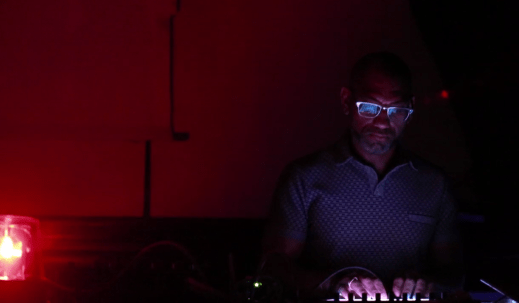
“I’m scared to death of these police.” Dave Chappelle’s voice—pitched down, but nonetheless recognizable—calls from the speakers, cutting through the darkness of Oakland, CA’s Starline Social Club. It’s closing night of the 2016 Matatu Festival of Stories, an annual celebration of Black diasporic narratives, technologies, and futures routed through the San Francisco Bay Area. King Britt—an eclectic electronic pioneer and producer, and former DJ for Digable Planets—has landed with the third version of “To Unprotect and Subserve: A Sonic Response.” (It was first performed after a march for Mike Brown in Ferguson in 2014.) I can barely see Britt, his solemn look bathed in the dim glow of electronic consoles and the red-and-blue pulse of police lights. “First money I got,” Chappelle continues, “I went out and bought me a police scanner. I just listen to these mothafuckas before I go out, just to make sure everything’s cool. ‘Cause you hear shit on there: ‘Calling all cars, calling all cars. Be on the lookout for a Black male between 4’7” and 6’8”.’” With this double invocation, Britt invites us to listen. Specifically, à la Chappelle, he invites us to listen back—to attune to the agents of a racialized security state that, from ShotSpotter to CIA surveillance, profile and police the world’s sonic landscapes.
This essay considers the ethical effects/affects in King Britt’s work of sampling what I call the sonic archive of police violence. From Oakland to Ferguson, the Movement for Black Lives has raised critical questions about the mass surveillance of Black and Brown communities, the undemocratic control of data in cases of police misconduct, and the use of smart phones and other recording devices as means to hold the state accountable. But the failure to indict or even discipline cops in police killings where audio/video evidence was not only available but overwhelming, from Eric Garner to Tamir Rice, casts doubt upon the emancipatory power of simply recording our race-based system of criminal (in)justice. And when re-presented ad nauseum on the news and social media, these recordings can retraumatize those most vulnerable to racist state violence. Indeed, at a discussion among Black artists at Matatu, each panelist admitted to limiting their exposure to what poet Amir Sulaiman called “e-lynching.”
What, then, can we learn from Britt about the praxis and politics of listening back when the circulation of what KRS One dubbed the “sound of da police” is now daily, digital, and ubiquitous? How can we make sense of audio recording when it’s come to signal repression, resistance, and painful reprisal all at the same time?
Back in the darkness of the club, Chappelle’s voice dissolves into a conversation between Darrin Wilson and a dispatcher from the Ferguson Police, who sends him to find the body of Mike Brown—a “Black male in a white t-shirt,” reportedly “running toward QuikTrip” with a stolen box of Swishers. The optimistic waves of sound that open the piece resolve into a throbbing pulse of 1/32nd notes that sounds like a helicopter. Britt begins to loop in other elements: a low bass tone, a syncopated stab. With kicks and reverb-heavy snares, he builds a slow, head-nodding beat (60 bpm) that coalesces around the vocal sample—swaddling, softening, and ultimately subsuming it with high-pitched legato tones. The synths are sorrowful. But the mesmerizing beat embraces listeners in their mourning.
This act of listening to the state differs from the one parodied at the start. Chappelle attends to the police scanner as a form of precaution, checking whether it’s safe for him to enter a realm where he can be marked as criminal (“Staying in the crib tonight! Fuck that!” he concludes). But Britt’s sonic bricolage is more therapeutic than protective. He uses repetition, reverb, and improvised melody to score a sonic altar—to open space, rather than control time—where we can meditate on the archive of police violence with the intention to heal. “Sometimes to push through the trauma we need to experience it in a different context,” he tells me over email. “There is room for healing within the chords and sounds that are carefully curated.” Britt thus reactivates the pathos buried inside this archive—reclaiming what Susan Sontag, in “On Photography,” recognizes as an “ethical content” of representational form that can fade from careless repetition (21).
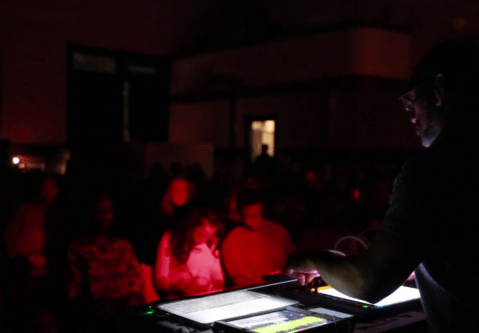
Picture of King Britt courtesy of Eli Jacobs-Fantauzzi for the Matatu Festival of Stories.
After removing the loops one-by-one, until the helicopter sound is all that remains, Britt releases a new sample into the mix. It’s audio from a cell-phone video taken in 2013 by two Black men as they’re harassed by White cops during a stop-and-frisk in Philadelphia (Britt’s hometown). He scores the somber scene with dissonant organs and an offbeat percussive note that reminds me of stress-induced arrhythmia—a heartbeat out-of-place, aggravated, precarious . Vibrating with anxiety, the soundscape temporarily snatches listeners from mourning, demanding that we listen in witness, instead.
The video reveals that the police tear the two men apart, pinning them to the cruiser. But the violence of the encounter is verbal as much as physical. The cops’ language and tone become increasingly abusive as the men contest their treatment in a sounding of agency that Regina Bradley, writing about Black women, calls “sonic disrespectability.” Philip Nace, the more audible of the officers, embodies a double bind built into what Jennifer Lynn Stoever calls the “sonic color line.” He threatens one of the men when he speaks out (“You’re gonna be in violation if you keep running your mouth when I split your wig open.”). But he turns around and ridicules him when, instead, the man refuses to speak (“You don’t know what we know…Right? Right?! What, you don’t hear now?”). As Stoever notes, the demand that African Americans speak when spoken to, but in a way that sounds their submission to Whites, is a feature of anti-Black oppression stemming from the “racial etiquette” of slavery (30-32).
Britt’s manipulation of vocals speaks to the centrality of sampling in hip-hop. According to Tricia Rose, hip-hop artists have long prioritized the sample as a way to recognize and renovate a communal repertoire of songs and sounds (79). And given the realities of anti-Black oppression in the U.S., this repertoire has often entailed the “sound(s) of da police.” From sirens to skits to verses, rappers and producers have remixed the sounds of the state to characterize, caricature, and critique the country’s criminal justice system. But Britt’s trespass on the state’s sonic sovereignty differs from classics like “Fuck tha Police,” in which N.W.A. conducts a mock trial of “the system.” Whereas N.W.A. reappropriates the rituals of legal testimony and judgment to condemn the police (“The jury has found you guilty of being a redneck, white-bread, chicken-shit mothafucka.”), Britt’s musical re-mediation of police violence favors grief over moralizing, dirge over indictment.
In this vein, the musical/ethical demand to witness waxes but then wanes. The soundscape becomes more and more dissonant until the vocals are consumed by a thunderous sound. Suddenly, the storm clears. Britt hits a pre-loaded drum track (136 bpm) with driving double-time congas and chimes over a steady sway of half-time kicks. He starts to improvise on the synth in an angelic register, revealing the impact of his early encounters with Sun Ra on his aesthetic. The catharsis of the scene is accentuated by the sporadic sound of exhalation. This sense of freedom dissolves when the beat runs out of gas…or is pulled over. In its stead, Britt introduces audio from the dashboard camera of Brian Encinia, the Texas State Trooper who arrested Sandra Bland. Encinia and Bland’s voices are pitched down and filtered through an echo delay, lending an intense sense of dread to his enraged orders (“Get out of the car! I will light you up!”).
Here, I sense the affective resonance of dub. Like the musicians on rotation in Michael Veal’s Dub, Britt manipulates the timbre and texture of voices in a way that demands a different sort of attention from listeners who, like me, may be desensitized to the sonic violence of the racialized security state as it’s vocalized and circulated in and between Ferguson, Philly, and Prairie View. Britt reworks the character and context of the vocals into a looping soundscape, and that soundscape sends me into a meditative space—one in which the vibes of humiliation and malice “speak” to me more than Encinia’s individual utterances as an agent of the state. According to Veal, the pioneers of dub developed a sound that, while reverberating with the severity of the Jamaican postcolony, “transport[ed] their listeners to dancefloor nirvana” and “the far reaches of the cultural and political imagination” (13). Now, conducting our Matatu, Britt is both an engineer and a medicine man. Rather than simply diagnose the state of anti-Black police violence in the American (post)colony, he summons a space where we can reconnect with the voices (and lives) lost to the archives of police violence amid what Veal refers to as dub’s Afro-sonic repertoire of “reverb, remembrance, and reverie” (198).
What Sontag once wrote about war photography no doubt holds for viral videos (and the less-recognized soundscapes that animate them). Namely, when used carelessly or even for gain, the documentary-style reproduction of the sonic archive of police violence can work to inure or even injure listeners. But in Britt’s care-full bricolage, sampling serves to literally re-mediate the violence of racialized policing and its reverberations throughout our everyday landscapes of listening. It’s not the fact of repetition, then, but the modality, that matters. And Britt draws upon deep traditions of scoring, hip-hop, and dub to sonically construct what he calls a “space to breathe.”
—
Featured image of King Britt’s performance courtesy of Eli Jacobs-Fantauzzi for the Matatu Festival of Stories.
—
Alex Werth is a doctoral candidate in the Department of Geography at UC Berkeley. His research looks at the routine regulation of expressive culture, especially music and dance, within the apparatuses of public nuisance and safety as a driver of cultural foreclosure in Oakland, CA. It also considers how some of those same cultural practices enable forms of coordination and collectivity that run counter to the notions of “the public” written into law, plan, and property. In 2016, he was a member of the curatorial cohort for the Matatu Festival of Stories and is currently a Public Imagination Fellow at Yerba Buena Center for the Arts in San Francisco. He lives in Oakland, where he dances samba and DJs as Wild Man.
—
REWIND!…If you liked this post, you may also dig:
Music to Grieve and Music to Celebrate: A Dirge for Muñoz— Johannes Brandis
Singing The Resistance: January 2017’s Anti-Trump Music Videos–Holger Schulze
Black Mourning, Black Movement(s): Savion Glover’s Dance for Amiri Baraka –Kristin Moriah
Share this:


Current Top Posts





April 2021

January 2020

November 2019

October 2019

August 2019

April 2014

November 2017

March 2015

December 2017

October 2015
 Sounding Out!
Recent Comments