
Pretty, Fast, and Loud: The Audible Ali

 Aaaaaaaaaaaaand NOW. . .in SO!‘s corner. . .writing for this month’s “Sound and Sport,” we have the scholar. . .the poet . . .the “Wordsmith of the Web” Taaaaaaaaaara Betts! In today’s post, she shares how listening influences her creative process AND knocks us out with an analysis of the importance of Muhammad Ali’s voice to his sports career and historical legacy. For an instant replay of last month’s post, click Melissa Helquist‘s “Goalball: Sport, Silence, and Spectatorship.” Next month’s rematch will feature Josh Ottum‘s research on sound and skateparks. But now, let’s get ready to ruuuuuuuummmbbble! —J. Stoever-Ackerman, Editor-in-Chief
Plap of glove against glove
Shush of scuffle and slide.
Rebuildin’, repeatin’, rebuildin’
All this repeatin’, getting’ up again & again
Discipline, routine and I keep
doing new things to prepare
my mind, my body, so my pretty
mouth keeps up with all my rhymes.
–Tara Betts, from “Repeatin’” (scene 8, The GREATEST!)
The recent Peggy Choy Dance Company production of “The GREATEST!: A Hip Dance Homage to Muhammad Ali” in April 2013 gave me cause to rethink the key events in Muhammad Ali’s life, particularly his burgeoning political awareness in the 1960s. As I wrote the libretto for the performance—which combined athletic dance performance with images, poems, and quotes from Ali—I kept thinking about how Ali had one of the most recognized, quoted, and distinct voices ever heard in the boxing world.
 In the libretto, I tried to capture the nuances of black vernacular and the southern hallmark of Ali’s hometown, Louisville, Kentucky (he was sometimes referred to as the “Louisville Lip”), vocal sounds that signify an African American experience. Is there a southern drawl? A bass-filled bravado? There are certain words that sound fuller and cut short based on the vernacular that was spoken during the time period of Cassius Clay and well into his evolution as Muhammad Ali. While many of the materials that I visited for inspiration and historical context were books, to capture the look, feel, and speech of the 1960s and 1970s, I had to crate-dig for some vinyl.
A copy of a 1963 spoken word album I Am The Greatest!: Cassius Clay and the 1997 documentary film When We Were Kings served as two such sources. Both recordings represent an audible Ali, at once a man whose iconic voice sounded as familiar to me as people who I’ve known personally and a historical figure whose vocal grain content embodied his shifts in political consciousness. The difference between Clay’s 1964 recording and the samples woven into the When We Were Kings soundtrack is more than the changes that gradually developed over time. These recordings reveal how Ali’s confidence is constructed around creating an affirming, critical identity, rather than merely promoting his athletic prowess. At first, he merely sounds cocky; later he sounds as if he is fighting for a group of people that he wants to inform, serve, celebrate, protect, and uphold. My libretto was deeply impacted both by the sonic continuities in Ali’s voice across time and space, as well as its audible shifts.
The champ ain’t nobody but me!
Pretty, fast & loud, I’ll shake the world,
with a lion’s might.
My children will lift
their fists and fight
–Tara Betts, from “‘By Any Means necessary: If they met in Harlem’’” (transition from scene 14, The GREATEST!)
Before Cassius Clay joined the Nation of Islam and changed his name to Muhammad Ali, he recorded a spoken word album on the Sony label in 1963. I Am The Greatest! was released in 1964 before Clay’s two key fights with Sonny Liston and Ali’s eventual victory for the heavyweight crown. The album included original liner notes from modernist poet Marianne Moore and New York Post sports journalist Milton Gross, but it was telling that comedy writer Gary Belkin and Cassius Clay were the co-authors of the spoken word material—which is more comedy than poetry or interviews. Belkin was a comedy writer for well-known comedians such as Carol Burnett and Sid Caesar, and the comedy show Car 54, Where Are You? So, Belkin was clearly accustomed to writing sketch comedy, but Clay was used to being humorous outside of a recording studio with a staged audience.

Overall, Clay’s delivery seems to be slower–both less fluid and more staged– than his impromptu recitations at boxing-related events outside the recording studio. Clay seems to anticipate that sound effects such as roaring crowds and clanging bells will be inserted into the tracks, so he over-enunciates and pauses. Each track begins with a bell ringing as if boxing round is about to begin, and there are eight “rounds,” probably because Clay insisted that any fight with Liston would be shorter than eight rounds. As I listened, I wondered if Ali was comfortable recording this album or if he considered it simply another way to promote and market one of the world’s best known boxers? To my ear, it lacked some of the speed and ease I associate with Clay’s speech in other settings. In the boxing world, his speeches mentally challenged his opponents and entertained crowds. The recording studio left less room for spontaneity, fluidity, and even the visual interplay of sound with his quick motion.

Cassius Clay in the studio recording I Am the Greatest! with Sam Cooke, Image from newblackman.blogspot, courtesy of Michael Ochs Archives/Getty Images
The eight rounds/comedic sketches lean heavily on Ali’s signature boisterous braggadocio in his loud, deliberate voice, using canned laughter and other voices setting up Clay to talk about his excellence. Otherwise, they are a grab bag of influences and sound effects. These other voices and sounds create an artificial environment that is not the same as being surrounded by boxers, trainers, and others in the athletic arena. In fact, these sounds and the sources sound quite different from Clay himself. “Round 1: I Am The Greatest” and “Round 2: I Am The Double Greatest” are accompanied by violins that sound more like a serenade than a classical composition. In “Round 4: ‘I Have Written A Drama,’ He Said Playfully,” a lute plays in the beginning that hints at a spoof of a Shakespearean-style drama about defeating dragons complete with affected British accents, including one actor speaking with the theatrical lisp. The knight “Cassius of Clay” enters with the audible clanking of armor.
Clay reveals a shift in tone when he sings on the last two tracks. He begins with “Stand By Me”–a cover of Ben E. King’s classic song/then recent hit–with fervor. In the last song, “The Gang’s All Here,” Clay follows some of the words of Tin Pan Alley lyricist Theodora Morse set to Sullivan’s tune from Pirates of Penzance.
Clay tries to pick up the energy lost by his less-than-enthusiastic singing. “Is Memphis with me? Is Louisville with me? Is Houston with me. Ain’t I purty?” Each question is answered with a crowd enthusiastically shouting a “Yeah!” Here Ali relies on his enthusiastic, improvised rhymes, departing from the song’s traditional lyrics to include himself in a song that does not come from an African American writer or the Black experience.
The same country that refuses to let people eat
or use the bathroom in the same places
wants ME to go and get killed?
What does THAT sound like?
—-Tara Betts, from “The Same Country” (scene 15, The GREATEST!)
Almost 35 years later, there are clear sonic differences between Cassius Clay’s debut on Sony and the soundtrack to When We Were Kings, the 1997 documentary of the 1974 heavyweight championship between George Foreman and Muhammad Ali. This retrospective record is decidedly more centered on black experiences and black voices that speak musically, politically, and spiritually, particularly about the Black presence in Islam. There are no comedic monologues, sketches or Greek choruses; it sonically represents Ali after his conversion to orthodox Islam, after his friendship with and separation from Malcolm X, and after his opposition to Vietnam. Every spoken part on this album affirms the multiplicities of a Black presence in blues, R&B, and songs recorded live on the African continent; the huffs and rhymes are cheered for by a live African audience. As I listened to When We Were Kings, I could hear Ali’s comfort and his freedom of movement, audibly in contrast with his other album.

When We Were Kings records his time in Kinshasa, Zaire where he trains and eventually fights George Foreman. It does not simply focus on Ali’s voice, but is sonically rich with music, interviews with people who witnessed that fight and those who knew Ali personally; the soundtrack reflects these interconnections in its continuous uninterrupted flow. The role of these sounds endeavors to document what was heard in Zaire in 1974, but it also includes Ali in the surrounding sonic environment as one person who becomes a focal point for the musicians and speakers who also articulate black identity on the record.
The first thing I heard was Ali’s voice:
I’m gonna fight for the prestige, not for me, but to uplift my little brothers who are sleeping on concrete floors today in America, black people who are living on welfare, black people who can’t eat, black people who don’t know no knowledge of themselves, black people who don’t have no future. I want win my title and walk down the alleys and sit on the garbage cans with the wineheads…
This opening sample of Ali sets the soundtrack’s tone, and kicks off the only hip hop song on the album, a sonic shift that signals a new generation/genre in black music in 1997, more than 30 years after Ali’s spoken word album as Cassius Clay. Ali’s quote also informs listeners that the emphasis of this album has little do with comedy, especially since the soundtrack draws from nonfiction, rather than setting Clay/Ali in fictionalized sketches. The focus is on black people and their struggles.
In the first song, emcees look back and tell the story of “The Rumble in the Jungle” but the verses also hail Ali as a hero. When The Fugees, A Tribe Called Quest, and Busta Rhymes rap over a fairly standard bassline, their presence on this soundtrack is an important signal of Ali’s influence and the recurring engagement between artists and Ali during his athletic heyday such as James Brown. In Jeff Chang’s Can’t Stop, Won’t Stop (2005), Afrika Bambaataa points out repeatedly how Brown became a consistent presence in hip hop when New York radio stations simply refused to play his music, particularly in the 1970s. After decades of infusing a variety of soul singers and Brown’s stylistic turns on “the one” and messages of black pride into the genre of hip hop, the presence of “The Rumble in the Jungle” on this soundtrack completely makes sense. As more than a wellspring for samples throughout the large, growing body of hip hop music, Brown was also embodying and representing black consciousness in music with a Black voice, much in the same way that Ali utilized Black speech. In some ways, Ali’s couplets predate rap lyrics and perform in a similar manner; Bambaattaa cites him as an influence, along with Malcolm X.
James Brown and many others flow seamlessly into the event and its soundtrack in a way that reflects the immediacy and proximity of these events. The “Black Woodstock” of the Zaire 1974 music festival that accompanied Ali and Foreman’s fight set the tone and soundtrack in real life, not just in the documentary. In fact, the festival itself was documented in the 2008 release Soul Power directed by Jeff Levy-Hinte. At this point, it’s clear that there is a continuum for hearing the connections between black voices across oceans and continents.
Following “Rumble in the Jungle,” the record samples Ali and Drew “Bundini” Brown (Ali’s assistant trainer and cornerman), snippets taken directly from the documentary footage. Brown is a slower, more deliberate speaker; he uses rhyme like Ali. He talks about the fruit returning to the root and Ali claiming his crown back home. For African Americans to return to Africa post-slavery, this trip and clip sonically reinforce the cultural significance of Ali’s trip. Such pilgrimages fortify the idea that black people have a homeland, a continent, and a cultural continuum, much in the same way that this soundtrack constructs.
“Ali, Bombaye!” in a sea of faces just like mine,
my brothers, my parents, my cousins.
I want to go home and tell the people
in the streets this is what we come from,
what we could be.
—-Tara Betts, from “The Hard Road to Zaire’” (scene 21, The GREATEST!)
When African girls chant to celebrate Ali’s arrival, they reassert how this is a homecoming for Ali, a welcome and a reconnection that fuels Ali’s determination. The chants seem to encourage the first sample of Ali when he issues his threat: “When I get to Africa we gon’ get it on cause we don’t get along. I’m gonna eat him up…” This sample segues into James Brown’s “The Payback” as it was performed before the fight, then another chant performed by Mobütu, named after Zaire’s controversial leader, Mobutu Sese Seko.
When Ali concludes the soundtrack, he interrupts chants of “Ali, Bombaye!” with huffs and a brief exhortation of knocking you out, “sucker.” These last words fade into a snippet of African chant. This constructs a very different narrative that looks back at Ali’s career, long after the younger Clay established part of his image with hyperbolic bravado. Ali has cultivated a Pan African, global, political awareness that includes black people in America from his hometown in Louisville, KY to across the globe.
Hearing Clay and Ali–their continuities and their differences–gave me an insight into the familiar voices of some of my older relatives (and their blues records), and it also helped me channel that voice in poems of my own. It allowed me to imagine how hyperbole helped encourage Ali to energize and cheer himself on, so much that others began rooting for him as well. It did not matter what arena he was in, Ali would use his voice, his fists, and his will to conquer it. As I wrote the libretto, I thought about how I might unearth that determination in a way that respectfully embodied his tone, cadence, vocabulary, and ebullience. One of the definitions of greatness relates to the defeat of time and distance, and in the words that I wrote about Ali, I found that listening to him, and hearing his significance grew over time, helped him transcend both.
Every mile, every turn of the rope brings
me closer to telling him he’s nothing.
I hate every minute of training,
but I say
Don’t quit.
Suffer now
and live your life
as a champion.
I am a myth, and a man,
of my own making.
–Tara Betts, from “The Hard Road to Zaire” (scene 21, The GREATEST!)
—
Tara Betts is the author of the poetry collection Arc and Hue, a Ph.D. candidate at Binghamton University, and a Cave Canem fellow. Tara’s poetry also appeared in Essence, Bum Rush the Page, Saul Williams’ CHORUS: A Literary Mixtape, VILLANELLES, both Spoken Word Revolution anthologies, and A Face to Meet the Faces: An Anthology of Contemporary Persona Poetry. Her research interests include African American literature, poetry, creative writing pedagogy, and most recently sound studies. In the 1990s, she co-founded and co-hosted WLUW 88.7FM’s “The Hip Hop Project” at Loyola University while writing for underground hip hop magazines, Black Radio Exclusive, The Source, and XXL. She is co-editor of Bop, Strut, and Dance, an anthology of Bop poems with Afaa M. Weaver. In April 2013, she published the libretto “THE GREATEST!: An Homage to Muhammad Ali” (Winged City Press) written for the live performance directed by Peggy Choy.
—
 REWIND! . . .If you liked this post, you may also dig:
They Do Not All Sound Alike: Sampling Kathleen Cleaver, Assata Shakur, and Angela Davis–Tara Betts
SO! LA: Sounding the California Story–Bridget Hoida
Freedom Back: Sounding Black Feminist History, Courtesy the Artists—Tavia Nyong’o
Share this:

Goalball: Sport, Silence, and Spectatorship
Editor’s Note: Today, SO! kicks off our summer series on “Sound and Sport,” an interrogation of the roles that sound and listening play in the interconnected aspects of many sports: athletic skill, spectatorial experience, laws of physics challenged and exploited, and politics expressed and created. Often, the true play in sports involves power–and sound is a key venue to help us understand its flows and snags, and parse out the actual winners and losers. And, perhaps more directly than other venues, sports is a heightened arena that helps us understand just how important sound is in our everyday lives, even if (and especially because) we take it for granted.
One of my favorite personal “sports metaphors” for sounds’ unacknowledged centrality involves the precise 3.5 seconds I snowboarded with an iPod before I hit an ice patch full speed and had one of the worst falls I have suffered in my 15+ years of the sport. While I was laying on the hard packed snow gasping for breath and trying to piece together what happened, I realized exactly how much I depended on my listening to provide me with crucial, even-life saving, information. With my ears overwhelmed with treble-y punk, I had charged straight into an icepatch that I would have deftly avoided as soon as I heard the inevitable and unmistakeable scratching sound signalling its location. That kinesthetic lesson has continued to inform my everyday, every day since it happened and has led me to ever deeper understandings about sound’s power and the various forms of power that it clarifies–and are clarified by it in turn. I hope that this series will do the same for you, but without the blood and the bruises, even as some of our writers will remind you about the complex and dubious relationship sports can draw between “pain” and “gain.”
Batting first up on our line-up is Melissa Helquist, who describes how the Paralympic sport Goalball challenges the norms of the spectator/athlete relationship. Look for a post on Muhammad Ali in June (Tara Betts), skateboarding in July (Josh Ottum) and an all-out Olympic extravaganza in August, including a podcast discussing the sonic transformations of Brazil’s favelas in anticipation of the world’s ears in 2016 (Andrea Medrado). This summer, it is Sounding Out! FTW. –-J. Stoever-Ackerman, Editor-in-Chief
—
it’s oh so quiet
it’s oh so still
you’re all alone
and so peaceful until
you ring the bell
bim bam
you shout and yell
hi ho ho
you broke the spell
–Bjork, “It’s Oh So Quiet”
During the London 2012 Olympics, the Copper Box venue, which hosted handball, was dubbed “the box that rocks.” The moniker was also, perhaps, a way to drum up interest in handball, a still obscure sport. And indeed, raucous spectators and the pulse and bounce of balls and shoes created a sonic spectacle.
.
When the Paralympics began a few weeks later, much was made of the transformation of “the box that rocks” into “the box that rocks you to sleep.” The game that supposedly will rock you to sleep is Goalball.
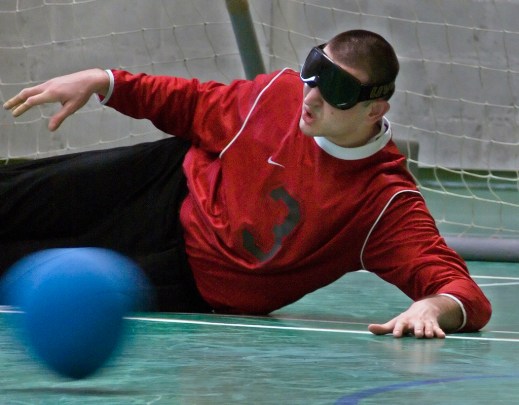
Goalball is a 3-a-side game, played in two 12-minute halves. The offensive team rockets the ball down the court (it must be rolling by mid-court), trying to gain the low and wide net on the other side. As the ball rolls toward the net, the defending players lie on their sides in front of the net, blocking the ball with their bodies. As the ball is pummeled back and forth across the court, it jingles—a simple, clear bell emanating from eight holes in the ball’s surface. In this sport, sound is quite literally a game changer.
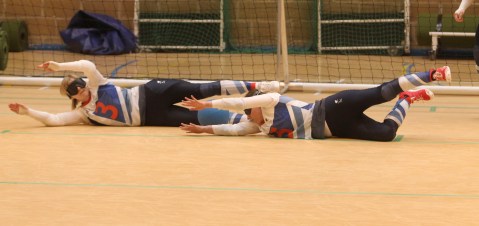
Goalball team practice at the ParalympicsGB Training Camp, Image by Flickr User The Department for Culture, Media and Sport
All goalball players are blind or low vison and wear blackout eyeshades to equalize the playing field and to ensure that any residual vision doesn’t get in the way of the gameplay’s sound. A pre-game equipment check includes referees ensuring that eyeshades don’t let in any light. Penalties include touching one’s eyeshades or making noises that disrupt the other team’s ability to hear the movement of the ball.
Goalball, a game first invented as a way to rehabilitate soldiers blinded in WWII, has been a Paralympic sport since 1976. It is one of the few sports designed specifically for blind athletes, rather than adapted from an existing sport. It is a game of sound and touch, a contrast to the visual perception typically associated with team-based ball games. The game, like many others in the Paralympics, expands the sensory experience of sport. The court’s borders are demarcated with tape-covered twine. Sonically, players orient themselves by calling out the position of the on-coming ball, rapping knuckles on the floor, and of course the jingle of the ball.
“Goalball” Courtesy of Perkins School for the Blind Archives
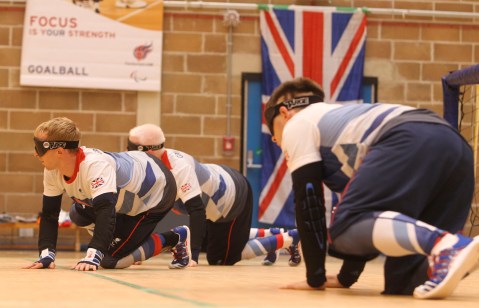
Image by Flickr User The Department for Culture, Media and Sport
The game is high impact; at the Paralympic level, the ball is thrown at speeds up to 60mph. Players launch the ball with high-velocity spins, something like a cross between a discus throw and bowling. Defenders block the ball with their entire bodies—hands, feet, torso. The game is intense, but it is also quiet.
The players’ reliance on sound demands new expectations of the audience. As spectators, we are watchers, but we are also noisemakers—shouters, shriekers, trashtalkers. Goalball spectators can (and do) cheer when a goal is scored, but when gameplay begins, silence is the rule. Before gameplay begins, referees demand, “Quiet Please!”
The Copper Box “was quite specifically designed to achieve a low background noise level so the blind athletes could play” (Soundscape, Issue 3, 38), enabling the venue to be transformed into an atypical space for the sound of sport and spectatorship, a place to challenge our assumptions and expectations.
Goalball? A description? from Daphnee Denis on Vimeo.
Goalball spectatorship doesn’t demand pure silence, but it is not the unfettered cacophony that we often expect in sports spectatorship. At the London 2012 Paralympics, Bjork’s “It’s So Quiet” was played during breaks in gameplay to remind spectators of their obligation. The song’s ebb and flow of silence and exuberance captures the sonic rhythm of Goalball, its pulsing cadence of silent attention and energetic eruption.
.
The nickname, “the box that rocks you to sleep” captures the discomfort spectators may have with Goalball’s soundscape. The silence during play is tense, but the scoring of a goal offers a sudden release. Spectators do not create a persistent cacophony, but rather a pulse, a constant pattern of lull and explosion. The silence of Goalball can feel disconcerting for spectators unfamiliar with the game. The sound of the crowd—the cheers, the clapping, the screams, the groans, the chants–often seem fundamental to the experience of sport.
Silent spectatorship, of course, is an expectation for other sporting events such as golf and tennis. Here, the demand for silence is linked ostensibly to concentration, but also invokes questions of tradition, class, and (in the case of tennis) gender. These sports are individualized demonstrations of skill, and we are admirers, observers.
Team sports invite identification from the crowd. We extend ourselves, making ourselves part of the team, often through sonic exuberance. Speaking about the crowd sounds of the London Olympics, Mike Goldsmith, author of Discord, notes:
Individual athletes commented that the crowd sound was a great source of energy to then, but could also distract. Their comments suggested that some of them used the crowd sound as a resource, that they could tap into or not as the moment demanded (Soundscape, Issue 3, 36).
Sound can feel like participation. Through sound, we make ourselves part of the game, cheering to support our team, hollering to distract a shot. Sound can make sport feel communal, and thus silence can feel like separation, a wall between spectator and team.
But the seeming silence of Goalball spectatorship offers an opportunity to pay attention to the sound of play, sounds that often get subsumed by the roar of the crowd. The meeting of disability and sport offers a “prime space to reread and rewrite culture’s makings” (Tanya Titchkosky, Reading and Writing Disability Differently, 2007), a space to hear sport differently. The culture of sport is rife with ableist assumptions about how we move, how we watch, how we play. Even when sound is part of sport, it is often an afterthought, an addition—sound might be distracting, it may affect play, but the center sensory preoccupation of sport is frequently visual. We watch, we spectate, we keep our eye on the ball. Sport is sight, but it is also sound. Spectatorship is raucous, but it is also silent.
zing boom shhhh.
—
Featured Image, “Goal Ball” by Flickr User BLac
—
Melissa Helquist is an Associate Professor of English at Salt Lake Community College and a PhD Candidate in Technical Communication and Rhetoric at Texas Tech University. Her dissertation research focuses on digital literacy and blindness and explores the use of sound to read, write, and interpret images. She is a 2012-13 HASTAC scholar and the recipient of a 2012-2013 CCCC Research Initiative Grant. She lives in Salt Lake City, where she hikes, camps, and canoes with her husband and daughter.
—
REWIND! . . .If you liked this post, you may also dig:
Eye Candy: The Absence of the Female Voice in Sports Talk Radio–Liana Silva
The Plasticity of Listening: Deafness and Sound Studies–Steph Ceraso
Taking Me Out of the Ball Game: Advertising’s Acoustic Pitch–Osvaldo Oyola
Share this:


Current Top Posts





April 2021

January 2020

November 2019

October 2019

August 2019

April 2014

November 2017

March 2015

December 2017

October 2015
 Sounding Out!
Recent Comments