
Echo and the Chorus of Female Machines
 Editor’s Note: February may be over, but our forum is still on! Today I bring you installment #5 of Sounding Out!‘s blog forum on gender and voice. Last week Art Blake talked about how his experience shifting his voice from feminine to masculine as a transgender man intersects with his work on John Cage. Before that, Regina Bradley put the soundtrack of Scandal in conversation with race and gender. The week before I talked about what it meant to have people call me, a woman of color, “loud.” That post was preceded by Christine Ehrick‘s selections from her forthcoming book, on the gendered soundscape. We have one more left! Robin James will round out our forum with an analysis of how ideas of what women should sound like have roots in Greek philosophy.
This week Canadian artist and writer AO Roberts takes us into the arena of speech synthesis and makes us wonder about what it means that the voices are so often female. So, lean in, close your eyes, and don’t be afraid of the robots’ voices. –Liana M. Silva, Managing Editor
—
I used Apple’s SIRI for the first time on an iPhone 4S. After hundreds of miles in a van full of people on a cross-country tour, all of the music had been played and the comedy mp3s entirely depleted. So, like so many first time SIRI users, we killed time by asking questions that went from the obscure to the absurd. Passive, awaiting command, prone to glitches: there was something both comedic and insidious about SIRI as female-gendered program, something that seemed to bind up the technology with stereotypical ideas of femininity.

“Maria the Maschinenmensch” by Flickr user Timothy Rose, CC BY-NC-SA 2.0
Speech synthesis is the artificial simulation of the human voice through hardware or software, and SIRI is but one incarnation of the historical chorus of machines speaking what we code to be female. Starting from the early 20th century Voder, to the Cold-War era Silvia and Audrey, up to Amazon’s newly released Echo, researchers have by and large developed these applications as female personae. Each program articulates an individual timbre and character, soothing soft spoken or matter of fact; this is your mother, sister, or lover, here to affirm your interests while reminding you about that missed birthday. She is easy to call up in memory, tones rounded at the edges, like Scarlett Johansson’s smoky conviviality as Samantha in Spike Jonze’s Her, a bodiless purr. Simulated speech articulates a series of assumptions about what neutral articulation is, what a female voice is, and whose voice technology can ventriloquize.
The ways computers hear and speak the human voice are as complex as they are rapidly expanding. But in robotics gender is charted down to actual wavelength, actively policed around 100-150 HZ (male) and 200-250 HZ (female). Now prevalent in entertainment, navigation, law enforcement, surveillance, security, and communications, speech synthesis and recognition hold up an acoustic mirror to the dominant cultures from which they materialize. While they might provide useful tools for everything from time management to self-improvement, they also reinforce cisheteronormative definitions of personhood. Like the binary code that now gives it form, the development of speech recognition separated the entire spectrum of vocal expression into rigid biologically based categories. Ideas of a real voice vs. fake voice, in all their resonances with passing or failing one’s gender performance, have through this process been designed into the technology itself.
A SERIES OF MISERABLE GRUNTS

“Kempelen Speakingmachine” by Fabian Brackhane (Quintatoen), Saarbrücken – Own work. Licensed under Public Domain via Wikimedia Commons –
The first voice to be synthesized was a reed and bellows box invented by Wolfgang Von Kempelen in 1791 and shown off in the courts of the Hapsburg Empire. Von Kempelen had gained renown for his chess-playing Turk, a racist cartoon of an automaton that made waves amongst the nobles until it was revealed that underneath the tabletop was a small man secretly moving the chess player’s limbs. Von Kempelen’s second work, the speaking machine, wowed its audiences thoroughly. The player wheedled and squeezed the contraption, pushing air through its reed larynx to replicate simple words like mama and papa.
Synthesizing the voice has always required some level of making strange, of phonemic abstraction. Bell Laboratories originally developed The Voder, the earliest incarnation of the vocoder, as a cryptographic device for WWII military communications. The machine split the human voice into a spectral representation, fragmenting the source into number of different frequencies that were then recombined into synthetic speech. Noise and unintelligibility shielded the Allies’ phone calls from Nazi interception. The Vocoder’s developer, Ralph Miller, bemoaned the atrocities the machine performed on language, reducing it to a “series of miserable grunts.”
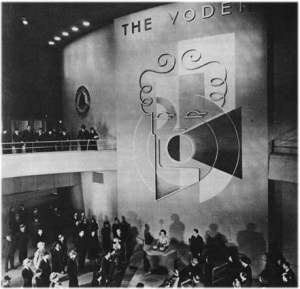
From website Binary Heap-
In his history of the The Vocoder, How to Wreck a Nice Beach, Dave Tompkins tells how the apparatus originally took up an entire wall and was played solely by female phone operators, but the pitch of the female voice was said to be too high to be heard by the nascent technology. In fact, when it debuted at the 1939 World’s Fair, only men were chosen to experience the roboticization of their voice. The Voder was, in fact, originally created to only hear pitches in the range of 100-150 HZ, a designed exclusion from the start. So when the Signal Corps of the Army convinced President Eisenhower to call his wife via Voder from North Africa, Miller and the developers panicked for fear she wouldn’t be heard. Entering the Pentagon late at night, Mamie Eisenhower spoke into the telephone and a fragmented version of her words travelled across the Atlantic. Resurfacing in angular vocoded form, her voice urged her husband to come home, and he had no problem hearing her. Instead of giving the developers pause to question their own definitions of gender, this interaction is told as a derisive footnote of in the history of the sound and technology: the punchline being that the first lady’s voice was heard because it was as low as a man’s.
WAKE WORDS
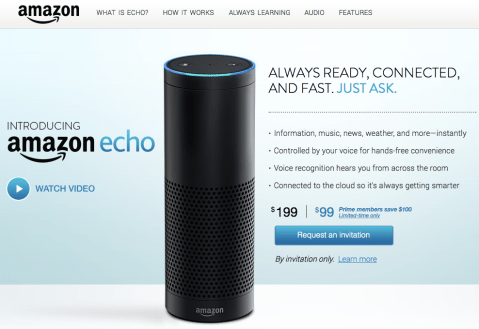
Screen shot of Amazon’s page for Echo
In fall 2014 Amazon launched Echo, their new personal assistant device. Echo is a 12-inch long plain black cone that stands upright on a tabletop, similar in appearance to a telephoto camera lens. Equipped with far field mics, Echo has a female voice, connected to the cloud and always on standby. Users engage Echo with their own chosen ‘wake’ word. The linguistic similarity to a BDSM safe word could have been lost on developers. Although here inverted, the word is used to engage rather than halt action, awakening an instrument that lays dormant awaiting command.
Amazon’s much-parodied promotional video for Echo is narrated by the innocent voice of the youngest daughter in a happy, straight, white, middle-class family. While the son pitches Oedipal jabs at the father for his dubious role as patriarchal translator of technology, each member of the family soon discovers the ways Echo is useful to them. They name it Alexa and move from questions like: “Alexa how many teaspoons in a tablespoon” and “How tall is Mt. Everest?” to commands for dance mixes and cute jokes. Echo enacts a hybrid role as mother, surrogate companion, and nanny of sorts not through any real aspects of labor but through the intangible contribution of information. As a female-voiced oracle in the early pantheon of the Internet of Things, Echo’s use value is squarely placed in the realm of cisheteronormative domestic knowledge production. Gone are the tongue-in-cheek existential questions proffered to SIRI upon its release. The future with Echo is clean, wholesome, and absolutely SFW. But what does it mean for Echo to be accepted into the home, as a female gendered speaking subject?
Concerns over privacy and surveillance quickly followed Echo’s release, alarms mostly sounding over its “always on” function. Amazon banks on the safety and intimacy we culturally associate with the female voice to ease the transition of robots and AI into the home. If the promotional video painted an accurate picture of Echo’s usage, it would appear that Amazon had successfully launched Echo as a bodiless voice over the uncanny valley, the chasm below littered with broken phalanxes of female machines. Masahiro Mori coined the now familiar term uncanny valley in 1970 to describe the dip in empathic response to humanoid robots as they approach realism.
If we listen to the litany of reactions to robot voices through the filters of gender and sexuality it reveals the stark inclines of what we might think of as a queer uncanny valley. Paulina Palmer wrote in The Queer Uncanny about reoccurring tropes in queer film and literature, expanding upon what Freud saw as a prototypical aspect of the uncanny: the doubling and interchanging of the self. In the queer uncanny we see another kind of rift: that between signifier and signified embodied by trans people, the tearing apart of gender from its biological basis. The non-linear algebra of difference posed by queer and trans bodies is akin to the blurring of divisions between human and machine represented by the cyborg. This is the coupling of transphobic and automatonophobic anxieties, defined always in relation to the responses and preoccupations of a white, able bodied, cisgendered male norm. This is the queer uncanny valley. For the synthesized voice to function here, it must ease the chasm, like Echo: sutured by a voice coded as neutral, but premised upon the imagined body of a white, heterosexual, educated middle class woman.
22% Female
 My own voice spans a range that would have dismayed someone like Ralph Miller. I sang tenor in Junior High choir until I was found out for straying, and then warned to stay properly in the realms of alto, but preferably soprano range. Around the same time I saw a late night feature of Audrey Hepburn in My Fair Lady, struggling to lose her crass proletariat inflection. So I, a working class gender ambivalent kid, walked around with books on my head muttering The Rain In Spain Falls Mainly on the Plain for weeks after. I’m generally loud, opinionated and people remember me for my laugh. I have sung in doom metal and grindcore punk bands, using both screeching highs and the growling “cookie monster” vocal technique mostly employed by cismales.
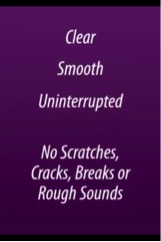 Given my own history of toying with and estrangement from what my voice is supposed to sound like, I was interested to try out a new app on the market, the Exceptional Voice App (EVA ), touted as “The World’s First and Only Transgender Voice Training App.” Functioning as a speech recognition program, EVA analyzes the pitch, respiration, and character of your voice with the stated goal of providing training to sound more like one’s authentic self. Behind EVA is Kathe Perez, a speech pathologist and businesswoman, the developer and provider of code to the circuit. And behind the code is the promise of giving proper form to rough sounds, pitch-perfect prosody, safety, acceptance, and wholeness. Informational and training videos are integrated with tonal mimicry for phrases like hee, haa, and ooh. User progress is rated and logged with options to share goals reached on Twitter and Facebook. Customers can buy EVA for Gals or EVA for Guys. I purchased the app online for my iPhone for $5.97.
My initial EVA training scores informed me I was 22% female; a recurring number I receive in interfaces with identity recognition software. Facial recognition programs consistently rate my face at 22% female. If I smile I tend to get a higher female response than my neutral face, coded and read as male. Technology is caught up in these translations of gender: we socialize women to smile more than men, then write code for machines to recognize a woman in a face that smiles.
As for EVA’s usage, it seems to be a helpful pedagogical tool with more people sharing their positive results and reviews on trans forums every day. With violence against trans people persisting—even increasing—at alarming rates, experienced worst by trans women of color, the way one’s voice is heard and perceived is a real issue of safety. Programs like EVA can be employed to increase ease of mobility throughout the world. However, EVA is also out of reach to many, a classed capitalist venture that tautologically defines and creates users with supply. The context for EVA is the systems of legal, medical, and scientific categories inherited from Foucault’s era of discipline; the predetermined hallucination of normal sexuality, the invention of biological criteria to define the sexes and the pathologization of those outside each box, controlled by systems of biopower.
Despite all these tools we’ll never really know how we sound. It is true that the resonant chamber of our own skull provides us with a different acoustic image of our own voice. We hate to hear our voice recorded because suddenly we catch a sonic glimpse of what other people hear: sharper more angular tones, higher pitch, less warmth. Speech recognition and synthesis work upon the same logic, the shifting away from interiority; a just off the mark approximation. So the question remains what would a gender variant voice synthesis and recognition sound like? How much is reliant upon the technology and how much depends upon individual listeners, their culture, and what they project upon the voice? As markets grow, so too have more internationally accented English dialects been added to computer programs with voice synthesis. Thai, Indian, Arabic and Eastern European English were added to Mac OSX Lion in 2011. Can we hope to soon offer our voices to the industry not as a set of data to be mined into caricatures, but as a way to assist in the opening up in gender definitions? We would be better served to resist the urge to chime in and listen to the field in the same way we suddenly hear our recorded voice played back, with a focus on the sour notes of cold translation.
—
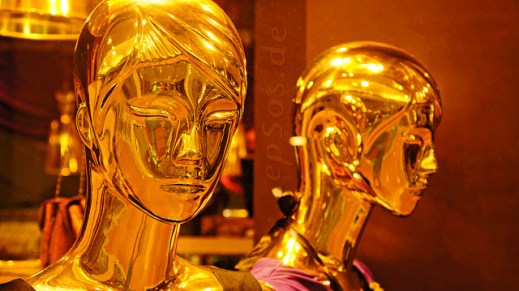
Featured image: “Golden People love Gold Jewelry Robots” by Flickr user epSos.de, CC BY 2.0
—
AO Roberts is a Canadian intermedia artist and writer based in Oakland whose work explores gender, technology and embodiment through sound, installation and print. A founding member of Winnipeg’s NGTVSPC feminist artist collective, they have shown their work at galleries and festivals internationally. They have also destroyed their vocal chords, played bass and made terrible sounds in a long line of noise projects and grindcore bands, including VOR, Hoover Death, Kursk and Wolbachia. They hold a BFA from the University of Manitoba and a MFA in Sculpture from California College of the Arts.
—
 REWIND!…If you liked this post, you may also dig:
Hearing Queerly: NBC’s “The Voice”—Karen Tongson
On Sound and Pleasure: Meditations on the Human Voice—Yvon Bonefant
I Been On: BaddieBey and Beyoncé’s Sonic Masculinity—Regina Bradley
Share this:

As Loud As I Want To Be: Gender, Loudness, and Respectability Politics

Editor’s Note: Here’s installment #2 of Sounding Out!‘s blog forum on gender and voice! Last week we hosted Christine Ehrick‘s selections from her forthcoming book; she introduced us to the idea of the gendered soundscape, which she uses in her analysis on women’s radio speech from the 1930s to the 1950s. In the next few weeks we’ll have SO regular writer Regina Bradley, with a look at how music is gendered in Shonda Rhimes’ hit show Scandal, A.O. Roberts with synthesized voices and gender, Art Blake with his reflections on how his experience shifting his voice from feminine to masculine as a transgender man intersects with his work on John Cage, and lastly Robin James with an analysis of how ideas of what women should sound like have roots in Greek philosophy.
As I planned for SO!’s February forum, I wondered about my own connection to the topic: how is the loudness of a voice gendered? Does it matter who we call “loud”? As a Latina, I’m familiar with the stereotypes of the loud Latina, and as a Puerto Rican I faced them at every gathering. So for this week I decided to reflect upon my experiences in a personal essay. Lean in, close your eyes, and don’t let the voices startle you.–Liana M. Silva, Managing Editor
—
I was 22 years old when someone called me deaf. I was finishing my bachelor’s degree at the University of Puerto Rico, Rio Piedras campus. After four years of living in San Juan, I still hadn’t gotten used to the class and race microaggressions I encountered regularly because I was a brown girl who grew up in the country and was going to school in the urban capital, el área metropolitana. These microaggressions were usually assumptions about who I was based on how I talked: I called pots a certain way, I referred to nickels in another way, and I couldn’t keep my voice down–all indications, according to my “urban” friends, that I grew up in the country. But being called “deaf” was a new one.
My boyfriend at the time had no cellphone, and his mother would call me regularly to see if he was on his way home from a gig or to ask him to run an errand. She and I were not close, but we were cordial. I always felt we didn’t click on some level. This particular weekend day, she had called to ask if he had left San Juan already to come visit her, and I told her I had just seen him that morning before he left. Somehow she and I went from small talk into a conversation.
In my head, I thought I was making headway with her and that this was a huge step forward in our relationship. We talked about his gig the night before, about how my family was doing, things like that. Then she asked me if my family had a medical history of people losing their hearing. “No? I don’t think so. Why do you ask?” I said in Spanish.
“Because you talk so loud, and so do your father and your sister. Your mom isn’t loud.”
That was over 10 years ago, but the comment still stings. I am certain that wasn’t the only time someone called me “loud” or pointed out the tone of my voice, but it’s the one time that still rings in my ears when I think about the intersection of gender and sound. It wasn’t just that I spoke at a high volume, it was that I was a woman who spoke at a high volume. I was the girlfriend who was loud.
Of course we’re not born loud- or soft-speakers – we learn to use the volume level that prevails in our culture, and then turn it up or lower it depending on our subculture and peer group.
-Anne Karpf, The Human Voice
What does “loud” mean, anyway? Denotations fade into connotations. As I write this, I struggle to think of how to describe loud in a way that doesn’t feel negative. Because every time I think of “loud” its negative connotations float up to the surface. Just take this Merriam-Webster online dictionary entry for “loud.” Aside from the reference to volume, “loud” also means sounds that are offensive, obtrusive—annoying.
To be fair, I’ve always been self-conscious of my voice, and not in the way most people hate the sound of their voice. I always felt my voice was not girly enough. I always felt as a teenager and a young adult not “pretty” enough, not thin enough, not “feminine” enough, so my insecurities also extended to my voice.
Growing up, I heard people tell me time and time again to keep my voice down, that I was talking too loud, that people next door could hear me, et cetera. Grandparents, cousins, parents, friends: I got it from every corner. Shush. But I don’t recall anybody saying that about the boys/men I hung out with. Add to that the comments I got about my appearance: “you’re too fat,” “your hair is too frizzy,” ‘you’re ugly.” I associated being loud with being unattractive. Just another flaw.
It’s no coincidence then that describing a woman as loud is almost never said as a compliment. Although a man can be loud—he might even be expected to have a deep, booming, commanding voice, as the above video describes—when a woman is described as loud, it’s almost never in a good light. Karpf mentions in The Human Voice: The Story of a Remarkable Talent that “Loudness certainly seems to be judged differently depending on the sex of the speaker. Talking loudly is considered an act of aggression in women, but in men as no more than they’re entitled to.” In other words, society deems men to be allowed to be loud, and by extension loudness comes off as a masculine feature. So loudness, something that at its base means high volume, ends up being constructed as more than just decibels. Women who are “loud” become noisy, rude, unapologetic, unbridled.
Mija pero que duro tu hablas.
In Puerto Rico, the word for “loud” was alto (high) but also duro (hard). I knew early on that when someone told me that I spoke duro they didn’t mean it in a kind way. The voice was described as hard, harsh, shards of glass. It hurt to be called loud. It hurt to be called hard. Especially when you understand that society accepts only certain ways of being a woman: soft, delicate, fragile, dainty. It was never meant as a compliment to have someone call your voice “hard.”
If I was listening to my mother and my aunts or cousins speaking, and then chimed in, I would get the “shhhh” or if they wanted to be discreet they would make a gesture with their hands to indicate to me that I should bring my voice down. I learned early on that a lower voice was more appealing than the loud voice hiding in my vocal box.

I am Puerto Rican, and even though I was born in New York City, I was raised in a small town on the western side of Puerto Rico. I was already well-aware of stereotypes and digs about my being born in New York, even at a young age. My cousins would tell me I was stuck up, I thought I was better than other people because I had cable, I only listened to music in English (I guess that was a bad thing to them). When I moved to San Juan, I was no longer a displaced Nuyorican but a country bumpkin. Peers, friends, and new acquaintances would not classify me as a Nuyorican but, because I was living in San Juan at the time, would categorize me as an islander, de la isla, which basically meant I was not from el “area metro.” I was, in short, a country bumpkin to them.
The loudness of my voice was not just a marker of where I came from (the country, with all of the classicism that the phrase entails) but for me became conflated with gender. I knew that even when I wasn’t living in the city, I had been called loud. It’s just that when my peers asked me to lower my voice or to not speak so “duro” it was also because they thought of me as jíbara, country.
Sometimes I would get carried away when I was telling a joke among my female roommates, or I’d be excited to share some news, and eventually someone would tell me to tone it down. Baja la voz. As I reflect upon my college years living with roommates in a crowded apartment in a crowded city, I remember that we often got together and laughed, talked over each other, shouted across the apartment. But I would get carried away and then someone would say something about it. Mira que nos van a mandar a callar. Someone’s gonna tell us to shut up.
It was in college, however, that I learned to modulate my voice. I am physically capable of whispering, but when I spoke in English in a classroom setting (I was an English major in a school whose language of instruction was Spanish) I felt even louder in English. So I made the effort to tone down my voice, literally. I equated English with career, and by extension with my professional persona.
Ultimately, English would be the language I spoke (and still speak) in academic circles; with the language came also the tone and the volume. Men in my classes seemed more often to initiate conversations in my classes, and sometimes even in the ones where they were a minority. Meanwhile, the driven graduate student that I was, I wanted to step in but not stand out because of my voice. I didn’t want to give them (or the professor for that matter) a chance to discount me because I was a loud Puerto Rican woman at an American school. Eventually I learned how to switch back and forth. So did my fellow female classmates.
I remember as a teacher modulating my voice so I would be less loud and less abrasive in a college classroom. I wanted to assert my authority. If some women resort to vocal fry in order to be taken seriously, as this 2014 article in The Atlantic (online) suggests, I resorted to modulating my voice. That was my way of passing: passing for creative elite, passing for feminine, passing for authoritative. I tried to assert my credibility as a burgeoning scholar and professor by tweaking my voice. I laughed a little softer, I spoke a little slower, I sounded a little lower. I teetered between trying to sound feminine and trying to downplay my femininity through my voice.
Was I trying to sound more like the stereotype of a woman so I could be more credible in the classroom? Was this my own version of respectability politics? “Don’t be so loud and they’ll listen to you”?
“White supremacy grants white people the ability to be understood as expressing a dynamic range; whites can legitimately shout because we hear them/ourselves as mainly normalized. At the same time, white supremacy paints black people as always-already too loud.”
-Robin James, “Some philosophical implications of the “loudness war” and its criticisms”
The negative rhetoric about women and loudness is also connected to respectability politics. Take for example the stereotype of the angry black woman (which is in the vicinity of the loud Latina). If women must be delicate and feminine, being loud would be unattractive, unseemly. Loud also means “not being silent,” in other words, speaking when not spoken to. Robin James touches upon “loudness” in contemporary music, and how the turn toward less loud tracks also has to do with racialized ideas about who can speak and who can be loud–in other words, what counts as noise and what counts as harmonious sound. She cites Goldie Taylor’s piece in The Daily Beast about how, regardless of how angry she felt about the racial injustices in the United States, she would never be able to scream and shout without consequences. Loudness is something racialized people cannot afford.
The stereotype of the angry woman points to how the notion of who is loud and what tone of voice is considered loud are constructed. Although there are studies that point out that the sound of one’s voice indicates to others that one is in a position of authority or that one’s voice can make or break one’s career, there is yet to be a study that shows how the biology of the body that produces the voice affects what one can or cannot do. In other words, the connection between voice and our abilities, or our social class, is constructed—in our heads.
Assertive, aggressive, leader: these descriptions benefit men, for the most part. Aggressiveness is seen as a masculine trait, and along with that a loud tone of voice is also seen as masculine. (This idea is also problematic, for it sets anything that isn’t aggressive and assertive as female, and therefore negative.) The opposite applies to women; the same way our society associates fragile delicate things with femininity, a fragile, soft, low tone of voice is the acceptable range for a woman. And James and Taylor’s comments point to how race also changes the equation. Damned if we speak, damned if we don’t.
***
Over the years, I’ve become more comfortable with the way I sound. I’ve also become more comfortable switching between my aural codes, like I do with English, Spanish, and Spanglish. I know that there’s a volume that I use in certain spaces. I also know that in other spaces I don’t have to watch over how loud I am. If I am in a familiar space, with people I am close to, I feel less inclined to watch myself. I feel safe, not judged. I can be as loud as I want to be. But loudness is also an accepted way of speaking around my family. If I spoke in a low tone, I’d probably be picked on for that. My father, for one, has a booming, deep, loud voice, and so do many of my family members.
For me, embracing my voice is also a kind of body acceptance. My body, plus-sized and all, takes up space. My voice takes up space too. As a teenager and an adult I was constantly shamed for the way I look (skin too brown, voice too loud, face too painted, hair too short), and for a time tweaking my voice became a way to try to fit in. But I later learned how to respond to the remarks. I learned to be sarcastic. I learned to make jokes. I learned to talk back. I didn’t find my voice; I embraced my voice.
Dear readers, let us know in the comments: have you been chastised for being loud? Or for not speaking loudly enough?
—
Featured image: property of the author.
—
Liana M. Silva is co-founder and Managing Editor of Sounding Out!.
—
 REWIND! . . .If you liked this post, you may also dig:
I Been On: BaddieBey and Beyoncé’s Sonic Masculinity–Regina Bradley
Learning to Listen Beyond Our Ears: Reflecting Upon World Listening Day—Owen Marshall
An Ear-splitting Cry: Gender, Performance, and Representations of Zaghareet in the U.S.–Meghan Drury
Share this:


Current Top Posts





April 2021

January 2020

November 2019

October 2019

August 2019

April 2014

November 2017

March 2015

December 2017

October 2015
 Sounding Out!
Recent Comments