
Sounding Out! Podcast #21: Jonathan Skinner at the Rutgers University Center for Cultural Analysis

DOI: https://doi.org/10.59350/6g9g5-93c70
CLICK HERE TO DOWNLOAD: Jonathan Skinner at the Rutgers University Center for Cultural Analysis
SUBSCRIBE TO THE SERIES VIA ITUNES
ADD OUR PODCASTS TO YOUR STITCHER FAVORITES PLAYLIST
This week’s podcast is a companion piece to our prior podcast Animal Transcriptions, Listening to the Lab of Ornithology. In this series of excerpts from Skinner’s three hour seminar at the Rutgers University Center for Cultural Analysis, Skinner discusses the importance of sound studies scholarship to his work. Ecopoetics, soundscapes, animal communication, and the post-human are all discussed in this lively roundtable! Listen in as Skinner explains the practice of sound poetry, and the importance of Sound Studies to his methodology.
Special thanks to The Center of Cultural Analysis and its wonderful fellows and attendees for lending such insightful discussion to this work. As explained on their site: “The Center for Cultural Analysis [is] Rutgers University’s hub for interdisciplinary research in the humanities and humanistically-oriented social sciences. Each year we run a biweekly seminar that draws faculty, advanced graduate students, post-doctoral researchers and various affiliated scholars into a sustained conversation on a topic of importance. In 2012-13 our seminar topic is “Formalisms.” What do we talk about when we talk about form, particularly across disciplines? Is form simply a residue or remainder after everything else, from motive to content, is taken away or accounted for? Or is it rather the ultimate and most important outcome?”
–
Jonathan Skinner founded and edits the journal ecopoetics, which features creative-critical intersections between writing and ecology. Skinner also writes ecocriticism on contemporary poetry and poetics: he has published essays on Charles Olson, Ronald Johnson, Lorine Niedecker, Mei-mei Berssenbrugge, Bernadette Mayer, Cecilia Vicuña, translations of French poetry and garden theory, essays on bird song from the perspective of ethnopoetics, and essays on horizontal concepts such as the Third Landscape and on Documentary Poetry. Currently, he is writing a book of investigative poems on the urban landscapes of Frederick Law Olmsted, and a book on Animal Transcriptions in contemporary poetry. He teaches poetry and poetics in the Department of English and Comparative Literature at the University of Warwick.
—

REWIND! . . .If you liked this post, you may also dig:
Peter DiCola at River Read Books— Peter DiCola
Animal Renderings: The Library of Natural Sounds— Jonathan Skinner
Animal Transcriptions, Listening to the Lab of Ornithology— Jonathan Skinner
—
Share this:

Sounding Out! Podcast Mini-Series (#18): Listening to The Tuned City of Brussels, Day 3: “Ephemeral Atmospheres”




DOI: https://doi.org/10.59350/zp0vd-0b916
CLICK HERE TO DOWNLOAD: Listening to The Tuned City of Brussels, Day 2: “Ephemeral Atmospheres”
SUBSCRIBE TO THE SERIES VIA ITUNES
ADD OUR PODCASTS TO YOUR STITCHER FAVORITES PLAYLIST

We conclude our podcast series which explores the Tuned City Brussels festival on World Listening Day. As World Listening Day seeks to draw attention to environmental awareness and acoustic ecology, today’s podcast focuses on these issues as it deals with the precarity of of Haren’s somewhat pastoral space, as it is threatened by a variety of institutional interests. So please grab your headphones and celebrate World Listening day this year with Sounding Out! as we turn our attention back to the Tuned City Brussels festival.
–
In this series of podcasts, Felicity Ford (Great Britain) and Valeria Merlini (Italy) explore the sonorities of the city during the Tuned City Brussels festival. Please click here for our podcast detailing the first night, here for our podcast exploring Day 1, “Noise,” or here for our podcast which focuses on Day 2, “Situational Listening.”
On the final day, Sunday, June 29th, the festival focused on the ephemeral resonances and atmospheres that either catch our attention or pass unnoticed within the city. An attention to diverse notions of ambiance is the starting point for the festival’s concluding day in Haren, which is situated at the north-eastern edge of the Brussels Capital Region. Despite the presence of a nearby airport and high-speed train link, Haren still maintains a tranquil atmosphere, reminiscent of the chicory farming village it once was. Today, however, this calm is nestled between abandoned industrial buildings and large scale construction sites for an expansive prison and the new NATO headquarters.
The first Tuned City project was realised in Berlin in 2008, with subsequent editions in Tallinn and Nürnberg. For the current edition Q-O2 workspace for experimental music and sound art has invited Tuned City to collaboratively research the sounds of Brussels. Brussels is a dense multi-layered city characterised by abrupt shifts in urban structure, architecture and the social environment. This patchwork provides an urban modality that resists a general grasp of the city while still providing room for individual expression. The abundance these juxtapositions during the festival creates a productive resonance where the city is manifest to the passerby in its vibrant, open-ended, multiplicity. How does one grasp the nature of these oscillations and what modes of resonance give shape to the particular Brussels vibe? Over the course of the four day festival, Tuned City Brussels probes these urban frequencies through concerts, walks, installations and interventions, while at the same time focusing the theoretical framework around three core notions: ‘Relational Noise’ (Day 1), ‘Situational Listening’ (Day 2), and ‘Ephemeral Ambience’ (Day 3). A different theme will be explored each day in a corresponding ‘zone’ in the city, in which the festival relocates. Several lectures, artistic presentations, residencies and workshops have led up to this four day festival. Particularly important was a collaboration with the art schools Sint Lucas Architectuur, Erasmus Hogeschool RITS/Radio, Sint Lukas Transmedia, a.pass and La Cambre (ENSAV) option Espace Urbain.
If you would like to learn more about the Tuned City Brussels Festival, please check out their program here.
–
Felicity Ford (Great Britain) works across a wide variety of platforms in order to engage the public with new modes of listening. She celebrates everyday life by linking the sounds of material culture, documentary sound-recording processes and listening to their larger social contexts. Since completing her PhD in 2011 she has completed commissions on Sonic Wallpapers for the Museum of Domestic Design and Architecture, a film soundtrack for the Welcome Library and the British Film Institute for a 1930s antenatal care film entitled “Bathing & Dressing,” Parts 1 & 2, and a knitted sound system with accompanying composition. She co-runs the website Sound Diaries with Valeria Merlini.
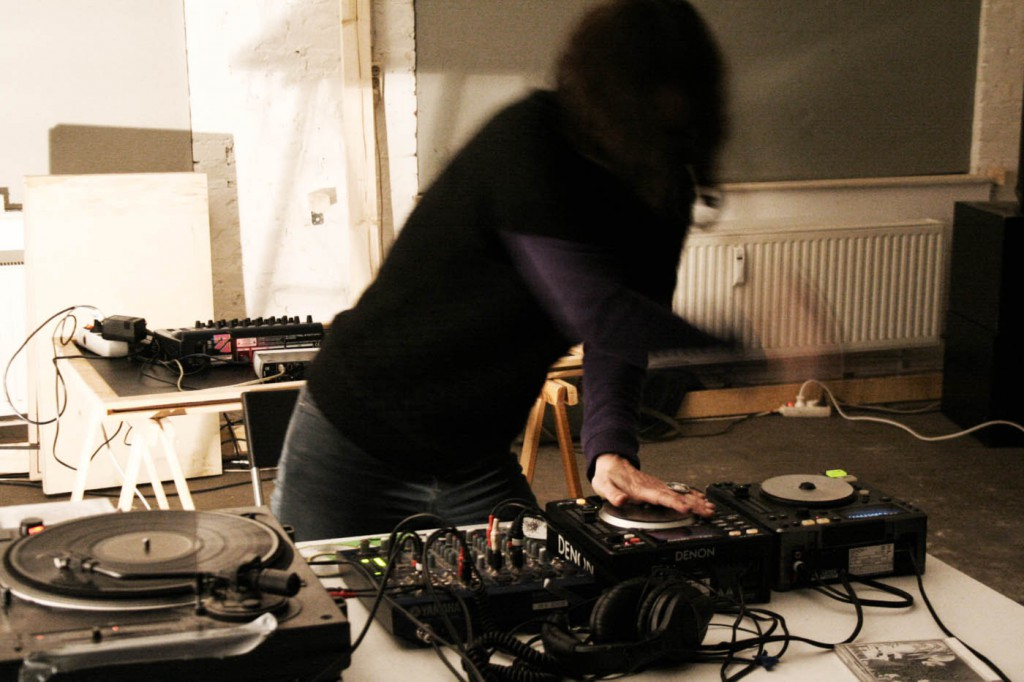
Valeria Merlini (Italy) is a Berlin based sound artist, turntablist, DJ and curator. After studying architecture in Florence, Italy, she obtained a Master’s degree in Sound Studies at The Berlin University of the Arts. Her work explores everyday sounds within an urban context through an interdisciplinary and critical approach. She is a co-founder of Studio Urban Resonance, a member of the Italian record label Burp Enterprise and co-runs Staalplaat Radio. As a DJ she focuses on experimental electronic music, constantly extending the conventions of turntablism, musique concrète, free improvisation and composed music. She was the director of the 2012 Museruole Festival and has participated in numerous international events and exhibitions.
—
Share this:




Current Top Posts





April 2021

January 2020

November 2019

October 2019

August 2019

April 2014

November 2017

March 2015

December 2017

October 2015


Recent Comments