
One Nation Under a Groove?: Music, Sonic Borders, and the Politics of Vibration

Welcome to week three of our February Forum on “Sonic Borders,” a collaboration with the IASPM-US blog in connection with this year’s IASPM-US conference on Liminality and Borderlands, held in Austin, Texas from February 28 to March 3, 2013. The “Sonic Borders” forum is a Virtual Roundtable cross-blog entity that will feature six Sounding Out! writers posting on Mondays through February 25, and four writers from IASPM-US, posting on Wednesdays starting February 6th and ending February 27th. For an encore of weeks one and two of the forum, click here. And now, get up and get ready for Marcus Boon, because there’s no parking on the dance floor at Sounding Out!–JS
—
DOI: https://doi.org/10.59350/ahkcg-50055
What borders remain when it comes to thinking about sound today? The field of sound studies has exploded in so many far-flung directions in the last few years. However, I argue that what is still somewhat off limits in the field is a consideration of the ontological status of sound: in other words, what it means to understand our own being in the world as a sonic phenomenon. Out of attempts to approach this sonic ontology, comes the realization that there are prohibitions, perhaps universal ones, on thinking about sound in this way, and from that emerges what I call the politics of vibration.
For those, such as myself, who have grown up as a part of sonic subcultures, it is not difficult to ponder sonic ontologies, for the simple reason that many of the most intense and powerful experiences we have had have occurred on dance floors or at clubs, as DJs, musicians, clubbers and/or listeners. I still remember the moment of first hearing Funkadelic’s “One Nation Under a Groove” blasting through the speakers at a Pop Group gig at the Electric Ballroom in London in the late 1970s: tumbling polyrhythms, polyphony, polysexuality, polyeverything. The feeling was: “wow, the universe contains this! And it contains other people who know what it is!” And contrary to the warnings of Slavoj Zizek concerning the “autistic jouissance” to be found at the limits of language, here we all were: high; the histories of Afrodiasporic displacement and solidarity echoing off the walls; our own implication in those histories illuminated; flickering between utopia and shame.
To quote Eric Satie: “When I was young they told me: You’ll see when you’re fifty. I’m fifty. I’ve seen nothing.” Me too. But I’ve heard a lot and I still experience that same power of sound in more or less the same way. If anything, sound’s power is more intense and surprising, each time it appears. Partly because I have learned how to be a social being through sound—how to love and be loved—enabling me to be more open to its impact than I was as an awkward youth. It makes me sad the way in Canada and elsewhere in el Norte people seem to lessen their involvement in the more intense aspects of sound cultures as they hit 30 or 40. It makes me sad that my four-year-old son rarely gets to hear a real sound system. I look for music at carnivals, weddings, community centers, on the beach. . .anywhere that those age barriers are ignored. Even as a DJ, I increasingly look for new or different kinds of publicness than that of club or dancehall.
Still, I do wonder. Was the movement into sonic subcultures that my generation (and those that followed) made–especially in the UK where music (and intoxicants, and immigration) were one of the few escape routes from the brutalities of Thatcherism–a mistake, precisely because we accepted as ontological, a structure that in fact was smoothly integrated into the operations of late capitalism? From the Factory and Paradise Garage to Berghain or Ministry of Sound. . . how will history look on the era of the mega-club?
Although one could argue that the Internet put an end to the idea of subculture, since it breaks down the locality and secrecy around which particular subcultural communities grow, in fact what seems to be happening is an acceleration in the generation and dissolution of subcultural formations. Hip-hop has adapted very quickly to the internet. The cassettes or CD-Rs sold out of DJ Screw’s record store in Houston, Texas, for example, morph into the world of online mixtapes, Youtube clips and Twitter battles; the gray market availability of samples sounds a lacuna of time, appearing for a day on a hosting site rather than flying below the radar in some particular geographical location. At the same time, sonic subcultures are expanding around the world. If Jacques Attali was right that sound is prophetic, then #idlenomore was announced by Ottawa Native dubstep crew A Tribe Called Red; Tahrir Square by Chaabi and North African hip-hop.
In his book 1989, Joshua Clover describes popular music in the period of neo-liberal globalization as the sound of ideological containment. It’s true that popular music is full of ontological claims about sound, of music that celebrates setting us free. . .but which fails to actually do so. A quote from Ray Brassier just came up on my Twitter feed:

If true, this would suggest that the intensity of moments of sonic jouissance does not necessarily mean anything in terms of ontology or the truth about what’s Real. It could be entirely delusional.
All of which might be true. We might come to realize that, to put it in Heideggerian terms, we’ve been thrown into this, and that maybe there’s not much difference between being thrown and being played. But somehow I think people on dancefloors already know this. The dramas of seduction, commitment and loss are at the core of disco, and many other kinds of popular music too. To quote the disco classic “Lost in Music” by Sister Sledge (later covered by post-punks The Fall):
We’re lost in music; caught in a trap.
No turning back. We’re lost in music.
We’re lost in music. Feel so alive.
I quit my nine-to-five. We’re lost in music.
Other examples are not lacking.
Perhaps sound and music border on a vibrational ontology, rather than being truly the core of one. This is why, as Michael Taussig, Jayna Brown, and others have suggested, they can be concerned with healing. Perhaps any practice that is meaningful — and sonic subcultures are certainly a matter of practice, as Julian Henriques indicates in his book Sonic Bodies — must necessarily work at the boundary of a space that it can never entirely inhabit as a practice, but which it can push one towards, and also receive one from. The anticipation, fear, desire before one goes out, for example, but also the blinding daylight, the sensation of cool air on exposed skin when one leaves a dancehall or a party.
Sound studies has not truly begin to explore these moments of exposure to and abjection from the vibrational core of sound. No doubt, Steve Goodman performed heroic work in Sonic Warfare—which sets out a proposal for a vibrational ontology in the midst of the commodification and militarization of the sonic —as have various explorations of the phenomenology of sound, such as those in Salome Voegelin‘s Listening to Noise and Silence. Yet in both cases, a full consideration of sonic ontology is in the end foreclosed. In Goodman’s case by Sonic Warfare’s emphasis on the militaristic applications of sound and vibration that are appropriated by sonic art and subcultures, which gives the violence of sound and vibration something like ontological status, while the aesthetic and cultural “uses” of the same have only a secondary, somewhat parasitic status. Conversely, in Voegelin’s work, an emphasis on the phenomenological rendering of the moment or event of sonic relationship forecloses a broader investigation of sonic ontology, because it “brackets” (to use Husserl‘s term) considerations beyond that of the subject-object relationship. In both cases, the sonic thing in itself, or indeed an ontology of vibration, risks being lost.
The recent turn to the speculative and to realism in philosophy has yet to make an impact in sound studies, despite the fact that the object of sound presents a provocative and very intimate entry point to that problematic. One of the more intriguing and improbable hypotheses emerging from the speculative realist movement is that of Quentin Meillassoux, who, in After Finitude, makes an argument that speculative knowledge of the real, unmediated by correlation with the Kantian subject, is possible through mathematics. It is roughly Alain Badiou‘s thesis in Being and Event too. As much as music is clearly about the contingency of sonic experience, there are strong arguments, going back to Pythagoras and beyond, about the relation of music to mathematics. Natural harmonics, rhythm: the elements of music express mathematical relationships. I am not interested in reducing music to a kind of vulgar scientism. But what if when we listen to music, we are exposed to a mathematical ontology and at the same time, the contingency of an unprecedented event? What if music is speculatively real? The word “speculative” here would refer not to philosophical propositions, but to the uncanny movement across subject/object individual/collective borders that the sonic matrix offers when “we” listen to “it.” Music not as the source of a speculative discourse on the real, but a speculative practice in which order and contingency meet.
Genres, styles form around places of cohesion, of transport, of passage. Not an instrumental mathematics (though it can be that too), but a speculative one that seeks out locations of collective affect, of resonance between micro and macro spheres. It matters little whether a specific knowledge of mathematics is invoked here, since many traditional musics find their way to structures that, according to scholars such Alain Danielou, already express mathematical relationships. And in this way, music and musicians can be said to participate in a sonic ontology.
Reluctantly perhaps. Ready or not. The question remains: how many institutional, historical, disciplinary, intellectual, social and political barriers remain in order that a cultural artifact like “One Nation Under a Groove” can be considered to have ontological significance? That is what I mean by the politics of vibration, and in terms of borders, it’s an important set of borders for researchers in sound studies to consider.
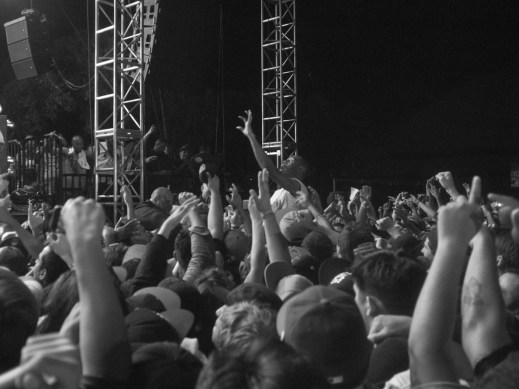
Much of my current work focuses on tropes of abjection in recent hip-hop and RnB music, notably that of Odd Future members Tyler, the Creator and Frank Ocean, artists like Azealia Banks, and a new generation of queer rap MCs emerging out of New York City such as Zebra Katz, Le1f and Cakes Da Killa. All of their work is bracingly obscene, funny, violent. . .a tumbling deck of cards of performances of gender, race, sexuality, class and more. Of course, cursing to a beat is nothing particularly new, but the way in which these artists multiply and collapse identities to an ever more minimal, humming beat perhaps is.
Katz’s remarkable “Ima Read” and its equally remarkable video is a case in point. Although Katz occasionally claims dryly that the song is “pro education,” the “reading” in question mostly refers to the drag queen balls of the Harlem ballroom/voguing scene of the late 1980s/early 1990s, where to read meant to verbally trash, i.e. abject, someone at a ball. The song is rapped by male and female voices, crisply denouncing a “bitch” who they are going to “take to college.” The violence of the song is ironic, as much a marker of queer community and Eros as of sexual difference, of racial and trans-racial solidarity as much as racialized violence. It is performed over a minimal beat with a humming, in-your-face bass drum that is the only recognizable tonal element.
Why make the leap to talking about ontology in discussing this admittedly awesome Youtube clip? Both Judith Butler’s famous elaboration of the performativity of gender, one of the bases of queer theory, and Katz and friends play with taboos concerning gender, sexuality and race in contemporary hip-hop emerge from that moment of the ballroom scene.
But what if Butler’s emphasis on performance actually covered up or abjected the ontological nature of experiments at the balls? Perhaps we need to rethink why the ultimate ball anthem is Cheryl Lynn’s “Got To Be Real.” What is sonic ‘realness’? In restoring the sonic dimension to the ballroom scene, and learning, from Zebra Katz, to face that constitutive abjection that Kristeva amongst others has pointed us towards, we can begin to feel for ourselves what a vibrational ontology is.
—
My thanks to Catherine Christer Hennix, Steven Shaviro, Kevin Rogers and Ken McLeod for conversations that helped me in thinking this through, and to Jennifer Stoever-Ackerman for luminous remix skills.
—
Featured Image by Flickr User depinniped
—
Marcus Boon is associate professor of English at York University in Toronto, and was a Fellow at Cornell’s Society for the Humanities in 2011-12. He is the author of The Road of Excess: A History of Writers on Drugs (Harvard UP, 2002) and In Praise of Copying (Harvard UP, 2010). He writes about contemporary music for The Wire. He is currently co-editing a book on Buddhism and critical theory, and a new edition of William S. Burroughs and Brion Gysin’s The Third Mind. He is also working on a book entitled The Politics of Vibration.
—
Share this:

Evoking the Object: Physicality in the Digital Age of Music

In our current relationship with technology, we bring our bodies, but our minds rule–Linda Stone, “Conscious Computing”
DOI: https://doi.org/10.59350/52w8z-60015
I begin with an epigraph from Linda Stone, who coined the phrase ‘continuous partial attention’ to describe our mental state in the digital age. The passive cousin of multi-tasking, continuous partial attention is a reaction to our constantly connected lifestyles in which everything is happening right now and where value is increasingly equated with our ability to digest it all. Almost everything we do has the potential to be interrupted, be it by an email, a text or a tweet; often we will give only partial attention to any one thing in anticipation of the next thing that will require our attention. In this internal fight for mental attention, listening to music has been seriously impacted.
The digital era has seen more music releases than ever before. Unfortunately, the massive influx of quantity is by no means a measure of how we are engaging with said music. iPhones and similar devices, for which music players have become mere features, enable listening to become a thing of partial attention. From allowing the shuffle or random modes to choose music selections for you, or even streaming music algorithms to calculate things you might like, to listening while playing Angry Birds or reading your Twitter stream, less commitment is made to the act of listening, and as such only a portion of our working memory is committed to the experience. Without working memory actively processing musical information, it is less likely to be stored for the long term, particularly if other information is continuously vying for space and attention.
These days video games sell better than music. Despite being a digital product, games are able to instill memories (even of the music) into one’s consciousness, because the game interface allows our sensory memories to work together in an active manner with the medium. Iconic memory stores visual cues from the game, echoic memory takes the audible cues from the game and the haptic memory is engaged in controlling game play. There is only so much more which can be done while playing a video game. If something were to interrupt game play, the game would be paused to address the new information rather than giving it partial attention. This is quite different from music which plays a background role in so much of our lives even when we are actively putting music on we tend to only engage it with partial attention.
When I began thinking about turning Concrète Sound System into a record label, one of my main goals was to create works that could engage the audience in active musical experiences that could create long term memories. I felt that as important as the music would be, it would take something material to create these memories, a physical product more evocative of earlier moments in recording history than the CD, its most recent gasp. I wondered if, by creatively evoking the physical object, the listener could be engaged in an active manner that would enable the memory of music and its power to persist through the everyday waves of digital noise.
The first mass duplicated audio medium was the Gold Moulded Edison Cylinder at the turn of the twentieth century. Imagine two cylinder copies of one of these recording today, as musical objects. Each of them would have over a hundred years of physical history. From the wear of the cases to the condition of the wax based on the temperature in which they were stored, each of these cylinders would be unique musical objects, with completely different histories, despite having the same origin. It is reasonable to assume that if the cylinders were played today on the same playback device, despite the fact that the compositions and performances are exactly the same, the differences between the recordings would be audible.
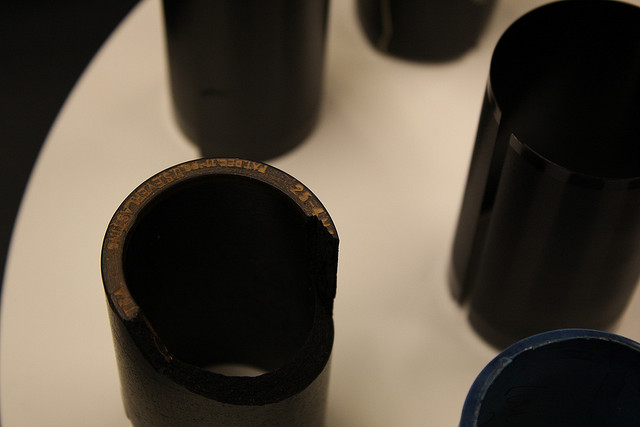
Even without a century of history, there would likely be audible differences between the cylinders. If one cylinder was the first copy made, and another the 150th –master cylinders of Gold Moulded Edison Cylinders could only produce 150 copies reliably–the physical wear in the process of reproduction would leave its own imprint, making each of those copies distinct musical objects. In the analog world, as the technology improved the differences between copies decreased substantially. Cassettes were manufactured in batches of ten to hundreds of thousands without audible differences. But even in circulations so high, over time each of those analog copies took on their own identity and collected their own memories.
The listener as an active agent contributed to the development of these unique musical objects. After a purchase, any number of variables played into the ritual of the first experience of the music. Was there a way to listen upon walking out of the store? Were there liner notes or lyric sheets inside? Would you read those prior to listening or as you listen? Where would you listen? Through headphones? The listening chair in front of the hi-fi stereo? Or on the boombox with some friends? All of these possibilities shaped memories as musical objects that defined the music consumption culture of the past.
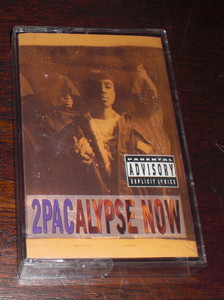
For example, I bought the debut 2Pac album 2Pacalypse Now on cassette the day it was released. I loved the album so much I kept it in regular rotation in my Walkman for months until finally the tape popped. Rather than go out and buy a new copy I decided to perform a surgery. It was in a screwless reel case which meant I couldn’t just open it up to retrieve the ends of the tape trapped inside, but rather had to crack the reel case open and transplant the reels into a new body. So, my copy of the 2Pacalypse Now cassette is now inside of a clear reel holder with no visual markings. It also has a piece of tape that was used to splice it back together, which makes an audible warp when played back. I can pretty much be sure that there is no other copy of 2Pacalypse which sounds exactly like mine. While this probably detracts from the resale value of the cassette (not that I’d sell it), it is imbued with a personal history that is priceless.
Cassettes, in particular, played a significant role in the attachment of physical memories to music beyond the recordings they held. They gave birth to the mixtape. The taper community was born from personal tape recorders that allowed concert-goers to record performances they attended, and, prior to the rise of peer to peer sharing online, these communities were trading tapes internationally via regular postal mail. European jazz and rock concerts were finding their way back to the states and South Bronx hip-hop performances were traveling with the military in Asia. All of these instances required a physical commitment with which came memories that inherently became their own musical objects.
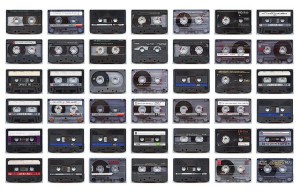
Needless to say the nature of musical exchange has changed with the rise of the digital age of music. This is not to say that memories as musical objects have gone away, but they are being taken for granted as the objects lose their physicality. I remember going to The Wiz on 96th Street with $10 to spend on music. I spent at least ten minutes trying to decide between Sid and B-Tonn and Arabian Prince. I ended up with Arabian Prince and have regretted it since I got home and listened that day, as I never found Sid and B-Tonn for sale again. Today I could download both in the time it took me to walk to the train station. After skimming through the first few songs of Arabian Prince I could decide it was not for me and drag drop it in the trash where the memory of it would disappear with the files. No matter how I felt about the music then, the memory of it is a permanent fixture in my mind because of the physical actions it took to listen.
The first release for Concrète Sound System, Schrödinger’s Cassette, tackled this issue head on by presenting the audience with its own paradox, an update of physicist Erwin Schrödinger’s famous Thought Experiment, where the ultimate fate of the cassette inside is left up to the individual. Schrödinger’s Cassette sought to take listeners out of digital modes of consumption by using an analog medium to evoke the physical. The cassette release trend has been growing over the last few years, almost in parallel to the rise of the digital music and speaking to the need to separate music from our digital lives and to a desire to work harder for it. At the minimum, listening to a cassette requires having a cassette player, and acquiring one these days takes commitment. Unlike digital media, listeners cannot instantly skip a song on a cassette or put a favorite on repeat. It takes physical manipulation of the medium to move through its songs and doing so is a time investment. All these limitations make the cassette a medium that is best for linear listening, from beginning to end (unless you physically cut, rearrange, and splice it yourself).

Schrödinger’s Cassette took the required commitment a step further by encasing the cassette itself in industrial grade concrete. This required the user to actively crack the concrete (or the french concrète meaning ‘real’, from which the label derives its name) in order to listen to the music. The paradox is that, depending on the listener’s method for cracking, harm could be done to the cassette that might render it ‘unlistenable’. Upon receiving one of these pieces, the listener holds in their hands a musical object which they must physically act upon in order to create an unrepeatable musical event. Schrödinger’s Cassette has a look, a sound (if shaken you can hear the cassette reels), a feel, a smell, and a taste as well (though I wouldn’t advise it). All of the senses can be actively focused on the object and, as such, the whole of one’s working memory is engaged in the discernment of the object’s musical contents.
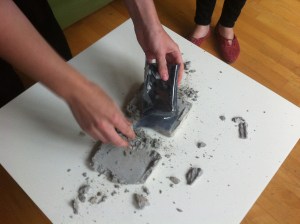
For many, Schrödinger’s Cassette was taken as a work of art and left uncracked. The Wire magazine successfully cracked one edition open, revealing a portion of the musical contents on their regular radio program. For those that decided not to crack it, digital versions were made available so that they could listen, though this option was only made available after the listener spent some time with their physical object. In this way, the music from the project, a compilation called Between the Cracks, was directly connected to physical memories spurred by a material presence.
Triggering active memory during the consumption of music through physical objects need not be this complex. Old medium such as vinyl and cassette releases inherently have the physical properties required without the concrete or much else. Perhaps for this reason they show new signs of life despite the rise of digital. No matter how much our reality is augmented by our digital lives, we still inhabit those bodies that we bring with us, and, as far as the memories those bodies carry with them go, physicality rules.
—
Featured Image: Wax Cylinders in the Library of Congress, Image by Flickr User Photo Phiend
—
Primus Luta is a husband and father of three. He is a writer and an artist exploring the intersection of technology and art, and their philosophical implications. He is a regular guest contributor to theCreate Digital Music website, and maintains his own AvantUrb site. Luta is a regular presenter for the Rhythm Incursions Podcast series with his monthly showRIPL. As an artist, he is a founding member of the live electronic music collectiveConcrète Sound System, which spun off into a record label for the exploratory realms of sound in 2012.
—
Share this:




Current Top Posts





April 2021

January 2020

November 2019

October 2019

August 2019

April 2014

November 2017

March 2015

December 2017

October 2015
 Sounding Out!
Recent Comments