
Into the Woods: A Brief History of Wood Paneling on Synthesizers*

Various Species for the Prophet 08, Analogics
*a companion piece of this research, on electronic sounds as lively individuals, is forthcoming in the American Quarterly special issue on sound, September 2011.
Not long ago, while researching the history of synthesized sound—or taking a break to troll for interesting synthesizers for sale online (activities that, for me, inevitably blend together)—I came across a thriving industry of small companies that offer custom-made wood panels to adorn the sides of old and new synths, like Synthwood, Custom Synths, Analogics, and MPCStuff.
As Trevor Pinch and Frank Trocco note in Analog Days, their history of Moog synthesizers, an “analog revival” is underway: “Today in the digital world, there is a longing to get back to what was lost” (9). The music technology magazine Sound on Sound concurs, documenting a renewed interest among electronic music-makers in modular synthesizers like those popularized by Moog and others in the late-1960s. Yet there seems to be more at play with this proliferation of wood customizations than merely nostalgia for analog synths, Hammond organs, and hi-fi cabinetry. How might we interpret this desire to adorn—lovingly, even obsessively—steel-encased machines that produce sound by electronic means, with various species of wood? What does this realm of audio esoterica reveal about material and social aspects of musical instruments, and the workings of contemporary media cultures more broadly?
On Contingency and Faith: Walnut, Purple Felt, and the True Cross
Pinch and Trocco describe the Minimoog as the first synthesizer to become a “classic,” due to its relative ease of use, widespread availability, portability and compact design (214). In the retrospective imaginations of historians and musicians, a significant feature that established its classic design was the walnut wood case on an early generation of Minimoog models.

The Moog Minimoog B (with walnut case), ca. 1970, Audities Foundation
However, Bill Hemsath, an engineer who assembled the first Minimoog prototypes in 1969-70, told Pinch and Trocco that these instruments were assembled from “junk I found in the attic” and an assortment of affordable materials cobbled together in the moment (214). Jim Scott, another engineer who worked on developing the Minimoogs, explained in a 1997 interview: “the reason we made it walnut [was] because Moog had gotten a deal someplace and had a whole barnful.” He noted that “the musicians certainly appreciated the fact that it was made out of walnut,” but eventually the designers “ran out of walnut and started buying something else and slapping paint on it to make it look like walnut.” The various kinds of wood used on models from different years, and the exact start and end dates of the coveted walnut models, remain contested matters among Moog enthusiasts.
Hemsath elaborated on this history in a 1998 interview by making an analogy to “classic” piano design: “There’s a similar story from Steinway. Back when they first got started in the U.S. they used to buy their felts from a feltmaker in Paris… And they got a lot of purple felt because [the supplier] used to be the felt maker for Napoleon’s army, and had a lot left over. So the colored cores in the hammers of those old Steinways were purple because of Napoleon’s army. Well, [the supplier] ran out, and [Steinway] said, red’s fine. They started making pianos with red felt, which is what they have today, and people started complaining, saying, it’s not a real Steinway, it’s not purple.” Like the proverbial purple felt on original Steinway pianos, walnut panels on synthesizers became “classic” because of their association with an originary moment, however happenstance, in the history of a particular instrument, and a limited supply and production run that rendered the material in question relatively rare.
So, a contemporary synthesizer enthusiast’s desire to acquire a “classic” walnut Minimoog, or to commemorate its aesthetic with customized wood panels, is in part an effort to establish a material connection to history. Synthesizer history unfolds in the deep time of technoscience which, as Donna Haraway has argued, often “barely secularize[s]” Judeo-Christian narratives of first and last things, of figural anticipation and fulfillment (9-10). The concern among some synthesizer enthusiasts to possess either the actual wood of an early-model Minimoog, or a faithful substitute for it, indeed resonates with Christian material cultures around relics of the True Cross and next-best artifacts with suitable provenance. A historical conjuncture that is contingent on otherwise unremarkable circumstances (e.g., Bob Moog’s good deal on a barnful of walnut in upstate New York) is marked as an originary or otherwise defining moment (the “invention” of a “classic” synthesizer) for a culture that defines itself as proceeding from it; the former is made to anticipate the latter, and the latter comes to fulfill the former.
Taking Stock: Materialities of Instruments, Sounds, Ecosystems
What kind of wood panels live in my studio? The manual to my Jomox XBase 09 drum machine, from 1999, details that its “steel sheet body” is bookended by “varnished side panels made of alder wood.” Wikipedia‘s pop-anthropological roundup of alder’s “use by humans” includes smoking various foods, treating skin inflammations and tumors, and building electric guitars. Fender Stratocasters have been built with alder since the 1950s. Guitar enthusiasts are notoriously fussy about which type of wood comprises the instrument’s body because of its effect on tone. Scientists, meanwhile, have taken to applying medical imaging techniques to Stradivarius violins, trying to “crack the mystery” of its prized tone. (Some say it’s due to the particular density of slow-growing trees in the Little Ice Age; others conclude it must be the varnish.)

The author
Given these interconnected concerns with instrument materials and the composition of tone, one might venture an etymological connection between timbre—which the Oxford English Dictionary describes as the character or quality of a musical sound depending upon the instrument producing it—and timber, which references “the matter or substance of which anything is built up or composed.” Music scholars often characterize timbre as the materiality of sound. Despite longstanding knowledge of the relationships of timber and timbre among instrument builders and musicians, and possible overlaps in historical applications of these words, placing wood panels on the sides of synthesizers surely has no effect on the resulting tone. Or does it? Audiophiles are prone toward occult-like habits, such as placing a single coin on top of a speaker to absorb vibration; and wood panels may well have subtle effects on the overall stability of an electronic instrument, resulting in barely perceptible sonic artifacts.
My Virus B synthesizer from the late-1990s has darker wood side panels than the Jomox, sort of a faux mahogany. Recently I wrote to Access Music, explaining my research on synthesizer history and inquiring what kind of wood they used. They replied that the B series featured stained beech wood (also commonly used and appreciated for producing smoked German beers and cheeses). Virus volunteered that they “in general do not use any kind of tropical wood for our devices.” Using sustainable wood has become a mandate and marketing concern at the Moog company as well; Moog’s wood “comes primarily from Tennessee. Hardwoods in Tennessee are growing faster than they are being harvested… US hardwoods are a world-wide model of sustained forest management.” Among contemporary synthesizer companies, there is often a selective eco-consciousness; as synthesizer designer Jessica Rylan suggested in our interview for Pink Noises: Women on Electronic Music and Sound (Duke: 2010), it is arguably impossible to build a synthesizer that does not incorporate at least some materials that are toxic in stages of manufacturing and/or disposal.

A Flashstick USB drive that incorporates wood from Berkshire, England
The paradox of dressing up an electronic machine made partly of toxic materials and processes with a sustainable-wood exterior is a fitting metaphor—like a contemporary fig leaf—for how we outwardly express environmentalist concern, despite plenty of contradictions in practice. Wood-adorned electronic devices, in all their glorious contradictions, are especially resonant in this cultural moment; see Asus’s EcoBook, Karvt’s lineup of custom wood skins for MacBooks, and, my favorite, Flashsticks: handmade wood USB “sticks” that combine “the high tech world of computing with the simplicity of the world of nature.” The story of Flashsticks’ handmade creation is a case study in eco-contradiction: the website implies that no trees were harmed in the making of their USB sticks—the company uses locally-sourced, “fallen wood from the previous winter’s storms”—yet we do not hear of the toxic materials that may comprise the drive itself.
Wood panels indeed work to conceal inconvenient truths. As Ruth Schwartz Cowan pointed out, the midcentury aesthetic of hiding household appliances behind wood paneling typified a culture that concealed gendered divisions of domestic labor (205). Lisa Parks has documented the similar recent phenomenon of dressing up cell towers as trees, which obscures the politics of media infrastructure behind a cloak of “nature.”
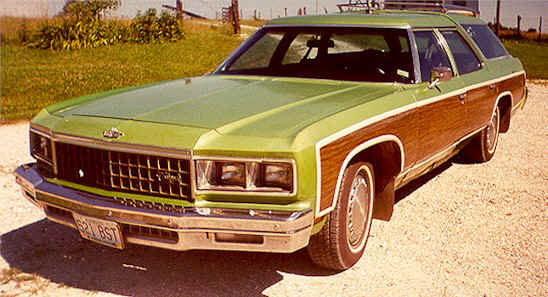
This is also a story about the mirage of a space between nature and artifice. Retro-culture enthusiasts celebrate that “real cars have fake wood paneling.” Meanwhile, a company called iBackwoods has engineered a “real wood” iPhone case that pays tribute to “timeless style of a wood panel station wagon.” Moog’s new Filtatron application for iPad, a software emulation of the company’s Moogerfooger filter pedal, is rendered authentic by its virtual wood panels. All of these examples reveal the “nature” of wood paneling to be cultural all the way down.

Washington DC - National Museum of American History: America on the Move - Park Forest, Illinois 1950s by Wallyg (via Flickr)
Ultimately, wood paneling might prompt us to recognize the interconnectedness among seemingly divergent materials, environments, and social practices. Consider, as a useful comparison to the climate-forged Stradivarius, the ash baseball bat: cherished by players for its “magical” effects on hitting, and now threatened by a warming climate and killer beetle in its source forests in Pennsylvania. Every synthesizer likewise holds and explodes into an ecosystem, and sometimes sounds like one too. The composer Mira Calix has suggested that analog synthesizers, with their individual quirks that increase with age, are much like wooden instruments; both seem to breathe like “little creatures” and take on a unique character, like a human voice. Our synthesizers, our kin.


Share this:

Within a Grain of Sand: Our Sonic Environment and Some of Its Shapers
“It devolves on us now to invent a subject we might call acoustic design, an interdiscipline in which musicians, acousticians, psychologists, sociologists, and others would study the world soundscape together in order to make intelligent recommendations for its improvement.”
–R. Murray Schafer
The Soundscape, Our Sonic Environment and the Tuning of the World
With those words, and with that book, Canadian composer, writer, educator, and environmentalist R. Murray Schafer introduced the concept of the soundscape…a sound, or combination of sounds, that forms or arises from an immersive environment. What follows is an exploration of how several key field recordists define and explore the notion of soundscape.
1. What do you do?
I capture moments.
I explore environments & structures using conventional & extended field recording methods. I also use instruments & small objects. Sometimes I perform live intuitive compositions, sometimes I install work & often I compose photographic scores.
For me it is the emotive impulse that most inspires.
I listen.
2. What can that tell us?
I believe passionately that one of the most important results of an exploration of overlooked detail in daily life (in terms of sound as well as visual elements) is how it can enhance ones life. It can allow us to engage with our surrounding in different ways & appreciate what remains & what has gone before or indeed is in danger of disappearing.
it can tell us that listening is a much, much broader vista than we all understand & one can spend a lifetime exploring.
photo: carina martins
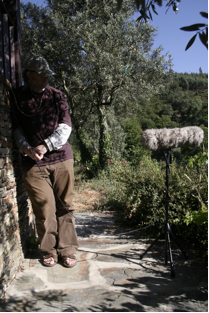
The study of the soundscape, called Acoustic Ecology, focuses on the relationship between living beings and their environment through sound. It’s a unique field in its interdisciplinary nature and beginnings, an interconnectivity between scientists, sociologists, anthropologists, and artists.
1. What do you do?
I am part of the organization Binaural/Nodar, which organizes educational and artistic creation events focused on a rural region in northern Portugal. Our creative focus is on sound and media arts that work with the natural and human environment of the region. As part of our activities, we organized a program of artist residencies dedicated to the river than passes through our region (Paiva river), which culminated in the Paivascapes festival, which took place in March this year. This was a multidisciplinary event that included a series of site-specific sound installations, a retrospective exhibition of sound and audiovisual works at a local museum, conferences on anthropological and environmental issues and nature walks. The festival had an itinerant nature, as it’s program was conceived to happen in several locations from the source to the mouth of the river.
2. What can that say?
The rural environment where we develop our activities has been inhabited for at least tens of thousands of years and each generation left their mark on the territory. So, we understand it as a infinitely complex, stratified and fragmented reality that most of the times cannot be fully comprehended if the approach is superficial, limited in time, based purely on a ‘naturalistic’ view of it that manifests itself for example on experiencing and recording the bucolic sights and sounds. It requires a more ‘relational’ approach, where what we see and listen to is mapped against other elements, stories, individual and collective memories, place names, old and new usages of the space, etc., which requires time, attention and empathy. We take these concerns on every aspect of our work such as which art projects to select, how and where to publicly present the works, how to mediate the relationship between the artists and the local communities.
-Rui Costa of Binaural/Nodar
photo credit: Binaural/Nodar
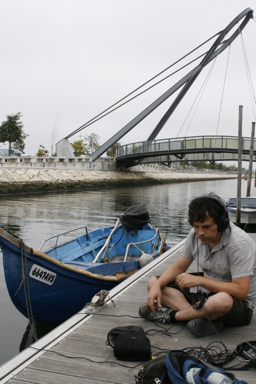
Acoustic Ecology has branched out to give birth to a movement in sound art called phonography, a neologism referring to the art of field recording. It’s also shown a spotlight upon our changing sonic environment, and has become an important tool in bioacoustics and biomusicology, which help us to understand what these changes can mean. Birds communicate mainly with sound. When their calls cannot be heard, their reproduction decreases. Scientists are working with acoustic ecologists to record and study environments in which this is happening. Some of these bird calls may someday only survive on these recordings.
1. What do you do:
I am interested in the common, the everyday and the ordinary in my art practice; and in the unnoticed, the trivial and the repetitive that constitutes daily life. The birds I am interested in have ambiguous reputations and are considered pests or nuisances but they are also loved and respected. Seagulls, crows/corvids and pigeons are all very sociable species and are often much more audible than visible and they proliferate in the favorable conditions we have provided in urban centers.
‘birdbrain’ focuses on our relationship with crows (corvids) and seagulls through voice (animal/human) and ideas about language (animal/human), including the spoken and written word. There is little philosophical discussion about animal voice, although the potential for animal language parallels current neurobiological research, which has identified that certain ‘motor and perceptual abilities’ essential for language in humans, also exist in birds.
2.What can that tell us:
The project has a number of components including an artist’s book that is posing as a mock field guide. The field guide comprises written texts of exchanges between a group of Little Ravens that I have transcribed over the course of a year using the phonetic words from conventional field guides.
The audio works consist of field recordings, mimicry and texts spoken by people with different accents. Scientific research tells us that birds also have regional accents and dialects, and that birds change their song according to place. Birds in cities sing more loudly to cope with urban noise and these songs tend to be simplified. Also, birds that have been introduced into different countries sing a song that is a variant from their brethren back in the homeland.
still from birdbrain, catherine clover

Cymatics is the study of sound waves made visible. Sound frequencies vibrate a surface and create distinct patterns. Sound needs a medium to vibrate, and the characteristics of the medium and sound wave will inform the shape. If you place a metal plate upon a speaker head, place sand upon that plate, and play certain frequencies through the speaker, you will see the sand vibrate into different patterns. If we could see sound around us, we would see expanding spheres with a kaleidoscopic-like pattern on its surface, effecting each other and all molecules in its path.
The interconnectivity of our world is often over looked, often not thought about. It is human nature to categorize, this is part of how we think and communicate. But what is lost when we consider our categories as islands, instead of a part of a whole, a pattern of overlapping systems? There is a saying that the whole of earth and ocean is found within one grain of sand.
1. What do you do?
I am an artist and composer who focuses on listening and the environment in my work. I am often recording my life and my travels, and the recordings or my observances from the recordings end up in my compositions, art installations, and soundwalks. In 2004, I was fortunate enough to find other people interested in sound and the environment and together, we formed The New York Society for Acoustic Ecology (NYSAE), a chapter of the World Forum for Acoustic Ecology. Through various organizations like the Whitney Museum, the Electronic Music Foundation, and free103point9, we have held events, panel discussions, and performances relating to sound and urban ecology. I am often asked how I “got into sound” and I usually don’t know how to answer it as it feels like I never got out of an interest in acoustics and space. I think that my interest in sound began when I carried around a tape recorder instead of a doll as a child. Perhaps not much has changed as I feel like my compositions reveal a layer of personal narrative conveyed through field recordings that describe how I relate to my environment. Often, my soundwalks do not include sounds that I have recorded; they are about sharing with others what I discovered about listening to the acoustics of a particular place. Points of interest are carefully arranged in guided tours with conceptual elements that emerge as sub-themes.
2. What can that say?
I am mostly interested in the relationship between people the sounds of the urban environment, particularly on how nature is defined by those who live in urban environments. When we slow down to listen to all that is in-between point A and point B, I think that we can begin to enjoy the fine details, even in a noisy city environment. I’ve worked with both children and adults in educational settings in cities who didn’t realize that they had birds living on their street until they were encouraged to listen. And I’ve discovered things like some people don’t like the sounds of birds at all, and they may prefer listening to the sounds of the subway. Sound can be just as subjective and adaptable of an art material as paint.

A drop of water falls into a puddle and creates a wave. A wave is a disturbance that travels through time and space. It affects everything it touches, it creates other waves, it continues colliding and transferring energy to molecules that do the same in turn to other molecules. It can be water, it can be light, it can be sound. It can be many things that collide into our molecules, and our system translates. The water is cold, the light is bright, the sound is loud. This is passive information. But when we actively feel how cooling the water is on a very hot day, when we actively consider how strong that sun is, and when we actively enjoy how the crash of an ocean wave makes our heart race…our world becomes so much richer.
1. What do you do?
Soundscape compositions, soundwalks, listening workshops, lectures, writing, editing, some mentoring of composition students, organizing as part of the World Forum for Acoustic Ecology (WFAE) and so on…
2.What can that say?
Everything I do seems to be focused on understanding the world through the act of listening and on the desire to share this understanding with as many people as possible. I believe that every sense perception gives us valuable and important connectedness to and information about the world in which we live. Our hearing sense has been underutilized (certainly in my lifetime, in our societies, nowadays) and a re-balancing of our senses may mean a re-balancing of how we approach life, environment, culture, politics and ideas. Experience in listening and composing has shown me ever new, changing and deepening approaches to space and time. And I wish this for everyone who learns to connect more consciously and deeply to his or her listening. What can that say: listening means noticing means inspiration means energy to do and act.
Hildegard Westkamp, Photo by Peter Grant
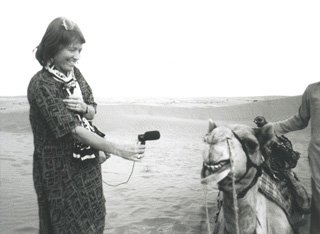
World Listening Day is July 18th. You can participate through the World Listening Day organization. Or just take the time, whatever you are doing, to stretch your ears and focus them on the rich acoustic world around you.
1. What do you do?
The World Listening Project maintains a website and online forum about its artistic and educational activities, including public workshops, forums, and lectures, as well as participating in exhibitions, symposiums, and festivals. Phonography and Acoustic Ecology inspired all of this. In the Chicago area, where we began, we formed the Midwest Society for Acoustic Ecology, a regional chapter of the American Society for Acoustic Ecology. We’re busy now inviting people to participate in the 2011 World Listening Day on July 18, the date of R. Murray Schafer’s birthday. If you visit our website you can learn how to celebrate. It’s quite open and last year the response was phenomenal.
2. What can that say?
Hearing tells us where to look. Wherever we are, every place on the planet has its own soundscape. From moment to moment the soundscape is always changing, often unpredictably. Depending on the time scale, dynamics, and frequency range we can choose to focus attention on. The World Listening Project suggests that listening is active, not passive: that listening means paying attention to the world. And when we do that we can begin to change it in a way conscious way. Bernie Krause has been a supporter. He’s making waves in the field of soundscape ecology. This is what Bernie says: “Western society bases most of what it knows on the visual. We actually ‘hear” what we ‘see.’ The World Listening Project aims to transform that perception in our otherwise urban centric and abstracted lives. At a time when we are facing not only a silent spring, but a silent summer, fall and winter, as well, it is clear that where a picture is worth a thousand words, a soundscape may soon be worth a thousand pictures.”
T


Share this:


Current Top Posts





April 2021

January 2020

November 2019

October 2019

August 2019

April 2014

November 2017

March 2015

December 2017

October 2015
 Sounding Out!
Recent Comments