
Twitchy Ears: A Document of Protest Sound at a Distance

“Royal Thai consulate 351 E52 St jeh” on Wikimedia Commons, CC-1.0
“I compare New York to Bangkok all the time,” a young activist told me, just moments before he joined a small, media-ready protest at the Thai consulate in midtown Manhattan. On a pleasant day this past July, along a quiet side street lined with the gold plaques of consulates general, his comparison felt strained—Thailand is currently governed by a free speech-averse military junta that seized power last year, and mourning a deadly terror attack. In Thailand, the tension and fear are acute; in New York, the local delivery driver was whistling.
The young activist, an ocean removed from Bangkok, sought ways of speaking politically, knowing well that he could and would be heard across that ocean When he returns, if he returns, he may be imprisoned, intimidated, or injured. In front of the consulate in New York, those problems were imperceptible to the uninitiated. But they weighed heavily on all of us. Whenever the group chanted or sang, their voices rose through the low ambience like heavy weights, and stopping they fell away without receiving a response. There was a perverse aural disjuncture between the easy rhythms of the day and the harrowing risk that we knew was present in every utterance.
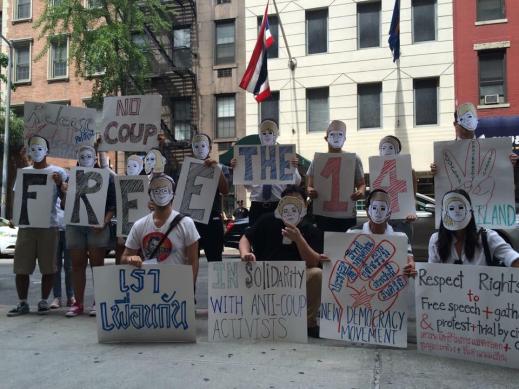
I had come to participate in the event, to speak against the military junta’s recent arrest of fourteen university students for protesting peacefully. I had also come to make a sound recording, and as usual to consider the odd phenomenon of protests staged to create media artifacts rather than to influence people in the flesh. The purpose of the protest was not to negotiate risk but to invite it. It barely mattered that New York City didn’t hear the protest as it occurred. Where it needed to sound potent, it would. Recorded sound surely renders all protest multi-sited; protest sound is a speech-act spatially and temporally deferred.

Picture of #FreeThe14 protest in New York City this past July. From Thai Students Center for Democracy (@TSCD_EN) tweet on July 7, 2015.
However, for protests staged at great physical distance from what’s being protested, the specter of comparison and difference between sites and movements can be profound. New York is in certain ways friendly to protest; the city is liberal with permits, and even unpopular opinions are expressible. Relative to most of Thailand, this is a welcome distinction. Of course, such freedom can blunt the acuity of dissenting speech — protests limited to a specific place and time, accompanied by two polite cops indifferent to the issue at hand, are easy to tune out. The United States has its own instruments of containing dissenting speech.
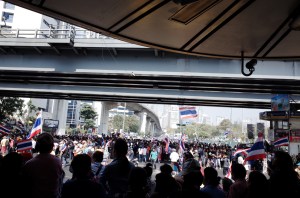
“Protests around Si Lom, Bangkok” by Flickr user
Anton Strogonoff, CC-BY-2.0
Furthermore, as responses to both Occupy Wall Street and the Black Lives Matter movement have shown, organizational structure and subjectivity make some actions more vulnerable to state violence than others. There are moments when a single word can provoke repression here in no less crude a fashion than the Thai junta prefers. But the game has wholly different rules, and these rules engender different strategic responses. Protesting at a distance is both a way of threading multiple sites together and of reflecting on how protesters in different places and movements choose to speak. In the mind of a young activist accustomed to Thailand’s particular labyrinth of political expression, the contrast with his own country can become a source of ideas.
“When I first came here,” the activist continued with a note of awe in his voice, “Occupy Wall Street just started, so it’s like, there is this obvious difference that really intrigued me in how people organize or react to causes. In Thailand we still kind of are using older ways to organize, kind of like really centralized, some figures pretty much
To develop a political movement in the United States is a different challenge than doing the same in Thailand, to put it mildly. In the United States the left risks triviality; in Thailand, it literally risks death. Thai communists were hunted by soldiers in the jungle in the twentieth century, and left-wing political parties are still forbidden today. Republicanism is treason. And with the ascent of the military junta, many trials are now held in secret, and intimidation of political critics is routine. A movement cannot attempt to run headlong toward whatever it wants to topple; circuitous end-runs are necessary. This explains the increased appeal of decentralized protest tactics to Thai activists. The young man I met was far from the first in his country who has espoused such an approach.
***

“Protest Music” by Flickr user killerturnip, CC BY-NC-ND 2.0
The protest began with one woman playing an acoustic guitar, leading the twenty of us assembled in a folk-style singalong. The sincere, uneven rendition of “Song of the Common Man,” currently popular among anti-junta protesters in Thailand, was followed by nervous laughter, and the honk of a nearby taxi. The lyrics are mild and the structure formulaic, but the song has caught on among the junta’s most outspoken critics – notably, one recording available online was made by a band whose songs are strident enough that they were pursued by the military, and forced to flee to Laos. The song lasted less than two minutes, and an American, who worked for a freedom-of-speech NGO in Southeast Asia, ensured that the group moved on to the next part of the tight half-hour schedule. Every moment was brief but assiduously documented.

Picture of #FreeThe14 protest in New York City this past July. From Thai Students Center for Democracy (@TSCD_EN) tweet on July 7, 2015.
We took selfies wearing masks shaped like the faces of the fourteen students who were set to appear before a military court that day. The Thai consulate employees watched with bemusement, and briefly chatted with us in the low, serious hush filled with polite participles that characterizes formal conversation in Thailand. The event ended, and the quiet side street remained undisturbed.
One moment was particularly chilling. The American was leading the group in a series of “what-do-we-want-when-do-we-want-it” chants, which though adapted to concerns of the anti-junta movement felt pro forma and out of place. That cadence and call-and-response pattern is almost never heard at protests in Thailand, and the protesters were not accustomed to it. When someone suggested chanting in Thai rather than English, the group naturally fell into a different rhythm. The repetition of Prayuth aawk bpai, an insulting demand that coup leader General Prayuth Chan-Ocha go away, was much sharper. The chant hearkened to protests of recent years against illegitimate Thai governments. A recording of it would, without doubt, be very risky once heard by the wrong ears in Thailand. Its potency was not only in its direct semantics, but in the connection it formed between the current protest and protests of the recent past. Protest in an age of ubiquitous media tends to form such links across boundaries of time and space.
But a curious thing happens when protest movements can readily observe one another. Comparisons are made all the time, but so are convergences. Rhetoric and strategy become cosmopolitan, not native to any place, and protests increasingly echo other protests. Contemporary Thai dissidents have been influenced by Argentinian horizontalism, and they swap documentaries about the Arab Spring online, for example. The watertight conditions of a geopolitical place have more leaks than was thought. And as ideas travel, the places themselves can become fertile grounds for the growth of those ideas in practice.

“Thailand” by Flickr user Marko Mikkonen, CC BY 2.0
Sound is vital to this process. Perhaps because it is often regarded as the most visceral expression of the body, sound has a special relationship to protest. Sound and self need not be romanticized as coterminous in order to appreciate that speech acts feel very close to the body. But listen again. Sound can both feel immediate and be radically disembodied. It can be a material for experimentation, for feeling out how to speak in the immediate present, and be by the same stroke a final product to be audited by the twitchy ears of the junta. The July protest was and will be both.
—
Benjamin Tausig is assistant professor of ethnomusicology at Stony Brook University, where he works on sound studies, music, and protest in Bangkok and other urban spaces. He is on Twitter @datageneral
—
Featured image: Picture of #FreeThe14 protest in New York City this past July. From Thai Students Center for Democracy(@TSCD_EN) tweet on July 7, 2015.
—
 REWIND! . . .If you liked this post, you may also dig:
SO! Amplifies: Cities and Memory-Stuart Fowkes
Toward A Civically Engaged Sound Studies, or ReSounding Binghamton–Jennifer Stoever
Share this:

World Listening Day 2015: Mendi + Keith Obadike’s “Blues Speaker [for James Baldwin]” (2015) #WLD2015

 For World Listening Day 2015, Sounding Out! is honored to debut Mendi + Keith Obadike’s new documentary video about their recent large-scale urban installation at The New School’s University Center in New York City, “Blues Speaker [for James Baldwin]” (April 2015), dedicated to writer and public intellectual James Baldwin (1924-1987). –JS
As Mendi + Keith describe, “For Baldwin sound, music, and the blues in particular were sources of inspiration. The multichannel sound art work meditates on a politics of listening found at the intersection of Baldwinʼs language and the sound worlds invoked in his work. It uses the glass façade of The New School’s University Center as delivery system for the sound, turning the building itself into a speaker. The 12-hour piece is created using slow moving harmonies, melodicized language from Baldwinʼs writings, ambient recordings from the streets of Harlem, and an inventory of sounds contained in Baldwin’s story ‘Sonnyʼs Blues.'”
“‘Blues Speaker’ celebrates James Baldwin’s keen understanding of the social role of the blues. In his important 1957 short story ‘Sonny’s Blues,’ the writer argued that attending to the blues required the listener to confront and accept both literal noise (sounds beyond the listener’s understanding) and ideological noise (elements of the lives of those whose journeys have taken radically different paths), and seek beauty and understanding. If this relationship to listening is specific to the blues — a form that takes its shape in response to the survival of black people in general and to the decisions of its craftspeople — then musicians who seriously engage the blues must hold a knowledge deeply important for humanity that lives in the music and extends beyond that medium.”–Artists’ Statement, Vera List Center for Art and Politics, The Year of James Baldwin Exhibition.
—
Mendi + Keith Obadike make music, art and literature. Their works include The Sour Thunder, an Internet opera (Bridge Records), Crosstalk: American Speech Music (Bridge Records), Black.Net.Art Actions, a suite of new media artworks (published in re:skin on M.I.T Press), Big House / Disclosure, a 200 hour public sound installation (Northwestern University), Phonotype, a book & CD of media artworks, and a poetry collection, Armor and Flesh (Lotus Press). They have contributed sounds/music to projects by wide range of artists including loops for soul singer D’Angelo’s first album and a score for playwright Anna Deavere Smith at the Lincoln Center Institute. You can find out more about them at http://obadike.com.
—
 REWIND! . . .If you liked this post, you may also dig:
SO! Amplifies: Mendi+Keith Obadike and Sounding Race in America
SO! Amplifies: Shizu Saldamando’s OUROBOROS
SO! Amplifies: Cities and Memory
Share this:


Current Top Posts





April 2021

January 2020

November 2019

October 2019

August 2019

April 2014

November 2017

March 2015

December 2017

October 2015
 Sounding Out!
Recent Comments