
“I’m on my New York s**t”: Jean Grae’s Sonic Claims on the City
 Hellooooooo, Cyberspace! Are you ready to rock??? Welcome to our February Forum on “Sonic Borders,” a collaboration with the IASPM-US blog in connection with this year’s IASPM-US conference on Liminality and Borderlands, held in Austin, Texas from February 28 to March 3, 2013. Expertly organized by Sounding Out!’s Managing Editor Liana Silva and IASPM’s Web Editor/Webmaster Justin Burton (and curated for SO! by yours truly), the “Sonic Borders” forum is a Virtual Roundtable cross-blog entity that will feature six Sounding Out! writers posting on Mondays beginning today and running through February 25, and four writers from IASPM-US, posting on Wednesdays starting February 6th and ending February 27th. We envision plenty of excitement and cross blog commenting from authors, audiences, and IASPM-US conference attendees. Consider this your ticket to the show, so please come on in and mix it up!
And what will we be talking about across our platforms? The “sonic borders” between sound studies and popular music studies. . .where their methods, objects of study, and approaches overlap, where they rub raw, where they challenge the people on either side to do do better, and where they meet to generate some of the finest scholarship in the contemporary humanities.
And who will you be hearing from over here at Sounding Out!?: Liana Silva, SO! regular Regina Bradley, Marcus Boon (York University, The Wire), Daphne Brooks (Princeton), Tavia Nyong’o (NYU), and Art Jones (film-maker, photographer, artist, mixer, raconteur, School of the Museum of Fine Arts, Boston).
And what topics do you have a front row ticket for? Some real New York shit. Django. Body-regenerating vibrations on the dance floor. Cabaret, jazz, and funk/soul, plus musical memory, dance, performance art, race, gender, sexuality, and politics. Sound gatherings in Pakistan.
Feel free to camp out and shine your cell phone lights at each day of our Forum, because we’re turning it up to 11 over here at Sounding Out! and IASPM-US!—Jennifer Stoever-Ackerman, Editor-in-Chief
***
If you had to guess whether the singers of the following lyrics were male or female, how would you fare? Click on the lyrics to hear the song and find out who’s the rap artist.
“We gon’ hold it down for Illadel for life
Came through made a name, nigga nailed it tight
An’ now we shine, been knew, shit, it was about time
Switched from streets, the beats, platinum lines
Used to struggle in the hood just to brodie the mic
Took the fame ’cause they ain’t give it us, now we excite
The biggest crowds an’ they screamin’ loud, “Philly the shit”
“They hear Brooklyn, and we up to no good
Well, here we come, so there goes your neighborhood
Timbos scuffed up, sess bein’ puffed up
Mess with the wrong one, kid, you get ruffed up”
“My city do it best, whether it’s East or West
We feelin’ good fine, love it when it’s summertime
Detroit in summertime, summer time in Detroit,
Detroit in summertime, summertime in Detroit”
Although it is somewhat unfair to judge the gender of a rapper by the lyrics of a song, it is commonly thought that if a rapper is talking about the city, they are more than likely a man. Are there borders in hip hop around the content that men or women can address?
Case in point: several years ago I wrote a paper on representations of the city in hip hop songs. It gave me the opportunity to look closely and write extensively about some of my favorite hip hop artists and songs. However, most of the songs I tackled in the paper, actually most of the songs that occurred to me, were written and sung by male rappers. When I realized this, I couldn’t believe my oversight. Surely there had to be female rappers invoking the city in their songs. Men couldn’t be the only ones claiming the city. So, over the years I have been on the hunt for songs by female emcees that talk about the city. (I recently started a Spotify playlist, but several of the songs I have come across are on mix tapes that don’t show up on Spotify. If you have any suggestions you’d like to add to this collaborative playlist, please add them or mention them in the comments!)

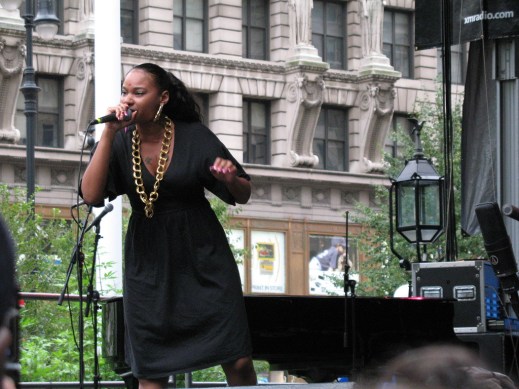
“Jean Grae” by Flickr user ultra5280 under Creative Commons 2.0 License
One of the female emcees that stands out most is Brooklyn-based Jean Grae. Born in South Africa in 1976, she moved to the United States with her parents shortly after she was born and grew up in New York City. In a 2006 interview with Robert Walsh for the academic journal Callaloo, Jean Grae reminisces about how hip hop culture was inescapable for a teen in New York City in the early nineties:
It was a thing when kids finally realized that you could put out your music yourself and you didn’t have to wait around and get signed. It was possible to learn for yourself and be able to put out music on your own or on an underground level. It was kind of unavoidable to be a part of it, I guess. (216)
After a brief stint as a DJ, she opted for rapping, as she was already writing (even if not necessarily rhyming). She took a hiatus from the hip hop scene in 2008 but later that year returned to performing and finally released a new mixtape named Cookies or Comas in 2011.
In hip hop, cities are often represented as masculine–what with the number of male rappers dropping stories about how things go down on the street–and Jean Grae complicates that representation. In Jean Grae’s version of Busta Rhymes’ “New York Shit,” she opens a door to thinking about female rappers and urban space, and her sonic intervention into Busta Rhymes’ narrative in his version of “New York Shit” illustrates how female rappers claim the city as well. I read her track as an act of urban homemaking: rapping about the city (and subverting the male voice that initially sung on the track, Busta) becomes a practice to claim the city as her home. In fact, it is not just through her lyrics but also through her voice that Jean Grae makes her presence felt.
Jean Grae’s version of “New York Shit,” a collaboration with rapper Talib Kweli, is an alternate version of Busta Rhymes’ hit track “New York Shit” from his 2006 album The Big Bang, although both songs use the same sampled loop and constantly repeat the phrase “New York Shit.”
The track that “New York Shit” samples is from the opening of a 1976 song titled “Faded Lady” from The Soul Sensation Orchestra (featuring Douglas Lucas and The Sugar Sisters, who sing together throughout the whole song). The song itself tells the story of a “faded lady” who seems to have lost her hopes, dreams, and connection to the world around her. “New York Shit,” both the Busta Rhymes and the Jean Grae/Talib Kweli version, samples approximately the first 13 seconds of the song, so that in their version the voices are erased; all that is left is the even thump thump of a drum, a bass, and a guitar, with the clash of a top hat and the bass in between, finally rising up to a climax with what sounds like a flute or clarinet until it drops back into the thump thump. The loop invokes the soundtracks of blaxploitation films, several of which were set in urban locations. The sample choice then places “New York Shit” in an urban soundscape.
Busta’s original song weaves images of New York as the birthplace of hip hop, as the location of great sports teams, and expensive taste around this soulful, smooth loop. The chorus of the song (“If you’re from New York, stand up right now, If you’re from New York, hands up right now”) calling forth New Yorkers. In the song, Busta also pays homage to some of the big names in hip hop who come from New York: Ol’ Dirty Bastard, Notorious BIG, Big Pun, Jam Master Jay, while the video includes cameos from people like Q-Tip, RZA, Slick Rick, and Big Daddy Kane. In this way, the song celebrates their contributions to hip hop, but also recreates a narrow, gendered view of who is part of that musical history.
However, the sonic picture Busta Rhymes paints is one that is devoid of women. Before the loop starts, Busta Rhymes’ voice emerges from the quiet: “DJ Scratch you’re sick for this one,” which acts as the signal for a chorus of male voices. Some of them whoop, some of them whistle, and some of them sing. Eventually they make way for Busta Rhymes to serenade listeners with his tales of New York life. His voice sounds gruff and aggressive, a contrast with the smooth vibe of “Faded Lady.” In fact, it seems as if the “faded lady” of the title is not just faded but erased–the women in the city become the faded ladies whose erasure makes possible for this problematic representation of urban space.
Enter Jean Grae.
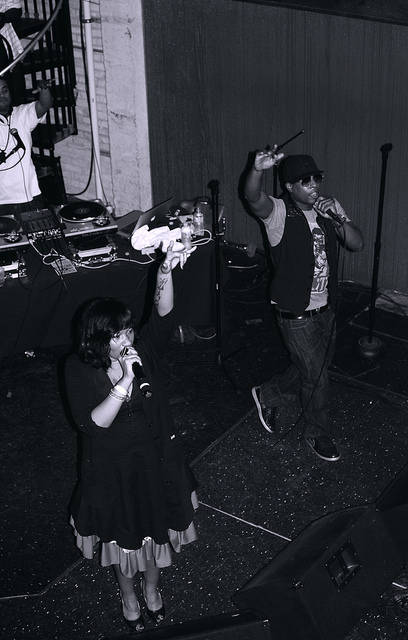
“talibjeangrae” by Flickr user HDShootsPhotos under Creative Commons License 2.0
In 2006, she and Talib Kweli released their version of “New York Shit” in a mixtape titled Hip Hop Docktrine: The Official Boondocks Mixtape which responds to Busta Rhymes’ sonic tribute to New York. (It also appeared on the mixtape Talib Kweli Presents Blacksmith the Movement.) Busta Rhymes’ song comes immediately to mind when listening to Jean Grae’s sixteen bars, especially when she starts with “Some of y’all forgot what New York is,” and in that vein it is hard not to hear Jean Grae’s track as a response to Busta Rhymes’.
Whereas Busta Rhymes’ song is ushered in by a chorus of disparate men’s voices, Talib Kweli and Jean Grae’s version starts with Talib Kweli’s introduction, followed by Jean Grae’s rapping. Talib Kweli’s introduction tricks the listener into thinking this version is just an echo of the original by Busta Rhymes (especially since the loop is virtually unchanged) until Jean Grae pops up by responding to Talib Kweli’s “I went for mine” with her “Go for yours, man.” The back-and-forth of the male and female voices, laid upon the same loop, acts as a subversion of Busta Rhymes’ male New York chorus.
But Jean Grae’s rapping is the most subversive element of the song. Jean Grae’s first line, “I’m on my New York shit,” calls forth Busta Rhymes’ song, even in her tempo. However, her verses take a swift turn from what Busta Rhymes puts forth in his song; at first listen, Busta Rhymes’ snappy, aggressive repetition of the phrase “New York [plus noun]” at the end of each verse is absent from Jean Grae’s rapping. Her voice seems to float on top of The S.S.O. loop, picking up speed when the loop reaches a climax, and dropping an octave or two (and slowing down a tad, too) when the climax of the track drops and loops back to the beginning. The resulting effect is that Jean Grae’s voice merges with the soulful flow of the song whereas Busta Rhymes’s voice is at war with it. Through her voice, Jean Grae disrupts Busta Rhymes’ sonic portrayal of a men’s-only New York. In fact, by subverting the vocal pattern Busta Rhymes sets up in the original version, Jean Grae creates a space in this New York hip hop narrative for female rappers to claim New York City as their own.
“New York City at Night” by Flickr user Alyssa L. Miller under Creative Commons License 2.0
In her verses, Jean Grae depicts a New York that is not glamorous or glitzy, like the one in Busta Rhymes’ song. Instead she talks about a “cement jungle,” and men who “struggle to their feet”; she also invokes the perils of gentrification when she talks about the Starbucks that pop up around the block (an indication of the white middle class coming to the neighborhood). But what catches my ear from this song is that Jean Grae mentions toward the end of her bars, “I just want to write and give back to the city that I’m a factor of.” Writing and rapping become a way for Jean Grae to practice her New York citizenship, an act of urban homemaking.
Even though Jean Grae busts her way into this narrative of urban masculinity, she is still a lonely female voice in the “New York Shit” repertoire. According to Wikipedia, there are several versions of the song, but Jean Grae is one of only two women to take on “New York Shit.” (Brooke Valentine has a version titled “H-Town Shit,” but I am limiting myself to the versions that look at New York City.) In that sense, Jean Grae’s female voice doesn’t necessarily fill a void in hip hop but rather points to it. On the other hand, her voice can be read/heard as highlighting a tradition of women rapping about the city. Whereas many rap songs invoke cities and urban locations, oftentimes these are portrayed as the sites of male dominance, normalizing a sonic cityscape that consists solely of men However, Jean Grae’s vocal track resists to that sonic cityscape, and that resistance too is an act of urban homemaking by virtue of claiming her space.
I continue to look for more tracks by female rappers and MCs that talk about U.S. cities, and this post has brought to mind more questions that I need to address. For example, what does it mean for a woman to rap about the city? Are there certain themes that echo throughout the songs (or throughout certain periods or subgenres)? Are there certain samples that are repeated? Do the sounds vary from city to city? These are questions that can be addressed by looking at a broader sample, but a close reading of one track can go a long way into thinking through these issues. Female rap artists like Jean Grae remind listeners that, to signify on Jay-Z, there is love in the heart of the city.
—
Featured Image of Jean Grae performing in New York City on August 26, 2006, Courtesy of Flickr User MrMoneda
—
Liana M. Silva is co-founder and Managing Editor of Sounding Out!
Share this:

Hearing “Media-Capitalism” in Egypt

As I began researching my first book Ordinary Egyptians, a study of Egyptian culture from the 1870s until the eve of the 1919 revolution, sounds and early sound media were the last thing on my mind. However, When I dug more deeply into the historical sources, I realized the importance of music and the comedic theater in the urban culture of turn of the century Egypt. This made me expand the scope of my research to incorporate the vernacular culture of Egypt as an entire media-system, which as I showed in my book, was instrumental in constructing a modern Egyptian national identity. Music, songs, plays, chants, speeches, conversations and chatter, were very influential in forming an Egyptian national culture at the end of the nineteenth century, especially in a society with low literacy rates. By incorporating performance and sound media–especially the rising record industry–my book strives to expand the historical study of this period beyond just the visual and the printed to include sound, and aural/oral expressions of culture.
“Muski Street, Cairo, 1903.” Source: William Herman Rau. From Library of Congress Prints and Photograph Division.
Ordinary Egyptians also engages with some of the theories of nationalism and tests their applicability to Egypt and the Arab world. It introduces the concept of “media-capitalism,” which expands the historical analysis of Egyptian nationalism beyond just print and silent reading, through the incorporation of audiovisual, sound, and performance media. By integrating these new media, especially the burgeoning record industry, my book attempts to make room for both the “ear” and the “eye”—for the aural and oral alongside the visual—and in the process provides a more comprehensive explanation for how individuals and communities digest and embody cultural information. As this excerpt explains, cultural productions, in any form, are not socially relevant unless they are communally and socially activated; they must be discussed, breathed, and animated in the routine of everyday life.
The following is an excerpt from Ordinary Egyptians, with thanks to Stanford University Press. Notes have been included in the text to conform to Sounding Out!‘s style sheet.
—
Mundane Nationalism
Egypt’s new mass media reflected on relevant everyday political, economic, and cultural concerns, and amplified them on the national stage in a comprehensible, locally pertinent and entertaining form. The repeated themes of many of these media included: bemoaning the lack of economic opportunities for native Egyptians, portraying the economic exploitation of Egyptians by foreigners, warning of perceived declines in national “morality,” satirizing and at times insulting British and native officials, and rousing patriotism and a sense of collective national solidarity.
However, the most effective way that national identity and a sense of nationhood was ‘absorbed’ was not only through these overstated themes and methods, but through the mundane media portrayals and representations of everyday “national” life and the internalization of these modes in actual practice. As Michael Billig describes in Banal Nationalism, nationalist ideology “might appear banal, routine, almost invisible,” however, these “subconscious” matter-of-fact representations create a common sense “naturalness of belonging to a nation” (15-16). Billig explains that often there is “continual ‘flagging’, or reminding, of nationhood,” as on a daily basis, citizens are reminded of their national identity. This reminding however, is “so familiar, so continual, that it is not consciously registered as reminding” (8). Mundane and unstated representations of Egyptian-ness abounded in most forms of mass culture, where “Egyptians” distinctively spoke and acted and were clearly, though tacitly, differentiated from non-Egyptians. Most of the media examined in this study implicitly addressed their listeners, viewers and readers as members of an Egyptian “nation.” To be sure, the most influential aspect of vaudeville and the satirical press were not necessarily the outwardly nationalistic messages of many of their articles, cartoons, and dialogues, but the recurring and mundane representations of colloquial Cairene as the de-facto dialect of all Egyptians, and the implicit understanding that flawlessly speaking and understanding it was the basic marker of a “modern” Egyptian national identity. Only an “authentic” ibn or bint al-balad (son or daughter of the country) would employ Egyptian Arabic and grasp its multiple meanings and nuances and hence participate in this new mass-produced colloquial culture. In fact, many of the comedic dialogues depicted in political cartoons and vaudeville repeatedly contrasted the mispronunciations of foreigners—who often played unsympathetic or villainous roles—with the “correct” pronunciation of affable Egyptian characters. This repeated portrayal of Cairene as the only “authentic” Egyptian accent reified it as an unofficial dialect of all Egyptians, even if back in the villages and towns of the Sa‛id more localized modes of expression were employed. By way of media-capitalism, Cairo’s dialect and culture was overwhelming—colonizing, if you will— the multitude of other localized dialects and cultures in Egypt. Thus, paradoxically, Cairene Arabic was the primary tool for nationalist, anti-imperialist discourse, and simultaneously, through internal-colonialism, it imposed its own culture on the “nation” [Note: This is very similar to what was happening in France during roughly the same time period. See Eugen Weber’s Peasants Into Frenchmen: The Modernization of Rural France, 1870-1914, 486-88].

“Egyptian crowds with Italian flag during 1919 Revolution.” Source: From L’Illustration (Paris), May 3, 1919.
The Sensorium and the Public Sphere
The efficacy of the new mass media and its potential for mass mobilization was best demonstrated during times of national crisis. The 1906 Dinshaway Incident and the 1919 Revolution in particular reveal how all forms of mass media functioned together to effectively document, memorialize, celebrate, and mobilize on a national scale. The growth of popular Egyptian mass culture, articulated almost exclusively in colloquial Egyptian, was the pivotal factor in the popularization and dissemination of an Egyptian national identity. The evolution and universalization of a colloquial Egyptian middle culture, made possible especially through the utilization of sound and audiovisual media, allowed for a shared and “uniquely” Egyptian cultural landscape. It is primarily within this non-official web of colloquial Egyptian mass culture, driven in large part by media-capitalism, that Egyptian national identity was widely disseminated and popularized.
One crucial aspect of this study was the critical role coffee shops played as cultural hubs, where differing mass media from newspapers to recorded music were publicly merged, negotiated, and digested. Many of the songs initially written for musical and comedic plays were recorded and played, or performed by street musicians at coffee shops and even in the streets and sidewalks. The role of the thousands of urban cafés and other public meeting areas in the broadcasting and reception of these new cultural productions is central to understanding the potency and effectiveness of this developing nationwide culture. Indeed, coffeehouses, as Peter Burke has remarked in A Social History of the Media, “inspired the creation of imagined communities of oral communication” (30).
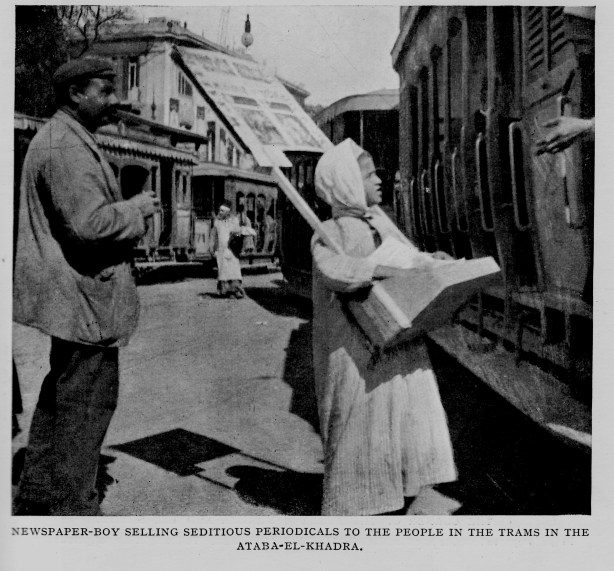
“Egyptian newspaper boy yelling out the latest headlines, Cairo, 1907.” Source: From Douglas Sladen, Oriental Cairo (London: 1911), 64.
However, as discussed in previous chapters, this was never a one way conversation, as writers of these vernacular media were plugged into the streets and public squares through these very same cafés. As we have observed in this study, it can be said that the entire vaudeville theater industry arose out of the cafés on ‘Imad al-Din Street, where most of the vaudeville theaters were housed [Note: See Ibrahim Ramzi, Masrahuna ’Ayyam Zaman wa Tarikh al-Fananin al-Qudama’ (Cairo: Matba‘at al-Salam (1984), 25. There were at least three major cafés in Imad al-Din Street that were frequented by actors, singers, writers, and musicians— Qahwat al-Fan (The Arts Café), Qahwat Barun (The Baron Cafés), and Qahwat Misr (The Egypt Café)]. It was through these dialogical “physical” interactions with the people in the streets, market places, and cafés that the writers, musicians and performers of these media (re)calibrated with the subtleties, textures, and flavors of everyday Egyptian life. As Mikhail Bakhtin cautions in The Dialogic Imagination, we must not ignore the “social life of discourse outside the artist’s study, discourse in the open spaces of public squares, streets, cities and villages;” for it is in these public spheres that Egyptian mass culture is embodied into everyday life, acquiring its socio-economic, political relevance, and more importantly perhaps, its perceived authenticity, and contemporaneity (259). Indeed, access to any form of knowledge— be it visual, aural, tactile, gustatory or olfactory—is corporally mediated and is acquired through a living dialogical engagement. Or as Bakhtin elaborates in Problems of Dostoevsky’s Poetics, “the single adequate form to verbally expressing authentic human life is the open ended dialogue . . . In this dialogue a person participates wholly and throughout his whole life, with his eyes, lips, hands, soul, spirit, within his whole body and deeds” (293). In other words texts alone are meaningless when viewed in isolation of the socially embodied realities of their production, and more importantly perhaps, their reception on the street. It is in their interrelationship with social life that texts become meaningfully activated and authenticated as genuinely reflecting popular concerns and realities. As we have seen throughout this book, colloquial Egyptian culture is better equipped in engaging in this dialogue with the everyday, and hence guaranteeing its circulation and popularity.
(Ordinary Egyptians, p. 170-172)
—
Featured Image: View 042: Egypt – Street in Native Quarter, Cairo., n.d., T. H. McAllister, Manufacturing Optician. 49 Nassau Street, New York. Brooklyn Museum Archives (S10|08 General Views_People, image 9785).
—
Ziad Fahmy is an Assistant Professor of Modern Middle East History at the department of Near Eastern Studies. Professor Fahmy received his History Ph.D. in 2007 from the University of Arizona, where his dissertation “Popularizing Egyptian Nationalism” was awarded the Malcolm H. Kerr Dissertation Award (2008) from the Middle East Studies Association. His first book, Ordinary Egyptians: Creating the Modern Nation through Popular Culture (Stanford University Press, 2011), examines how, from the 1870s until the eve of the 1919 revolution, popular media and culture provided ordinary Egyptians with a framework to construct and negotiate a modern national identity. His articles have appeared in the International Journal of Middle East Studies and in Comparative Studies of South Asia, Africa and the Middle East. Professor Fahmy is currently beginning another book project tentatively titled, Listening to the Nation: Sounds, Soundscapes, and Mass Culture in Interwar Egypt. In 2011-2012, he was a Faculty Fellow at the Society for the Humanities at Cornell University, where the focal theme was “Sound: Culture, Theory, Practice, and Politics.”
Share this:


Current Top Posts





April 2021

January 2020

November 2019

October 2019

August 2019

April 2014

November 2017

March 2015

December 2017

October 2015
 Sounding Out!
Recent Comments