
SO! L.A.: Sounding the California Story

 Editor’s Note: Welcome to the second installment in our month-long exploration of listening in observation of World Listening Day on July 18, 2012. For the full introduction to the series click here. To peep the previous post, click here. Otherwise, whip out your most oversized sunglasses, kick back, and listen to Bridget Hoida’s California. –JSA
—-
STOP.
Do not read along with me “in your book.”
Resist the temptation to follow along with your eyes.
Click play. Listen.

Sunset in the San Joaquin Valley
If I had things my way, I would whisper these stories to you as we sat in mesh folding chairs on the poured concrete porch of my Central Valley childhood home. If I had things my way, I would refill your glass with lemons and gin, and we would breathe in the sweet, summer smell of rotting blackberry brambles. If I had things my way, we would wait until the sun set against a Tokay harvest, taking with it the harsh triple digit temperature and leaving us nothing but the quiet of a delta breeze and moonlight. If I had it my way, I would ask you to lean in close as I whisper with canonical voices:
“This is a story about love and death in the golden land, …”
“I remember that moment exactly, those exact words registering in my mind like the notes of a solo…”
“Bobby Gene was a tattletale he told everything he heard…”
“You must not tell anyone what I am about to tell you…”
“My history is murky, and I wanted it [ …] that way so I could be free to tell whatever I wanted. ”
“I’ll tell you what I suppose from your silences and few words and you can tell me if I’m mistaken. You’ll have to speak up with the real stories if I’ve got you wrong…”
“And so they talked and told tales of their region, and I listened. Long into the night I listened until I dropped off to sleep and my father would pick me up onto his lap as he continued to talk about the Revolution…. And every camp was different, none existing for more than six or seven weeks, then off we would go to the next harvest, where new people would gather and there would be new tales to be told and heard. I knew when I was six years old that the one thing I most wanted from life was to be a storyteller.
The storied sound of California
-All Voices
Shush…. Listen.
Linger with me on the drawn-out drawl of the stories I was raised on. Of the stories I was raised upon. For this is the sound of the California story: A myriad of voices sounding out narratives onto the page. Conflicting, concurring, spoken-over and rewrote…no one lasts longer than the next harvest, the next filmic “Action!” This is the sound of the storied terrain of interwoven melodies spoken upon the California soil that I call home.
1.
In or around 1995, I fell madly in love with Joan Didion. It’s not so much Didion the woman but rather the sound of Didion’s words that have me so hung up. My obsession began in the stacks of the Bancroft Library at UC Berkeley. I was assistant to the assistant librarian there and during my lunch hour I would take the dumb waiter up to the roof, eat a Kaiser roll with apricot jam, and read dime store copies of classic novels. I chose the roof because I like to read aloud, and in libraries at the time, reading aloud, especially to yourself, was expressly forbidden.

So there I was on the roof of Bancroft, with my roll, my jam, and my dime store copy of Play It As It Lays. I opened the page and read something about snakes and Iago. A mother died, the town of Silver Wells was won, and then lost, in much the same way a marriage slips into divorce. And then it happened. I stumbled across a line that changed the way I thought about words. Page 7, the first full sentence of the top paragraph, on the right: I might as well lay it on the line, I have trouble with as it was.
And after that line a whole lot of white space.
Beautiful, brilliant, blank white space.
As though in the silence of the rooftop, of the view, Didion was screaming to the reader, to me, something louder than words. In that white space there was sound and it was deafening.

2.
Later, when I decided to get a Ph.D. in creative writing, and although I couldn’t say as much on paper, examine, among other things, the commonality of language in California writers and the sonic devices of oral storytelling, I came across a quote from Didion, in interview, that said:
I had the technical intention to write a novel so elliptical and fast […] it would scarcely exist on the page at all…white space. Empty space. […] A white book to which the reader would have to bring his or her own bad dreams…
And although I adore everything about her I almost wished she hadn’t said it. Or that I hadn’t read it, because the thing about Didion is that statement… the part about the blank space… and the nightmare… it was already there. On the roof of the Bancroft library with my Kaiser roll and apricot jam, when the air tasted like September, I brought my own bad dreams because in that brilliant bit of white space I heard the scream.
3.
I like the white page. I prefer stories to plots. Plot for me is how the narrative moves from one space in time (from one line on the page) to the next. Story is how the narrative sounds. Story is voice. Plots are where girls meet boys and girls lose boys and girls get boys back. Stories are the shuffle and stop of scuffed shoes walking railroad levees, old men clearing phlegm, the surprise of an elastic bikini band as it snaps against the freshly burnt back of a burgeoning starlet. And the sounds of words as they smack unbridled against the page.

a traditional page by John Steinbeck

a white page by Joan Didion
4.
When I read Didion we are on my porch and I hear her voice. When we think of writing, when we imagine reading, we think of quiet moments that exist alone with fixed type on a printed page. But as a reader, and more importantly as a writer, I have never felt this way.
5.
Voice, to paraphrase Emily Dickinson, is the “slant” you bring to your version of “the truth.” Plots are recyclable. Hell, you can buy one on eBay, to be sure. But a writer’s voice is different. I don’t read a book to figure out what happens next. I read to hear the whisper of the author’s voice. If they whisper well, I turn the page.
6.
From John Steinbeck to Gertrude Stein, John Fante to Susan Straight, Larry Levis and Mary Hunter Austin to William Saroyan and Shawna Yang Ryan, there is commonality of sound and language that I’m willing to claim composes an aural palimpsest of sorts. A voicing over, both literally and figuratively of native daughters and native sons held up on the tongue of the golden state.
The cadence, the rhythm, the obsession with things past. The aching nostalgic longing. The reflection. The fear. The reclamation. The imagination. The witness of an agrarian undoing. Sleepy Hollow moments reborn—again and again on western soil. The feeling of home. The feeling of home slipping away. The feeling of self, self-made in the image of home, slipping away alongside it. There’s a certain Californianess to it.
7.
What if we found a way to consider the sound these “fixed texts” emote? What if we broke with conventional narrative structure and embraced a written technique that more adeptly mirrored the sound and cadence of spoken story telling? Then might it be possible that the very aurality that is “written over” on the read palimpsest is in fact the sound that also remains?
As a writer, a writer who believes in voice, who rejoices in sounds as the strike-like syllables against a now forgotten Olivetti key, my pursuit in writing not only a novel, but in writing a novel about California was how I could possibly enter into this conversation. How I might be able to raise my voice loud enough to embrace the crowd of such a respectable page. How I could construct my text in such a way that it would not only read, but also sound Californian.

a “docu-page” by Raymond Barrio
8.
In my struggle to voice not only my novel, So L.A., but also my protagonist Magdalena de la Cruz, I relied heavily on the patterns, soundscapes and literary devices of the collective California canon comprised of authors such as the ones I spoke of above. In So L.A. I was looking for a way to tell the story out loud while still operating within the conventional structure of a “type and text” book.
 9.
9.
My novel opens with Magdalena falling off a boat and then moves both forward and backward in time. This is how most people tell stories orally. They begin in the middle and then jump around, forgetting, amending, and calling attention to the most important parts, while the listener rarely ever exclusively listens but instead interjects and provides his or her own connections, observations and experiences. Eliminating quotations allowed me to access some of this interplay. It allowed me to question the reliability of spoken language. Spoken utterance does NOT always translate to precise hearing of the said words uttered. There is always interference—be it emotional (memory-sound triggers), psychological (felt meaning as opposed to said meaning), physical (honking cars, loud birds, eye rolls and sneezing) or linguistic (signifiers and unspoken gestures). Just because words are utter does not mean they are the same words that are heard. And not only did I want this, but I needed it on my page. Although I considered the docunovel (in the vein of Raymond Barrio), autho-interview collage (like Anna Deavere Smith) and autofictive exploration (ala Salvador Plascencia) I ultimately decided to abandon quotation marks.


a “sounded” page from The People of Paper
10.
This (“) says open. It says start.
This (”) says closed. It says stop.
But (“) and (”) also sound.
For me they sound like a particularly rough clearing of the throat. They sound like standing on a library rooftop, trying to confess your love with the passion of a librarian “with hiccups.”
“They” interrupt the eye. “They” provide visual cues for accessing character and I didn’t want Magdalena “to be seen.” I wanted her to sound.
Her voice required a fluidity and unreliability not attainable “in quotes.” Without conventional quotes I was free to wander inside the head and voice of my protagonist as I pushed the blur between what she was saying, what the listener perceived she was saying, and what other characters were voicing without visual interruption.
11.
Also important in my authorial access to sound (and the absence of sound) on the fixed and written page was the use of filmic microchapters (some only as long as a single sentence). A sentence that reads as a chapter, surrounded by all that stark and lovely white space, not only looks different from a classical bookish chapter, but it also sounds different. Read out loud, or quietly inside the reader’s head, it sounds out a particular meaning and resonated differently within the mind’s eye and ear.
12.
With so much of the present world turning virtual, author and storyteller Barry Sanders concludes, “We demand less from the historical accuracy of our stories. We even demand less of a truth. We are content with images and feelings. If it feels closer to the truth then it might as well be.” However I’d like to extend Sander’s assessment beyond image and feeling to include sound. In this newly constructed world of virtual storytelling we are again experiencing a shift (not unlike the shift from oral to written storytelling) that is also sound dependent and sonically informed. From the staccato sounds of Twitter as compared to the unconstricted and leisurely expanse of Tumblr, it is important to acknowledge that the twenty-second sound bite can be (and historically has been) used (and utilized) in fiction to make noise and call attention to lasting moments of profound revelation. Although Didion’s Maria may “have trouble with how it was” I find a certain sense of comfort in how it is provided we are all able to lean in close and listen. Listen past the interference of type, text and YouTube to the sound of words both on and upon the page as,
“These are tales told in darkness in the quiet at the end of the day’s heat…”
—
Opening Image Credit: “L.A. Sky at Sunset” by Flickr User David Vienna
Audio note: Voices used, with the exception of Bridget Hoida, are not the actual voices of the authors listed, nor are they meant to be representative of said authors.
—
Bridget Hoida is the author of So L.A. (2012). In a past life she was a librarian, a DJ, a high school teacher, and a barista. In this life she experiments with words and has taught writing at UC Irvine, the University of Southern California and is currently a professor at Saddleback College. Hoida is the recipient of an Anna Bing Arnold Fellowship and the Edward Moses prize for fiction. She was a finalist in the Joseph Henry Jackson/San Francisco Intersection for the Arts Award for a first novel and the William Faulkner Pirate’s Alley first novel contest. Her short stories have appeared in the Berkeley Fiction Review, Mary, and Faultline Journal, among others, and she was a finalist in the Iowa Review Fiction Prize and the Glimmer Train New Writer’s Short Story Contest. Her poetry has been recognized as an Academy of American Poets Prize finalist and she was a Future Professoriate Scholar at USC.
She has a BA from UC Berkeley, a MA in fiction from San Francisco State University, and a Ph.D. in Literature and Creative Writing from the University of Southern California. So L.A. is her first novel.
Share this:

In the Flesh: Embodiment, Listening, and Transcription
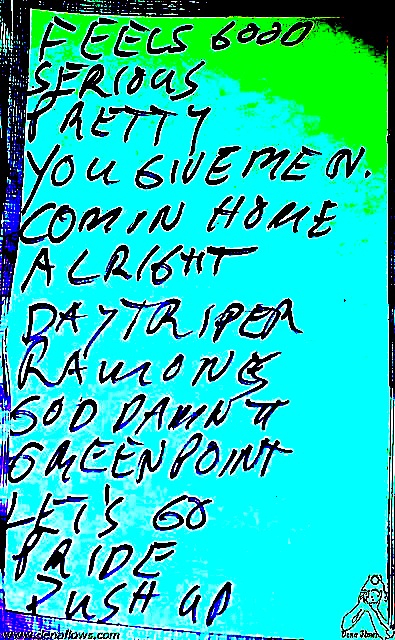
The Fleshtones Setlist, 9/11/12 show in Bilbao, Spain,
Editor’s Note: July 18th, 2012 has been designated as World Listening Day by the World Listening Project, a nonprofit organization founded in 2008 “devoted to understanding the world and its natural environment, societies and cultures through the practices of listening and field recording.” World Listening Day is a time to think about the impacts we have on our auditory environments and, in turn, its affects on us. This year, Sounding Out! has decided to observe World Listening Day by planning a month-long special forum of posts exploring several different facets of listening such today’s offering by SO!‘s Multimedia Editor Aaron Trammell on listening’s relationship to the body and next week’s discussion by novelist Bridget Hoida on the impact of listening on her writing process. We will also explore questions that we need to remember when we celebrate listening as a cultural, embodied act. What happens when listening is interrupted? distorted? A post on tinnitus by Mack Hagood will help us think through what happens when we take listening (and the able body) for granted as a universal, normative experience. We’ll also publish a special bonus multi-sensory post by our newest regular writer, Maile Colbert, on World Listening Day itself and we will launch our regular quarterly spring podcast for on July 12th, which will feature Eric Leonardson, director of the World Listening Project. In addition to being interesting as all hell, the podcast will suggest some ideas for how to get involved in WLD activities–or how to embark on a listening project of your own this July. Enjoy our ear-opening extravaganza and please keep those comments coming. We’d love to hear from you! –JSA, Editor-in-Chief
—
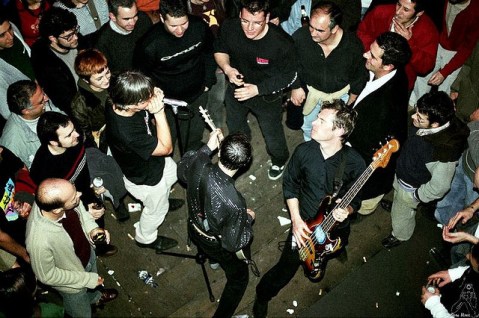
The Fleshtones, October 23, 2008, Image by Flickr User Dena Flows
What happens when the body translates sound from one medium to another? How is the body both affected by a song (when listening), and affecting it’s content (when writing)? In this post, I will relate my experience transcribing the lyrics of the song “Hexbreaker!” by The Fleshtones in an effort to answer these questions.
I love to sing. Often, I feel that it is only through singing that I feel that I can adequately relate to the emotions, ideas, and narrative of the songwriter. This relational practice is called embodiment. While psychologists such as Sigmund Freud and Carl Jung had at one point considered this sort of emotional relationship to be a libidinal drive – either to the phallus (in Freud’s case), or a unifying mythological symbol like the mandala (in Jung’s). These feelings, or drives, in classical psychoanalytic theory are part of our interior psyches, the unconscious mind.
Contemporary physiological research has departed from the sharp dichotomy of the conscious/unconscious mind. Instead, emotions are looked at as exterior phenomena – invisible links which form between bodies. As Lisa Blackman (2010) explains in her essay Embodying Affect: Voice-hearing, Telepathy, Suggestion and Modelling the Non-conscious: “The voices can be materialized through particular technologies of inscription such as neuro- imaging scans, and can even be located within the right temporal-parietal lobe, showing the capacity of the right brain not only for psychological attunement, but also for registering the affects of others” (166). Other theorists such as Sara Ahmed (2004) have argued that emotions float between and stick to bodies. Julian Henriques (2010) has even noted the ways that sonic vibrations work to activate reciprocal affective moods in others (75), a point very much in line with Blackman’s musings on the voice’s centrality to “psychic,”right brain, linkages. To these points, it is important to consider exactly what it means for the body to work as a medium of translation. What emotions can a song activate in my body, and how do these feelings become words, stored in the mnemonic confines of paper?
Because listening is central to the transmission and construction of emotional bonds, I will now detail my experience transcribing “Hexbreaker!”.
The Fleshtones are a band that I love. Their songs find the perfect balance of Animal House cool, Swinging Medallions style garage rock, and campy B-movie flavor. They have cred too, as they were a frequent act in the late-70s CBGB punk scene who shared a rehearsal space with The Cramps (a similar, but notably more famous band). Their song “American Beat” was key in the soundtrack of Tom Hanks’ shlocky 1984 film Bachelor Party. Peter Zaremba, the group’s singer, was a host on MTV’s interview based program, I.R.S. Records Presents the Cutting Edge. And, best of all, The Fleshtones have been largely eclipsed by bands with more visible albums, members, and histories. The band is all mine, and they serve as the perfect accent to any mixtape or conversation trivia at a mixer.
The digital footprint left by The Fleshtones is surprisingly sparse. Only a handful of key songs (from movie soundtracks) come up when a search for “fleshtones lyrics,” is queried on Google. A search for guitar notation or chord charts is completely fruitless, a rare feat in today’s search ecosystem. Even their vintage releases, 1982’s Roman Gods and 1983’s Hexbreaker!, were hard to pin down until the Australian label Raven re-released them on CD in 2011. For whatever reason, this sense of scarcity does nothing but excite me. It makes me feel an increased sense of intimacy and ownership. The Fleshtones, in this sense, are a knowledge commodity that has been underappreciated. By transcribing “Hexbreaker!”, and submitting it to the lyrics archive at lyrics.com (yet to be posted), I feel that I am laying claim to a space of knowledge and expertise neglected by many others.
Transcription is generally dull. Having transcribed many interviews in the past, I admit to regarding it as a job that requires patience more than practice: Press play. Listen for ten seconds. Jot down what was said. Forget half of what I was writing. Rewind five seconds. Listen again. Not quite enough to replace when I missed. Rewind eight seconds. Finish constructing the first sentence. Repeat. Hang in there for a few hours. Slow, repetitive, and monotonous is the work of interview transcription. In lieu of my previous experiences, I was happy to learn that the work of song transcription is notably more pleasurable. Although it came with its own share of frustrating and repetitive points, the presence of melody, cadence, and rhyme schemes made the entire process much more endearing and predictable.
One of the most engaging portions of song transcription came with the puzzling-out of unintelligible lyrics. The second verse of “Hexbreaker!” begins with a line that sounded like “With ____-____ mud and a hoodlum stack, finding fire in a mangled park” on first listen. It wasn’t until I had listened to each phrase five times in a row that I was able to revise to, “Well knee-high mud, and a moon lit shack, fightin’ flies in a mangled marsh.” Still not confident with that wording, I decided to do a dictionary search for similar words. To my elation after I had typed m-a-n-g into the dictionary the first word to appear was “mangrove,” the perfect word which I would never have guessed (it’s a weed-like tree found in coastal swamps!). Next I was spirited to discover that the following line evoked images of conquistadors sailing and exploring: “Well knee-high mud, and a moon lit shack, fightin’ flies in a mangrove marsh / Sendin’ sabres across the seven seas, or any foreign shores they may wash / I need a hexbreaker!”
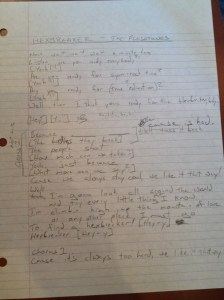
A transcript well done!
After I was able to get a gist of the overall narrative through transcription, I went back through the piece and was better able to make educated guesses about what the lyrics were. Although Zaremba often takes an unintelligible pitch when singing, the context of 17th century exploration helped me to piece together many of the tougher bits of the song. For instance, I revised the beginning of the chorus from “Well toss it back / [The bottles they break],” to fit the overall theme of colonial exploration, “The cause is had. / [The bodies they break].” Although, I’m not certain that these are the words to the song, I’m very confident because they match the overall theme. The practice of song-transcription has been fulfilling in the same way that figuring out a jigsaw, or tangram is exciting. It is a creative sort of problem solving, one that combines both analytic (left brain) and spatial, metaphoric (right brain) intelligence.
Emotionally, however, I did not feel the same satisfaction that I do when singing. Perhaps this has something to do with transcription alternate mode of embodiment. Transcription, and the pleasures associated – problem solving, precision, and permanence – are all of an analytical, and somewhat strategic sort. These are the pleasures of a conduit, processes associated more with the enduring construction of emotional bonds (belonging, and community), than the lucid enjoyment of them. It is my hope that one day another Fleshtones fan plumbs the depths of Google to find the lyrics of “Hexbreaker!” and that the fruit of my efforts, a completed transcript on lyrics.com, greets them and helps them to sing along and revel. Until then, it is enough to know that the work of transcription, for myself at least, is analytic and dry–definitely worlds apart from the euphoric mode of singing where my entire body vibrates in rhapsody to the melody, rhythm, and harmony of song.
—
Aaron Trammell is co-founder and multimedia editor of Sounding Out! He is also a Media Studies PhD candidate at Rutgers University.
Share this:


Current Top Posts





April 2021

January 2020

November 2019

October 2019

August 2019

April 2014

November 2017

March 2015

December 2017

October 2015
 Sounding Out!
Recent Comments