
Listening to and as Contemporaries: W.E.B. Du Bois & Sigmund Freud


 Inspired by the recent Black Perspectives “W.E.B. Du Bois @ 150” Online Forum, SO!’s “W.E.B. Du Bois at 150” amplifies the commemoration of the occasion of the 150th anniversary of Du Bois’s birth in 2018 by examining his all-too-often and all-too-long unacknowledged role in developing, furthering, challenging, and shaping what we now know as “sound studies.”
It has been an abundant decade-plus (!!!) since Alexander Weheliye’s Phonographies “link[ed] the formal structure of W.E.B. Du Bois’s The Souls of Black Folk to the contemporary mixing practices of DJs” (13) and we want to know how folks have thought about and listened with Du Bois in their work in the intervening years. How does Du Bois as DJ remix both the historiography and the contemporary praxis of sound studies? How does attention to Du Bois’s theories of race and sound encourage us to challenge the ways in which white supremacy has historically shaped American institutions, sensory orientations, and fields of study? What new futures emerge when we listen to Du Bois as a thinker and agent of sound?
Over the next two months, we will be sharing work that reimagines sound studies with Du Bois at the center. Pieces by Phillip Luke Sinitiere, Kristin Moriah, Aaron Carter-Ényì, Austin Richey, Julie Beth Napolin, and Vanessa Valdés, move us toward a decolonized understanding and history of sound studies, showing us how has Du Bois been urging us to attune ourselves to it. To start the series from the beginning, click here.
Readers, today’s post (the first of an interwoven trilogy of essays) by Julie Beth Napolin explores Du Bois and Freud as lived contemporaries exploring entangled notions of melancholic listening across the Veil.
–Jennifer Lynn Stoever and Liana Silva, Eds.
When W.E.B. Du Bois began the first essay of The Souls of Black Folk (1903) with a bar of melody from “Nobody Knows the Trouble I See,” he paired it with an epigraph taken from a poem by Arthur Symons, “The Crying of Water”:
O water, voice of my heart, crying in the sand,
All night long crying with a mournful cry,
As I lie and listen, and cannot understand
The voice of my heart in my side or the voice of the sea,
O water, crying for rest, is it I, is it I?
All night long the water is crying to me.
A listener, the poem’s speaker can’t be sure of the source of the sound, whether it is inward or outward. Something of its sound is exiled and resonates with Symons’ biographical position as a Welshman writing in English, an imperial tongue. At the heart of the poem is a meditation on language, communication, and listening. Personified, the water longs to be understood and sounds out the listener’s own interiority that struggles to be communicated. The poem’s speaker hears himself in the water, but he is nonetheless divided from it. If he could understand the source of the sound in a suppressed or otherwise unavailable memory, the speaker might be put back together. But listening all night long, that understanding does not come.

Démontée, Image by Flickr User Alain Bachellier
Together, the poem and song serve as a circuitous opening to Du Bois’ “Of Our Spiritual Strivings,” an essay that grounds itself in Du Bois’ training as a sociologist to detail “the color line,” which Du Bois takes to be the defining problem of 20th century America. The color line is not simply a social and economic problem of the failed projects of Emancipation and Reconstruction, but a psychological problem playing out in what Du Bois is quick to name “consciousness.” As the first African American to receive a PhD from Harvard in 1895, Du Bois had studied with psychologist William James, famous for coining the phrase “the stream of thought” in his modernist opus, The Principles of Psychology (1890). In her study of pragmatism and politics in Du Bois, Mary Zamberlin describes how James encouraged his students to listen to lectures in the way that one “receives a song” (qtd. 81). In his techniques of writing, Du Bois adopts and reinforces the paramount place of intuition and receptivity in James’ thought to conjoin otherwise opposed concepts. Demonstrated by the opening epigraphs themselves, Du Bois’ techniques often trade in a lyricism that stimulates the reader’s multiple senses.
I argue that Du Bois surpasses James by thinking through listening consciousness in its relationship to what we now call trauma. While I will remark upon the specific place of the melody in Du Bois’ propositions, I want to focus on the more generalized opening of his book in the sounds of suffering, crying, and what Jeff T. Johnson might call “trouble.” The contemporary understanding of trauma, as a belated series of memories attached to experiences that could not be fully grasped in their first instance, comes to us not from the scientific discipline of psychology, but rather psychoanalysis.
Among the field’s first progenitors, Sigmund Freud, was a contemporary of Du Bois. Though trained as a medical doctor, Freud sought to free the concept of the psyche from its anatomical moorings, focusing in particular on what in the human subject is irrational, unconscious, and least available to intellectual mastery. His thinking of trauma became most pronounced in the years following WWI, when he observed the consequences of shell-shock. Freud discovered a more generalizable tendency in the subject to go over and repeat painful experiences in nightmares. Traumatic repetition, he noted, is a subject struggling to remember and to understand something incredibly difficult to put into words. At the heart of Freud’s methods, of course, was listening and the observations it afforded, grounding his famous notion of the “talking cure.” Because trauma is so often without clear expression, Freud listened to language beyond meaning, beyond what can be offered up for scientific understanding.

Image by Flicker User Khuroshvili Ilya
The beginning of Souls, along with its final chapter on “sorrow songs,” slave song or spirituals, tells us that Du Bois’ project shared that same auditory core. Du Bois was listening to consciousness, that is, developing a theory of a listening (to) consciousness in an attempt to understand the trauma of racism and the long, drawn-out historical repercussions of slavery. Importantly, however, Du Bois’ meditation on trauma precedes Freud’s. But Du Bois’ thinking also surpasses Freud in beginning from the premise that trauma is the sine qua non of theorizing racism, which makes itself felt not only outwardly in social and economic structures, but inwardly in consciousness and memory.
Du Bois claimed that he hadn’t been sufficiently Freudian in diagnosing white racism as a problem of irrationality. He didn’t mean by this that Freud himself made such a diagnosis, but rather that Freud was correct in refusing to underestimate what is least understandable about people. Freud’s thinking, however, remained mired in racist thinking of Africa. Though he claimed to discover a universal subject in the structure of the psyche—no one is free from the unconscious—racist thinking provided the language for the so-called “primitive” part of the human being in drives. This primitivism shaped Freud’s myopic thinking of female sexuality, famously remarking that female sexuality is the “Dark Continent,” i.e. unavailable to theory. Freud drew the phrase from the imperialist travelogues of Henry Morton Stanley in the same moment that Du Bois was turning to Africa to find what he called, both with and against Hegel, a “world-historical people.” As I argue, Du Bois found in the music descended from the slave trade not only a “gift” and “message” to the world, but the ur-site for theorizing trauma.
Ranjana Khanna has shown how colonial thinking was the precondition for Freudian psychoanalysis. Anti-colonial psychiatrist Frantz Fanon, for example, both took up and resisted Freud when he elaborated the effects of racism as the origin of black psychopathology, i.e. feelings of being split or divided. Du Bois, like Fanon after him, was hearing trauma politically as a structural event. The complex intellectual biography of Du Bois, which includes a time of studying (in German) at Berlin’s Humboldt University, mandated that he took from European philosophical interlocutors what he needed, creating a hybrid yet decidedly new theory of listening consciousness. That hybridity is exemplified by the opening of his book, an antiphony between two disparate sources bound to each other across the Atlantic through what I will call hearing without understanding. In this post, I ask what Du Bois can tell us about psychoanalytic listening and its ongoing potential for sound studies and why Freud had difficultly listening for race.
***

“Before the Storm,” Image by Flickr User Marina S.
“Psychoanalysis . . . , more than any twentieth-century movement,” writes Eli Zaretsky in Political Freud, “placed memory at the center of all human strivings toward freedom” (41). He continues, “By memory I mean no so much objective knowledge of the past or history but rather the subjective process of mastering the past so that it becomes part of one’s identity.” In 1919, Freud gave a name to the experience resounding for Du Bois in Symons’ poem “The Crying of Water:” “melancholia.” Unlike mourning after the death of a loved one, whose aching and cries pass with time, melancholia is an ongoing, integral part of subjects who have lost more inchoate things, such as nation or an ideal. This loss, Freud contended, could in fact be constitutive of identity, or the “ego,” Latin for “I” (“is it I? Is it I?” Symons asks). In mourning, one knows what has been lost; in melancholia, one can’t totally circumscribe its contours.
Zaretsky details the way that Freudianism, particularly after its rapid expansion in the US after WWI, became a resource for the transformation of African American political and cultural consciousness, playing a pronounced role in the Harlem Renaissance, the Popular Front, and anti-imperialist struggles. Zaretsky rightly positions Du Bois and his 1903 text as the beginning of a political and cultural transformation, but it is an anachronism to suggest that Freudianism contributed to Du Bois’ early work. Not only does Du Bois’ analysis of “The Crying of Water” predate Freud’s “Mourning and Melancholia” by nearly two decades, the two thinkers were contemporaries. In the years that Freud was writing his letters to Wilhelm Fliess, which became the body of his first book, The Interpretation of Dreams (1900), Du Bois was compiling his previous publications for The Souls of Black Folk, along with writing a new essay to conclude it, “The Sorrow Songs,” a sustained reflection on melancholia and its cultural reverberations in song. 1903 is the year of Souls compilation, not composition.
Du Bois’ thinking of a racialized listening consciousness is not only contemporary to Freud, but also fulfills and outstrips him. To approach Du Bois and Freud as contemporaries involves positioning them as listeners on different, but not opposing sides of what Du Bois calls the “Veil.” It is the psychological barrier traumatically instantiated by racialization, which Du Bois famously describes in the first chapter of Souls. The Veil, Jennifer Stoever describes, is both a visual and auditory figure, the barrier through which one both sees and hears others.
To better define the Veil, Du Bois—like Frederick Douglass before him—returns to a painful childhood scene that inscribed in his memory the violence of racial difference and social hierarchy. Early works of African American literature often turn to memoir, writing their elided subjectivity into history. But we miss something if we don’t recognize there a proto-psychoanalytic gesture. In the middle of a sociological, political essay, Du Bois writes of the painful memory of a little white girl rejecting his card, a gift. In this, we can recognize the essential psychoanalytic gesture of returning to the traumatic past of the individual as a forge for self-actualization in the present.

“Storm Coming Our Way” by Flickr User John
As Paul Gilroy has described, Du Bois’ absorption of Hegel’s thought while at Humboldt cannot be underestimated, particularly in terms of the famous master-slave dialectic. In this dialectic, the slave-consciousness emerges as victorious because the master depends on him for his own identity, a struggle that Hegel described as taking place within consciousness. Like Hegel, Zaretsky notes, Du Bois understood outward political struggle to be bound to “internal struggle against . . . psychic masters” (39). I would state this point differently to note that Du Bois’ traumatic experience as a raced being had already taught him the Hegelian maxim: the smallest unit of being is not one, but two. For Hegel, the slave knows something the master doesn’t: I am only complete to the extent that I recognize the other in myself and that the other recognizes me in herself. That is the essential lesson that an adult Du Bois gleans from the memory of the little girl who will not listen to him. He recognizes that she, too, is incomplete.
The essential difference between psychoanalysis and the Hegelian thrust of Du Bois’ essay, however, is that while a traditional analysand seeks individual re-making of the past—not only childhood, but a historical past that shapes an ongoing political present– Du Bois emphasizes the collective and in ways that cannot be reduced to what Freud later calls the “group ego.” If we restore the place of Du Bois at the beginnings of psychoanalysis and its ways of listening to ego formation, then we find that race, rather than being an addendum to its project, is at its core.
We can begin by turning to a paradigmatic scene for psychoanalytic listening, the one that has most often been taken up by sound studies: the so-called “primal scene.” In among the most famous dreams analyzed by Freud, Sergei Pankejeff (a.k.a. the “Wolf Man”) recalls once dreaming that he was lying in bed at night near a window that slowly opened to reveal a tree of white wolves. Silent and staring, they sat with ears “pricked” (aufgestellt). Pricked towards what? The young boy couldn’t hear, but he sensed the wolves must have been responding to some sound in the distance, perhaps a cry.

“The Wolf Man’s Dream” by Sergei Pankejeff, Freud Museum, London
In “The Dream and the Primal Scene” section of “From the History of An Infantile Neurosis” (1914/1918), Freud concluded that the dream was grounded in the young boy’s traumatic experience of witnessing his parents having sex. Calling this the “primal scene,” Freud conjectured that there must have been an event of overhearing sounds the young boy could not understand. In the letters he exchanged with Fliess, Freud had begun to attend to the strange things heard in childhood as the basis for fantasy life and with it, sexuality.
The primal scene is therefore crucial for Mladen Dolar’s theory in A Voice and Nothing More when he pursues the implications of an unclosed gap between hearing and understanding. In the Wolf Man’s case, it is impossible, Freud writes, for “a deferred revision of the impressions…to penetrate the understanding.” In Dolar’s estimation, the deferred relation between hearing and understanding defines sexuality and is the origin of all fantasy life. This gap in impressions cannot be closed or healed, and, for Jacques Lacan it also orients the failure of the symbolic order to bring the imaginary order to language. From this moment forward, psychoanalytic theory argues the subject is “split,” listening in a dual posture for the threat of danger and the promise of pleasure. Following Lacan, Dolar, Michel Chion, and Slavoj Žižek return to the domain of infantile listening—listening that occurs before a person has fully entered into speech and language—to explain the effects of the “acousmatic,” or hearing without seeing.
After Freud, the phrase “primal scene” has taken on larger significance as a traumatic event that, while difficult to compass, nonetheless originates a new subject position that makes itself available to a collective identity and identification. The original meaning of hearing sexual and libidinal signals without understanding them, I would suggest, holds sway. Psychoanalytic modes of listening, particularly if restored to its political origins in racism, offer resources for what it means to listen beyond understanding, but such thinking of race immediately folds into intersectional thinking of gender and sexuality. Consider the place of the traumatic memory of the little girl who rejects the card. In The Sovereignty of Quiet, Kevin Quashie returns to Du Bois’ primal scene to note how the scene takes place in silence, for she rejects it, in Du Bois’ terms, “with a glance.” I want to expand upon this point to note that where there is silence, there is nonetheless listening. Du Bois is listening for someone who will not speak to him; he desires to be listened to and the card—a calling card—figures a kind of address.

Vintage Calling Card, Image by Flickr User Suzanne Duda
It has gone largely unnoticed that, to the extent that the scene is structured by the master-slave dialectic, it is also structured by desire. This scene of trauma is shattering for both boy and girl. The desire coursing through the scene is suppressed in Du Bois’ adult memory in favor of its meaning for him as a political subject. What would it mean to recollect, on both sides, the trace of sexual (and interracial) desire? In “Resounding Souls: Du Bois and the African American Literary Tradition,” Cheryl Wall notes the scant place for black women in the political imaginary of this text. This suppression, I would argue, already begins in the memory of the girl who appears under the sign of the feminine more generally. The fact that she is white, however, casts a greater taboo over the scene and therefore allows more for a suppression of sexuality in his memory. Du Bois emerges as a political agent disentangled from black women—with one notable exception, the maternal, and this exception demands that we listen with ears pricked to “The Sorrow Songs,” as Du Bois’ early contribution to the psychoanalytic theory of melancholia.
Next week, part two will further explore The Souls of Black Folk as a “displaced beginning of psychoanalytic modes of listening,” emphasizing the African melodies once sung by his grandfather’s grandmother that Du Bois’s hears as a child, as “a partial memory and a mode of overhearing.”
—
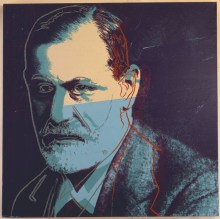
Featured Images: “Nobody Knowns the Trouble I See” from The Souls of Black Folk, Chapter 1, “W.E.B. Du Bois” by Winold Reiss (1925), “Sigmund Freud” by Andy Warhol (1962)
—
Julie Beth Napolin is Assistant Professor of Literary Studies at The New School, a musician, and radio producer. She received a PhD in Rhetoric from the University of California, Berkeley. Her work participates in the fields of sound studies, literary modernism and aesthetic philosophy, asking what practices and philosophies of listening can tell us about the novel as form. She served as Associate Editor of Digital Yoknapatawpha and is writing a book manuscript on listening, race, and memory in the works of Conrad, Du Bois, and Faulkner titled The Fact of Resonance. Her work has appeared in qui parle, Fifty Years After Faulkner (ed. Jay Watson and Ann Abadie), and Vibratory Modernism (ed. Shelley Trower and Anthony Enns).
—
 REWIND! . . .If you liked this post, you may also dig:
“A Sinister Resonance”: Joseph Conrad’s Malay Ear and Auditory Cultural Studies–Julie Beth Napolin
“Scenes of Subjection: Women’s Voices Narrating Black Death“–Julie Beth Napolin
Unsettled Listening: Integrating Film and Place — Randolph Jordan
Share this:

In Search of Politics Itself, or What We Mean When We Say Music (and Music Writing) is “Too Political”

Music has become too political—this is what some observers said about the recent Grammy Awards. Following the broadcast last week, some argued that musicians and celebrities used the event as a platform for their own purposes, detracting from the occasion: celebration of music itself. Nikki Haley, the U.S. Ambassador to the United Nations, tweeted:
I have always loved the Grammys but to have artists read the Fire and Fury book killed it. Don’t ruin great music with trash. Some of us love music without the politics thrown in it.— Nikki Haley (@nikkihaley) January 29, 2018
I don’t know for sure, but I imagine that the daily grind of a U.N. ambassador is filled with routine realities we refer to as “politics”: bureaucracy, budget planning, hectic meetings, and all kinds of disagreements. It makes some sense to me, then, that Haley would demand a realm of life that is untouched by politics—but why music in particular?
The fantasy of a space free from politics resembles other patterns of utopian thought, which often take the form of nostalgia. “There was a time when only a handful of people seemed to write politically about music,” said Chuck Klosterman, a novelist and critic of pop culture, in an interview in June 2017. He continued:
Now everybody does, so it’s never interesting. Now, to see someone only write about the music itself is refreshing. It’s not that I don’t think music writing should have a political aspect to it, but when it just becomes a way that everyone does something, you see a lot of people forcing ideas upon art that actually detracts [sic] from the appreciation of that art. It’s never been worse than it is now.
He closed his interview by saying: “I do wonder if in 15 years people are going to look back at the art from this specific period and almost discover it in a completely new way because they’ll actually be consuming the content as opposed to figuring out how it could be made into a political idea.” Klosterman almost said it: make criticism great again.
Reminiscing about a time when music writing was free from politics, Klosterman suggests that critics can distinguish between pure content and mere politics—which is to say, whatever is incidental to the music, rather than central to it. He offers an example, saying, “My appreciation of [Merle Haggard’s] ‘Workin’ Man Blues’ is not really any kind of extension of my life, or my experience, or even my values. […] I can’t describe why I like this song, I just like it.” If Klosterman, an accomplished critic, tried to describe the experiences that lead him to like this particular song, he probably could—but the point is that he doesn’t make explicit the relationship between personal identity and musical taste.

Screen Capture of Merle Haggard singing “Workin’ Man Blues,” Live from Austin, Texas, 1978
The heart of Klosterman’s concern is that critics project too many of their own problems and interests onto musicians. Musician and music writer Greg Tate recently made a similar suggestion: when reviewing Jay-Z’s album 4:44, Tate focuses on how celebrities become attached to public affects. In his July 2017 review, “The Politicization of Jay-Z,” he writes:
In the rudderless free fall of this post-Obama void […] all eyes being on Bey-Z, Kendrick, and Solange makes perfect agitpop sense. All four have become our default stand-ins until the next grassroots groundswell […] Bey-Z in particular have become the ready-made meme targets of everything our online punditry considers positive or abhorrent about Blackfolk in the 21st century.
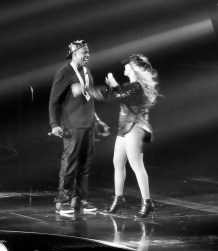
Jay and Bey perform live in 2013, by Flickr user sashimomura,(CC BY 2.0)
He suggests that critics politicize musicians, turning them into repositories of various projections about the culture-at-large. Although writing from a very different place than Klosterman, Tate shares the sense that most music criticism is not really about music at all. But whereas Klosterman implies that criticism resembles ideological propaganda too much, Tate implies that criticism is a mere “stand-in” for actual politics, written at the expense of actual political organizing. In other words, music criticism is not political enough.
In 1926, W.E.B. Du Bois wrote about this problem, the status of art as politics. In his essay “Criteria of Negro Art,” he dissects what he perceives to be the hypocrisy of any demand for pure art, abstracted from politics; he defends art that many others would dismiss as propagandistic—a dismissal revealed to be highly racialized. He writes:
Thus all Art is propaganda and ever must be, despite the wailing of the purists. I stand in utter shamelessness and say that whatever art I have for writing has been used always for propaganda for gaining the right of black folk to love and enjoy. I do not care a damn for any art that is not used for propaganda. But I do care when propaganda is confined to one side while the other is stripped and silent.
Du Bois’s ideas would be engaged extensively by later authors, including Amiri Baraka. In his 1963 essay “Jazz and the White Critic,” he addresses politics in terms of “attitude.” Then-contemporary white critics misunderstood black styles, he argued, because they failed to fully apprehend the attitudes that produced them. They were busy trying, and failing, to appreciate the sound of bebop “itself,” but without considering why bebop was made in the first place.
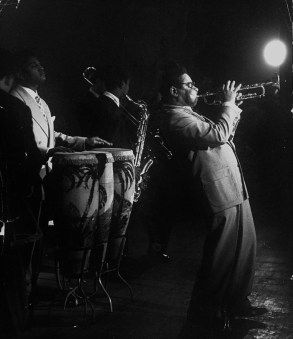
Dizzy Gillespie, one of BeBop’s key players, in Paris, 1952, Image courtesy of Flickr User Kristen, (CC BY 2.0)
As Baraka presents it, white critics were only able to ignore black musicians’ politics and focus on the music because the white critics’ own attitudes had already been assumed to be superior, and therefore rendered irrelevant. Only because their middle-brow identities had been so thoroughly elevated in history could these middle-brow critics get away with defining the object of their appreciation as “pure” music. Interestingly, as Baraka concludes, it was their ignorance of context that ultimately served to “obfuscate what has been happening with the music itself.” It’s not that the music itself doesn’t matter; it’s that music’s context makes it matter.
In response to morerecent concerns about the politicization of popular music, Robin James has analyzed the case of Beyoncé’s Lemonade. She performs a close reading of two reviews, by Carl Wilson and by Kevin Fallon, both of whom expressly seek the album’s “music itself,” writing against the many critical approaches that politicize it. James suggests that these critics can appeal to “music itself” only because their own identities have been falsely universalized and made invisible. They try to divorce music from politics precisely because this approach, in her words, “lets white men pop critics have authority over black feminist music,” a quest for authority that James considers a form of epistemic violence.
That said, James goes on to conclude that the question these critics ask—“what about the music?”—can also be a helpful starting point, from which we can start to make explicit some types of knowledge that have previously remained latent. The mere presence of the desire for a space free from politics and identity, however problematic, tells us something important.
 Our contemporary curiosity about identity—identity being our metonym for “politics” more broadly—extends back at least to the 1990s, when music’s political status was widely debated in terms of it. For example, in a 1991 issue of the queercore zine Outpunk, editor Matt Wobensmith describes what he perceived to be limitations of thinking about music within his scene. He laments what he calls “musical purism,” a simplistic mindset by which “you are what you listen to.” Here, he capitalizes his points of tension:
Suddenly, your taste in music equates you with working class politics and a movement of the disenfranchised. Your IDENTITY is based on how music SOUNDS. How odd that people equate musical chops with how tough or revolutionary you may be! Music is a powerful language of its own. But the music-as-identity idea is a complete fiction. It makes no sense and it defies logic. Will someone please debunk this myth?
Wobensmith suggests that a person’s “musical chops,” their technical skills, have little to do with their personal identity. Working from the intersection of Klosterman and Tate, Wobensmith imagines a scenario in which the abstract language of music transcends the identities of the people who make it. Like them, Wobensmith seems worried that musical judgments too often unfold as critiques of a musician’s personality or character, rather than their work. Critics project themselves onto music, and listeners also get defined by the music they like, which he finds unsettling.
 That same year, in an interview published in the 1991 issue of the zine Bikini Kill, musicians Kathleen Hanna and Jean Smith addressed a similar binary as Wobensmith, that of content and technique. But they take a different view: in fact, they emphasize the fallacy of this dualism in the first place. “You just can’t separate it out,” said Hanna, questioning the possibility of distinguishing between content—the “music itself”—and technique on audio recordings.
Female-fronted bands of this era were sometimes criticized for their lack of technique, even as terrible male punk bands were widely admired for their cavalier disregard of musical rules. Further still, disparagement of women’s poor technique often overlooked the reasons why it suffered: many women had been systematically discouraged from musical participation in these scenes. Either way, as Tamra Lucid has argued, it is the enforcement of “specific canons of theory and technique,” inevitably along the lines of identity, that cause harm if left unexamined.
All of these thinkers show that various binaries in circulation—sound and identity, personality and technique, music and politics—are gendered in insidious ways, an observation arrived at by the same logic that led Du Bois to reveal the moniker of “propaganda” to be racialized. As Hanna puts it, too many people assumed that “male artists are gonna place more importance on technique and female artists’ll place more on content.” She insists that these two concepts can’t be separated in order to elevate aspects of experience that had been implicitly degraded as feminine: the expression of righteous anger, or recollection of awkward intimacy.

Bikini Kill at Gilman Street, Berkeley, CA, 1990s, Image by Flickr User John Eikleberry, CC BY-NC 2.0
Punk had never pretended not to be political, making it a powerful site for internal critique. Since the 1970s, punk had been a form in which grievances about systemic problems and social inequality could be openly, overtly aired. The riot grrrls, by politicizing confessional, femme, and deeply private forms of expression within punk, demonstrated that even the purest musical politics resemble art more than is sometimes thought: “politics itself” is necessarily performative, personal, and highly expressive, involving artifice.
Even the act of playing music can be considered a form of political action, regardless of how critics interpret it. In another punk zine from c. 1990, for example, an anonymous author asks:
What impact can music have? You could say that it’s always political, because a really good pop song, even when it hasn’t got political words, is always about how much human beings can do with the little bag of resources, the limited set of playing pieces and moves and words, available […] Greil Marcus calls it ‘the vanity of believing that cheap music is potent enough to take on nothingness,’ and it may be cool in some places to mock him but here he’s dead-on right.
But music is never only political—that is, not in the elections-and-petitions sense of the word. And music is always an action, always something done to listeners, by musicians (singers, songwriters, producers, hissy stereo systems)—but it’s never only that, when it’s any good: no more than you, reader, are the social roles you play.
The author persuades us that music is political, even as they insist that it’s something more. Music as “pure sound,” as a “universal language” seems to have the most potential to be political, but also to transcend politics’ limitations—the trash, the propaganda. Given this potential, some listeners find themselves frustrated with music’s consistent failure to rise to their occasion, to give them what they desire: to be apolitical.

Kelly Clarkson performed at The Chelsea on July 27, 2012, image by Flickr User The Cosmopolitan of Las Vegas, CC BY-NC 2.0
In an interview during the recent Grammys broadcast, pop singer Kelly Clarkson said, “I’m political when I feel like I need to be.” It’s refreshing to imagine politics this way, like a light we turn on and off–and it’s a sign of political privilege to be able to do so. But politics are, unfortunately, inextricable from our lives and therefore inescapable: the places we go, the exchanges we pursue, the relationships we develop, the ways we can be in the world. Thinking with Robin James, it seems that our collective desire for a world free from all this reveals a deeper knowledge, which music helps make explicit: we wish things were different.
I wonder if those who lament the “contamination” of the Grammys with politics might be concerned that their own politics are unfounded or irrelevant, requiring revision, just as many white people who are allergic to identity politics are, in fact, aware that our own identity has been, and continues to be, unduly elevated. When Chuck Klosterman refuses to describe the reason why he likes “Workin’ Man Blues,” claiming that he “just does,” does he fear, as I sometimes do, not that there is no reason, but that this reason isn’t good enough?
Fortunately, there are many critics today who do the difficult work of examining music’s politics. Take Liz Pelly, for example, whose research about the backend of streaming playlists reminds us of music’s material basis. Or what about the astute criticism of Tim Barker, Judy Berman, Shuja Haider, Max Nelson, and others for whom musical thought and action are so thoroughly intertwined? Finally, I think of many music writers at Tiny Mix Tapes, such as Frank Falisi, Hydroyoga, C Monster, or Cookcook, for whom creation is a way of life—and whose creative practices themselves are potent enough to “take on nothingness.”
“Music is never only political,” as the anonymous ‘zine article author argues above, but it is always political, at least a little bit. As musicians and critics, our endeavor should not be to transcend this fact, but to affirm it with increasing nuance and care. During a recent lecture, Alexander Weheliye challenged us in a lecture given in January 2018 at New York University, when listening, “To really think: what does this art reflect?” Call it music or call it politics: the best of both will change somebody’s mind for real, and for the better.
—
Featured Image: Screen Capture from Kendrick Lamar’s video for “HUMBLE,” winner of the 2018 Grammy for “Best Music Video.”
—
Elizabeth Newton is a doctoral candidate in musicology. She has written for The New Inquiry, Tiny Mix Tapes, Real Life Magazine, the Quietus, and Leonardo Music Journal. Her research interests include musico-poetics, fidelity and reproduction, and affective histories of musical media. Her dissertation, in progress, is about “affective fidelity” in audio and print culture of the 1990s.
—
 REWIND!…If you liked this post, you may also dig:
SO! Reads: Jace Clayton’s Uproot–Elizabeth Newton
Re: Chuck Klosterman – “Tomorrow Rarely Knows”–Aaron Trammell
This is What It Sounds Like . . . . . . . . On Prince (1958-2016) and Interpretive Freedom–Ben Tausig
Share this:


Current Top Posts





April 2021

January 2020

November 2019

October 2019

August 2019

April 2014

November 2017

March 2015

December 2017

October 2015
 Sounding Out!
Recent Comments