
Listen to the Sound of My Voice
Betrayal
I first realized there was a problem with my voice on the first day of tenth grade English class. The teacher, Mrs. C, had a formidable reputation of strictness and high standards. She had us sit in alphabetical order row after row, and then insisted on calling roll aloud while she sat at her desk. Each name emerged as both a command and a threat in her firm voice.
“Kelly Barfield?”
“Here,” I mumbled quietly. I was a Honor Roll student with consistent good grades, all A’s and one B on each report card, yet I was shy and softspoken in classes. This was an excellent way to make teachers amiable but largely go unnoticed. The softness of my voice made me less visible and less recognizable.
Mrs. C repeated my name. Caught off guard, I repeated “here” a little more loudly. She rose to her feet to get a better look at me. I knew what she saw: a petite girl with long ash blonde hair, big brown eyes, and overalls embroidered with white daisies on the bib. When her gaze finally met mine, Mrs. C frowned at me and cleared her throat loudly. I curled into my desk, hoping to disappear.

“Lincoln High School 9-16-2007 008” by Flickr user Paul Horst, CC BY-NC 2.0
“Miss Barfield, did you hear me call your name twice? In this class, when I call roll, you respond.” I gave a quick nod, but Mrs. C wasn’t finished: “We use our strong voices in here, not our girly, breathy ones.” My cheeks flushed red while Mrs. C droned on about confidence and classroom expectations.
“Do you understand me?”
I stammered a “yes.” Mrs. C turned her attention back to the roll call. Her harsh words rang in my ears. I sank low in my chair, humiliated and angry. I couldn’t help that I sounded girly: I was, in fact, a girl. This was the way my voice sounded. It was not an attempt to sound like the dumb blonde she appeared to think I was.
That day I decided that I would never speak up in her class. Forget the Honor Roll. If the sound of my voice was such a problem, then my mouth would remain firmly shut in this class and all of my others. I would never speak up again.

“Listen” by Flickr user lambda_x, CC BY-ND 2.0
My vow to stop speaking lived a short life. I enjoyed Mrs. C’s serious fixation on diagramming sentences and her attempts to show sophomores that literature offered ideas and worlds we didn’t quite know. At first, I spoke up with hesitation and fear of the inevitable dismissal, but I continued to speak. Becoming louder became my method to seem confident, even when I felt anything but.
Throughout high school, my voice emerged again and again as a problem. Despite the increased volume, my voice still sounded tremulous, squeaky, hesitant, and shrill to my own ears. Other girls had these steady, warm voices that encouraged others to listen to them. Some had higher voices that were melodic and lovely. I craved a lower, more resonant voice, but I was stuck with what I had. In drama club, our director scolded me with increasing frustration about my tendency to end my lines in the form of a question. My nerves materialized as upspeak. The more he yelled at me, the more pronounced the habit became. He eventually gave up, disgusted by my inability to control my vocal patterns.

By Dvortygirl, Mysid [GFDL (http://www.gnu.org/copyleft/fdl.html) or CC-BY-SA-3.0 (http://creativecommons.org/licenses/by-sa/3.0/)%5D, via Wikimedia Commons
Meanwhile, at a big state university in my native Florida, I learned quickly that a Southern accent marks you as a dumb redneck from some rural town that no one had heard of. Students in my classes asked me to say particular words and then giggled at my pronunciations. “You sound like a Southern belle,” one student noted. This was not really a compliment. According to my peers, Southern belles didn’t have a place in the classroom. Southern belles didn’t easily match up with “college student. As a working-class girl from a trailer park, I learned that I surely didn’t sound like a college student should. I worked desperately to rid myself of any hint of twang. I dropped y’all and reckon.
I listened carefully to how other students talked. I mimicked their speech patterns by being more abrupt and deadpan, slowly killing my drawl. When I finally removed all traces of my hometown from my voice, my friends both from home and from college explained that now I sounded like an extra from Clueless. My voice was all Valley girl. I was smarter, they noted with humor, than I sounded and looked. My voice now alternated between high-pitched and fried. Occasionally, it would squeak or crack. I thought I sounded too feminine and too much like an airhead, even when I avidly tried not to. I began to hate the sound of my voice.
My voice betrayed me because it refused to sound like I thought I needed it to. It refused to sound like anyone but me.
When I started teaching and receiving student evaluations, my voice became the target for students to express their displeasure with the course and me. According to students, my voice was too high and grating. Screechy, even: one student said my voice was at a frequency that only bats could hear. In every set of evaluations, a handful of students declared that I sounded annoying. This experience, however, was not something I alone faced. Women professors and lecturers routinely face gender bias in teaching evaluations. According to the interactive chart, Gender Language in Teaching Evaluations, female professors are more likely to be called “annoying” than their male counterparts in all 25 disciplines evaluated. The sound of my voice was only part of the problem, but I couldn’t help but wonder if how I sounded was an obstacle to what I was teaching them.
Once again, I tried to fix my problematic voice. I lowered it. I listened to NPR hosts in my search for a smooth, accentless, and educated sound, and I attempted to create a sound more like them. I practiced pronouncing words like they did. I modulated my volume. I paid careful attention to the length of my vowels. I avoided my natural drawl. None of my attempts seemed to last. Some days, I dreaded lecturing in my courses. I had to speak, but I didn’t want to. I wondered if my students listened, but I wondered more about what they heard.
Sound
Public Domain, https://commons.wikimedia.org/w/index.php?curid=1393933
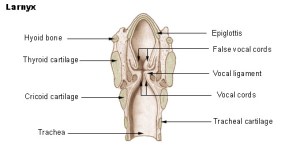
The sound of your voice is a distinct trait of each human being, created by your lungs, the length of your vocal cords, and your larnyx. Your lungs provide the air pressure to vibrate your vocal cords. The muscles of your larnyx adjust both the length and the tension of the cords to provide pitch and tone. Your voice is how you sound beyond the resonances that you hear when you speak. It is dependent on both the length and thickness of the vocal cords. Biology determines your pitch and tone. Your pitch is a result of the rate at which your vocal cords vibrate. The faster the rate, the higher your voice. Women tend to have shorter cords than men, which makes our voices higher.
Emotion also alters pitch. Fright, excitement, and nervousness all make your voice sound higher. Nerves would make a teenage girl have an even higher voice than she normally would. Her anxious adult self would too. Her voice would seem tinny because her larnyx clenched her vocal cords tight. Perhaps this is the only sound she can make. Perhaps she is trying to communicate with bats because they at least would attempt to listen.
Biology, the body, gives us the voices we have. Biology doesn’t care if we like the ways in which we sound. Biology might not care, but culture is the real asshole. Culture marks a voice as weak, grating, shrill, or hard to listen to.
“Speak” by Flickr user Megara Tegal, CC BY-NC-ND 2.0
My attempts to change my voice were always destined to fail. I fought against my body and lost. I couldn’t have won even if I tried harder. My vocal cords are determined that my voice would be high, so it is. The culture around me, however, taught me to hate myself for it. Voice and body seem to cast aspersions on intelligence or credentials. It’s the routineness of it all that wears on me. I expect the reactions now.
I wonder if I’m drawn to the quietness of writing because I don’t have to hear myself speak. I crave the silence while simultaneously bristling at it. Why is my voice a problem that I must resolve to placate others? How can I get others to hear me and not the stereotypes that have chased me for years?
Fury
My silence has become fruitful. The words I don’t say appear on the page of an essay, a post, or an article. I type them up. I read aloud what I first refused to say. I wince as I hear my voice reciting my words. I listen carefully to the cadence and tone. This separation of words and voice is why writing appeals to me. I can say what I want to say without the sound of my voice causing things to go awry.
People can read what I write, yet they can’t dismiss my voice by its sound. Instead, they read what I have to say. They imagine my voice; my actual sound can’t bother them. But, they aren’t really hearing me. They just have my words on the page. They don’t know how I wrap the sound around them. They don’t hear me.
Rebecca Solnit, in “Men Explain Things to Me,” writes “Credibility is a basic survival tool.” Solnit continues that to be credible is to be audible. We must be heard to for our credibility to be realized. This right to speak is crucial to Solnit. Too many women have been silenced. Too many men refuse to listen. To speak is essential “to survival, to dignity, and to liberty.”

“Listen” by Flickr user Emily Flores, CC BY-ND 2.0
I agree with her. I underline her words. I say them aloud. The more I engage with her argument, the more I worry. What about our right to be heard? When women speak, do people listen? Women can speak and speak and speak and never be heard. Our words dismissed because of gender and sound. Being able to speak is not enough, we need to be heard.
We get caught up in the power of speaking, but we forget that there’s power in listening too. Listening is political. It is act of compassion and empathy. When we listen, we make space for other people, their stories, their voices. We grant them room to be. We let them inhabit our world, and for a moment, we inhabit theirs. Yes, we need to be able to speak, but the world also needs to be ready to listen us.
We need to be listened to. Will you hear me? Will you hear us? Will you grant us room to be?
When I think of times I’ve been silenced and of the times I haven’t been heard, I feel the sharp pain of exclusion, of realizing that my personhood didn’t matter because of how I sounded. I remember the burning anger because no one would listen. I think of the way that silence and the policing of how I sound made me feel small, unimportant, or disposable. As a teenager, a college student, and a grown woman, I wanted to be heard, but couldn’t figure out exactly how to make that happen. I blamed my voice for a problem that wasn’t its fault. My voice wasn’t the problem at all; the problem was the failure of others to listen.
“listen” by Flickr user Jay Morrison, CC BY-NC-ND 2.0
Loss
While writing this essay on my voice, I almost lost mine, not once but twice. I caught a cold and then the flu. My throat ached, and I found it difficult to swallow. A stuffy nose gave my voice a muted quality, but then, it sounded lower and huskier. I could hear the congestion disrupting the timber of my words. My voice blipped in and out as I were radio finding and losing signal. It hurt to speak, so I was quiet.
“You sound awful,” my husband said in passing. He was right. My voice sounded unfamiliar and monstrous. I tested out this version of my voice. It was rougher and almost masculine. I can’t decide if this is the stronger, more authoritative voice I wanted all along or some crude mockery of what I can never really have. I couldn’t sing along with my favorite songs because my voice breaks at the higher register. I wheezed out words. I croaked my way through conversations. “Are you sick?” my daughter asked, “You don’t sound like you.”
Her passing comment stuck with me. You don’t sound like you. Suddenly, I missed the sound of my voice. I disliked this alien version of it. I craved that problematic voice that I’ve tried to change over the years. I wanted my voice to return.
After twenty years, I decided to acknowledge the sound of me, even if others don’t. I want to be heard, and I’m done trying to make anyone listen.
—
Featured image: “Speak” by Flickr user Ash Zing, CC BY-NC-ND 2.0
—
Kelly Baker is a freelance writer with a religious studies PhD who covers religion, higher education, gender, labor, motherhood, and popular culture. She’s also an essayist, historian, and reporter. You can find her writing at the Chronicle for Higher Education‘s Vitae project, Women in Higher Education, Killing the Buddha, and Sacred Matters. She’s also written for The Atlantic, Bearings, The Rumpus, The Manifest-Station, Religion Dispatches, Christian Century’s Then & Now, Washington Post, and Brain, Child. She’s on Twitter at @kelly_j_baker and at her website.
—
 REWIND!…If you liked this post, you may also dig:
Vocal Gender and the Gendered Soundscape: At the Intersection of Gender Studies and Sound Studies — Christine Ehrick
On Sound and Pleasure: Meditations on the Human Voice– Yvon Bonefant
As Loud As I Want To Be: Gender, Loudness, and Respectability Politics — Liana Silva
Share this:

The Noise of SB 1070: or Do I Sound Illegal to You?
 There have been many heated debates over Arizona’s newly-implemented legislation SB 1070, a law which targets one of the U.S.’s most vulnerable communities, undocumented workers, and makes them subject to deportation, police harassment, and criminalization. However, in the midst of all the shouting, there has been surprisingly little said about what the role of sound will be in the enforcement of this law. Conversations about racial profiling have been predominately limited to visual aspects: skin color, haircuts, and most infamously, footwear selection. However, in order to fully understand the devastating impact of SB 1070, we need to render sonic examples of discrimination as visible as their visual counterparts. In other words, what does “illegality” sound like? And, conversely, how is U.S. citizenship produced through sound? Even though we rarely talk about either of these auditory social constructions, sonic representations of both abound in American culture, and—regardless of constitutionality—Arizona residents will use both to ferret out whom they feel belongs and whom they believe does not.
In other venues, I have termed dominant listening practices in America the listening ear [For those with access to an online Social Text subscription, click here to download the full text of my article, “Splicing the Sonic Color-Line: Tony Schwartz Remixes Postwar Nueva York”]. The listening ear is a phrase that describes mainstream perception. It represents the ways in which Americans have been disciplined to consider some sounds as natural, normal, and desirable, whole deeming alternate ways of listening and sounding as aberrant, dangerous, and yes, even illegal. Basically, the listening ear is what Judith Butler calls “a constitutive constraint” in Bodies that Matter: a socially-constructed filter that produces but also regulates specific cultural ideas about sound. In regards to SB 1070, the listening ear lines up a little too comfortably with the hazy language of “reasonable suspicion” that has been the focus of so much outcry against the law.
Basically, before Judge Susan Bolton declared a temporary injunction against the law on July 28th, 2010, it allowed police to check the immigration status of any one they made a “lawful contact” with, provided that “reasonable suspicion exists that the person is an alien.” Because unspoken, racialized norms about sound exist and circulate through American culture via the listening ear, members of dominant groups may use sound with impunity to forge “reasonable suspicion” about the citizenship status of anyone who sounds different from them (and who creates, consumes, and appreciates sounds differently from them). Certainly the sound of Spanish is at the top of this list; even though the United States does not have an official language, Arizona has enacted multiple strident “English Only” laws, the most recent of which resulted in the removal of a U.S. Census 2010 banner in Prescott, AZ because it included a sentence in Spanish. Beyond the sound of Spanish itself, there is the sound of accented English, and, as Stanford sociologist John Baugh’s work on linguistic profiling bears out, accents can have extreme impact on one’s economic chances in the U.S. as well as one’s sense of belonging. Now, accents may decide whether or not one gets hassled for their papers and detained and—if not a citizen or a legal resident—deported. Undoubtedly, the accent of the Fresno, CA-born American citizen who was asked to show his birth certificate to police at a truck weigh-in station in Arizona in April 2010 had much to do with his subsequent detainment.
In one of few examples to address the sonics of citizenship via language and accent, the ACLU’s recently released video “Would You Ask This Man for His Papers?” utilizes the sound of Spanish to illustrate the potential for auditory markers to determine citizenship status, especially in concert with visual cues like skin color and classed and raced job duties, like landscaping in the Southwest.
The video’s message—that sonic markers of citizenship are just as unreliable as visual ones—hinges on the fact that the man in the video, Roberto Reveles, is not only bilingual, but a prominent, natural born citizen; he has been president of the Arizona Board of Directors of the ACLU since 2006. However, the stark contrast in representation here risks reifying the division between the sound of Spanish as “foreign” and the sound of English as “normal” or “American,” just as it suggests that speakers of Spanish are much more agreeable to the American listening ear when their citizenship status is no longer in question.
The sounds of Spanish, however, are only the most obvious of a whole host of sonic markers of citizenship. The sounds of music are another. The American listening ear lumps musical genres like mariachi, Tejano, salsa, norteña and reggaetón together—regardless of the diverse national origins of the music or its consumers—and the sounds of instruments like the accordion, timbales, and brass horns become metonyms for the presence of Latino/a “Others.” For many monolingual English-speaking U.S. citizens, the increasing numbers of radio stations that broadcast pan-Latin musical genres—there are over 23 in the state of Arizona—sonically symbolize the perceived invasion and encroachment of the undocumented Latino/a “Others” on (white, English) American territory. The film “The Job” (2008), a short by Screaming Frog that satirizes the imagery of immigration in light of America’s most recent economic crash, represents one facet of the ready associations that the dominant American listening ear draws between music, sound, race, and social status.
The parodic twist in “The Job” turns on the association of particular types of music with undocumented workers. Note the sonic contrast between the “serious” sounds of the white corporate atmosphere and the festive stylings of the Latin music—not unimportantly, a “stock” song called “mariachi” that the producers obtained from Royalty Free Music—as well as the expedient way in which the horns function to herald the brown body of the Latino day laborer before viewers see him.
Given these preexisting aural connections, noise laws are a ready site at which SB 1070’s all-important “reasonable suspicion” can be obtained in a manner that circumvents traditional “colorblind” ideas about racial profiling. After all, it isn’t merely the content of a sound that determines whether or not listeners will hear it as “noise,” but also its context—its appearance in time and space. Whereas numerous forms of representation have disciplined the dominant American listening ear to hear mariachi music at El Torito’s Sunday brunch as a pleasant aural form of “local color,” the reaction to hearing a version of said music emanating from the backyard of one’s neighbor late on a Saturday night might be qualitatively and quantitatively different, particularly if the listener is already primed to perceive immigrants and/or people of color as threatening trespassers, no matter what their legal status may be. Historian Peter Bailey describes noise as “sound out of place,” and I cannot think of a more apt description for the aural stakes of illegality in America’s borderlands. In other words, it isn’t just the sound of an accent or the blare of a trumpet that marks someone as a noncitizen—or worse yet, a non-person, as the progenitors of the dehumanizing term “illegal alien” would have it—but where and when the sound appears and what boundaries it is perceived to cross by citizens empowered to lodge noise complaints.
Tellingly, the language of many noise ordinances is just as vague as SB1070, echoing the normative language of “reasonable suspicion” and the hidden classed, raced, gendered, and nationalized standards of the dominant American listening ear. For example, although the noise laws of Phoenix, Arizona can be quite specific—referencing barking dogs, whistling on the streets, and loudspeakers for advertising—they include a general “morals and conduct” clause that allows that “anything which is obnoxious to health, or is indecent, or is offensive to the senses, or is an obstruction to the free use of property so as to interfere with the comfortable enjoyment of life or property by any considerable number of persons, or unlawfully obstructs any public street, alley, sidewalk or highway is hereby declared a nuisance and may be abated by order of the City Court” (emphasis mine). Clearly, terms like “comfortable” and “offensive” are a socially determined grey area dependent upon which “considerable number of persons” comprise the power base for any given area. It is not a stretch of the imagination to consider how already “Othered” sounds like Spanish accents and Latin music or the sounds of daily life in Latino households that fall outside of the purview of the dominant American listening ear—alternate religious practices, holidays, and customs about children’s play and front/back yard use, for example—can lead to some SB 1070 dime-dropping by one of said “considerable number of persons.” Just ask the predominately Latino gardeners of Los Angeles, CA, who found themselves sonically profiled by wealthy whites who rallied against the sound of the gas-powered leaf blower in 1998, in part to decrease their presence in exclusive neighborhoods. Despite a prominent hunger strike on the steps of city hall by a coalition of Latino gardeners, leaf blowers were deemed illegal in L.A. that same year.
Not surprisingly, there has been an uptick in the battle against noise in the state of Arizona at the same time as the struggle over SB 1070 has heated up. Citizens of cities like Scottsdale and Prescott have been clamoring for tighter noise legislation and increased noise code enforcement in 2010; in language quite similar to SB 1070, one citizen of Scottsdale told the Arizona Republic that police officers should be empowered to “distinguish and make judgment calls as to who is loud and who’s not.” Note the telling slippage between noise and the people who (allegedly) make it.
 Interestingly, in spite of the utility of noise laws for implementing SB 1070, the overt demographic target of much Arizona noise legislation has been motorcycle owners, who are among the whitest, wealthiest, malest, and most middleaged populations in the U.S. according to statistics complied by the 2008 Motorcycle Industry Council Owner Survey, and therefore traditionally a group resistant to visual racial profiling—at least in the arena of law enforcement. Perhaps, given Gary L. Kieffner’s claim in “Police and Harley Riders: Discrimination and Empowerment” in the Spring 2009 issue of the International Journal of Motorcycle Studies that the struggle of Harley-Davidson riders had “similarities with the civil rights movement of the 1960s, women’s liberation in the 1970s, and advances by other oppressed minorities,” aggrieved motorcyclists will join hands with the undocumented workers finding themselves on the wrong side of America’s sonic color- line.
Instead of holding my breath, I am going to put at least some of my faith in Sound Strike, a group of artists including Ozomatli, M.I.A., Rage Against the Machine, Nine Inch Nails, DJ Spooky, Los Tigres del Norte, Kanye West, and Yeasayer among many others devoted to fighting the noise of SB 1070 with the silence of Arizona’s empty concert halls.
The Sound Strike on Facebook
Sound Strike Petition to Stop SB 1070
And it’s not like Public Enemy hasn’t been warning us for years. I’d like to close with their “noisy” rejoinder to Arizona’s refusal to acknowledge Martin Luther King Jr. as a national holiday back in 1986, “By the Time I Get to Arizona”. DJ Spooky has created a free downloadable remix of the song in the wake of SB 1070 for your listening displeasure. Let the sound strike begin.
P.S. I also want to mention that many artists are choosing to fight SB 1070 through their performances in AZ rather than boycotting the state, most notably Lady Gaga.


Share this:


Current Top Posts





April 2021

January 2020

November 2019

October 2019

August 2019

April 2014

November 2017

March 2015

December 2017

October 2015
 Sounding Out!
Recent Comments