
Clapping Back: Responses from Sound Studies to Censorship & Silencing


SO! Amplifies. . . a highly-curated, rolling mini-post series showcasing cultural makers and organizations doing work we really dig —
The MS Sound Forum invites papers for a guaranteed session at the Modern Language Association’s annual conference in Toronto, Canada in January 2026. The session responds in part to the MLA Executive Council’s refusal to allow debate or a vote on Resolution 2025-1, which supported the international “Boycott, Divest, and Sanction” (BDS) Movement for Palestinian rights against the ongoing genocide in Gaza. In light of the Council’s suppression of debate, some of the Sound Forum Executive Committee members decided to resign in protest while others remained to hold the MLA accountable for its undemocratic procedures. To acknowledge and respect the decision of those who left, the remaining members chose not to immediately fill the vacancies to let the parting members’ silence speak.
At MLA 2026, the Sound Forum seeks to provide a space for dialogue and meditation on silencing, censorship, and the role of organizations like the MLA in systemic violence and suppressing academic freedom. Sound studies scholars have long articulated listening as a practice for critical interventions, especially in the face of oppression. For example, Sonali Chakravarti’s Sing the Rage—written in the wake of the South African Truth and Reconciliation Commission—argues for an engaged and good faith reception of anger in the aftermath of colonial and institutional violence like apartheid and genocide. Chakravarti posits listening as the ground of recognition and a key path for attaining justice in the aftermath of mass violence (123). Drawing on Chakravarti, Naomi Waltham-Smith in Free Listening insists that listening “isn’t restricted to a power of relief but is precisely what enables catharsis to transform into a vehicle for justice because it promotes trust” (67).
To entrust MLA with the task of upholding one of its core values—the commitment to champion intellectual freedom—does not come easy. Indeed, Waltham-Smith reminds us that “Rage—and especially Black rage—is figured as an excrescence to the European rational logos. It’s too loud or too dissonant for the ears to parse” (55-56). The MLA Executive Council’s justification for their pre-emptive silencing of debate on Resolution 2501-1—as chronicled by our colleagues Anthony Alessandrini, Raj Chetty, Cynthia Franklin, Hannah Manshel, David Palumbo-Liu, Neelofer Qadir, S. Shankar, Rebecca Colesworthy, Chris Newfield, and others—remits to this noise-logos dichotomy, appealing to legalistic and fiduciary logic as a rationale for denying debate.

Waltham-Smith develops this argument in dialogue with Black feminist thinkers like bell hooks and Audre Lorde, asserting: “Rage is also connected with aurality in that a lack of listening—a feeling of going unheard—is itself a spur to anger, which is further compounded when the expression of that anger and, hence, its legitimacy is denied through silencing of one kind of another. It is this double injury that Jean-François Lyotard articulates in The Differend with his notion of the différend, whereby the original damage is compounded by the fact that it cannot be brought to the attention of or recognized by others. […] The assumption here is that listening has always already softened the blow” (63). This double injury occurs when one’s rage is discredited, deemed to be out of proportion to the weight of the wrong, or simply unheard, thus compounding the rage and shutting down avenues for multiracial collectivity when “white people remain unable to hear black rage, if it is the sound of that rage which must always remain repressed, contained, trapped in the realm of the unspeakable” (hooks, Killing Rage 12).
It is no accident that we are invoking studies of Black rage when discussing the plea of our Palestinian colleagues. Indeed, one of the seminal sound studies monographs, The Sonic Color Line, was written by Jennifer Lynn Stoever in part to historicize the state and police violence Black Americans were subjected to in the 2010s by positioning these instances of brutality—often triggered by disputes or disagreements over what a soundscape of the public space ought to be—within a larger history of the racialized listening practices. Those of us who experienced the Ferguson uprising in 2014 witnessed Palestinian allies sharing—over Twitter and in solidarity against the state violence—their first aid strategies when assaulted by the police tear gas for standing up for the dignity of Black and brown lives.

It is within this context of the MLA’s refusal to listen that we organize this panel. Beyond the immediate confines of the MLA, we also bear witness to contemporary practices of silencing, such as CEO Elon Musk tweaking X’s algorithm to penalize posts he deems to be “negative”; the Trump administration’s defunding of research on marginalized communities on the basis of flagged terms like “historically” and “female” (Palmer); and anthropocentric disregard for the more-than-human in enacting environmental policies, among others. At this juncture, resisting the erosion of democratic decision-making procedures and the freedom of expression is imperative.
While the panel theme is motivated by our collective desire to hold the MLA to account for its undemocratic procedures and to improve the Association’s processes from below, we also invite proposals thinking capaciously about questions of silencing, censorship, or free expression—as well as the role of listening and sound in these dynamics—through a sound studies framework. Topics might include: silencing of the more-than-human; AI and social media censorship (algorithmic black boxes); scholasticide and epistemological imperialism; ableism as silencing; authoritarianism and political censorship, etc.

Please submit your 200-word abstract and 50-word bio by March 20, 2025 to:
- John Melillo, johnmelillo@arizona.edu
- Setsuko Yokoyama, setsuko_yokoyama@sutd.edu.sg
- Tamara Mitchell, tamara.mitchell@ubc.ca
Please note that all speakers must update their MLA membership by April 7th, 2025 to participate in the conference. We look forward to receiving your proposals.
While the MS Sound Forum has decided to hold this guaranteed session at MLA 2026, we acknowledge and respect the decision of many of our colleagues to resign from their MLA-affiliated positions and withhold their membership, financial contributions, and labor in protest.
The MLA Sound Forum Executive Committee
John Melillo, Tamara Mitchell, Julie Beth Napolin, Setsuko Yokoyama
—
Featured Image: Photo by Photo by Jon Tyson on Unsplash
—

REWIND! . . .If you liked this post, you may also dig:
My Music and My Message is Powerful: It Shouldn’t be Florence Price or “Nothing” –Samantha Ege
The Sound of Feminist Snap, or Why I Interrupted the 2018 SEM Business Meeting–Alex W. Rodriguez
Spaces of Sounds: The Peoples of the African Diaspora and Protest in the United States–Vanessa Valdes
EPISODE 61: Ni Le Pen, ni Macron: Parisian Soundscapes of Resistance–Naomi Waltham-Smith
Share this:

Femmes Fucking the Camera: Listening to the Sonics of Boudoir Photography

Pictured above areRaven Von Scrumptious (right) an Sepia Jewel (left), two burlesque dancers from San Diego, California. Raven and Sepia started “eye fucking” in burlesque classes with Coco L’Amour and later they transferred these gestures to the photo studio and the stage, gestures that as Juana Maria Rodriguez notes, “dance, flirt and fuck” (2014). “Eye fucking” is transmitting tease, a play with your audience that is coquettish. Eye fucking entails going beyond the gaze of the audience into a realm where you meet your inner erotic, your inner gaze. Eye fucking creates arousal, homosociality, agency, femme desire, confidence, and a queer space with a lot of glitter. As Smiley LaRose—the name I chose to take on as my student burlesque name—I have learned to “fuck the camera lens” from these two women and the burlesque community in San Diego, who encourage me to embrace what Celine Parreñas Shimizu calls “productive perversity.”
In this post, I reflect on the sonic intimacies between burlesque and boudoir photography. I am sharing part of a larger film project titled #GlitterBabes, where I tell a story of how burlesque as a recreational practice empowers women to engage their sensual selves. The film came about when I signed up for a Soloist Workshop and my burlesque stage persona Smiley LaRose was born. I tell this story through Glitter Tribe Studio, the first studio dedicated to the art of burlesque in San Diego.
In fact, both the dance and photography studios I write about here have an intimate relationship. The film starts with Smiley’s curiosity about how her classmates and teachers engaged the art of tease and navigated all the different aspects of it. As a fat performer, I was particularly interested in the way that my burlesque sisters and myself would navigate topics of body confidence, sensuality and stripping. As it turned out, these practices require a practice of listening to the details of our bodies and its engagement with musicality, the rhythm of our tease(s), and our awareness for how the camera can capture our corporeal erotic wavelengths both on and off stage.
In other words, I engage in ‘dirty listening’ to describe the sonics of boudoir photography and the erotic sounds that go into capturing sensuality in its most intimate ways. In their qualitative study of erotic photographers, Wentland and Muise found that in order to have a successful shoot it was crucial to create “relaxing and comfortable” spaces for femmes. A common practice among the photographers was to have “constant dialogue with their clients, both at the beginning and during the photo shoot, in order to help their clients relax.” They allowed femmes to have control over the shoot and explained every step along the way. In fact, as photo shoots progressed, several clients “requested shots that were more revealing than what they had initially discussed” (106). The findings by Wentland and Muise share many commonalities with the way photographers in San Diego also engage the practice of Boudoir, particularly the understanding that agency is experienced along a continuum and photographers support their clients by accommodating different techniques that can silence their negative self-talk.
At Bad Kitty Photography, where both Raven and Sepia had their shoots, a layer enabling femmes to get into an affective state of sensual comfort is music. To prepare for shoots, Bad Kitty asks their clients to think about their favorite music to set the mood. On their website, they list creating a music playlist as a recommendation to prepare for the shoot. This recommendation intrigued me and aroused an intellectual sonic orgasm. As a scholar of music, sound, and sexuality, their suggestion reminded me of a post by Robin James, where she argues that “we can understand the physical pleasures of listening to music, music making, and music performance as kinds of sexual pleasure.” In Modernity’s Ear: Listening to Race and Gender in World Music, Roshanak Khesti has described the erotic aspects of aurality, and has described the ear, as an ‘invaginated organ’ that penetrates the body with pleasure-in-listening. Here, music is consumed in a femme-centered space to get the model and its photographer to a state of intoxicating perversity.
Beyond the music recommendation, the photographer who worked with me also used sonic techniques to help me get relaxed and comfortable. Ashley Rae, aka “My Bomb Ass photographer,” no longer works at Bad Kitty, but her impact there particularly with other women of color clients is remembered. While we were choosing my outfits, I shared with Ashley, how nervous I was about not being able to make sexy faces. She looked at me and said, “It’s easy! All you have to do is pronounce ‘juice.’” She later asked me to look at the mirror while I practiced. The trick in the exercise was how slow I said “juice” the slowness and softness or my pronunciation created a shape in my lips that unconsciously also influenced the way my eyes moved. After juice she told me to pronounce “prune.” Ppppp-rrrr-uuuuuuu-nnnnnn—ee.
I look at my photos and I see the effect it created. “vocal utterances function as another kind of embodied gesture – opening the mouth and projecting sounds, words, and breath imprinted by the unique physical qualities of our inhabited bodily instruments,” as she points out in Sexual Futures, Queer Gestures, and other Latina Longings (124).
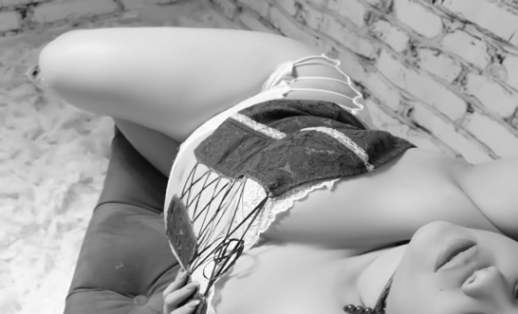
She spoke dirty to me and I liked it.

“Give me more bootyhole,” Ashley said.
Rodriguez asks, “what happens when I talk dirty to you? How does the address of speech transform the performative gesture of its utterance?” (125). Dirty talk– how my photographer engaged me in dialogue – contributed to my afloje (looseness) as the shoot progressed. The address of her speech, along with her gestures, made me get lost in her camera. Witnessing the way she touched herself–and the way she wanted me to touch my body–formed a collective vision of sensuality, one where all femmes of color could feel like goddesses. It was her dirty talk, the tone of her voice, and the power of her Black Femme gaze that helped me get there. Following Audre Lorde’s vision for the power of the erotics, we imaged a different world with her camera, a world where femmes eye fuck each other, and for each other, constantly displacing the male gaze. Her foreplay allowed me to listen to how my Eyes Talked, My Eyes Teased, My Eyes Fucked.
Beyond the shoot, the boudoir photos that she took of me would capture forever the fat perversity that she inspired in me. The energy we created inside that studio lingers in my skin. I remember her dirty talk and when we pose, my friends who have also gone through her spell also say, “give me more bootyhole” Like that, my remix yells “si, metete con mi Cucu!”

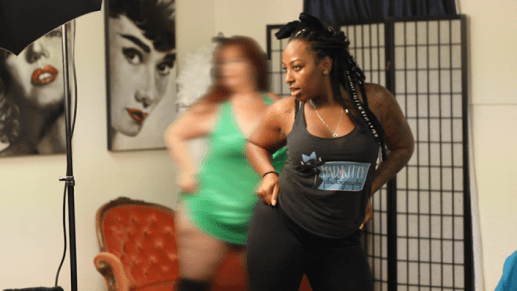
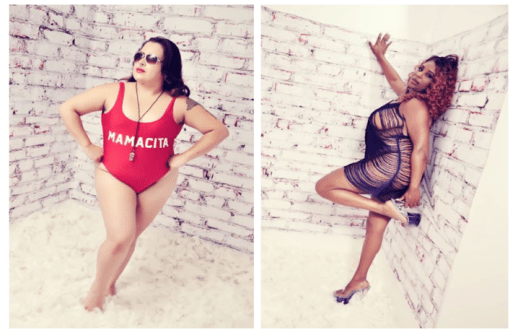
As a fat student of burlesque, my dirty talk, my dirty listening, is inspired by other women of color, fat performers, and porn stars. I gaze upon them for inspiration, guidance on eye fucking, and poses. On March 9, 2018, I participated in the second annual Plus Size Art Show at Meseeka Art studio in San Diego, California. I submitted 20 pieces of boudoir photography to the show that celebrated the bodies of five women of color plus-size burlesque performers from San Diego. They included Buttah Love, Raven VonScrumptious, Lucy May, Sepia Jewel and Smiley LaRose. The other art pieces in the show also centered fat perversity by presenting women in shibari, bikinis, nude, and boudoir.
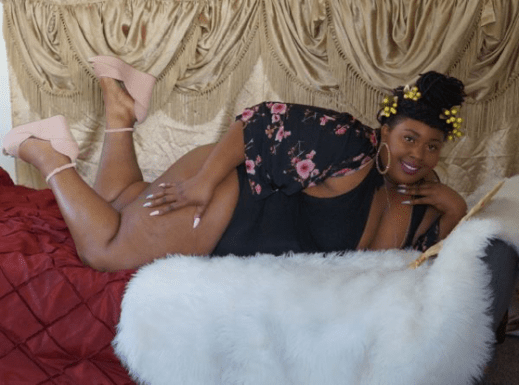
Photographed by Ahnyung Nadine
The all-women DJ collective Chulita Vinyl Club de San Diego played at the show while people danced, drank, and viewed the live fat artwork in formation. Listening to the charlas in the room, you could hear fat women share the power they felt from seeing other fat women feeling sexy. One of the participants approached Sepia and Smiley to ask us if we were also exhibited in the artwork. We both pointed at our images, celebrating each other by complementing our sexy poses. She told us that it was her first time ever taking photos in lingerie, and that playing with the shoot was empowering. We both agreed, because as burlesque dancers and students, stripping to nakedness has had multiple effects on the way we viewed our bodies, and their sensuality. Can you listen to how we use boudoir, erotic art and burlesque to create a visual archive of fat-sex-positivity?
Although Raven was not able to attend the opening of the show, she saw it through Buttah’s Instagram story. When I texted Raven, she told me she almost cried from seeing her photos framed on the wall. Raven was art, a fat femme was art. But even though she was not there, her photos transmitted energy and a fat perversity: her fat eyes talked, her fat eyes teased, her fat eyes fucked us.

Prrruuuuuu-nnnnnnneeeeee
We moan.
—
All images courtesy of the author.
—
Yessica Garcia Hernandez is a doctoral candidate and filmmaker in the Department of Ethnic Studies at the University of California San Diego. Her scholarship bridges fan studies, sound studies, women of color feminisms, fat studies, girl studies, and sexuality/porn studies to think about intergenerational fans of Mexican regional music. Yessica earned her B.A. in Chicanx Studies from University of California, Riverside and an M.A. in Chicanx and Latinx Studies at California State University Los Angeles. She has published in the Journal of Popular Music, New American Notes Online, Imagining America, Journal of Ethnomusicology, and the Chicana/Latina Studies Journal. Her dissertation entitled, “Boobs and Booze: Jenni Rivera, the Erotics of Transnational Fandom, and Sonic Pedagogies” examines the ways in which Jenni Rivera fans reimagine age, gender, sexuality, motherhood, and class by listening to her music, engaging in fandom, and participating in web communities. She explores the social element of their gatherings, both inside and outside the concert space, and probe how these moments foreground transmissions of Latina power. Yessica’s broader research interests includes paisa party crews, Banda Sinaloense, Contestaciones, and Gordibuena/BBW erotics. She is a co-founder and member of the Rebel Quinceañera Collective, a project that utilizes art, music, photography, creative writing, filmmaking, and charlas to activate spaces for self-expression and radical education by and for youth of color in San Diego.
—
 REWIND!…If you liked this post, check out:
Unapologetic Paisa Chingona-ness: Listening to Fans’ Sonic Identities–Yessica Garcia Hernandez
Freedom Back: Sounding Black Feminist History, Courtesy the Artists– Tavia Nyong’o
Mediated Sexuality in ASMR Videos–Emma Leigh Waldron
Share this:


Current Top Posts





April 2021

January 2020

November 2019

October 2019

August 2019

April 2014

November 2017

March 2015

December 2017

October 2015
 Sounding Out!
Recent Comments