
Clapping Back: Responses from Sound Studies to Censorship & Silencing


SO! Amplifies. . . a highly-curated, rolling mini-post series showcasing cultural makers and organizations doing work we really dig —
The MS Sound Forum invites papers for a guaranteed session at the Modern Language Association’s annual conference in Toronto, Canada in January 2026. The session responds in part to the MLA Executive Council’s refusal to allow debate or a vote on Resolution 2025-1, which supported the international “Boycott, Divest, and Sanction” (BDS) Movement for Palestinian rights against the ongoing genocide in Gaza. In light of the Council’s suppression of debate, some of the Sound Forum Executive Committee members decided to resign in protest while others remained to hold the MLA accountable for its undemocratic procedures. To acknowledge and respect the decision of those who left, the remaining members chose not to immediately fill the vacancies to let the parting members’ silence speak.
At MLA 2026, the Sound Forum seeks to provide a space for dialogue and meditation on silencing, censorship, and the role of organizations like the MLA in systemic violence and suppressing academic freedom. Sound studies scholars have long articulated listening as a practice for critical interventions, especially in the face of oppression. For example, Sonali Chakravarti’s Sing the Rage—written in the wake of the South African Truth and Reconciliation Commission—argues for an engaged and good faith reception of anger in the aftermath of colonial and institutional violence like apartheid and genocide. Chakravarti posits listening as the ground of recognition and a key path for attaining justice in the aftermath of mass violence (123). Drawing on Chakravarti, Naomi Waltham-Smith in Free Listening insists that listening “isn’t restricted to a power of relief but is precisely what enables catharsis to transform into a vehicle for justice because it promotes trust” (67).
To entrust MLA with the task of upholding one of its core values—the commitment to champion intellectual freedom—does not come easy. Indeed, Waltham-Smith reminds us that “Rage—and especially Black rage—is figured as an excrescence to the European rational logos. It’s too loud or too dissonant for the ears to parse” (55-56). The MLA Executive Council’s justification for their pre-emptive silencing of debate on Resolution 2501-1—as chronicled by our colleagues Anthony Alessandrini, Raj Chetty, Cynthia Franklin, Hannah Manshel, David Palumbo-Liu, Neelofer Qadir, S. Shankar, Rebecca Colesworthy, Chris Newfield, and others—remits to this noise-logos dichotomy, appealing to legalistic and fiduciary logic as a rationale for denying debate.

Waltham-Smith develops this argument in dialogue with Black feminist thinkers like bell hooks and Audre Lorde, asserting: “Rage is also connected with aurality in that a lack of listening—a feeling of going unheard—is itself a spur to anger, which is further compounded when the expression of that anger and, hence, its legitimacy is denied through silencing of one kind of another. It is this double injury that Jean-François Lyotard articulates in The Differend with his notion of the différend, whereby the original damage is compounded by the fact that it cannot be brought to the attention of or recognized by others. […] The assumption here is that listening has always already softened the blow” (63). This double injury occurs when one’s rage is discredited, deemed to be out of proportion to the weight of the wrong, or simply unheard, thus compounding the rage and shutting down avenues for multiracial collectivity when “white people remain unable to hear black rage, if it is the sound of that rage which must always remain repressed, contained, trapped in the realm of the unspeakable” (hooks, Killing Rage 12).
It is no accident that we are invoking studies of Black rage when discussing the plea of our Palestinian colleagues. Indeed, one of the seminal sound studies monographs, The Sonic Color Line, was written by Jennifer Lynn Stoever in part to historicize the state and police violence Black Americans were subjected to in the 2010s by positioning these instances of brutality—often triggered by disputes or disagreements over what a soundscape of the public space ought to be—within a larger history of the racialized listening practices. Those of us who experienced the Ferguson uprising in 2014 witnessed Palestinian allies sharing—over Twitter and in solidarity against the state violence—their first aid strategies when assaulted by the police tear gas for standing up for the dignity of Black and brown lives.

It is within this context of the MLA’s refusal to listen that we organize this panel. Beyond the immediate confines of the MLA, we also bear witness to contemporary practices of silencing, such as CEO Elon Musk tweaking X’s algorithm to penalize posts he deems to be “negative”; the Trump administration’s defunding of research on marginalized communities on the basis of flagged terms like “historically” and “female” (Palmer); and anthropocentric disregard for the more-than-human in enacting environmental policies, among others. At this juncture, resisting the erosion of democratic decision-making procedures and the freedom of expression is imperative.
While the panel theme is motivated by our collective desire to hold the MLA to account for its undemocratic procedures and to improve the Association’s processes from below, we also invite proposals thinking capaciously about questions of silencing, censorship, or free expression—as well as the role of listening and sound in these dynamics—through a sound studies framework. Topics might include: silencing of the more-than-human; AI and social media censorship (algorithmic black boxes); scholasticide and epistemological imperialism; ableism as silencing; authoritarianism and political censorship, etc.

Please submit your 200-word abstract and 50-word bio by March 20, 2025 to:
- John Melillo, johnmelillo@arizona.edu
- Setsuko Yokoyama, setsuko_yokoyama@sutd.edu.sg
- Tamara Mitchell, tamara.mitchell@ubc.ca
Please note that all speakers must update their MLA membership by April 7th, 2025 to participate in the conference. We look forward to receiving your proposals.
While the MS Sound Forum has decided to hold this guaranteed session at MLA 2026, we acknowledge and respect the decision of many of our colleagues to resign from their MLA-affiliated positions and withhold their membership, financial contributions, and labor in protest.
The MLA Sound Forum Executive Committee
John Melillo, Tamara Mitchell, Julie Beth Napolin, Setsuko Yokoyama
—
Featured Image: Photo by Photo by Jon Tyson on Unsplash
—

REWIND! . . .If you liked this post, you may also dig:
My Music and My Message is Powerful: It Shouldn’t be Florence Price or “Nothing” –Samantha Ege
The Sound of Feminist Snap, or Why I Interrupted the 2018 SEM Business Meeting–Alex W. Rodriguez
Spaces of Sounds: The Peoples of the African Diaspora and Protest in the United States–Vanessa Valdes
EPISODE 61: Ni Le Pen, ni Macron: Parisian Soundscapes of Resistance–Naomi Waltham-Smith
Share this:

How not to listen to Lemonade: music criticism and epistemic violence

With the premier last month of Lemonade, her second visual album, Beyoncé didn’t make the world stop so much as she make it revolve: around her, around her work, around black women. For all of the limitations of pop music as a medium (it’s inherently capitalist, for one) and Lemonade’s various feminist strategies (“Formation,” with its “Black Bill Gates” language, can be heard as a black parallel public to white corporate feminism), the album nevertheless re-centered mainstream media attention on black women’s cultural and creative work.
As the conversation about Lemonade revolved around black women and black feminism, two white men pop critics writing for major publications responded with “So What About The Music?” articles. The description to Carl Wilson’s Slate piece asks “But how is it as strictly music?,” and Kevin Fallon’s Daily Beast piece asks both “But is the music any good?” in the title and “But is the music worth listening to?” in the dec. Each time, the “but” sounds like the antecedent to its implied mansplainy consequent “actually…” And just as “but actually” recenters men as authorities and experts, these three questions decenter features prioritized in black women’s pop performance traditions, and in Lemonade itself. As posed in these two articles, the “so what about the music?” question frames “music” so narrowly that it both obscures or at best trivializes what the album does musically. Wilson and Fallon’s essays are good examples of how not to listen to Lemonade.

Borrowed from “Let’s Talk About Sex(ism)” from Twin Geeks
I want to read Wilson and Fallon carefully so we can think about when this question makes for both technically correct and ethically/politically responsible theory and criticism, and when it makes for technically incorrect and ethically/politically irresponsible theory and criticism. My aim here isn’t to argue that Wilson and Fallon are bad people. My focus is the definition or concept of “music” that’s at the heart of the method they use in these two articles (and methods are bigger than individual writers). In more academic terms, I’m asking about research ethics. If, as Wilson’s and Fallon’s articles prove, the “so what about the music?” question can be a power move that establishes the critic’s or theorist’s authority, how can we–especially the mainstream we–ask about the music parts of pop music without making that power move?
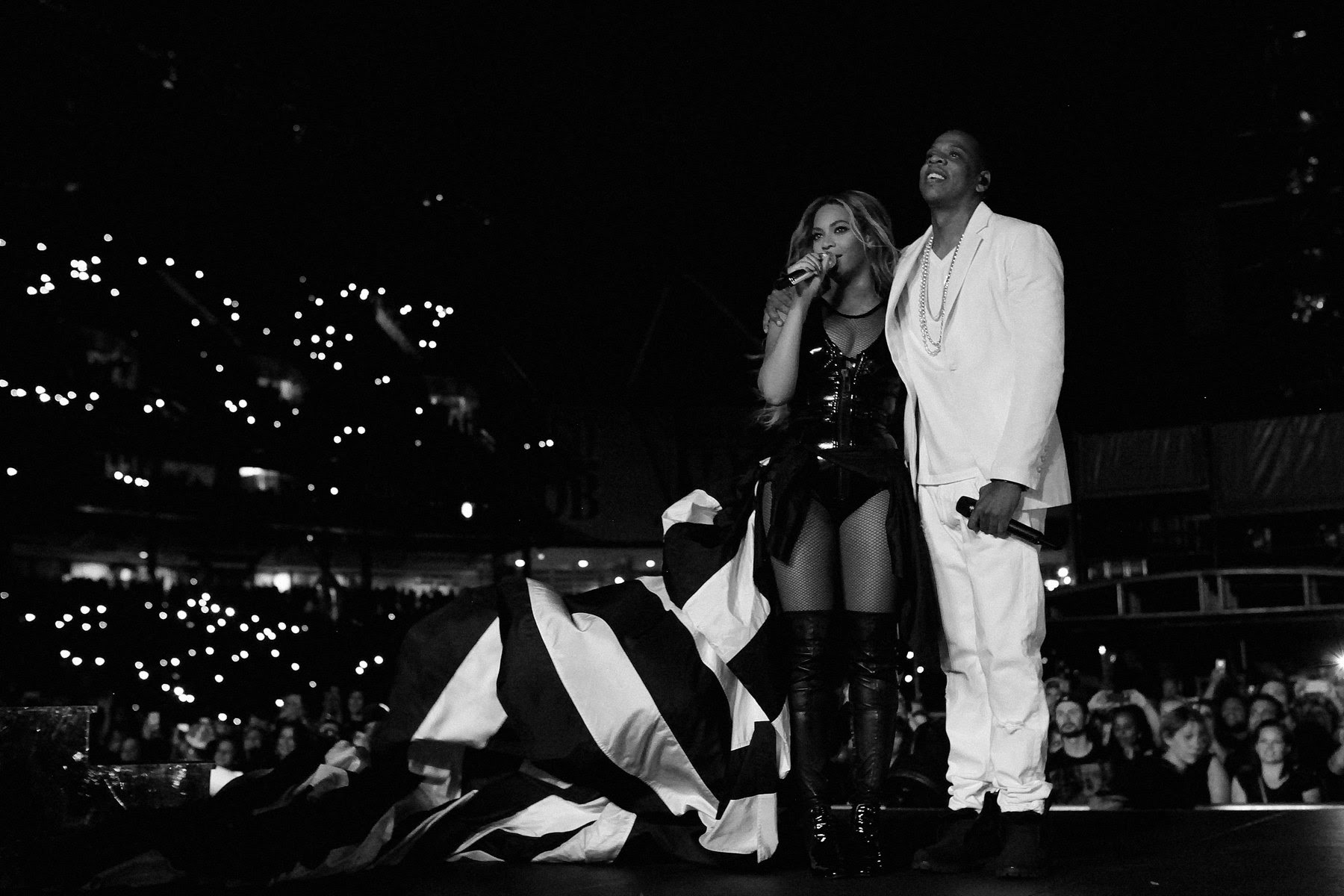 Firstly, both articles apply fairly conventional European fine art aesthetics to the album. Wilson invokes pre-Enlightenment European aesthetics to argue that the “reality show aspect” of the album is somehow aesthetically inconsistent with great pop music. Prior to the 17th century, it was commonly thought that the status of a work’s form or medium ought to correspond to the status of its representational content: painting, the most highly regarded art form, should have subject matter of equal stature–gods and royalty. Wilson’s claim that “the other distraction is the way that the album’s central suite of music interacts with tabloid-style gossip (and a certain elevator video clip) about Beyoncé and her husband Jay Z” echoes that centuries-old sentiment, a sentiment which is about as alien to Lemonade’s aesthetic as, well, Boethius is.
Fallon begins his article with a genuflection to Prince (as does Wilson), scrunches its nose at the gossipy lyrical and narrative content, and then twice scoffs at the very idea of a visual album, “whatever that is,” as though we in the West don’t have precedents for this sort of Gesamtkunstwerky (the total artwork combining music, visuals, and lyrics) thing going back to Wagner and the Florentine Camerata (the collective attributed with inventing opera in the 17th century). He does talk more extensively about the sounds and music than Wilson does, but given the rapid turnaround he also faced, there’s not a lot of close listening to specific musical figures, performances, or compositional techniques, mostly just a survey of the different genres on the album.
Wilson says that the cheating story detracts from the album’s musical quality because it’s an unoriginal narrative:
a drama of jealousy, betrayal, and reconciliation, one of the most ancient and common of human experiences, and of songwriting fodder…that issue of thematic freshness may render some of the songs here less distinctive and invigorating than Beyoncé was.
I find this an odd criticism to level at a pop album, or even an artwork. Nobody would say that West Side Story or Romeo & Juliet were aesthetically diminished because they recycled that tired old theme of jealousy, betrayal, and (failed) reconciliation. Moreover, as Angela Davis argued in Blues Legacies and Black Feminism, these themes of jealousy, betrayal, and reconciliation are the foundation of black feminist pop music aesthetics in a personal-is-political kind of way. Both articles force a contextually incorrect definition of “politics” onto the album, one which sees the most intimate details of relationships, sex, and kinship as merely personal and apolitical. Fallon, for example, says “there’s no doubt that the music on the album is far more personal than it is political.” Both critics fail to consider it in terms established in black women’s pop performance traditions.
Even in Wilson’s attempt to focus strictly on the music, he spends most of the time talking about visuals and lyrics. He hears a wide range of sonic references in Lemonade, from Dolly Parton to Donna Summer to the Lomax recordings to calypso. But he thinks this makes it sound derivative: “as an aural album, Lemonade is a little less fascinatingly singular and eccentric than Beyoncé” (Wilson). Fallon makes an almost identical remark in his article: “Lemonade doesn’t hurl itself toward any genre in a statement of artistry. Instead it masters… um, all of them, but in turn doesn’t make the same powerful statement of Beyoncé’s artistic mission, like her last album did.” Contrast this with the way Jonathan Shecter talks about Diplo’s post-genre eclecticism as “fresh and cutting-edge,” part of an “ongoing artistic evolution.” As philosopher Christine Battersby has argued, the habit of thinking that flexibility is a sign of innovation when attributed to white men, but a sign of regression when attributed to anyone else, is a habit that goes back to the 19th century. It’s not surprising that Beyoncé gets dinged for the same thing that garners Diplo praise: in her case, what Fallon calls “the most daringly genre-hopping music she’s ever produced” is evidence of unoriginality, whereas in Diplo’s case post-genre eclecticism is evidence of his ability to distinctively transcend provincialism. Even when Wilson’s article does manage to talk about sounds and music, it trivializes Beyoncé’s other artistic achievements on the album.
Both articles rely on some gendered and racialized interpretive habits to address the song’s aesthetic value, lyrical content, and Beyoncé’s artistry. But what about their discussion of the music?

“listen” by Flickr user Robyn Jay, CC BY-SA 2.0
These same racialized, gendered habits tune Wilson and Fallon’s listening and mask the sonic dimensions of Lemonade that don’t fit their narrow concept of music. Both critics make a conceptual move that separates musical practice from black feminist practice. Fallon uses some parentheses and a “but…?” question to put rhetorical and grammatical space between Lemonade’s black femininity and its musical and sonic features: “(By the way, it’s powerful, and feminist, and unapologetically black, and transfixing, and gorgeous, and assured, and weird, and confusing, and dumb, and groundbreaking.) But hey: Is the music any good?” This framing defines “the music” as something distinct and independent of the album’s black femininity, as though black women’s and black feminist musical traditions didn’t infuse the album’s music…or, to the extent they do, they don’t count as “music.”

“Listening” by Jens Schott Knudsen, CC BY-NC 2.0
Wilson makes an identical move. Following the white liberal feminist aesthetics that influence lots of contemporary post-feminist pop, Wilson’s piece locates treats the black feminist message primarily in the video. “In video form…it’s more evident that [Lemonade] is equally the cyclical story of generations of black women dealing with men and balancing their struggle for R-E-S-P-E-C-T (as well as S-E-X) against the violations and injustices of race and gender.” He sees the politics in the visuals, but doesn’t consider the sounds as having anything to say or do about that story and that struggle.
This approach isn’t limited to well-meaning but ignorant white men pop critics: even bell hooks’ now (in)famous essay on Lemonade looks at but doesn’t listen for its politics. She argues that it is a “visual extravaganza” whose “radical repositioning of black female images does not truly overshadow or change conventional sexist constructions of black female identity.” Locating the politics entirely in Lemonade’s visuals, hooks’s essay treats black feminism as something contested solely in terms of images. (And divorcing the images from the sounds fails to consider the fact that the sounds impact how viewers interpret what they see.)

Screenshot from Lemonade
This is the wrong method to use for thinking about Lemonade and Beyoncé’s work as a whole (and pop music in general). Sounds on this album don’t operate independently of black femininity, black women’s performance traditions, or individual artists’ black feminist politics. On the one hand, thinking with Daphne Brooks and Regina Bradley, it’s more accurate to say that Beyoncé’s sound game has generally led the way and been more politically cutting-edge than her visual game. On the other hand, sound can also be what does the heavy lifting for patriarchy and other systems of domination, as I argue here. Separating the music itself out from the political content misrepresents what music is and how it works. And it is a particularly gendered misrepresentation: critics are not so eager to separate Kendrick’s sounds from his politics. In both white and black philosophical traditions, dominant concepts of politics and the political are normatively masculine (just think about the gendered public/private distinction, for example), so from these perspectives feminine and feminized sounds don’t feel or seem “political.”
But in these two cases the divorce between music and politics is also what lets white men pop critics have authority over black feminist music. If they can distill Lemonade down to its “solely musical” aspects, then they can plausibly present themselves as experts over generic, depoliticized sound, sounds disconnected from knowledges and values tied to particular lived experiences and performance traditions. Problem is, in the same way that there is no generic ‘person’ without a race or a gender, there is no generic, depoliticized sound. As Jennifer Stoever has argued, even though Western modernity’s occularcentric epistemology obscures the sonic dimensions of white supremacist patriarchy and the subaltern knowledges developed under it, sounds nevertheless work politically. Digging deep into the music on Lemonade or any other pop song does not involve abstracting the music away from every other aspect of the work and its conditions of production. Digging deep into the music part of pop music means digging deeper into these factors, too.
When Regina Bradley, Dream Hampton, Laur M. Jackson, Zandria Robinson, and Joan Morgan talk about how Lemonade makes them feel, what affects and knowledges and emotions it communicates, they are talking about the music–they just work in a tradition that understands music as something other than ‘the music itself’ (that is, they don’t think music is abstracted away from visual and cultural elements, from structures of feeling common to black women with shared histories and phenomenological life-worlds). As I have tried to show in my own work, the sounds and musical performance are central to Beyoncé and Rihanna’s work because they engage traditions of black women’s and black feminist knowledges. Aesthetic practices develop and emerge as types of implicit (i.e., non-propositional or non-verbal) knowledge, knowledge created in response to lived experiences in a particular social location. Aesthetic practices can communicate and perform knowledges that reinforce systems of domination, and they can also communicate and perform subordinate knowledges that map out strategies for survival amid domination. Dominant institutions (like the music industry) and people from dominant groups (like Iggy Azalea or Eric Clapton) separate the aesthetic practice from the implicit knowledges that make it meaningful, and thus neutralize those knowledges and make the aesthetic practice fungible and co-optable. Talking about “the music itself” or “solely music” does the same thing: it is a form of what philosophers call epistemic violence.

Screenshot from Lemonade
So, asking “but what about the music?” is a way to dig into those implicit knowledges to show where much of this epistemic work is happening. And that’s good analysis that isn’t (necessarily) epistemically violent. It demonstrates what Stoever calls “an ethical responsibility to hear African American cultural production with…assumptions about value, agency and meaning” (31) that are appropriate to them. But you can also ask “but what about the music?” in a way that abstracts away from these implicit knowledges. That’s what Wilson’s and Fallon’s pieces do, and that’s why they’re both epistemically violent and objectively poor methods of musical interpretation. But we can and do better when we write about and theorize the music part of pop music. And, to riff on Mariana Ortega’s argument in her article on the type of epistemic violence she calls “loving, knowing ignorance,” doing better means listening to and with black women, black women’s music, and black feminist aesthetics. You can’t divorce music or listening from politics; listening better can and will follow from practicing more just politics.
—
Robin James is Associate Professor of Philosophy at UNC Charlotte. She is author of two books: Resilience & Melancholy: pop music, feminism, and neoliberalism, published by Zer0 books last year, and The Conjectural Body: gender, race and the philosophy of music was published by Lexington Books in 2010. Her work on feminism, race, contemporary continental philosophy, pop music, and sound studies has appeared in The New Inquiry, Hypatia, differences, Contemporary Aesthetics, and the Journal of Popular Music Studies. She is also a digital sound artist and musician. She blogs at its-her-factory.com and is a regular contributor to Cyborgology.
—
 REWIND!…If you liked this post, you may also dig:
I Been On: BaddieBey and Beyoncé’s Sonic Masculinity-Regina Bradley
Listening to Sounds in Post-Feminist Pop Music-Robin James
Of Resilience and Men: How Bieber, Skrillex, and Diplo Play with Gender in “Where Are Ü Now”-Justin Burton
Share this:


Current Top Posts





April 2021

January 2020

November 2019

October 2019

August 2019

April 2014

November 2017

March 2015

December 2017

October 2015
 Sounding Out!
Recent Comments