
This Past Weekend with Theo Von: Brocasting Trump, Part II
But first. . .
A Brief Synopsis of an Introduction to Bro-casting Trump: A Year-long SO! Series by Andrew Salvati
—
In total, Trump appeared on fourteen podcasts or video streams during his 2024 campaign, which together earned a combined 90.9 million views on YouTube and on other video streaming platforms, not even including audio podcast listens, which, because of the decentralized nature of RSS, are notoriously difficult to pin down.
That’s a lot.
In the following series of posts, I am particularly concerned with Trump’s success with the so-called podcast bros – partially because my own research interests are in the area of mediated masculinities, but also because they may have put him over the edge with a key demographic – with (white) Gen-Z men.
Over this series—which began in January 2026 with Logan Paul—I will examine several of Trump’s appearances on largely apolitical “bro” podcasts during the 2024 campaign season, including his interviews with Logan Paul, Theo Von, Shawn Ryan, Andrew Schulz, the Nelk Boys, and Joe Rogan. In the course of this examination, I will pay attention not only to what Trump said on these shows, but also to the way in which they established a sense of intimacy, and how that intimacy worked to underscore Trump’s reputation for authenticity. Along the way, I will also discuss the podcasts and podcasters themselves and attempt to locate them within the broader scope of the manosphere. Finally, given the passage of time since Trump’s appearances, I will consider to what extent, if any, individual hosts have become critical of his administration’s policies and actions – as Joe Rogan famously has.
Here’s the second installment, on This Past Weekend with Theo Von.
***
This Past Weekend with Theo Von: Brocasting Trump, Part II
DOI: 10.59350/qkwp6-e439
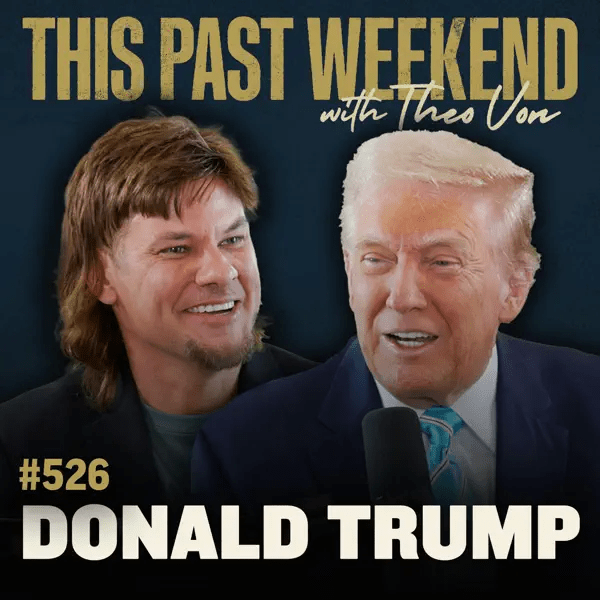
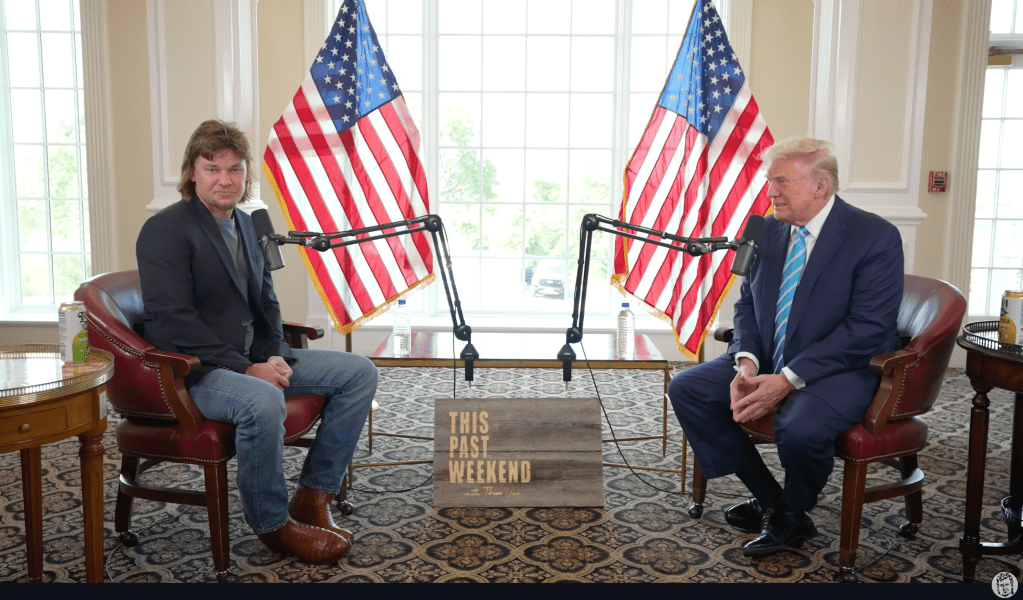
With about five-and-a-half minutes remaining in the podcaster and comedian Theo Von’s August 2024 interview with Donald Trump, the conversation turned to the U.S. southern border. Thus far, the interview had not shied away from policy concerns; however, though the questions were earnest, the answers were evasive and superficial. Noting that he had hosted Border Patrol agents on his show in the past, Von reported that one of the biggest problems that the agency faced was that its officers were arresting the same people over and over again. The reason, according to Von, was that “the people that are coming in illegally aren’t being prosecuted.”
The 44-year-old podcaster then asked the president in his lilting Louisiana accent what he would do differently to alleviate the problem and make the border more secure. Like many, it was a question that allowed Trump to indulge in his penchant for superlative and self-aggrandizement.
“So, the borders, well, I did it. I did it,” Trump declared. “We had the best border … we had the wall built. We had more going to come beyond, long beyond what I promised. I built hundreds of miles of wall, and it worked.”
Now, this post isn’t necessarily the venue for relitigating the failures of what was Trump’s signature project during his first administration, for reminding you, dear reader, that despite his promise on the 2016 campaign trail that he would “build a great, great wall on our southern border” (which Mexico would pay for), and despite signing an executive order just days after taking office that directed the Secretary of Homeland Security “to immediately plan, design, and construct a physical wall along the southern border,” by the end of his term in office in January, 2021, only 452 miles of wall had been constructed – much of which was not new, and had merely replaced existing barriers. Such reminders can be found elsewhere.
Rather, the moment captured the credulity which Von freely gave the former president throughout the interview, and thereby highlighted what I suggested in my last post is the problem – or, from the candidate’s perspective, the virtue – of a media strategy that allotted a significant amount of time to non-journalists: it was unlikely that he’d get much pushback.
***
And after listening through the episode a few times and trying to put myself in the place of an apolitical Theo Von listener, or one perhaps too young to remember the first Trump administration, I began to more fully appreciate the extent to which his apparent authenticity coupled with a sense that he is not just a political outsider, but an autonomous agent free of obligation to party. Typically, this last part comes out when Trump takes aim at “them” – Joe Biden, Kamala Harris, Chuck Schumer, Nancy Pelosi, and other unnamed Democratic elites, as well as any other members of the “deep state,” or “establishment” who oppose him.
In contrast to these shadowy figures, Trump presents himself as someone who, largely because of his wealth, remains independent, and as such, is uncorrupted by “them.” He can thus position himself as a man of the people, and in fact frequently trumpeted his own popularity during the episode – with Von only too happy to provide affirmation.
But this turn toward the border and to immigration policy is also significant in retrospect, given that Von has since been critical of the second Trump administration’s mass deportation policies, and of the Department of Homeland Security’s (DHS’s) unauthorized use of his image and voice in one of its marketing videos in a way that seemed as if he supported the department’s deportation efforts.
In the now-deleted video (part of which can be seen here), Von looks directly into the camera and says “Heard you got deported dude, bye.”
The comedian quickly took to X (formerly Twitter) to vent. “Yoo DHS I didn’t approve to be used in this,” he said in a post that he later deleted. “I know you know my address so send a check. And please take this down and please keep me out of your ‘banger’ deportation videos. When it comes to immigration my thoughts and heart are a lot more nuanced than this video allows. Bye!”
Roughly a week later, on October 2, 2025, Von returned to the subject on his podcast with an impassioned statement explaining to his listeners the situation with the video and outlined some of his own thoughts on immigration. Contextualizing the clip by saying that it had been made in a parking lot after one of his comedy shows as a joke – though in Von’s telling, what he said still comes off as callous, as the “girl” who approached him with the camera was trying to tell the comedian that her friend had recently been deported – Von went on to talk about the blowback he received as a result of the DHS video, which was in no way an accurate depiction of his complex thoughts on immigration.
“And my father immigrated here from Nicaragua, right?” he explained, his voice beginning to break. “Like one of my prized possessions is I have his immigration papers [from] when he came here. And I have them in a frame … and, so I have tons of thoughts about it, but this was just fucked up, right? It was fucked up. And it was everywhere. It was on all platforms and stuff.”
What Von seemed to be doing here was saying that, though he may have supported a tough line on illegal immigration and had little tolerance for those who had been admitted into the country with a criminal record, he could not necessarily get behind the Trump DHS’s indiscriminate deportation scheme, which was sweeping up immigrants who had come into the country the “right way” alongside those who maybe hadn’t.
However in listening to Von’s Trump interview from 2024, it’s hard not to hear the future president laying the groundwork for what would become a maximalist strategy on immigration. “We have over 20 million people, in my opinion, right now, that came into our country [the number of unauthorized immigrants in the U.S. was estimated at 14 million in 2023]. Many come from prisons, jails, mental institutions, many terrorists,” Trump claimed, later adding that “we’re going to spend a lot of time getting the criminals out … we have a lot of people, hundreds of thousands of murderers. We have people, drug dealers … it’s not even believable.”
Although it would have been difficult at the time of the recording to imagine the terror that Trump’s Immigration and Customs Enforcement (ICE) sweeps would unleash on communities like Los Angeles, Chicago, New York, and Portland in the months following his return to office, we can hear in his attempts to vilify unauthorized foreign nationals, and in his fear-mongering about how many of them were bad actors, a justification for the use of blunt force rather than nuanced policy.
And it seemed like Von agreed, at least in principle, with the law-and-order logic underpinning Trump’s statements. “Oh, I don’t think people should be allowed to be in our country if they’re criminals,” he stated.
To give this conversation a charitable reading, it is perhaps likely that Von assumed that, once in office, Trump’s administration would have the tools to determine which foreign nationals were authorized to be in the country and which were not. Further, he may also have believed ICE would know who among this group had a criminal record – and not conduct mass roundups based on race.
Yet, as we should have all probably known by the summer of 2024, for Trump and his chief advisers, blunt force (and cruelty) was the point. Recall the so-called “Muslim Ban” instituted during Trump’s first term, which was hardly an example of a well-calibrated policy, but was rather a “total and complete shutdown” of travelers and immigrants from seven Muslim-majority countries (though even this wasn’t without its conflicts of interest as it excluded several countries like Saudi Arabia and the United Arab Emirates where Trump had business dealings).
Even the wall, which was conceived by Trump insiders in 2015 as a mnemonic device intended to help their boss to remember to mention illegal immigration at his campaign rallies, was deemed effective precisely because it was not subtle. As Trump 2016 campaign adviser Sam Nunberg told Business Insider, “I think one issue is people did understand walls … the wall in 2016 was symbolic of Donald Trump: common sense, practical solutions, simplified answers – as opposed to long nuanced, detailed policy speak.”
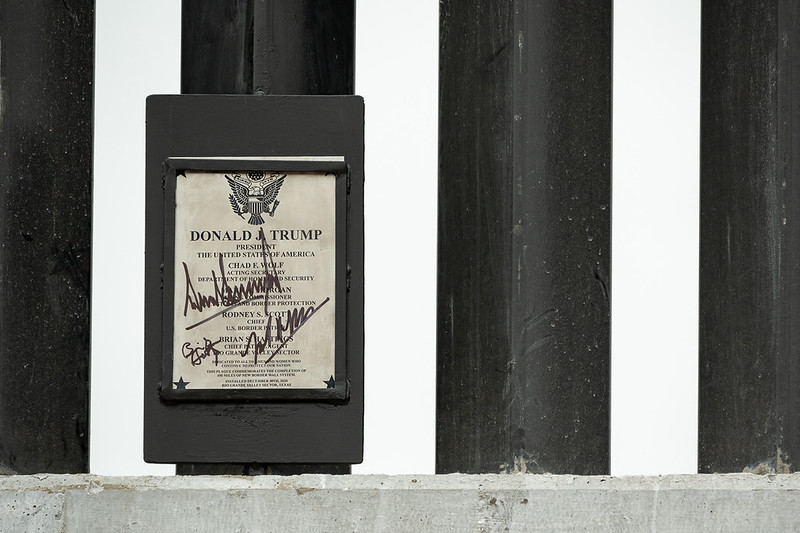
President Donald J. Trump’s signature is seen on a plaque on the border wall Tuesday, Jan. 12, 2021, at the Texas-Mexico border near Alamo, Texas. (Official White House Photo by Shealah Craighead) (PDM 1.0)
And this would be a fair characterization of Trump’s remarks on This Past Weekend – when Von asked earnest policy questions, Trump offered simplified, seemingly common sense responses that presented his own approach to the problems of government as something different than politics-as-usual, different because it was guided by an intensely practical, no-nonsense ethos.
Like his appearance on Logan Paul’s Impaulsive, Trump’s calm, yet forceful tone of voice on This Past Weekend tended to support his overall credibility as a leader capable of bringing logical solutions to a crisis-ridden government – of brining decisive, masculine order to the chaos in Washington. Such was the impression that listeners may have gotten, for instance, from Trump and Von’s discussion of the president’s first term executive order mandating price transparency for hospital care, which Von asked Trump about specifically, and which, Trump claimed, “would have brought down the cost of care by 50, 60%” if Biden and Kamala had enforced it.
But Trump’s appeals to common sense also provided cover for what might have otherwise been an embarrassing bit of hypocrisy. When Von began to turn the conversation toward the power of lobbyists, asking why it was that the government couldn’t seem to do anything about the so-called revolving door, Trump explained that there was a “whole constitutional thing there” (the First Amendment right to petition the government), and agreed with Von that it was “a problem and … a big problem,” adding that “we were [in his first term] doing things about it.”
What his administration did, was issue an executive order banning executive branch employees from becoming lobbyists for a period of five years. This move may have seemed like it indicated a genuine desire to “drain the swamp,” as Trump routinely promised to do on the campaign trail in 2016, but, as ProPublica revealed in a 2019 report, his administration had actually hired 1 lobbyist for every 14 political appointees that it had made since taking office (281 in total), which was four times more than Obama had appointed six years into office.
Given that they had provided ingress to the executive branch, it is perhaps unsurprising that they would eventually provide egress, executive order notwithstanding. Indeed, on the final day of his first term, Trump revoked the order without giving explanation, clearing the way for members of his administration to secure lucrative lobbying gigs. Such contradictions, however, were more or less concealed behind Trump’s populist rhetoric, behind his apparent recognition that conflicts of interest are a problem in politics, or that medical debt is crushing Americans.
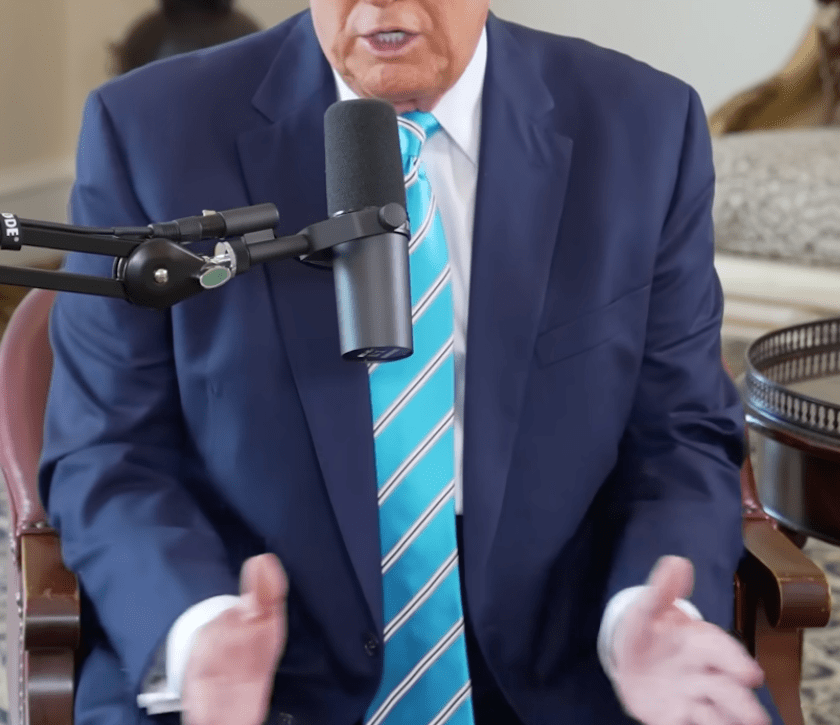
But taking a sound studies perspective, we can also see – or hear – how Trump’s tone of voice, which admittedly seems less energetic than it was during his Logan Paul interview, tended to convey an assurance that what he said was an authentic expression of his own thoughts and perspectives. Again, this was not the kind of stream-of-consciousness raving that we have come to expect from his rallies, but rather a low-key, intimate conversation about relevant issues and facts – or, at least facts as Trump saw them.
The implication here is that Trump as a political leader is free to operate in ways that mere politicians and government officials simply can’t because of their obligations to party, to donors, or to lobbyists. What is likely missed in all of this, however, is that what Trump is describing is a thoroughly authoritarian approach to political power, one that is of a piece with his claim that “I alone can fix it.” Positioning himself outside the political establishment – and even independent of the Republican Party of which he is nominally the leader – Trump can offer himself as a political messiah and claim the moral authority to act without regard for democratic processes in the name of a specious popular mandate.
In other words, by contrasting himself with “them,” and by holding himself at a distance from the dominant political order, Trump clears himself of the obligation to work with any group or individual that he deems to be opposed to his own quasi-populist agenda.
And for Von and those in his audience who are fed up with the status quo, that is a powerful appeal.
—
Featured Image: Theo Von, Edited James Tamim, Wikimedia Images (CC BY-SA 2.0)
—
Andrew J. Salvati is an adjunct professor in the Media and Communications program at Drew University, where he teaches courses on podcasting and television studies. His research interests include media and cultural memory, television history, and mediated masculinity. He is the co-founder and occasional co-host of Inside the Box: The TV History Podcast, and Drew Archives in 10.
—
REWIND! . . .If you liked this post, you may also dig:

Impaulsive: Bro-casting Trump, Part I—Andrew Salvati
Taters Gonna Tate. . .But Do Platforms Have to Platform?: Listening to the Manosphere—Andrew Salvati
Listening to MAGA Politics within US/Mexico’s Lucha Libre –Esther Díaz Martín and Rebeca Rivas
Gendered Sonic Violence, from the Waiting Room to the Locker Room–Rebecca Lentjes
—
Layout by Jennifer L. Stoever
—
Share this:

Singing The Resistance: January 2017’s Anti-Trump Music Videos

 SO! Amplifies. . .a highly-curated, rolling mini-post series by which we editors hip you to cultural makers and organizations doing work we really really dig. You’re welcome!
—
The US presidential campaigns in 2016 were escorted by a number of songs regarding the person who was recently inaugurated as president. These songs served mostly as a kind of dystopic, fear-indulging, angsty “comedy music”—to reference Frank Zappa’s 1971 “Dental Hygiene Dilemma”—with a perverted thrill, or functioned in the retro manner of balladesque storytelling in songform. Performance art band Pussy Riot’s rather blunt “Make America Great Again” falls in the former category, while many examples from the brave and radiating 30 Days, 30 Songs project fall in the latter, summoning indie-rock icons as Death Cab For Cutie, R.E.M., Bob Mould, EL VY, Jimmy Eat World and Franz Ferdinand.
Lesser known tracks like “Trump,” produced by German DJ and producer WestBam, used a collage with sampled footage organized on a 4/4-beat to uncover Trump’s lies and remodel them into articulations of the vocal intentions of this subject: “We need drugs. We need crime.” However, as horrific and uncanny as this video seems, this subject as head of government then figured only in an unthinkable, impossible world.
In June 2016, Los Angeles rappers YG and Nipsey Hussle apparently sensed the horrible threat so creepily approaching the Oval Office, releasing “Fuck Donald Trump,” which produced a long string of versions, extensions, and new parts in the months afterward: “Don’t let Donald Trump win, that nigga cancer / He too rich, he ain’t got the answers / He can’t make decisions for this country, he gon’ crash us / No, we can’t be a slave for him.” In this song, before the votes were cast, the rappers and the Angelenos in the video address the urgency of a pending openly white supremacist government and the need to publicly resist it. For very good reasons, these musicians did not put the subject now in power into the box of a neglectable funny weirdo candidate. They recognized the threat as being as serious and imminent as it really was. “Fuck Donald Trump / Fuck Donald Trump / Yeah, nigga, fuck Donald Trump/ Yeah, yeah, fuck Donald Trump.”
In the week before the inauguration, artists released a string of music videos that struck very different tones from 2016. A comedy? No more. A gruesome, colorful story to tell? Too vague, too meek. “Hallelujah Money,” sings Benjamin Clementine in the song by the ever-so dystopic anime-band Gorillaz. The new song—the band’s first release in almost 7 years—is a freaked out lament, engendering bewilderment and prayer, taking on a sonic persona that cries out to The One & Only God Of Mammon – the lyrical subject is here the governing subject: “And I thought the best way to perfect our tree / Is by building walls / Walls like unicorns / In full glory / And galore.” In the video, the KKK marches along, the pigs in George Orwell’s animal farm blare, a lone and deathstruck cowboy meditates on the horizon behind Clementine, swinging in distorted rhythms and harmonies. In the end, Clementine burns his hair in a gigantic megaton-explosion while praying for money, praying for the last credible authority: “Hallelujah money (Past the chemtrails) / Hallelujah money (Hallelujah money).”
An angered, revolutionary will also stokes the song “Smoke ’em Out,” released on Jauary 17th, 2017 by a feminist trio consisting of sisters Sierra Casady & Bianca Casady (known as CocoRosie) and transgender singer Anohni (also known as the lead singer for Antony and the Johnsons). The song matches solid beats with serene pizzicatos, creating a surprisingly catchy melody of intriguing courage and uplifting collective resistance: “Burning down the house / The dead girl shouts / Smoke em out!”
Rhythmically demanding and just as sonically unforgiving comes “I Give You Power” by the Arcade Fire featuring Mavis Staples, an amalgamation of anger and the will to move ahead, to transcend current limitations of micro politics into a desired and imagined near future. The song opens with a flat electronic beat that builds up to a fat bulldozing bass sequence with added effects over which Mavis Staples’s multiplied voices lament and demand and call out in grief and angry bewilderment. The song merges disco, soul and funk with traditions of protest chanting, topped off with church organ chords. The music video reveals nothing beyond an older analog mixing desk operated now and then with calm sensitivity and deep knowledge of how this production tosses and turns: bright and glaring lights flicker over the image of the desk.
The Brooklyn-based Sateen, in contrast, perform “Love Makes The World” in a lavish scenery replete with luxurious flashing red gowns of large ruffles. They sing in the woods and in a brick underpass, while joined and complemented by a series of queer singers, dancers & personae presenting themselves, their love and their resistance in public and in private situations. Angelic voices sing over the cycling and motorized club beats, providing electronic sounds of hope whose joyful alien flavors are often in tension with the song’s lyrics: “How can we progress: / When we’re ruled by racists?”
The first music video, however, that drew my attention to this prolific phenomenon of songs against the US’s new governing subject was a cover of Morrissey’s “Interesting Drug” (1989), released by the notorious OK Go:
This time OK Go does not flatter us with their usual acrobatic and meticulously choreographed video performance, but rather present plain white-on-black-text between brief seconds of footage and screenshots of “the bad people on the rise” now in charge of the US, images ready to become the memes and gifs of a resistance movement. The music video ends with an explicit call to action–“It’s a difficult time but fear and anger aren’t the answer. Work to make a better world” followed by a list of five civil rights organizations including the American Civil Liberties Union, the Immigrant Defense Project and Planned Parenthood, headed by an unmistakable imperative: “Volunteer and donate.”
Discovering this song and video, I soon stumbled across yet another song that struck me first of all as a very clever and all too obvious marketing move, Green Day’s “Troubled Times,” which of course resonates with the band’s hit record “American Idiot” about the George W. Bush presidency.
“What good is love and peace on earth / When it’s exclusive.” In the visual style of traditional black and white newspaper collages—with splashes of red that summon Schindler’s List–the band animates the contemporary pandemonium of hatred, racism, sexism and plutocratic sadism to stage yet another traditional Green Day pop punk song, though one with a rather less disruptive, and much more forlorn note. I have to note a ertain awkwardness here, as the business model of lining up with this protest movement seems rather obvious, and many sections of these lyrics and the video’s imagery seems more cliché than genuine. Are these times really only structurally and anonymously “troubled? Are there no actual wrongdoers, criminals and hatemongers to be named, accused, and condemned? Roger Waters truly unexpected—and much more direct—recent live performance of “Pigs” in Mexico City in October 2016 comes to mind, with its massive projection of KKK & TRUMP-imagery as icons of hate – reinvigorating the political urgency present in a song from 1977.
Still, the song by Green Day might get airplay on nationwide rock radio unlike many of other songs of resistance, and by this it could actually succeed in its overstated mission.
The most aggressive and decidedly agitprop-productions come from Moby and Fiona Apple. Collaborating with Michael Wahlen, Apple recorded a chant for the massive Women’s March on Washington (and the many simultaneous marches occurring across the US and the world) the day after the inauguration:
With lines like “We don’t want your tiny pants / Anywhere near our underpants” Wahlen and Apple revive the protest chant traditions of the 1960s with its mean, challenging, and unforgiving humor. Late last year Apple already released a joyful yet sadistic little piece in the style of a sentimental Christmas carol that keeps “Trump’s nuts roasting on an open fire (…) Merry Christmas, Merry Christmas: Donald Trump, fuck you.”
In contrast, Moby merges his 1990s rave skittishness with an unrepentant love for precisely-targeted guitar punk riffs in “Erupt & Matter.” Original footage of demonstrations, resistance gatherings, and a selection of the absurd and terrifying authoritarian and nationalist figures of our time – first Erdoğan, Farage, Assad, then Duterte, Trump, Wilders, Le Pen, Petry, Hofer and many more – alternate with classic performance shots of Moby and his band The Void Pacific Choir, generating a sentiment of accelerating urgency: “WE DON’T TRUST YOU ANYMORE. WE DON’T TRUST YOU ANYMORE.”
But the anger against sclerotic oligarchies and a condescending establishment is ironically mimicked by exactly the most unsettling and authoritarian protagonists of various nationalist parties worldwide. Even as Moby’s aggressive protest chant becomes an infectious and intriguing earworm, does he render such a revolutionary impetus dubious? Pondering this reminded me of the Atari Teenage Riot line from 1995: “Riot sounds produce riots.” (Atari Teenage Riot 1995)
In the first few weeks of January alone, several consortiums have launched protest song campaigns to ensure that songs like these will just keep coming. On inauguration day, the platform “Our First 100 Days” was launched. Here, one new protest song will be released on every day for the first one hundred days of the current president’s administration, with all profits raised from the sales of songs by groups such as PWRBTTM going, as their website states, “directly to organizations working on the front lines of climate, women’s rights, immigration and fairness.” Paste Magazine expanded its “30 Days, 30 Songs” campaign for the long haul, offering up to 1000 Songs in 1000 Days— one song a day for every weekday of Donald Trump’s term.
However, as I write these last lines, the global public is remixing the resistance in its own lightning-fast ways. The recent public sucker-punch of white supremacist neo-Nazi Richard Spencer has already become a legendary object of meme culture. Folks have synched this clip to multiple—and diverse—soundtracks that invite repeated viewings, from Celine Dion’s “My Heart WIll Go On,” Bruce Springsteen’s “Born In The USA,” Queen’s “We Will Rock You,” Gwen Stefani’s “Hollaback Girl,” Pharrell Williams’s “Happy,” The Notorious B.I.G.’s “Hypnotize” to Frank Zappa’s “Black Page #2”. . .and the list continues.
Singing the resistance in the 21st century poses a truly complex task. Artists must sonically navigate a wide array of musical aesthetics—some geared toward more immediate public appeal, while others evoke more erratic and dissonant affects—and keep an eye toward combining sound with impactful media events and artifacts, while never forgetting to consider the critical question “How Does it Feel?”
This blogpost has its own playlist: click here
—
Holger Schulze is full professor in musicology at the University of Copenhagen and principal investigator at the Sound Studies Lab. His research focuses on the cultural history of the senses, sound in popular culture and the anthropology of media. Recent book publications are: American Progress (2015), Sound as Popular Culture (2016, ed.) and Krieg Singen: Singing The War (2017, ed.).
—
 REWIND!…If you liked this post, you may also dig:
On Ventriloquism, Dummies, and Trump’s Voice – Sarah Kessler
À qui la rue?: On Mégaphone and Montreal’s Noisy Public Sphere – Lillian Radovac
The Noise of SB 1070: or Do I Sound Illegal to You? – Jennifer Stoever
Share this:




Current Top Posts





April 2021

January 2020

November 2019

October 2019

August 2019

April 2014

November 2017

March 2015

December 2017

October 2015


Recent Comments