
Benefit Concerts and the Sound of Self-Care in Pop Music
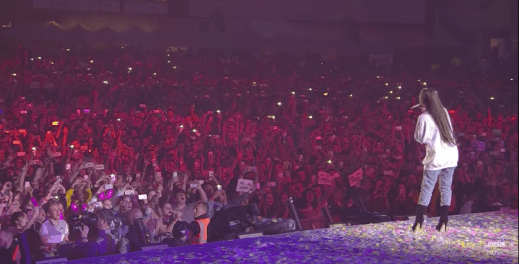
Less than two weeks after a suicide bombing killed 22 people at the Manchester Arena following an Ariana Grande concert, the singer was back on stage in the city. She capped her three-hour One Love Manchester benefit concert with the 2015 single, “One Last Time,” which had found its way back into the UK Singles chart in the days following the blast. It was technically a solo performance, but Grande was joined on stage by the many artists who had already held the mic that day. At one point she was too overwhelmed to sing, and the audience took over for her. Grande’s occasional loss of voice is moving to watch. Throughout the concert, she would frequently struggle to speak, mostly sticking to short introductions of singers and a variation of “Thanks for being here; I love you so much,” her voice often cracking or sounding uncharacteristically pinched, the tears barely held at bay. Until “One Last Time,” she could always find her full voice through song, but as dusk settled on the city and the concert drew to a close, Grande could no longer sing through the weight of the moment, so the community she’d called together so she could “see and hold and uplift” them lifted her.
Benefit concerts and the products surrounding them—as well as the critiques that target them—have become familiar fare since the 1984 Band Aid recording of “Do They Know It’s Christmas” spun off to form 1985’s Live Aid, a multi-site concert event complete with commemorative souvenirs and the performance of the USA For Africa single, “We Are the World.” Skeptical accounts of benefit concerts fall like crumbs from Marx’s beard: they’re capitalism deployed as band-aids on problems capitalism created; they’re opportunities for celebrities to enhance their brands; they’re colonial; they’re neo-colonial; they’re exaggerated performances of wokeness intended to absolve people of their complicity in systems of violence. As communal rituals in response to tragedy, though, benefit concerts also function as metaphorical keystones that hold the tension of competing emotions, politics, and sounds. Listening to music emerges as a form of self-care, but that act may not sound the same for different people. Looking at the case of Grande’s One Love Manchester, I will map self care in the context of this contemporary moment by filtering the Manchester concert through Cheryl Lousley’s feminist analysis of benefit concerts (2014). Specifically, in order to highlight what’s different about One Love Manchester, I’ll start with Lousley’s attention to the way feminized compassion is performed through benefit concerts as an outward-facing love. Here, Grande performs the same kind of feminized compassion but shifts the focus of the benefit to an inward self-care. But not all selves experience care or self-care the same way. I’ll end by listening to Grande’s “One Last Time” alongside Solange Knowles’s “Borderline” (2016) in an effort to situate those sounds in contemporary politics that shape who has access to what kind of care.

Screenshot from 1984’s Band Aid song, “Do They Know It’s Christmas?”
Cheryl Lousley, in “With Love from Band Aid: Sentimental Exchange, Affective Economies, and Popular Globalism,” grants that benefit concerts aren’t just about fake feeling, but she doesn’t lose sight of capitalist and imperialist critiques. For her, benefit concerts are events “where feeling is validated, where space is made for feeling.” For her, if we allow that participants (whether organizers, performers, audiences) can be aware of the capitalism-fueled problems of benefit concerts but choose to be involved with them anyway, then we can access further dimensions of cultural analysis. In Lousley’s case, that includes gender and emotion, as she keys in on how the performance of feminized compassion and love creates an “affective economy” of “feeling too much.” When confronted with tragedy enormous enough to press the limits of the social imaginary, society looks for somewhere to put their big feelings and turn them into some kind of action. Benefit concerts like Live Aid invoke a moral imperative to give of one’s own wealth to someone who needs it, a public moral activism Lousley grounds in feminized emotional labor, a gendered compassion that extends to the entire nation. She demonstrates that public Anglophone discourse surrounding the Ethiopian famine leading up to Live Aid revolved around domestic scenes of feminized affect performed across gender boundaries. The affect of Live Aid, then, included a gendered performance of love and compassion turned outward, and this has been the template for numerous benefit concerts since, including Farm Aid (1985), Concert for New York City (2001), and Hope for Haiti Now (2010), among others.
 The announcement of Ariana Grande’s One Love Manchester echoes Lousley’s idea of the benefit concert as a gendered performance of love and compassion. A skim of her Twitter post (which is a picture of a message longer than 140 characters) announcing the event reveals emotive terms and phrases throughout. Grande offers sympathy, compassion, admiration, solidarity, and, importantly, music, the latter in the form of a concert where she and her fans can feel too much together. What’s different about Grande’s benefit concert, though, is that it’s pitched not as an outward demonstration of compassion for others, but as an inward compassion for one’s self, what I call here “self-care”:
From the day we started putting the Dangerous Woman tour together, I said that this show, more than anything else, was intended to be a safe space for my fans. A place for them to escape, to celebrate, to heal, to feel safe and to be themselves…[The bombing] will not change that.
At the concert we can hear Grande model self-care for her audience as she struggles to maintain her composure and then gathers it through song, performing for herself the same kind of care she wants concert attendees to extend to themselves and their city.
Analyses and critiques of self-care generally start with Audre Lorde’s A Burst of Light quote, “Caring for myself is not self-indulgence, it is self-preservation, and that is an act of political warfare,” then contextualize how this quote functions for Lorde, a queer woman of color, differently than it does for the white women who have become the faces and consumers of #selfcare. Caring for one’s self when the world wishes to marginalize and destroy you is, indeed, warfare. And while white women suffer at the hands of the patriarchy, the long history of feminist movements also reveals that white women not only have access to privilege and resources unavailable to women of color, but also that they have wielded that privilege in ways that further marginalize and harm women of color. In other words, self-care means something different based on who the self is and—and Sara Ahmed has outlined this in characteristically brilliant terms—who else will show up to care for you. Intersectionality shows us that queer people and women of color and people with disabilities often must perform self-care because the world is not organized to care for them. “For those who have to insist they matter to matter,” Ahmed writes, “self-care is warfare,” a necessity for survival. What I want to explore below is how self-care can sound different based on who the self is and whether that self must “insist they matter to matter.”
 Ariana Grande’s performance of “One Last Time” at One Love Manchester presents self-care for a self who also receives support from others. Here, Grande mirrors the collaborative nature of Live Aid by performing alongside other pop stars whose presence—confirmed relatively last-minute, almost certainly with a degree of effort to rearrange busy schedules, and without the usual compensation for their performance—tells Manchester and those harmed by the bombing that they matter. For “One Last Time,” many voices join together to provide “a safe space for [Grande’s] fans” to take care of themselves, and they, in turn, are able to take care of Grande when her voice escapes her. The underlying theme of many critiques of white feminist self-care is that it is frivolous, a market-driven excuse to indulge, a selfish pursuit of happiness for happiness’s sake. And sure, as with benefit concerts, capitalism is a big problem here, and sometimes we call something self-care when it really is just self-indulgence. But I’d like to suggest we can make a finer distinction that doesn’t require the oversimplification that comes with divvying up some actions or products as care and others as indulgence (or: Schick’s self-care marketing of a razor may be exploitative at the very same time the razor actually functions as a form of self-care for some), and this is one reason I find the One Love Manchester concert compelling. Manchester and the survivors of the blast and Ariana Grande and her touring team could absolutely use the safe space the concert is trying to create. As Lousley reminds us, the performed compassion of benefits isn’t simply fake feeling; the trauma Grande and the city and her fans experienced was real, and it’s especially audible in the moments Grande’s voice is pinched off mid-lyric. Let’s consider others who could use the safe space One Love Manchester is trying to create: victims of bombings and terror throughout the world. The music industry isn’t as eager to remind them that they matter. Self-care, it turns out, is easier for some to perform because the world is literally willing to invest in the care of those selves.
By contrast, Solange Knowles’s “Borderline (An Ode to Self-Care)” (from her 2016 album A Seat At The Table) is lyrically rooted in the black feminist work of community organizing and activism. The singer explains to her lover that she needs a night off so that she can have the resolve to go back out to the “borderline” and fight again. Self-care as warfare, indeed. The singer’s self-care has more than one purpose: it’s a time to remind herself that she matters, and it’s a time to restore the energy needed to go out and insist that her community matters. Instead of a bevy of pop stars lending their voices to create a safe space for her or an audience of adoring and grateful fans ready to take over if she can’t, Solange’s “Borderline” calls forth a more intimate setting. She multitracks her voice so that she collaborates and harmonizes with herself, with a faint doubling on the hook from Q-Tip, who is turned down in the mix and following Solange’s lead. “Borderline” is a mostly solo act of self-preservation that enables the singer to go out and create safe spaces for others.
This inward-to-outward focus of self-care is evident in the instrumentation. After a smooth piano-and-bass duet in the introduction, the kick drum enters at the 0:28 mark, overblown and rough around the edges. The effect sounds like oversaturation, where the signal’s gain is driven so that we lose some of the fidelity of its lower frequencies. This effect gives the kick a brighter timbre as the higher frequency overtones shine through and also muddies the lower frequencies so that they sound as if you’ve blown your car speakers and are getting noise in the mix that isn’t supposed to be there. The drum kit also includes a white noise sound (think “tsshhh”) that hits on the upbeat of the first, third, and fourth beats of each measure, joining the kick drum in creating a generally rough texture. This texture stands out because it sounds imperfectly mixed, like a sound engineer who messed something up. I hear in this a sonification of what Solange describes in her lyrics – a world that has frayed her edges, a world at war with her, a world disinterested at its best and hostile at its worst to the idea of her preservation. Hence, she pleas to retreat and preserve her own self.
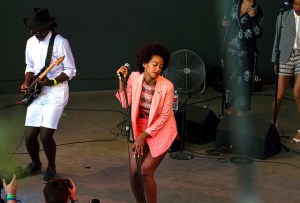
“Solange” by Flickr user Greg Chow, CC BY-NC-ND 2.0
The interlude that follows “Borderline” is the immediate payoff of this, as Solange sings with Kelly Rowland and Nia Andrews that she has “so much [magic], y’all, you can have it.” Then comes “Junie,” a fresh and energetic funk track that finds the singer back out on the activist grind after the night off that made it possible for her to return to the borderline.
As self-care proliferates in so many different practices performed by different selves, and as the term is emptied of meaning one hashtag at a time, one way we might track how power circulates through self-care is to listen to sonic representations of self-care. In Grande’s “One Last Time” performance at One Love Manchester we hear self-care staged and protected by cultural icons and government officials who assure attendees that their selves matter, while in Solange’s “Borderline” we hear self-care as an intimate, closed act that makes self- and community-preservation possible even when cultural icons and government officials refuse to participate in that preservation. In “One Last Time” we hear a community who shows up to help a singer when the world is hard, while in “Borderline,” we hear a singer having to reassure her own self that it’s okay to step away for a moment when the world is hard. By listening carefully in these moments, we can hear which selves are more readily recognizable as worthy of care—a chorus of voices surrounded and kept safe by heightened police presence—and which selves are more likely to have to perform care for themselves quietly or privately, for fear of retribution. Sound, in this instance, calls our attention to details that can let us more firmly hold onto a concept like self-care—a concept and series of practices that have been fundamental to the survival of black and queer women in a hostile world—that otherwise threatens to slip from our grasp. But hold on tight, and we just might make it back out to the borderline.
—
Featured image: Screenshot from Youtube video “Ariana Grande – One Last Time (One Love Manchester)” by user BBC Music
—
Justin Adams Burton is Assistant Professor of Music at Rider University. His research revolves around critical race and gender theory in hip hop and pop, and his book, Posthuman Rap, is available for pre-order (it drops October 2). He is also co-editing the forthcoming (2018) Oxford Handbook of Hip Hop Music Studies. You can catch him at justindburton.com and on Twitter @j_adams_burton. His favorite rapper is one or two of the Fat Boys.
—

REWIND! . . .If you liked this post, you may also dig:
Unlearning Black Sound in Black Artistry: Examining the Quiet in Solange’s A Seat At the Table-Kimberly Williams
Trap Irony: Where Aesthetics Become Politics-Justin Burton
Listening to Sounds in Post-Feminist Pop Music-Robin James
Share this:

If La Llorona Was a Punk Rocker: Detonguing The Off-Key Caos and Screams of Alice Bag


Image of Alice Bag used with her permission (thank you!)
For full intro and part one of the series click here. For part two, click here. For part three click here. For part four click here.
Our Punk Sound series implicitly argues that sound studies methodologies are better suited to understanding how punk works sonically than existing journalistic and academic conversations about musical genre, chord progressions, and/or genealogies of bands. Alexandra Vasquez’s sound-oriented work on Cuban music, for example, in Listening in Detail (2014) opens up necessary conversations about the “flashes, moments, sounds” in music that bear its meanings and its colonial, raced, classed, and gendered histories in material ways people can hear and feel. While retaining the specificity of Vasquez’s argument and the specific sonic archive bringing it forth, we too insist on “an ethical and intellectual obligation to the question: what do the musicians sound like” (12) and how do folks identifying with and through these musical sounds hear them?
In this series, we invite you to amplify varied historicized “details” of punk sound–its chunk-chunk-chunk skapunk riffs, screams, growls, group chants, driving rhythms, honking saxophones–hearing/feeling/touching these sounds in richly varied locations, times, places, and perspectives: as a pulsing bead of condensation dripping down the wall of The Smell in Downtown LA (#savethesmell), a drummer making her own time on tour, a drunk sitting too near the amp at a backyard party, a queer teenager in their bedroom being yelled at to “turn it down” and “act like a lady[or a man]”. . .and on and on. In today’s essay Marlen Rios-Hernandez discusses how all the politics of punk sound, queer chicana identity, and feminism can be found in the scream.
SOUND!
–Aaron SO! (Sounding Out!) + Jenny SO! (Sounding Out!)
—
Mexican cultural theorist Carlos Monsiváis looked at various aspects of Mexican youth subcultures in the early 80s and revealed how youth relied on “caos” or chaos as a way to attain pleasure within disruption, spontaneity, and noise (68-79). How does the scream emerge through caos as a instrument of resistance? Alongside scholars like Fred Moten, I argue that the scream ruptures caos and allows us to glimpse the pleasure of resistance. In Alice Bag’s scream we find this medley of pleasure, interruption, and spontaneity. Bag explains, “once the Bags hit the stage and the music started, ego checked out and id took over, channeling my libido, my inner rage, whatever… I was free to be myself with no holds barred. It was the ultimate freedom” (221). These elements epitomize what I consider a queer Chicana feminist exorcism of tonality.
As explained in Bag’s memoir, particular to punk, there is a general reliance on informal/community-based ear training where musicians teach each other (183). European traditions of musical analysis both negate the horizontal learning central to punk while also normalizing the historical colonial presence within the Borderlands. In order to reveal how Bag’s scream exorcises these Eurocentric traditions, I consider her performance of “Violence Girl” at the Whiskey (1978), footage of “Gluttony” from The Decline of Western Civilization Part 1 (1981), and a brief clip of The Bags’ “Survive” in What We Do is Secret (2007). Because of how the scream disrupts formal analysis, there is an urgency to understand how it works against the grain.
In the face of Chicana women being politically silenced by the Chicano Movement and Women’s Movements during the late 70s and 80s, it was important for Chicanas to speak up for increased autonomy and access to space. Thus, Alice Bag’s caos is informed by an intersectional ethic of Chicana feminism. At the time queer Chicanas were largely absent from Chicano nationalist organizing. Between the Chicano Movement and unruly Chicana punks, the screaming voice became a multi-layered instrument of protest and empowerment necessary to invert normative gender and sexual politics within punk, the Chicano movement, and second wave feminism. The ability of the Chicana scream to contest oppression is not new. Such a linage can be drawn from La Llorona–– the villanized folkloric mother that drowns her children and haunts Mexico’s shores by wailing in the night.
Drawing on Latinx scholarship and a sonic reimagining of La Llorona’s wailing (as a feminist cry and public display against patriarchy), this post reimagines Alice’s scream as simultaneously resistance and pleasure. This aligns with Gloria Anzaldúa’s notion of deslengualidad. Suturing Anzaldúa’s concept of deslengualidad (detonguing)–which I define as Chicanas speaking with an orphan tongue–with caos shows how Chicanas can claim visibility through the scream. Deslengualidad and caos account for colonial interventions within the Chican@ identity, they demand the preservation and celebration of the mestiza language and help to provide visibility to Chican@ art.
Though the voice has been rendered repeatedly as a gendered instrument, usually legible via lyrics, and always harmonic, some examples tell us otherwise. For example, Alice’s scream is interrupted by her microphone malfunctioning in her performance of “Violence Girl” at the Whiskey (1978). This multi-layered recording with it’s already grainy inaudible features, helps us to understand the scream as a stand alone act of caos. Although the scream is interrupted by multiple forms of dissonance, it also persists as a public gesture of empowerment. The quality of the recording is poor and in it Alice experiences technical issues on stage. These distortions lead Alice to artfully perform a sonic delengualidad by making use of silence, inaudible screaming, and the body. She continues to move, interrupt, and most importantly still is accompanied by stable beat of the Bags despite singing without a microphone. Yet, in the absence of aurally decipherable lyrics (like the absence of a singular Chicana language) a lyrical analysis here wouldn’t serve any other purpose than to organize that which is on its own refuses order––her voice.
The seminal footage of “Gluttony” in The Decline of Western Civilization Part 1 (1981), features an aural scream. It helps us think about how the Chicana scream goes beyond mere aurality. Michelle Habell-Pallán’s notion of “el grito,”–the shout–relates to Alice’s shriek in “Gluttony.” Both punctuate emotional drama and harken back to Ranchera music. I suggest, however, that Bag’s shriek in “Gluttony” also signifies a growing concern with the homogeneity of white suburban beach punks who had infiltrated the scene. In her memoir Bag shares, “as I looked out into the audience, I could see that the once quirky men and women artists who prized originality above all else were being replaced by a belligerent, male dominated mob…playing for a belligerent group of individuals can be quite satisfying. What I didn’t like was the sameness” (308). Pushing back against the scene’s homogeneity, Bag does not end “Gluttony with a full closed cadence. Rather, she ends abruptly, leaving the listener with a sense of incompleteness.
The combination of repeated interruptions throughout “Gluttony” and the inability to conclude pushes the listener to a place of discomfort, where they are left yearning for some kind of ending. The musicologist Susan McClary argues that the absent cadences in Carmen signify how the cadence represents a return to normality and a satisfying feeling of closure. By withholding a full cadence in “Gluttony” and using her “grito” to celebrate difference, Bag enacts caos by rejecting the emerging uniformity of the scene. Much like Bag’s performance of “Violence Girl” at The Whiskey, the scream is less about being musical and ordered but instead a gesture to making do with what one has, a similar manifestation of deslengualidad.
The brief sound clip of the Bags’ “Survive” in What We Do is Secret (2007) illustrates how Alice’s scream offers a genealogy of caos via her disruption of the story of L.A. punk. The Bag’s “Survive” for the duration of a few seconds plays in the background during a scene in which fans are getting ready to watch The Germs perform at The Masque. In this clip, Alice’s voice isn’t immediate because of how it resonates within the background music. Hence, her voice refuses containment by emanating from the periphery. Alice’s voice emerges as delengualidad within the film precisely because women are written out of the story of L.A. punk. They are depicted as secondary players in the film. Fred Moten’s In The Break reminds us that the site “where shriek turns speech turns song–– remote from the impossible comfort of origin–– lies the trace of our descent.” Within the shriek also lies our resistance tactics as Chicanas. The map of our survival through loudness–though heavily stereotyped–is a testament to the unwavering and inherited conocimiento that silence has never protected us. It is the task of women of color to interrupt, archive, and preserve their roles in the L.A. scene.
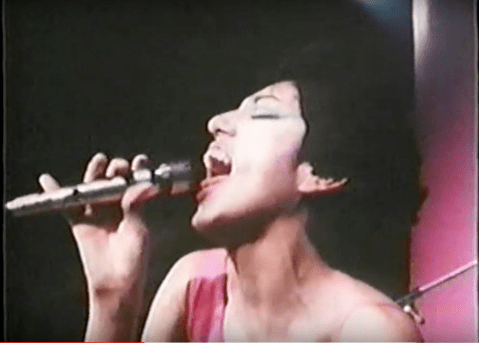
Screenshot from Alice Bag Band’s video “Gluttony.” Image used for purposes of critique.
Within Bag’s screaming from the Whiskey performance, Decline, to What We Do is Secret are snapshots or sonic/visual testimonios of queer Chicana women during the early 80s. These sonic snapshots/testimonios speak to the severely gendered and racialized repression of queer Chicana youth while still reconfiguring what empowerment looked like in the aftermath of the major socio-political movements of the 60s and 70s. In a casual conversation with Alice in a panel I guest moderated, she mentioned that watching “Gluttony” today was irksome to her because she was off-key. Perhaps, being off-key is one way that Chicana feminisms audibly reject neoliberal (and gendered) state repression. When we are surrounded by noise, we must remain enveloped in its infinite shape and simply listen. In noise we can resist, interrupt, and move away from orthodoxy and order. In today’s political climate, we need this framework now more than ever.
The return to Alice’s voice in this current moment is no coincidence. In preparation for this piece, I reflected on my brother’s deployment to Iraq during George W. Bush’s term. I was in community college taking a music appreciation course and I was searching for a paper topic that would be palatable to me as both a newly politicized queer Chicana and a former regular in the South Gate punk scene. It was through an interview with Teresa Covarrubias of The Brat and Alice Bag in an issue of Los Angeles Magazine that I heard Alice’s scream for the first time. It was the description of these women’s careers that led me to look up Chicana punk and come across the Whiskey performance of “Violence Girl.” To this day, Alice’s voice reminds us that if “Alice Bag was born from chaos” (310) then the Chicana punk voice remains a testament to punk’s resilience in the face of political uncertainty.
–
Featured image “Alice Bag Performing at Club Lingerie with the Cambridge Apostles” (CC BY 2.0)
–
Marlen Ríos-Hernández is a Ph.D. Candidate in the Ethnic Studies Department at the University of California, Riverside. Her current research revolves around queer Chicana/Mexicana punks in Mexico and Los Angeles from 1977-early 2000s respectively. Her dissertation aims to theorize and argue how Alice Bag, an innovator of the 1970s Los Angeles punk scene alongside other Mexicana punks, utilized noise to correlate the systemic disenfranchisement of womxn of color with the desire for transformational change integral to the survival of Mexicanas and first generation Chicana womxn especially during the Reagan and Bush Administrations. Via Ethnic Studies as her area of study along with her humanities and arts training as a Musicologist, Marlen investigates the relationship between unruly Chicana/Mexicana performing bodies and bisexuality, swapmeets, police brutality, photography, and film as instruments of noise-making.
–
REWIND! . . .If you liked this post, you may also dig:
G.L.O.S.S., Hardcore, and the Righteous White Voice – Chris Chien
Feeling Through the Keen and Grind: Team Dresch’s Personal Best – Gretchen Jude
Riot-Grrrl, Punk and the Tyranny of Technique – Tamra Lucid
Share this:


Current Top Posts





April 2021

January 2020

November 2019

October 2019

August 2019

April 2014

November 2017

March 2015

December 2017

October 2015
 Sounding Out!
Recent Comments