
#MMLPQTP Politics: Soccer Chants, Viral Memes, and Argentina’s 2018 “Hit of the Summer”
DOI: https://doi.org/10.59350/zphze-kd931
Note: all translations of quotations from linked media are the author’s own.
In early March, viewers of the Argentine public television cooking show Cocineros Argentinos were treated to a jaunty bit of live interstitial music as the program returned from a commercial break. In keeping with the day’s Italian theme, a small band consisting of an accordion, violin, and sousaphone played a lively but simple minor-key melody in a brisk tarantella rhythm. “Those boys can play anything,” one of the hosts remarked approvingly. The other observed, “It’s the hit of the summer!”
These sixteen seconds of seemingly innocuous instrumental music on a government-sponsored television program sparked a minor firestorm in the Argentine press. One channel wondered whether they were deliberately “picking a fight with [President] Mauricio Macri,” while another categorized the musical selection as “polemic.” Social media voices in support of the embattled president called for Cocineros Argentinos to be cancelled. Ultimately, the program’s directors apologized to the public for having “bothered or disrespected” their viewers with “ingredients that do not belong in the kitchen.”
How could a bit of instrumental, pseudo-Italian kitsch cause such an uproar? Understanding the offense – for the musical selection was indeed intended as an obscene insult to the nation’s president – requires a bit of a dive into the history and culture of Argentine politics, protest, and sports fandom. The “hit of the summer” of 2018 in Argentina is not a pop song, but a chant that started in a soccer stadium, and has become a viral sonic meme, multiplying across social media and fragmenting into countless musical iterations. By early March, listeners in Argentina heard a clear meaning in this melodic sequence, and no singer was necessary to hear the words it invoked: Mauricio Macri, you son of a whore.
The melody comes originally from a source that expresses quite a different political sentiment. In 1973, after eighteen years of forced exile, ousted populist president Juan Domingo Perón was allowed to return to Argentina, and was shortly thereafter re-elected president. Perón died in office ten months later and was succeeded by his vice president and third wife Isabelita. Isabelita’s reign would soon devolve into an infamously brutal military junta, but in 1973 populist national fervor was running high in the country, and the airwaves were full of catchy, simple patriotic marches:
“Es tiempo de alegrarnos” (“It is time for us to be happy”), by Raúl “Shériko” Fernandez Guzmán, is full of optimism for what Perón’s return means for the country. The second stanza celebrates: “I see that my people returns once more to laughter / It’s that my country has begun to live again / Pain and sadness are left behind / The days of happiness and bliss have returned.”
It’s a sentiment that would be difficult to find today in a country where political discourse is polarized and acrimonious. Macri was elected in November 2015 on a platform that was largely about undoing the policies of the decade of Peronist administrations that preceded him (his party itself is called “Cambiemos” [Let’s Change]). Since coming to power, Macri’s party has pursued a neoliberal agenda that has been increasingly unpopular with the working and middle class. Cuts to state subsidies have made the cost of utilities and mass transit skyrocket, and groups from truck drivers to teachers have organized large-scale protests in response to the austerity measures and budget cuts to the public sector. In response to these increasingly fervent protests, Macri has even authorized violent police repression of crowds. In short, as of the beginning of 2018, he’s politically embattled and a target of widespread criticism from a wide range of sectors.
Yet the “hit of the summer” is not merely an ironic repurposing of an old bit of patriotic musical fluff in a time of unrest. In fact, as the phenomenon first went viral, most Argentines were unware of the music’s original source, which had been a fleeting fad. Instead, the melody had lived on and been transformed through the great repository of popular musical memory that is Argentine soccer culture.
Soccer fandom in Argentina is a full-throated affair. As Kariann Goldschmitt has observed in the case of Brazil, the soundscape of mass gatherings in the soccer stadium, and the affective charge of crowds experiencing the collective pain of loss or the exultation of victory, is a fundamental ingredient of popular identity in Argentina. But it is not the commercial, mediatized end of what Goldschmitt calls the “sports-industrial complex” that is primarily influential here.
Rather, hinchadas, or fan clubs, pride themselves on being able to sing loudly throughout the match, arms extending in unison, typically accompanied by bombos (bass drums), trumpets, and other loud instruments. Fan clubs pride themselves on the variety and creativity of their cantitos – the ‘little songs” that repurpose popular melodies with new lyrics that praise their own side, and insult their opponents’ lack of fortitude. Any memorable melody is fair game: for example, fans of Creedence Clearwater Revival’s “Bad Moon Rising” might have found the cantito that Argentina embraced during the 2014 World Cup vaguely familiar. In the decades since its release, “Es tiempo de alegrarnos” had been used periodically by the clubs of several teams, in variants whose unifying factor was the use of the obscenity “la puta que te parió” (literally, “the whore that birthed you”) for emphasis.
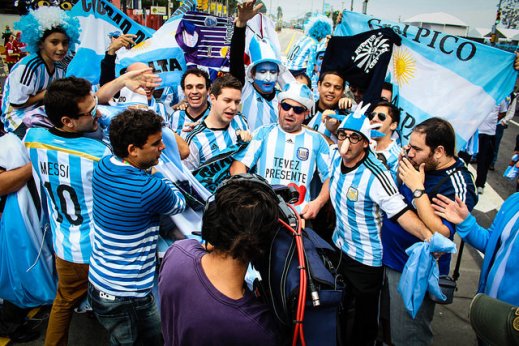
It was San Lorenzo’s fans who gave the cantito a new life in politics, during a match against Boca Juniors. The connection between Boca and President Macri was obvious for fans of both teams; Macri began his political career as the president of that team. When San Lorenzo fans felt they had been the victim of biased refereeing, the song began: “Mauricio Macri, la puta que te parió…”. All four phrases of the melody repeated the same words.
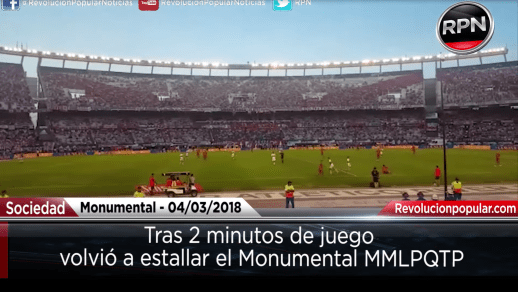
Unusually for a soccer cantito, the chant was soon picked up by the fans of another team, River Plate, who used it in similar circumstances when facing Macri’s Boca Juniors, their archrivals. Even more unusual, though, is the life that the chant has since taken on outside of the soccer stadium, where it is directed at the President not due to his association with his former club, but because of growing discontent with his political career. In the last weeks of February the cantito, now popularly known by its initials as “MMLPQTP” was heard in concert halls, basketball stadiums, and even in a crowded subway station (where, despite fare prices that have risen at eight times the rate of inflation, service remains irregular and delays are common). Journalists covering the phenomenon began to refer to it as “el hit del verano,” or “the hit of the summer.”

Using the English-language “hit” made clear that the allusion was not merely to the season (February is, of course, summer in the southern hemisphere, and a popular vacation time for Argentines) but to the seasonal nature of pop music consumption. The popular music critic’s thinkpiece seeking to define the essence of the summer song, celebrate it or lament its banality is almost as much of a trope as the phenomenon of the hit summer song itself. The sonic zeitgeist of summer 2018, these journalists suggested, could best be defined not with a breezy club banger, but with the hoarse and irate voices of a nation embroiled in an economic crisis that would make idle days at the beach unthinkable for many of its citizens.
There were attempts to curtail the spread of MMLPTQTP: the national referee’s association debated suspending future soccer matches if the chant broke out, characterizing it as potentially “discriminatory” speech (some cantitos do traffic in racist, anti-Semitic, and homophobic epithets, and referees have suspended games in the past to control them). In the end, no such suspensions occurred, perhaps because soccer fans and other musicians alike had already realized that the MMLPQTP chant had re-signified its melody so strongly that the lyrics were no longer necessary. One political cartoonist pointed out the referees’ conundrum perfectly: “They’re not singing the lyrics, sir, just humming the music,” the referee observes, asking, “should I suspend [the game] anyway?” Faced with the specter of censorship, Argentines embraced the full expressive potential of non-linguistic sonic signifiers, and the democratic possibilities of virally distributed, user-created content. A sonic meme was born.
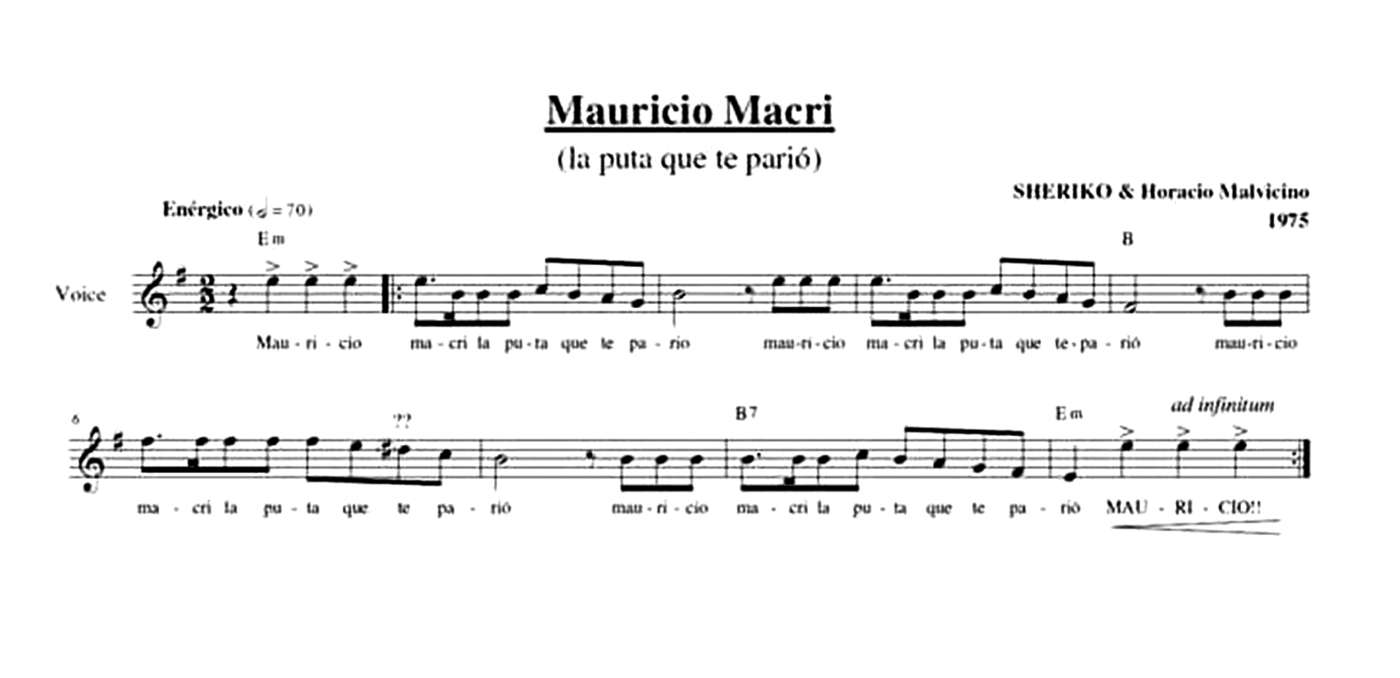
The term “meme” was coined by Richard Dawkins, who used it to mean a basic unit of information analogous to a gene, only for information or ideas. I use the term here, though, in keeping with the more contemporary popular usage, to refer to user-generated humorous content – generally captioned images — shared online. Meme sharing sites often provide templates to help users easily generate variations on a theme. In this case, the structural template was a melody and two simple chords (which musicians helpfully transcribed and shared, both in standard Western notation and instructional video formats).
Musicians of all backgrounds flocked to Twitter, Facebook and YouTube to riff on MMLPQTP. In a catalog too long to list in its entirety here, a greatest hits compilation might include solo versions for piano and charango, covers in popular genres from blues to cumbia to metal. Argentines with a strong sense of national identity might prefer tango, but Brazilian-style Carnival samba also made an appearance (playfully invoking the possibility of censorship with Spanish “subtitles” that replace the offending phrase with “la la la”). And thus finally, scandalously, the hit song made its way to national television on a cooking show, where despite its transformation into an Italian-style instrumental ditty, the sting of its insulting words was still clearly heard.
The viral success of instrumental versions of MMLPTQP is a prime example what ethnomusicologist Anne Rasmussen has recently called “the politicization of melody.” In music’s potential to comprise and thus link simultaneous linguistic and non-linguistic codes lies its ability to render those linguistic codes superfluous. These linkages provide the potential to signify political messages through melody alone, opening up possibilities for protest that are more difficult to prevent through legal means (broadcasters’ obscenity clauses, for example), or easier to circumvent through technological means (amplified instruments). It would be easy to overstate the durability or pervasiveness of such linkages, however. One need only look back to that same melody’s entirely differently politicized origin, which is today largely forgotten or seen as a curiosity, to imagine that the linkage between the melody to “Es tiempo de alegrarnos” and its current manifestation of partisan abuse might one day fade from popular memory like the one-hit wonders of summers past.
—
Featured Image: Screencapture from “Monumental MMLPQTP”
—
Michael S. O’Brien is an assistant professor of music at the College of Charleston. He has been conducting ethnographic field research on music and cultural politics in Argentina since 2003. His article examining the use of thebombocon platillo in Carnival music, soccer fandom, and political culture is forthcoming in the journal Ethnomusicology this fall. He has also published research on protest music in the U.S. in the journal Music and Politics and Smithsonian Folkways Magazine.
—

REWIND!…If you liked this post, you may also dig:
Heard Any Good Games Recently?: Listening to the Sportscape–Kaj Ahlsved
In Search of Politics Itself, or What We Mean When We Say Music (and Music Writing) is “Too Political”–Elizabeth Newton
Twitchy Ears: A Document of Protest Sound at a Distance–Ben Tausig
The Sounds of Selling Out?: Tom Zé, Coca-Cola, and the Soundtrack to FIFA Brazil 2014–Kaleb Goldschmidt
—
Share this:

The Sounds of Selling Out?: Tom Zé, Coca-Cola, and the Soundtrack to FIFA Brazil 2014

DOI: https://doi.org/10.59350/m7zjr-2ww67
Welcome back to our summer series on “Sound and Sport.” In today’s post, Kariann Goldschmitt discusses the gamechanging controversy over Brazilian musician Tom Ze’s commercial for Coca-Cola’s FIFA 2014. For an instant replay of July’s post click Josh Ottum‘s “Sounding Boards and Sonic Styles: The Music of the Skatepark” or of June’s post, click Tara Betts‘s “Pretty, Fast, and Loud: The Audible Ali.” For May’s post, click Melissa Helquist‘s “Goalball: Sport, Silence, and Spectatorship.” This Thursday’s grand finale will continue our discussion of Brazil, with a podcast by Andrea Medrado entitled “The Sounds of Rio’s Favelas: Echoes of Social Inequality in an Olympic City” AND keep you on the edge of your seat with a bonus Olympic doubleheader post excerpted from David Hendy‘s recent Noise broadcasts for BBC Radio 4 on the sounds of Olympic crowds. And now. . .the sounds of FIFA’s sponsors. —J. Stoever, Editor-in-Chief
—
Tensions in Brazil have been running high as the the country ramps up preparations for next year’s FIFA World Cup. Brazil’s economy is one of the world’s strongest, but its middle class has suffered as economic growth has stagnated amid rapidly rising costs of living. Yet, FIFA demands that Brazil’s government spend large amounts of money to renovate stadiums and further bolster tourism-based services at the expense of everything else. This last June, news of another hike in transit fees was the final straw for many citizens and they took to the streets to protest corruption and the routing of public funds to tournament preparations while basic services suffered. Protesters argue that the country is burnishing its international brand on the backs of its citizens. It is thus no surprise that much of the Brazilian public is fed up with FIFA and its multinational partners. As a consequence, musicians who participate in World Cup-related ad campaigns risk damaging their relationship with the public.
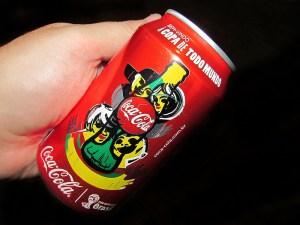
In Spring 2013, the Facebook page of one of Brazil’s most eccentric musical iconoclasts, Tom Zé, was bombarded by negative comments. Unforgivably to some of his most ardent fans, Zé had lent his vocal talents to a Coca-Cola commercial that sought to connect Brazil’s oft-mythologized cultural diversity to the universals of the World Cup and Coca-Cola’s alleged populism. Zé inflected his delivery of the ad copy with an especially musical speaking cadence and rhythm. It was a peculiar take that drew on his signature vocal eclecticism.
The ad opens with Zé stating,
Muita gente se pergunta como vai ser a copa
A coca-cola vai falar como ela não vai ser
[Many people are asking themselves what this cup will be like
Coca-Cola is going to tell you what it won’t be like]
as the shot features a group of people smoothing out a giant kite with the Brazilian flag. There is a strong syncopated rhythm to Zé’s voice that matches the carnival samba drums (especially the caixa) that accompany the ad throughout. As it continues, the imagery matches what Zé describes, in either stills or brief shots, often recalling the frenzy surrounding world cups of the past. In a rapid cadence, he says:
não vai ser só a copa de vuvuzela, do vidente, da celebridade
da menina bonita, do jogadores com cabelo da moda…”
[it won’t be the Cup of the vuvuzela, the psychic, nor of celebrity
of beautiful women, nor of players with fashionable hair]
The synchronization of Zé’s rapidly rhythmic delivery over archetypal images of Brazil’s tournament excitement is crucial to the ad’s message. This passage mentions two icons of the 2010 tournament, the vuvuzela and the psychic (vidente) octopus, with accompanying images. In under four seconds, the camera jumps from a man holding a celebrity magazine (celebridade), a woman cheering (menina bonita), some player figurines (jogadores) and a boy with an elaborate buzz cut. By aligning himself with an official sponsor of the upcoming tournament through ad copy that valorizes Brazil’s present, Zé also lent the sound of his voice to the sports-industrial complex, thereby opening himself up to accusations that he was a “sell-out” (vendido).
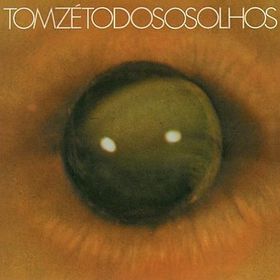
Zé is famous for taking part in the tropicália of the late 1960s – a cultural movement that was most effective through popular music. Tropicália musicians bucked Brazilian musical conventions by blending imported rock ‘n’ roll with national music protest songs during a period when musical taste often indicated one’s support or disapproval of the military dictatorship. While most involved in tropicália eventually became Brazilian musical mega-stars (Caetano Veloso, Gilberto Gil, Gal Costa, Os Mutantes, and Mara Bethânia), Zé drifted to obscurity by rejecting many of the machinations of the record industry. He only found an international audience when David Byrne’s Luaka Bop Records released some of his music in the 1990s, the most successful of which was Fabrication Defect [Com Defeito de Fabricação] (1998). Due to his peculiar status, Zé disrupted fan expectations and threatened his brand when he embraced a corporate power so intricately connected to an increasingly unpopular athletic tournament.
The controversy surrounding the Coca-Cola ad took a turn towards farce when, on April 22nd, 2013, Zé released a free 5-song EP on his website titled Tribunal do Feicebuque – a clear play on the way that Brazilians tend to pronounce “Facebook.” Accompanying the songs was a parody of tribunal orders listing the performing and collaboration credits along with lyrics to the songs. Zé’s actions exposed how the incident was a different kind of sonically-driven sports spectacle – this time it was played out over social media, in Brazil’s most influential newspaper, in Tribunal references and fights with fans during his shows at Rio’s famed Circo Voador, and in the ensuing blog reviews of his shows.
The chaotic structure of the EP’s title track, while typical of Zé catalog, disrupts his fans’ claims of “selling out.” He employs a variety of sonically disjunct approaches, opening with the startup sound for Microsoft’s Vista OS before jumping into a psychedelic samba-rock tune with a staccato guitar and a brass section. Zé recorded his vocals over multiple tracks, at times simultaneously sung/spoken at a low pitch and sung at a high pitch. The first half is familiar – the voices trade between Zé and a female companion in something sounding like a duet over a samba-rock beat. The lyrics directly reference infamous moments when Brazilian audiences have turned on their musical icons thought to be too involved in international business influences.
Vendido, vendido, vendido!
A preço de banana
Já não olha mais pro samba
Tá estudando propaganda
[Sell-out, sell-out, sell-out!
The price of a banana
He no longer looks to samba
He’s studying advertising]
At the mid-point, rock gives way to a serious march and more voices enter (including famed São Paulo hip-hop artist Emicida) making the song’s structure more like a trial, complete with competing arguments, before returning to samba-rock under Emicida’s rapping. The song is creative and fun, but it is far from Brazil’s top-40 fare which often favors smoother genre blends and urban pop hits.
Given all of the attention paid to musicians’ efforts to supplement their meager income from digital sales and streaming royalties by forging partnerships with a variety of multinational corporations, it is a little surprising that Tom Zé’s participation in a Coca-Cola commercial would be this controversial. It is difficult to find a musician in Brazil that hasn’t benefitted from some kind of corporate sponsorship. Most artists accept funding from a granting arm of a national corporation (oil company Petrobras, major bank Itaú), license music to national ad campaigns, or embark on a more direct co-branding effort from the likes of mobile phone providers and skin care companies.
One of the hallmarks of the recent changes that have affected the music industry is that musicians rarely refuse opportunities for their music to be used as the soundtrack for mainstream audio/visual entertainment and advertisements. The practice is so common that one of the best-regarded music industry survival books explains possible changes to a musician’s brand when they participate in the advertising of other products. Instead of “don’t license your music,” musicians should license their music in a way that will benefit their brand. It is rare for a song’s success among World Cup spectators to harm musicians; anthems that reflect well on the host nation(s) and express the energy of cheering crowds are a central feature of the tournament. Shakira’s “Waka Waka” actually bolstered her credibility among music fans across the African continent because it sampled Golden Sounds’ hit “Zamina Mina,” a popular song among hip-hop artists in Camaroon and Senegal. In Zé’s case, he misjudged how the tournament and its corporate sponsors were being read by the Brazilian public just weeks before tensions exploded in protest. Indeed, as compared to other Brazilian artists who have recorded potential 2014 World Cup anthems, the reaction to Zé is unique.
As others have noted, television advertising played an important role in the June protest soundtrack. Protesters appropriated the song from a Fiat commercial (released just weeks after Zé’s Facebook episode) that explicitly connects cheering soccer crowds in the street to a new car.
The meaning of “torcer,” a common expression for “cheer” in both advertisements’ copy, is transformed back to its original meaning to wrench or twist thereby exposing the conflicts that have been exacerbated by Brazil’s preparations for the tournament and the sports industrial complex.
These crowds twisted an ad’s soundtrack to challenge the role of multinational agencies and corporations in Brazil’s skewed socio-economic priorities. Indeed, as Leo Cardoso wrote in Sounding Out! a year ago, some of these priorities include regulating sound in Brazil’s largest cities.
For both of these cases involving sonic responses to advertisements that explicitly seek to capitalize on excitement for the soccer tournament, their original intended meaning was twisted and wrenched, forcing musicians to re-evaluate their publics. In the current political climate, Zé found that musical sounds can be aligned with the FIFA World Cup, so long as they are about celebrating sport rather than its multinational sponsors.
—
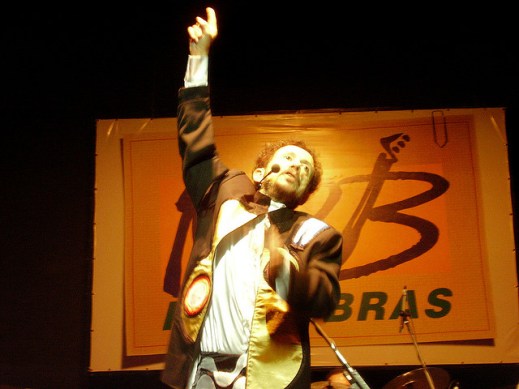
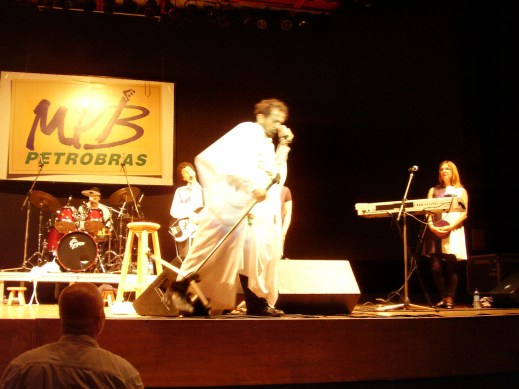
Featured Image: Tom Zé in 2008 performing in front of a Petrobras sign, photo used by CC license, Neto Silveira
—
—

REWIND! . . .If you liked this post, you may also dig:
“Sound-politics in São Paulo, Brazil”–Leonardo Cardoso
Quebec’s #casseroles: on participation, percussion and protest–Jonathan Sterne
Hello, Americans: Orson Welles, Latin America, and the Sounds of the “Good Neighbor”–Tom McEnaney
—
Share this:




Current Top Posts


April 2021
January 2020

November 2019

October 2019

August 2019

April 2014

November 2017
March 2015

December 2017

October 2015


Recent Comments