
Press Play and Lean Back: Passive Listening and Platform Power on Nintendo’s Music Streaming Service

I remember long car rides as a kid in the early 2000s, headphones on, gazing out the window at the passing scenery while looping background music from The Legend of Zelda and Pokémon games on my Game Boy. After school, I’d occasionally throw the Super Smash Bros. Melee soundtrack on my Discman CD player, keeping me motivated while doing homework. Like many others, I found Nintendo’s music to be an effective accompaniment to everyday activities, a kind of functional listening long before streaming platforms like Spotify and YouTube made it trendy. Which raises the question: how has Nintendo adapted to the streaming age?
Unlike many other game publishers, Nintendo has conspicuously kept its music off streaming services—despite having some of the most recognizable soundtracks in video game history, such as Super Mario Bros., Donkey Kong, and Metroid. Instead, the company took a different direction by unveiling its own music streaming service in October 2024, aptly titled Nintendo Music. The platform, available to Nintendo Switch Online subscribers, showcases soundtracks spanning the company’s history, from 1980s NES titles to recent Nintendo Switch 2 releases.
In a listening landscape dominated by Spotify, Apple Music, and YouTube Music, Nintendo’s decision to launch its own proprietary streaming service makes it unique among video game companies. This move is idiosyncratic in a way that feels characteristically Nintendo, but it is also a bold bid to compete in the broader attention economy. By situating itself alongside, rather than within, the major music streaming services, Nintendo signals that its soundtracks are valuable cultural content worth curating and controlling directly.
Nintendo Music caters specifically to video game fans by including screenshots with each track, having a “Spoiler” filter that lets users block music from games they haven’t played, and making personalized recommendations based on each user’s play history. But perhaps most notable is its emphasis on background listening: through features like mood playlists and an “Extend” tool, video game music is explicitly framed as a companion for contexts like relaxing, working out, or doing household chores.
By repurposing game soundtracks as tools for everyday routines, Nintendo Music capitalizes on nostalgia and contemporary listening habits to deepen fan engagement and retain control over its brand—a strategic move from a company that is famously (over)protective of its intellectual property. More generally, it also reflects neoliberal logics in which music is woven into daily life to regulate mood and productivity, revealing the increasing reach of digital platforms over how we work, listen, and live.
Listening in Loops: Video Game Music in the Background
In advertisements for Nintendo Music, actors hum and sing along to famous video game tunes while carrying out their daily activities. “Whether you’re grocery shopping, straightening up at home, or getting some studying done, Nintendo Music can be the background sound to your everyday life,” the description to one video reads.
This marketing is strikingly similar to strategies by streaming services such as Spotify, which encourage listening to music in any and every context. Playlists based around specific moods or activities—like Spotify’s “Gym Hits,” “Intense Studying,” and “sad girl starter pack”—use music as a tool to manage listeners’ energy levels, focus, and emotions as they go about their lives. Anahid Kassabian’s concept of “ubiquitous listening” helps describe this phenomenon, showing how even passive, background engagement can shape listeners’ affects and experiences.
In many ways, video game music is ideal for the ubiquitous listening that streaming services promote. Game soundtracks are generally (though not always) designed for the background and are usually instrumental, setting the emotional tone of on-screen action, from serene soundscapes to intense boss battles. Unlike other multimedia soundtracks, such as film scores, much video game music is also composed to loop indefinitely, making it especially effective for sustained listening.
As Michiel Kamp demonstrates in Four Ways of Hearing Video Game Music, “background listening” is one of the main ways users experience video game soundtracks. He writes that “background music both in games and elsewhere requires us to be so attuned to it that it offers no experiential friction in need of interpreting, and through this it has the capacity to attune us to our environment, be it a mythical underworld full of dangers or a convenience store full of groceries” (2024, 175).
While Kamp primarily focuses on background listening while playing games, game music can attune listeners to moods, activities, or environments even when heard outside of gameplay. In fact, video games train us to listen in this way, using music to establish the appropriate affect for narrative events, settings, and characters. These immersive qualities have made video game music immensely popular on streaming services: soundtracks from games and franchises like Halo, Final Fantasy, The Elder Scrolls, Undertale, and Minecraft have collectively garnered over a billion streams on Spotify alone.
But Nintendo, by launching its own proprietary platform, trades streaming royalties and wider exposure for something arguably more valuable: the ability to control how and where fans experience its content.
Features in Focus: Nintendo Music’s Approach to Passive Listening
Nintendo Music’s features illustrate how the service adapts soundtracks for continuous, everyday listening. Perhaps most notable is the service’s unique Extend feature, which allows users to stretch the runtime of tracks up to 60 minutes. Described in the app as “the perfect accompaniment to studying or working,” this feature facilitates seamless background listening without the distraction of frequent track changes. So if you’ve ever wanted to loop the Wii Shop music for a full hour—and let’s be honest, who hasn’t—now you can.


Alongside complete soundtracks, Nintendo Music also foregrounds curated playlists, including those based around specific video game characters, themes, and moods. The “Powering Up” playlist features “up-tempo tracks to fill you with energy,” for example, while “Good Night” has “down-tempo tracks to help you drift into dreamland.” Screenshots for each track further immerse listeners, visually reinforcing the moods and environments the music is designed to evoke. On these playlists, Nintendo’s music is presented less as individual compositions and more as “vibes.”

Packaging music around moods or vibes is not a neutral act. In Mood Machine: The Rise of Spotify and the Costs of the Perfect Playlist, Liz Pelly asserts that “organizing music by mood is a way to transform it into a new type of media product. It is about selling users not just on moods, but on the promise of the very concept that mood stabilization is something within their control. It’s a tactic for luring users to double click and start streaming” (2025, 40). Pelly’s observation underscores that mood-based playlists do more than entertain: they are a way for platforms to influence how listeners organize their time and attention.
Furthermore, Nintendo Music’s approach positions music not only as a creative or cultural artifact, but also as a commodified resource for self-regulation. This aligns with Eric Drott’s claim that streaming services often employ music as a “technology of social reproduction,” used to structure and maintain day-to-day existence. For Drott, this is “part of a broader tendency under neoliberal capitalism that prizes music, the arts, and culture not on account of their aesthetic worth but on account of their ‘expediency’ for other social, political, and economic ends” (2024, 197).
Many users still actively listen to their favourite Nintendo soundtracks on the platform, and there’s also nothing inherently wrong with background listening—it’s how much of this music was originally designed to be heard. However, presenting music as an aid to concentration, productivity, or mood regulation also risks repurposing soundtracks as a form of “neo-Muzak,” a vehicle for continuous consumption designed to keep listeners plugged into Nintendo’s broader product ecosystem.
Background Benefits: Nintendo’s Platform Power
Beyond guiding listening habits, Nintendo Music reinforces the company’s brand image of nostalgia, innovation, and family-friendly fun while increasing engagement with its intellectual property on its own terms. As a Nintendo spokesperson said in an interview with Nippon TV News, “To increase the number of people who have access to Nintendo IP, we believe that game music is an important and valuable form of content. Nintendo Music is a service that allows us to deliver this game music in a way that is uniquely Nintendo. . . . We hope that Nintendo Music will help you recall some of your favorite gaming experiences and think that it will also encourage people to play the games again” (translation by Nicholas Anderson).
Nintendo’s efforts to centralize its music are also likely, at least in part, a response to fans unofficially circulating soundtracks online. As part of a broader trend of functional music compilations (think lofi beats to study/relax to), YouTube hosts countless user-generated Nintendo music playlists designed for activities such as studying and sleeping. Despite Nintendo’s notoriety for issuing takedown notices over copyright infringement—including shutting down the massively popular YouTube video game music channel GilvaSunner in 2022—many of these unofficial videos and reuploads continue to accrue millions of views.
By providing an official home for soundtracks and its own contextual playlists, Nintendo Music is a subtle exercise in platform power, gating access to subscribers. It redirects listeners from other platforms, letting Nintendo control its content without diluting its brand on third-party services. Although Nintendo Music’s catalogue is currently slim—as of writing it has roughly 100 soundtracks—the company continues to trickle out new music most weeks, incentivizing listeners to keep coming back.
Nintendo Music promotes ongoing background listening not only to attract users who are already accustomed to mood and activity playlists, then, but also to keep them on the platform and connected to the company’s games and services. After all, every minute a listener spends on Nintendo Music looping David Wise’s “Aquatic Ambiance” from Donkey Kong Country is a minute they aren’t spending on YouTube, Spotify, or any other entertainment platform.
* * *
Video game music is, in many respects, perfectly suited for the streaming age. From the popularity of playlists to the ascent in ambient music, streaming services’ focus on passive listening aligns with the background function of video game soundtracks. As we’ve seen, Nintendo Music takes full advantage of this, using its marketing and features to bolster branding, solidify control over IP, and encourage engagement.
For many, Nintendo Music offers an enjoyable experience and a convenient way to stream nostalgic soundtracks. But the service also exposes how proprietary platforms concentrate power and leverage passive listening for ongoing consumption, reinforcing broader patterns where work and leisure become intertwined with corporate interests. By prompting users to integrate Nintendo’s music into their activities, the platform extends the reach of its games beyond the screen and into daily life.
Whether you’re listening to famed composer Koji Kondo or everyone’s favourite troubadour dog K.K. Slider, Nintendo’s message is clear: press play and lean back.
—
Featured Image: “Mario Kart” by MIKI Yoshihito (#mikiyoshihito), CC BY 2.0
—
Ryan Blakeley is Visiting Assistant Professor at Northeastern University and holds a PhD in Musicology from the Eastman School of Music. His research investigates how digital platforms like music streaming services are shaping creative practices, listening habits, and music industry power dynamics.
—
REWIND!…If you liked this post, you may also dig:

Video Gaming and the Sonic Feedback of Surveillance: Bastion and the Stanley Parable–Aaron Trammell
Playing with the Past in the Imagined Middle Ages: Music and Soundscape in Video Games–James Cook
Beyond the Grave: The “Dies Irae” in Video Game Music–Karen Cook
Sounding Out! Podcast #29: Game Audio Notes I: Growing Sounds for Sim Cell–Leonard J. Paul
Papa Sangre and the Construction of Immersion in Audio Games— Enongo Lumumba-Kasongo
Share this:

In Search of Politics Itself, or What We Mean When We Say Music (and Music Writing) is “Too Political”

Music has become too political—this is what some observers said about the recent Grammy Awards. Following the broadcast last week, some argued that musicians and celebrities used the event as a platform for their own purposes, detracting from the occasion: celebration of music itself. Nikki Haley, the U.S. Ambassador to the United Nations, tweeted:
I have always loved the Grammys but to have artists read the Fire and Fury book killed it. Don’t ruin great music with trash. Some of us love music without the politics thrown in it.— Nikki Haley (@nikkihaley) January 29, 2018
I don’t know for sure, but I imagine that the daily grind of a U.N. ambassador is filled with routine realities we refer to as “politics”: bureaucracy, budget planning, hectic meetings, and all kinds of disagreements. It makes some sense to me, then, that Haley would demand a realm of life that is untouched by politics—but why music in particular?
The fantasy of a space free from politics resembles other patterns of utopian thought, which often take the form of nostalgia. “There was a time when only a handful of people seemed to write politically about music,” said Chuck Klosterman, a novelist and critic of pop culture, in an interview in June 2017. He continued:
Now everybody does, so it’s never interesting. Now, to see someone only write about the music itself is refreshing. It’s not that I don’t think music writing should have a political aspect to it, but when it just becomes a way that everyone does something, you see a lot of people forcing ideas upon art that actually detracts [sic] from the appreciation of that art. It’s never been worse than it is now.
He closed his interview by saying: “I do wonder if in 15 years people are going to look back at the art from this specific period and almost discover it in a completely new way because they’ll actually be consuming the content as opposed to figuring out how it could be made into a political idea.” Klosterman almost said it: make criticism great again.
Reminiscing about a time when music writing was free from politics, Klosterman suggests that critics can distinguish between pure content and mere politics—which is to say, whatever is incidental to the music, rather than central to it. He offers an example, saying, “My appreciation of [Merle Haggard’s] ‘Workin’ Man Blues’ is not really any kind of extension of my life, or my experience, or even my values. […] I can’t describe why I like this song, I just like it.” If Klosterman, an accomplished critic, tried to describe the experiences that lead him to like this particular song, he probably could—but the point is that he doesn’t make explicit the relationship between personal identity and musical taste.

Screen Capture of Merle Haggard singing “Workin’ Man Blues,” Live from Austin, Texas, 1978
The heart of Klosterman’s concern is that critics project too many of their own problems and interests onto musicians. Musician and music writer Greg Tate recently made a similar suggestion: when reviewing Jay-Z’s album 4:44, Tate focuses on how celebrities become attached to public affects. In his July 2017 review, “The Politicization of Jay-Z,” he writes:
In the rudderless free fall of this post-Obama void […] all eyes being on Bey-Z, Kendrick, and Solange makes perfect agitpop sense. All four have become our default stand-ins until the next grassroots groundswell […] Bey-Z in particular have become the ready-made meme targets of everything our online punditry considers positive or abhorrent about Blackfolk in the 21st century.

Jay and Bey perform live in 2013, by Flickr user sashimomura,(CC BY 2.0)
He suggests that critics politicize musicians, turning them into repositories of various projections about the culture-at-large. Although writing from a very different place than Klosterman, Tate shares the sense that most music criticism is not really about music at all. But whereas Klosterman implies that criticism resembles ideological propaganda too much, Tate implies that criticism is a mere “stand-in” for actual politics, written at the expense of actual political organizing. In other words, music criticism is not political enough.
In 1926, W.E.B. Du Bois wrote about this problem, the status of art as politics. In his essay “Criteria of Negro Art,” he dissects what he perceives to be the hypocrisy of any demand for pure art, abstracted from politics; he defends art that many others would dismiss as propagandistic—a dismissal revealed to be highly racialized. He writes:
Thus all Art is propaganda and ever must be, despite the wailing of the purists. I stand in utter shamelessness and say that whatever art I have for writing has been used always for propaganda for gaining the right of black folk to love and enjoy. I do not care a damn for any art that is not used for propaganda. But I do care when propaganda is confined to one side while the other is stripped and silent.
Du Bois’s ideas would be engaged extensively by later authors, including Amiri Baraka. In his 1963 essay “Jazz and the White Critic,” he addresses politics in terms of “attitude.” Then-contemporary white critics misunderstood black styles, he argued, because they failed to fully apprehend the attitudes that produced them. They were busy trying, and failing, to appreciate the sound of bebop “itself,” but without considering why bebop was made in the first place.
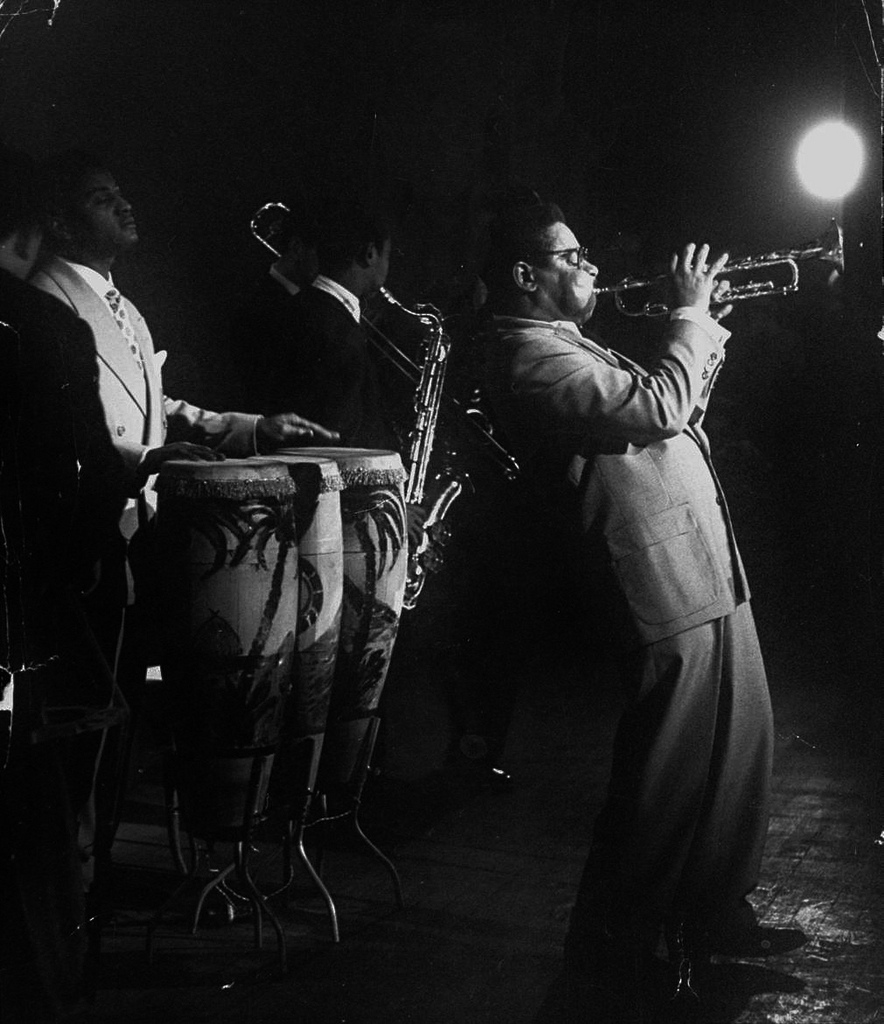
Dizzy Gillespie, one of BeBop’s key players, in Paris, 1952, Image courtesy of Flickr User Kristen, (CC BY 2.0)
As Baraka presents it, white critics were only able to ignore black musicians’ politics and focus on the music because the white critics’ own attitudes had already been assumed to be superior, and therefore rendered irrelevant. Only because their middle-brow identities had been so thoroughly elevated in history could these middle-brow critics get away with defining the object of their appreciation as “pure” music. Interestingly, as Baraka concludes, it was their ignorance of context that ultimately served to “obfuscate what has been happening with the music itself.” It’s not that the music itself doesn’t matter; it’s that music’s context makes it matter.
In response to morerecent concerns about the politicization of popular music, Robin James has analyzed the case of Beyoncé’s Lemonade. She performs a close reading of two reviews, by Carl Wilson and by Kevin Fallon, both of whom expressly seek the album’s “music itself,” writing against the many critical approaches that politicize it. James suggests that these critics can appeal to “music itself” only because their own identities have been falsely universalized and made invisible. They try to divorce music from politics precisely because this approach, in her words, “lets white men pop critics have authority over black feminist music,” a quest for authority that James considers a form of epistemic violence.
That said, James goes on to conclude that the question these critics ask—“what about the music?”—can also be a helpful starting point, from which we can start to make explicit some types of knowledge that have previously remained latent. The mere presence of the desire for a space free from politics and identity, however problematic, tells us something important.
 Our contemporary curiosity about identity—identity being our metonym for “politics” more broadly—extends back at least to the 1990s, when music’s political status was widely debated in terms of it. For example, in a 1991 issue of the queercore zine Outpunk, editor Matt Wobensmith describes what he perceived to be limitations of thinking about music within his scene. He laments what he calls “musical purism,” a simplistic mindset by which “you are what you listen to.” Here, he capitalizes his points of tension:
Suddenly, your taste in music equates you with working class politics and a movement of the disenfranchised. Your IDENTITY is based on how music SOUNDS. How odd that people equate musical chops with how tough or revolutionary you may be! Music is a powerful language of its own. But the music-as-identity idea is a complete fiction. It makes no sense and it defies logic. Will someone please debunk this myth?
Wobensmith suggests that a person’s “musical chops,” their technical skills, have little to do with their personal identity. Working from the intersection of Klosterman and Tate, Wobensmith imagines a scenario in which the abstract language of music transcends the identities of the people who make it. Like them, Wobensmith seems worried that musical judgments too often unfold as critiques of a musician’s personality or character, rather than their work. Critics project themselves onto music, and listeners also get defined by the music they like, which he finds unsettling.
 That same year, in an interview published in the 1991 issue of the zine Bikini Kill, musicians Kathleen Hanna and Jean Smith addressed a similar binary as Wobensmith, that of content and technique. But they take a different view: in fact, they emphasize the fallacy of this dualism in the first place. “You just can’t separate it out,” said Hanna, questioning the possibility of distinguishing between content—the “music itself”—and technique on audio recordings.
Female-fronted bands of this era were sometimes criticized for their lack of technique, even as terrible male punk bands were widely admired for their cavalier disregard of musical rules. Further still, disparagement of women’s poor technique often overlooked the reasons why it suffered: many women had been systematically discouraged from musical participation in these scenes. Either way, as Tamra Lucid has argued, it is the enforcement of “specific canons of theory and technique,” inevitably along the lines of identity, that cause harm if left unexamined.
All of these thinkers show that various binaries in circulation—sound and identity, personality and technique, music and politics—are gendered in insidious ways, an observation arrived at by the same logic that led Du Bois to reveal the moniker of “propaganda” to be racialized. As Hanna puts it, too many people assumed that “male artists are gonna place more importance on technique and female artists’ll place more on content.” She insists that these two concepts can’t be separated in order to elevate aspects of experience that had been implicitly degraded as feminine: the expression of righteous anger, or recollection of awkward intimacy.

Bikini Kill at Gilman Street, Berkeley, CA, 1990s, Image by Flickr User John Eikleberry, CC BY-NC 2.0
Punk had never pretended not to be political, making it a powerful site for internal critique. Since the 1970s, punk had been a form in which grievances about systemic problems and social inequality could be openly, overtly aired. The riot grrrls, by politicizing confessional, femme, and deeply private forms of expression within punk, demonstrated that even the purest musical politics resemble art more than is sometimes thought: “politics itself” is necessarily performative, personal, and highly expressive, involving artifice.
Even the act of playing music can be considered a form of political action, regardless of how critics interpret it. In another punk zine from c. 1990, for example, an anonymous author asks:
What impact can music have? You could say that it’s always political, because a really good pop song, even when it hasn’t got political words, is always about how much human beings can do with the little bag of resources, the limited set of playing pieces and moves and words, available […] Greil Marcus calls it ‘the vanity of believing that cheap music is potent enough to take on nothingness,’ and it may be cool in some places to mock him but here he’s dead-on right.
But music is never only political—that is, not in the elections-and-petitions sense of the word. And music is always an action, always something done to listeners, by musicians (singers, songwriters, producers, hissy stereo systems)—but it’s never only that, when it’s any good: no more than you, reader, are the social roles you play.
The author persuades us that music is political, even as they insist that it’s something more. Music as “pure sound,” as a “universal language” seems to have the most potential to be political, but also to transcend politics’ limitations—the trash, the propaganda. Given this potential, some listeners find themselves frustrated with music’s consistent failure to rise to their occasion, to give them what they desire: to be apolitical.

Kelly Clarkson performed at The Chelsea on July 27, 2012, image by Flickr User The Cosmopolitan of Las Vegas, CC BY-NC 2.0
In an interview during the recent Grammys broadcast, pop singer Kelly Clarkson said, “I’m political when I feel like I need to be.” It’s refreshing to imagine politics this way, like a light we turn on and off–and it’s a sign of political privilege to be able to do so. But politics are, unfortunately, inextricable from our lives and therefore inescapable: the places we go, the exchanges we pursue, the relationships we develop, the ways we can be in the world. Thinking with Robin James, it seems that our collective desire for a world free from all this reveals a deeper knowledge, which music helps make explicit: we wish things were different.
I wonder if those who lament the “contamination” of the Grammys with politics might be concerned that their own politics are unfounded or irrelevant, requiring revision, just as many white people who are allergic to identity politics are, in fact, aware that our own identity has been, and continues to be, unduly elevated. When Chuck Klosterman refuses to describe the reason why he likes “Workin’ Man Blues,” claiming that he “just does,” does he fear, as I sometimes do, not that there is no reason, but that this reason isn’t good enough?
Fortunately, there are many critics today who do the difficult work of examining music’s politics. Take Liz Pelly, for example, whose research about the backend of streaming playlists reminds us of music’s material basis. Or what about the astute criticism of Tim Barker, Judy Berman, Shuja Haider, Max Nelson, and others for whom musical thought and action are so thoroughly intertwined? Finally, I think of many music writers at Tiny Mix Tapes, such as Frank Falisi, Hydroyoga, C Monster, or Cookcook, for whom creation is a way of life—and whose creative practices themselves are potent enough to “take on nothingness.”
“Music is never only political,” as the anonymous ‘zine article author argues above, but it is always political, at least a little bit. As musicians and critics, our endeavor should not be to transcend this fact, but to affirm it with increasing nuance and care. During a recent lecture, Alexander Weheliye challenged us in a lecture given in January 2018 at New York University, when listening, “To really think: what does this art reflect?” Call it music or call it politics: the best of both will change somebody’s mind for real, and for the better.
—
Featured Image: Screen Capture from Kendrick Lamar’s video for “HUMBLE,” winner of the 2018 Grammy for “Best Music Video.”
—
Elizabeth Newton is a doctoral candidate in musicology. She has written for The New Inquiry, Tiny Mix Tapes, Real Life Magazine, the Quietus, and Leonardo Music Journal. Her research interests include musico-poetics, fidelity and reproduction, and affective histories of musical media. Her dissertation, in progress, is about “affective fidelity” in audio and print culture of the 1990s.
—
 REWIND!…If you liked this post, you may also dig:
SO! Reads: Jace Clayton’s Uproot–Elizabeth Newton
Re: Chuck Klosterman – “Tomorrow Rarely Knows”–Aaron Trammell
This is What It Sounds Like . . . . . . . . On Prince (1958-2016) and Interpretive Freedom–Ben Tausig
Share this:


Current Top Posts





April 2021

January 2020

November 2019

October 2019

August 2019

April 2014

November 2017

March 2015

December 2017

October 2015
 Sounding Out!
Recent Comments