
SO! L.A.: Sounding the California Story
 Editor’s Note: Welcome to the second installment in our month-long exploration of listening in observation of World Listening Day on July 18, 2012. For the full introduction to the series click here. To peep the previous post, click here. Otherwise, whip out your most oversized sunglasses, kick back, and listen to Bridget Hoida’s California. –JSA
—-
STOP.
Do not read along with me “in your book.”
Resist the temptation to follow along with your eyes.
Click play. Listen.

Sunset in the San Joaquin Valley
If I had things my way, I would whisper these stories to you as we sat in mesh folding chairs on the poured concrete porch of my Central Valley childhood home. If I had things my way, I would refill your glass with lemons and gin, and we would breathe in the sweet, summer smell of rotting blackberry brambles. If I had things my way, we would wait until the sun set against a Tokay harvest, taking with it the harsh triple digit temperature and leaving us nothing but the quiet of a delta breeze and moonlight. If I had it my way, I would ask you to lean in close as I whisper with canonical voices:
“This is a story about love and death in the golden land, …”
“I remember that moment exactly, those exact words registering in my mind like the notes of a solo…”
“Bobby Gene was a tattletale he told everything he heard…”
“You must not tell anyone what I am about to tell you…”
“My history is murky, and I wanted it [ …] that way so I could be free to tell whatever I wanted. ”
“I’ll tell you what I suppose from your silences and few words and you can tell me if I’m mistaken. You’ll have to speak up with the real stories if I’ve got you wrong…”
“And so they talked and told tales of their region, and I listened. Long into the night I listened until I dropped off to sleep and my father would pick me up onto his lap as he continued to talk about the Revolution…. And every camp was different, none existing for more than six or seven weeks, then off we would go to the next harvest, where new people would gather and there would be new tales to be told and heard. I knew when I was six years old that the one thing I most wanted from life was to be a storyteller.
The storied sound of California
-All Voices
Shush…. Listen.
Linger with me on the drawn-out drawl of the stories I was raised on. Of the stories I was raised upon. For this is the sound of the California story: A myriad of voices sounding out narratives onto the page. Conflicting, concurring, spoken-over and rewrote…no one lasts longer than the next harvest, the next filmic “Action!” This is the sound of the storied terrain of interwoven melodies spoken upon the California soil that I call home.
1.
In or around 1995, I fell madly in love with Joan Didion. It’s not so much Didion the woman but rather the sound of Didion’s words that have me so hung up. My obsession began in the stacks of the Bancroft Library at UC Berkeley. I was assistant to the assistant librarian there and during my lunch hour I would take the dumb waiter up to the roof, eat a Kaiser roll with apricot jam, and read dime store copies of classic novels. I chose the roof because I like to read aloud, and in libraries at the time, reading aloud, especially to yourself, was expressly forbidden.

So there I was on the roof of Bancroft, with my roll, my jam, and my dime store copy of Play It As It Lays. I opened the page and read something about snakes and Iago. A mother died, the town of Silver Wells was won, and then lost, in much the same way a marriage slips into divorce. And then it happened. I stumbled across a line that changed the way I thought about words. Page 7, the first full sentence of the top paragraph, on the right: I might as well lay it on the line, I have trouble with as it was.
And after that line a whole lot of white space.
Beautiful, brilliant, blank white space.
As though in the silence of the rooftop, of the view, Didion was screaming to the reader, to me, something louder than words. In that white space there was sound and it was deafening.

2.
Later, when I decided to get a Ph.D. in creative writing, and although I couldn’t say as much on paper, examine, among other things, the commonality of language in California writers and the sonic devices of oral storytelling, I came across a quote from Didion, in interview, that said:
I had the technical intention to write a novel so elliptical and fast […] it would scarcely exist on the page at all…white space. Empty space. […] A white book to which the reader would have to bring his or her own bad dreams…
And although I adore everything about her I almost wished she hadn’t said it. Or that I hadn’t read it, because the thing about Didion is that statement… the part about the blank space… and the nightmare… it was already there. On the roof of the Bancroft library with my Kaiser roll and apricot jam, when the air tasted like September, I brought my own bad dreams because in that brilliant bit of white space I heard the scream.
3.
I like the white page. I prefer stories to plots. Plot for me is how the narrative moves from one space in time (from one line on the page) to the next. Story is how the narrative sounds. Story is voice. Plots are where girls meet boys and girls lose boys and girls get boys back. Stories are the shuffle and stop of scuffed shoes walking railroad levees, old men clearing phlegm, the surprise of an elastic bikini band as it snaps against the freshly burnt back of a burgeoning starlet. And the sounds of words as they smack unbridled against the page.

a traditional page by John Steinbeck

a white page by Joan Didion
4.
When I read Didion we are on my porch and I hear her voice. When we think of writing, when we imagine reading, we think of quiet moments that exist alone with fixed type on a printed page. But as a reader, and more importantly as a writer, I have never felt this way.
5.
Voice, to paraphrase Emily Dickinson, is the “slant” you bring to your version of “the truth.” Plots are recyclable. Hell, you can buy one on eBay, to be sure. But a writer’s voice is different. I don’t read a book to figure out what happens next. I read to hear the whisper of the author’s voice. If they whisper well, I turn the page.
6.
From John Steinbeck to Gertrude Stein, John Fante to Susan Straight, Larry Levis and Mary Hunter Austin to William Saroyan and Shawna Yang Ryan, there is commonality of sound and language that I’m willing to claim composes an aural palimpsest of sorts. A voicing over, both literally and figuratively of native daughters and native sons held up on the tongue of the golden state.
The cadence, the rhythm, the obsession with things past. The aching nostalgic longing. The reflection. The fear. The reclamation. The imagination. The witness of an agrarian undoing. Sleepy Hollow moments reborn—again and again on western soil. The feeling of home. The feeling of home slipping away. The feeling of self, self-made in the image of home, slipping away alongside it. There’s a certain Californianess to it.
7.
What if we found a way to consider the sound these “fixed texts” emote? What if we broke with conventional narrative structure and embraced a written technique that more adeptly mirrored the sound and cadence of spoken story telling? Then might it be possible that the very aurality that is “written over” on the read palimpsest is in fact the sound that also remains?
As a writer, a writer who believes in voice, who rejoices in sounds as the strike-like syllables against a now forgotten Olivetti key, my pursuit in writing not only a novel, but in writing a novel about California was how I could possibly enter into this conversation. How I might be able to raise my voice loud enough to embrace the crowd of such a respectable page. How I could construct my text in such a way that it would not only read, but also sound Californian.

a “docu-page” by Raymond Barrio
8.
In my struggle to voice not only my novel, So L.A., but also my protagonist Magdalena de la Cruz, I relied heavily on the patterns, soundscapes and literary devices of the collective California canon comprised of authors such as the ones I spoke of above. In So L.A. I was looking for a way to tell the story out loud while still operating within the conventional structure of a “type and text” book.
 9.
9.
My novel opens with Magdalena falling off a boat and then moves both forward and backward in time. This is how most people tell stories orally. They begin in the middle and then jump around, forgetting, amending, and calling attention to the most important parts, while the listener rarely ever exclusively listens but instead interjects and provides his or her own connections, observations and experiences. Eliminating quotations allowed me to access some of this interplay. It allowed me to question the reliability of spoken language. Spoken utterance does NOT always translate to precise hearing of the said words uttered. There is always interference—be it emotional (memory-sound triggers), psychological (felt meaning as opposed to said meaning), physical (honking cars, loud birds, eye rolls and sneezing) or linguistic (signifiers and unspoken gestures). Just because words are utter does not mean they are the same words that are heard. And not only did I want this, but I needed it on my page. Although I considered the docunovel (in the vein of Raymond Barrio), autho-interview collage (like Anna Deavere Smith) and autofictive exploration (ala Salvador Plascencia) I ultimately decided to abandon quotation marks.


a “sounded” page from The People of Paper
10.
This (“) says open. It says start.
This (”) says closed. It says stop.
But (“) and (”) also sound.
For me they sound like a particularly rough clearing of the throat. They sound like standing on a library rooftop, trying to confess your love with the passion of a librarian “with hiccups.”
“They” interrupt the eye. “They” provide visual cues for accessing character and I didn’t want Magdalena “to be seen.” I wanted her to sound.
Her voice required a fluidity and unreliability not attainable “in quotes.” Without conventional quotes I was free to wander inside the head and voice of my protagonist as I pushed the blur between what she was saying, what the listener perceived she was saying, and what other characters were voicing without visual interruption.
11.
Also important in my authorial access to sound (and the absence of sound) on the fixed and written page was the use of filmic microchapters (some only as long as a single sentence). A sentence that reads as a chapter, surrounded by all that stark and lovely white space, not only looks different from a classical bookish chapter, but it also sounds different. Read out loud, or quietly inside the reader’s head, it sounds out a particular meaning and resonated differently within the mind’s eye and ear.
12.
With so much of the present world turning virtual, author and storyteller Barry Sanders concludes, “We demand less from the historical accuracy of our stories. We even demand less of a truth. We are content with images and feelings. If it feels closer to the truth then it might as well be.” However I’d like to extend Sander’s assessment beyond image and feeling to include sound. In this newly constructed world of virtual storytelling we are again experiencing a shift (not unlike the shift from oral to written storytelling) that is also sound dependent and sonically informed. From the staccato sounds of Twitter as compared to the unconstricted and leisurely expanse of Tumblr, it is important to acknowledge that the twenty-second sound bite can be (and historically has been) used (and utilized) in fiction to make noise and call attention to lasting moments of profound revelation. Although Didion’s Maria may “have trouble with how it was” I find a certain sense of comfort in how it is provided we are all able to lean in close and listen. Listen past the interference of type, text and YouTube to the sound of words both on and upon the page as,
“These are tales told in darkness in the quiet at the end of the day’s heat…”
—
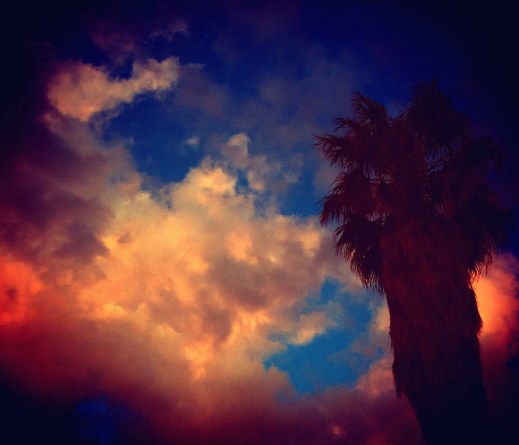
Opening Image Credit: “L.A. Sky at Sunset” by Flickr User David Vienna
Audio note: Voices used, with the exception of Bridget Hoida, are not the actual voices of the authors listed, nor are they meant to be representative of said authors.
—
Bridget Hoida is the author of So L.A. (2012). In a past life she was a librarian, a DJ, a high school teacher, and a barista. In this life she experiments with words and has taught writing at UC Irvine, the University of Southern California and is currently a professor at Saddleback College. Hoida is the recipient of an Anna Bing Arnold Fellowship and the Edward Moses prize for fiction. She was a finalist in the Joseph Henry Jackson/San Francisco Intersection for the Arts Award for a first novel and the William Faulkner Pirate’s Alley first novel contest. Her short stories have appeared in the Berkeley Fiction Review, Mary, and Faultline Journal, among others, and she was a finalist in the Iowa Review Fiction Prize and the Glimmer Train New Writer’s Short Story Contest. Her poetry has been recognized as an Academy of American Poets Prize finalist and she was a Future Professoriate Scholar at USC.
She has a BA from UC Berkeley, a MA in fiction from San Francisco State University, and a Ph.D. in Literature and Creative Writing from the University of Southern California. So L.A. is her first novel.
Share this:

“Once the word ‘sound’ was in the title, it opened up a kind of door”: A Conversation with Eric Weisbard

“Eric Weisbard” by Flickr user Joe Mabel undre Creative Commons 2.0 License
Last March, I attended the first Experience Music Project (EMP) Pop Conference in New York City. (See my pre-conference round-up for SO!, and my blog post for IASPM-US on my post-conference impressions.) Post-conference, I had the opportunity to interview Eric Weisbard, co-founder and organizer of EMP Pop Conference. One late March morning, we talked via phone about the story behind Pop Con, rock critics and academics, and the intersection of Sound Studies and Popular Music Studies.
Weisbard is currently a professor at the University of Alabama’s American Studies department. In addition to organizing Pop Con, he is also the Vice President of the International Association for the Study of Popular Music (US Branch) and Associate Editor of the Journal of Popular Music Studies. He has also edited three collections of essays drawn from Pop Con presentations: This Is Pop: In Search of the Elusive at Experience Music Project (2004), Listen Again: A Momentary History of Pop Music (2007), and Pop When the World Falls Apart: Music in the Shadow of Doubt (2012).
In 2001, Weisbard was invited, along with his wife (rock critic and journalist Ann Powers), by the Experience Music Project Museum in Seattle to organize their first rock music conference. “I was a grad-school-dropout turned New-York-media-rock-critic-guy” Weisbard explained, “and when I was asked to work on a conference my one framing idea was we will mix academics and non-academics.” The conference has been going strong for ten years now, and has expanded from Seattle to Los Angeles and, this year, New York City.
Part of Weisbard’s approach to Pop Con is rooted in his move from self-declared “grad-school-dropout” to music editor at The Village Voice and SPIN. Weisbard created the well-known Village Voice column “Sound of the City,” which he admits was inspired by Charlie Gillet’s 1970 book The Sound of the City. (Gillet’s book also inspired the theme of this year’s conference.) Weisbard saw in the conference a place where academics and non-academics alike could converse together about music. He pointed out, “this is a place where there’s room for enthusiasm, for intellectual work, but we call it a pop conference; we won’t put barriers to the ability of the ordinary person to come and put something out. The last few years it’s become a free conference, an important step to making it accessible and not just for academics.”
Considering the location of the conference, I asked him what the soundscape of this year’s Pop Con sounded like to him, in retrospect. Three things stood out to Weisbard: the collision of cultures in New York City’s soundscape, the sound of media (embodied in the voices present at the conference), and the music that came from the conference rooms. Weisbard reflected:

“Kimmel Center” by Flickr user edenpictures under Creative Commons License 2.0
“For me, I might point to three things: the most familiar and most cliché is the cultural collision side of the New York City soundscape. You’d have a conference panel at 905/907 [at the Kimmel Center, where the conference was held]; every time I was there I’d hear music from below [….] Another aspect, which is more specific and maybe undertheorized, is the sound of media. I don’t mean media as abstract tools for disseminating information but media in terms of people who have to say clever things on a regular basis and who have to use words all the time. To me, that’s a very particular kind of sound. One of the things that’s interesting of being in New York, and having the non-academic side of the conference (which had been ebbing and is suddenly coming back full swing) is that from academics to journalists to people in the business, [it] was a loud version of my sonic memory of being a media guy in New York. Media chatter, a kind of chatter that’s loudest in New York. New York allows you to be face to face with people all the time [….] Number three is how music itself floated through the other two realms. You might hear a song, as an example, or one night I saw vaudeville songs of the bowery, a late night offering. [This could be in reference to Poor Baby Bree’s presentation during the conference.–Ed.] We’re not a music conference, we are a music writing conference, but nonetheless music is at the core. That would be third thing; typically you listen to music at a conference, at home, in car, and there are all more directly ways of listening to music. Music permeated things but at intervals. It’s appearance was not predictable. You didn’t know where it would pop up.”
Yes, music was everywhere, and so was sound. The title of this year’s conference opened up the conversation to Sound Studies Scholars. Weisbard pointed out, “when we came up with the theme, which is a riff on Charlie Gillett’s line on “the sound of the city,” we recast it as ‘Sounds of the City,’ in keeping with what we’ve always wanted to do at the conference, which is emphasize different kinds of music. In an interesting way, once the word ‘sound’ was in the title, it opened up a kind of door: in exactly the same way that being in New York we think about the city, when you think about cities you think about sound.”
From the beginning of the interview, Weisbard explained that he was still trying to understand what Sound Studies comprises and where it intersects with Popular Music Studies. More importantly, Weisbard pointed out that some may talk about Sound Studies to avoid associating with Popular Music Studies, which may point to a tension between the fields: “My biggest concern about the phrase ‘Sound Studies is that it is a defensive way for critics who think that if they talk about ‘Popular Music Studies,’ they won’t sound as serious.” Weisbard acknowledged that these questions of legitimacy have plagued Popular Music Studies for a while.
When I asked Weisbard about what Sound Studies can learn from Popular Music Studies, he admitted that he still didn’t have a clear grasp of Sound Studies to be able to offer a strong opinion. However, he shared an example of what he thought was a strong contribution to the field that was, also, accessible to people outside of the field: “The latest pop music collection, Pop When The World Falls Apart, has an essay from Martin Daughtry on listening as it’s undertaken by soldiers in Iraq. That was a presentation. When I saw the presentation as a 20-minute talk, I remember feeling more moved than any presentation on music I had ever heard. That’s where I feel like Sound Studies work can be as satisfying as any work on music [….] Daughtry wrote with a sense of almost confronting something terrifying, while trying to understand how people listen.”
The tension between the academic and the popular is something Weisbard grapples with in his own work. (He stated, “Anything that’s a purely academic version of how to present work is flawed and has to be challenged”). At the moment he is working on a book on commercial radio formats. He describes it as such: “I’m interested in how formatting music (different from genres) creates parallel mainstreams. I’m interested in how every button can represent a different construction of the middle.” For Weisbard, his academic work and the work he does as a rock critic bleed into one another. “It’s about using the rock critic’s ability to enjoy cultural weirdness” he said, “and the historian’s tendency to keep on digging and get to the bottom of it. I definitely see my work in conversation with people who are grappling with the nature of pop music in general. I love that the word “pop” emphasizes the commercial, trashy, places where it’s least likely called authentic, or [seen as an] embodiment of progressive values. It simply has to live or die on its own. I think academic work should too.”
What’s next for EMP? It will return next year to Seattle, but the theme has not yet been decided. In fact, Weisbard says that EMP’s return the year after is never a sure thing:”There was no guarantee in 2002 that we’d become big [….] The provisional nature [of the conference] is one of its best qualities. There’s absolutely nothing guaranteeing whether it comes again. There’s no organization attached to it, you don’t have a job from it. It depends on the people working. A gathering doesn’t work if people don’t come.”
—
Liana M. Silva is co-founder and Managing Editor of Sounding Out!
Share this:


Current Top Posts





April 2021

January 2020

November 2019

October 2019

August 2019

April 2014

November 2017

March 2015

December 2017

October 2015
 Sounding Out!
Recent Comments