
Radical Listening and the People’s Microphony: A Conversation with Elana Mann
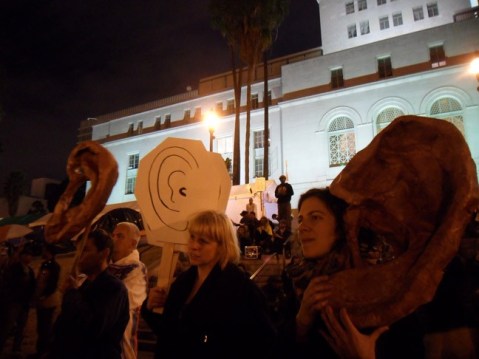
Members and collaborators of ARLA (Paula Cronan, Juliana Snapper, and Elana Mann) participating in a General Assembly at Occupy LA City Hall, November 11, 2011
Listen to everything all the time and remind yourself when you are not listening–Pauline Oliveros
“CAN YOU HEAR ME?!” “I CAN HEAR YOU!!” “IT’S A VAN GOGH PARADE!!” . . .were some of the enthusiastic replies when artist Elana Mann, musician Juliana Snapper, and other members of ARLA (Audile Receptives Los Angeles) arrived on the scene at Occupy LA with giant hand-made ears. Mann co-founded ARLA in the Spring of 2011 with Snapper, filmmaker Vera Brunner-Sung, and choreographer Kristen Smiarowski. After studying scores and techniques on listening developed by composer Pauline Oliveros, ARLA developed a workshop geared toward Occupy LA that included a listening parade in which they held up the giant ears and protest signs with ears on them. Snapper recalls, “The simple physical presence of people carrying large paper-mache ears was met with a kind of hungry recognition…recognition of what it meant that we were holding the symbols (giant ears).” They led workshops, listening sessions, and discussion groups. They performed Oliveros’ sonic meditation “Teach Yourself to Fly” and a composition written by Mann and Snapper entitled “People’s Microphony.” And a project was born. Through personal interviews and audio-visual examples, I document, contextualize, and analyze its work. 
Mp3=The People’s Microphony Camerata performing “Teach Yourself to Fly” Pauline Oliveros
I am happy that Elana Mann chose to use my Sonic Meditations for the People’s Microphony project. These pieces are meant for anyone that wants to perform them regardless of musical training.” –Pauline Oliveros
For Mann, active listening is “a process of tuning in simultaneously inward and outward. Active listening allows for an awareness of and an opening up to sounds around me and also a digestion of what is happening inside of me in relation to these sounds.” Much of the recent focus on this practice comes from the music and sound art worlds, as well as acoustic ecology, a field formed from the overlapping area between science and art that concentrates on the importance of experiencing and investigating our sonic surroundings with detailed care and respect to understand its importance on our world and our place within it. Mann’s work addresses a unique angle at the intersection of these fields: listening’s empathetic effect on those whom you are listening to, a consideration arising from a project she worked on between 2007-2010 with Iraq war veteran Captain Dylan Alexander Mack, called “Can’t Afford the Freeway.”
. “Can’t Afford the Freeway” highlights how her collaborations emerge as conversations between involved artists as well as the audience. Speaking to Mann about the project, she stated,Alex created some recordings for me and I kept listening to them over and over again trying to figure them out. I eventually produced more interviews with him and realized that he needed his story to be heard and I needed to try and understand his story. So I created a project in which I attempted to listen as best I could. Listening to his recordings made me feel close to him, but I also recognized that no matter how many times I heard his words they were still foreign to me. Still the very act of me struggling to listen was important for both of us, and I think this is true of many interpersonal/political and social situations. You can never experience what it is like to be someone else, but active listening opens up a space of empathy and connection. I also think we can see how a lack of active listening is affecting the political landscape in the United States so negatively, by producing a highly polarized and vitriolic environment.
And what about at Occupy LA?
At Occupy LA I was hopeful that there would be a place for listening to voices that had not been heard before and sometimes that happened. Other times people used the space for projecting, not receiving. I think that there needs to be strong voices making themselves heard, but I don’t want to lose the other part of that equation, which is those voices being quiet and listening to others, and themselves.

ARLA Ear Strengthening Workshop, Occupy LA site, November 11, 2011, Photo by Carol Cheh
Mann, thinking and researching about social, aesthetic, and political points of listening and voicing, felt there was something to be considered about the “radical receptivity and the core message of the OWS movement” and its global amplification of voices struggling to be heard. In the Spring of 2012, she formed The People’s Microphony Camerata with Snapper, a radical experimental choir based in Los Angeles exploring the process of the People’s Microphone. The exact history of the “People’s Microphone,” or “People’s Mic” is unclear, but its use in the Occupy Movement has already become iconic. Ted Sammons discusses the implications of the People’s Mic for communication in his October 2011 post, “‘I didn’t say look; I said listen’: The People’s Microphone, #OWS, and Beyond.” The human microphone is a way to deliver one person’s message to a large group of people in situations where amplification tools, such as bullhorns, are either not allowed or unavailable, or if the acoustics of a space distort amplification. The speaker calls, “mic check!” to alert their intentions. Those around them call back, “mic check!”, until the gathering understands something will be said. The speaker breaks their statement into short sentences, pausing to allow those around them, or the “first wave,” to repeat them in unison. They then pause for those further away, or the “second wave,” to repeat again…and so on until those in the back of the gathering have heard the statement.
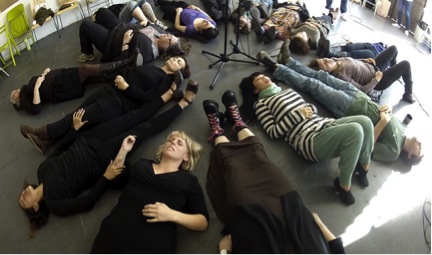
Members of People’s Microphony Camerata rehearsing in Los Angeles, April 15, 2012, Photo by Jean-Paul Leonard
The group’s trademark intensity sometimes carried over to the audience. Mann discovered such transference often had to do with prior associations with a location or context. Mann recalled a particular performance at the Occupy movement called “Chalkupy” that was formed in response to a protest running simultaneously with the LA Art Walk, in which activists had handed out chalk and told stories of police repression while chalk drawings were created on the walkways. The police shut down the art walk and a violent struggle ensued. The Occupy LA movement called for people globally to take to the street with chalk in protest, and the day was called “Chalkupy”. The audience of protestors was mixed and tense, and when the PMC began their performance of a highly emotive score called “Sob-Laugh” by Daniel Goode, people were either drawn to or repelled by the performance.
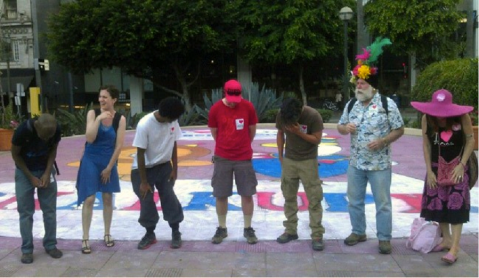
The PMC performing “Sob Laugh” at the “Chalkupy” protest in downtown Los Angeles, Image by Daniel Goode
I think there was some fear about the vulnerable revelation of emotions in the space of the protest. Many of the Occupy LA protests were so risky that everyone had to be extremely tough to exist in that activist space. I respect that. Still I think there are other things that can happen in a space of protest that bring out different feelings. Some activists wanted us to be more musically conventional, “why can’t you just sing some folk songs like normal protest choirs,” we were asked. But we really were not into that kind of thing. . .
In most protest situations, the audiences welcomed their activities. Many shared that it opened up a new space where people could meet each other as humans rather than adversaries or collaborators. Mann edited and published a monochromatic grassroots songbook with the various scores the PMC received for performance, opening up the circle for anyone and everyone to perform and feel that closeness.
Sometimes it was hard to translate a piece that worked during a group rehearsal to something for an audienceperformer situation. . .The PMC never fully developed how to deal with audience participation, but this is something I have been developing on my own in working with students on PMC materials. The scores from the People’s Microphony Songbook and the techniques Juliana and I developed when we first formed the PMC create an immediate closeness within a group, which is remarkable.

From the “People’s Microphony Songbook”: Many voices that were once silenced are now resonating through large crowds, not only of activists, but ordinary people all over the world, assisted by internet networks, and a simple technology called the People’s Microphone. The People’s Mic expressed the interrelated desires of collective and individual voices to speak and be heard, to hear one’s words spoken back through different mouths, and to digest someone else’s words through one’s own body. Beyond projecting an individual’s voice further then it can resonate on its own, the People’s Mic has implications for all of the bodies in its vicinity. It energizes listeners in ways the microphone or megaphone cannot by making listening active, vocal, and embodied. The project, like the Occupy movement, holds all the complexity, beauty, and drive of being human, whether you consider it “working” or not. When I asked Mann about how changes within and towards the Occupy Movement affected the choir, and whether they were winding down or taking a new form, she answered:
I think more than anything else, our group faced a lot of the same challenges that the Occupy Movement faced challenges in horizontality, in the push and pull between interior and exterior exploration, in the sometimes painful vulnerability of investigating the intimate personal and political space with others. I think the project is still developing. The choir still communicates, and some members are currently collaborating with composer Daniel Corral, but the PMC does not meet and rehearse like we used to I think it will continue to wax and wane. In the meantime, I am still working on ideas of active listening. I am currently creating a project called “Listening as (a) movement” within an under-served neighborhood in Pasadena, CA, exploring ideas of radical listening within a specific neighborhood.
In an age of constant bombardment of stimuli, our heads scream with thoughts, opinions, arguments, and expressions. With our current technology, our input and output can be a constant rush of snap reactions and impulses, which has a profound effect, of course, on our day-to-day lives, on our culture(s), on our politics. But these circles cannot be affectively complete without the other side. We need someone to hear us, and, more then that, we need someone to listen to us. And we, in turn, need to listen to them.
—
Maile Colbert is a multi-media artist with a concentration on sound and video who relocated from Los Angeles, US to Lisbon, Portugal. She is a regular writer for Sounding Out!
—
 REWIND! . . .If you liked this post, you may also dig:
“Sensing Voice”–Nina Sun Eidsheim
“Within a Grain of Sand: Our Sonic Environment and Some of Its Shapers”–Maile Colbert
“Listening to #Occupy in the Classroom”–Travers Scott
Share this:

Six Years in Nodar: Sound Art in a Rural Context
My family comes from a tiny village called Nodar in northern Portugal, part of the European Union-funded project “Tramontana” which focuses on preserving the immaterial heritage of mountain regions of southern Europe. In Nodar, centuries of isolation and self-sufficiency have created a unique blend of cultural expressions, ways of living, and inhabited landscapes. Like much of the Portuguese countryside, Nodar is undergoing a process of abandonment, which leaves rural communities with a weakened sense of identity. The agrarian paradigm, which has been central to the history and social fabric of rural communities, is arriving to an almost hopeless vanishing point, and the guardians of that memory are also disappearing. With this as formative part of my background, and considering my artistic interest in community-oriented projects, I felt almost a duty to direct much of my work to Nodar, a place that means so much to me and where I thought I could make a difference. In 2004 my brother Luis and I founded Binaural/Nodar, an arts collective based in the village and operating in the surrounding region of the Gralheira mountain range.
Since March 2006, the Nodar Rural Art Lab has invited both local and international artists who work in the areas of sound, video, and intermedia arts to address issues such as collective memory, identity, gender, age, life, death, geography, topography, music, sound heritage, landscape, vegetation, consumption and leisure dynamics, myths, traditions, crafts, agriculture, and shepherding. During their stay, the resident artists give public presentations in the region and are encouraged to establish interactions with the place and its inhabitants, geographic spaces, and social memory. Many of the artworks held in Nodar cross different artistic practices, often blending borders.
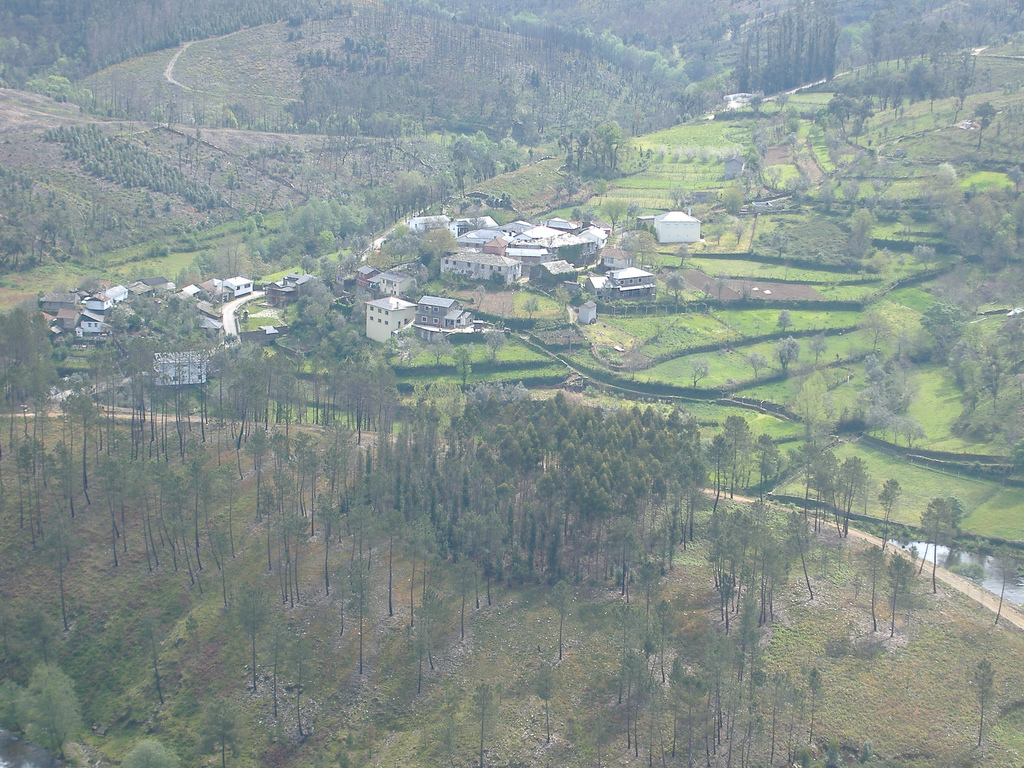
Nodar, Portugal. Photo by Carina Martins. All rights reserved by Binaural/Nodar
The decision to initiate an artist residency center in Nodar was motivated by my desire to deepen the investigation of exploratory artistic practices in close interaction with a specific rural context and its social and cultural possibilities. Throughout the year, the Nodar Rural Art Lab programs various residency modules in order to stimulate a collaborative environment between artists from different artistic fields and geographic origins. During the course of the residencies, several parallel activities are organized, such as conferences, lectures and educational activities, namely youth-oriented. At the end of each residency module, there is a public presentation organized in the village in which the art projects are presented and discussed by the artists and the organization.
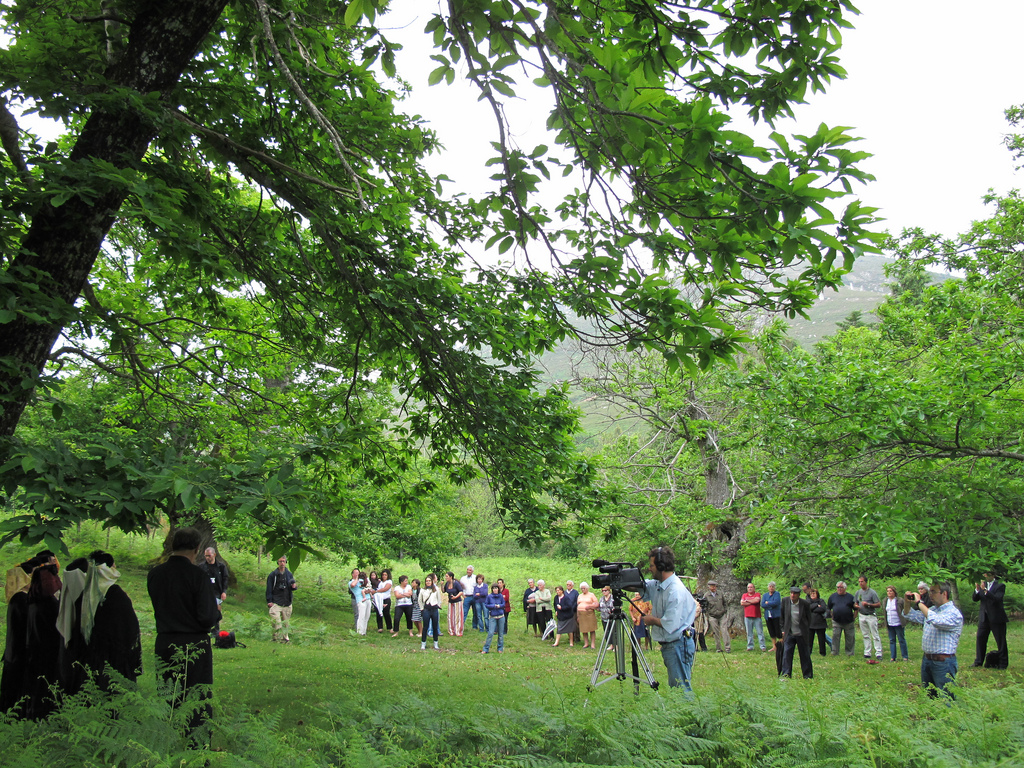
Public presentation of an art project in Nodar. Photo by Carina Martins. All rights reserved by Binaural/Nodar
The sonic dimension has a critical role in the model we have developed in Nodar, especially because it operates as a powerful metaphor for the intimate and personal discovery of a place. Artists have documented the area’s soundscapes and oral heritage in Nodar since 2006. There are three central lines of artistic interaction that converge here: Sound, Space and People:
SOUND (Interaction with the acoustic environment): Some sound artists, who work with the acoustic dimension in an experimental way, are part of the team that runs the Nodar Rural Art Lab. The Lab has always been active in the international theoretical and artistic domains of the so-called soundscapes, and it has hosted some of the most respected sound artists of today, who–using idiosyncratic techniques for sound capturing, editing and manipulation–have created works based on particular aspects of the local acoustic context.
One of our approaches is what we call “sound interventions,” where we use field recordings and performance in order to “activate the space” and establish a dialogical approach between what is activated and what just “is,” which can incorporate body, gesture, sound, object, space and voice in this process. An example of this approach was the “Revenant : Paiva” project, conceived in 2009 by Patrick McGinley, Marjia-Liisa Plats, Luís Costa and Tiago Carvalho, in which a series of performative actions were staged in a section of the river Paiva that crosses Nodar. Using materials found in-situ as instruments, in addition to the artists’ own voices, to generate sounds that interacted with the acoustic environment itself, all activity was purely acoustic, with no amplification. The resulting work was presented live with the artists and audience spread out across the space with no preferential “point of listening”, which created subtle overlaps between the artists’ work and the space.
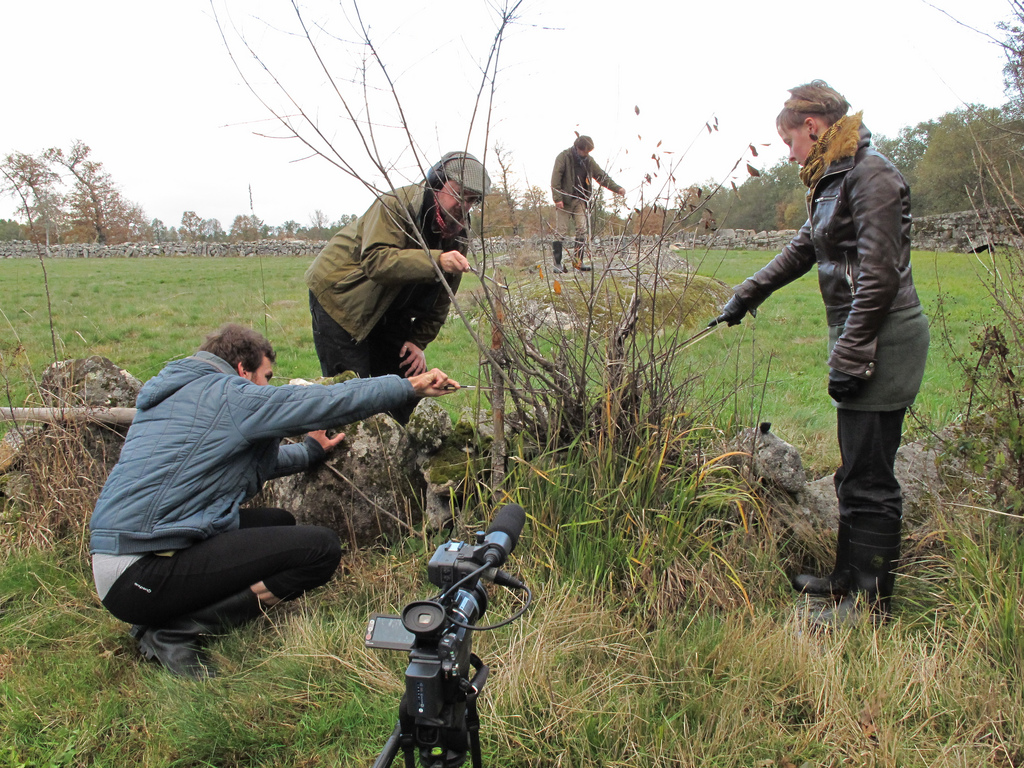
Working on “Revenant : Paiva.” Photo by Carina Martins. All rights reserved by Binaural/Nodar
SPACE: Interaction with the geographic space. The landscape surrounding Nodar is beautiful and diverse; there are mountains, rivers, caves, slate stone architecture, terraced fields, and so much more. Moreover, we are witnessing an irreversible process of transformation of rural space. These two elements form fertile ground for the creation of works within nature, which either capture the dreamlike and timeless aspects of the landscape or question possible future uses for the same landscape.
Of particular interest to us is the use of geography as a means for projecting sound in which specific variables of the territory, such as topography and meteorology, intersect with instrumental or subjective aspects of artistic creation, namely the position occupied in the space and the choice of sound recording and reproduction tools and techniques. A good example of this approach was Lisa Premke’s project “Aural Lookout,” developed in 2012, in which she built a canvas lookout on the top of a hill that allowed the visitors to be sheltered from the environment while listening to the nature sounds acoustically amplified, as if being inside a large drum.
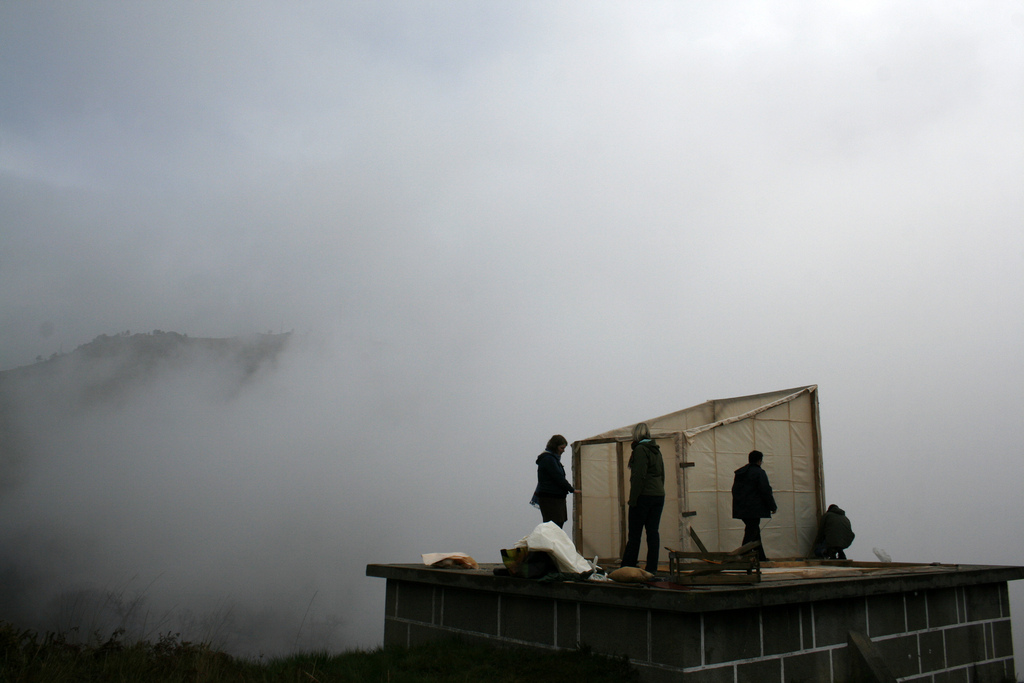
Working on “Aural Lookout.” Photo by Carina Martins. All rights reserved by Binaural/Nodar
PEOPLE: Interaction with local inhabitants. Since the beginning of our activities, we have been encouraging artists to interact, question and to some extent “provoke” local populations. As a result of these communication processes, various art projects have been developed reflecting and expressing aspects of the region’s collective memory and new habits and experiences.
Working on the subject of the anthropological voice may involve direct conversation with the local communities based on topics proposed by the artists and related to everyday life and local memory, as well as it may focus on linguistic aspects such as accents, musicality of the voice, etc. Maile Colbert’s “Over the Eyes,” created in 2007, was a very successful example of this sort of “conversational” project, where she organized a knitting circle with the village women, recorded the conversations with them, their songs and stories and incorporated them into the sound design of a multimedia installation, along with field recordings of the area, and text on physiological, biological, and psychological aspects to memory creation and destruction in humans. The projection screen was composed of raw wool and the knitted cloths made during the circle, which created an interesting dialogue with the immaterial nature of the audiovisual element of the piece.
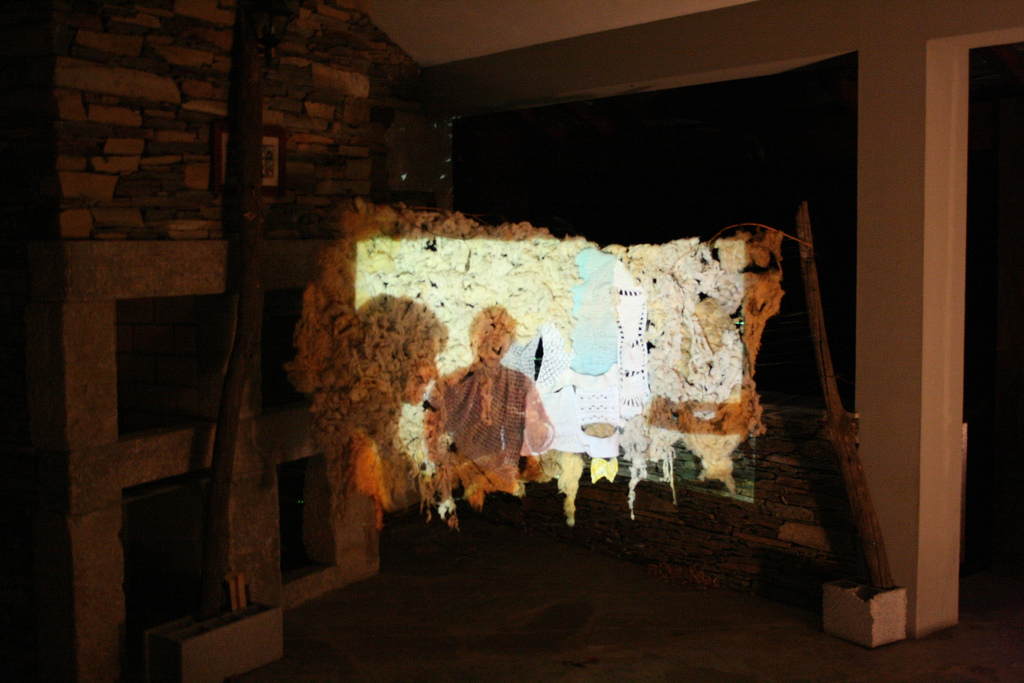
Maile Colbert’s “Over the Eyes.” Photo by Carina Martins. All rights reserved by Binaural/Nodar
We have always emphasized a type of sound art that enhances the context within which a specific sound work is produced, escaping a purely acoustic, or “sound-in-itself” approach. We believe that this emphasis on subjectivity and context is necessary, because sound–and the practice of field recording in particular—sometimes carries a burden of “objectivity” because it stems from the documentation of reality. The subjectivity inherent to the sound recollection –for instance, the choice of the point of listening and of the technological means of sound capturing–is often not sufficient to alleviate this burden.
When we host sound artists in Nodar, we always try to convey the idea that the region’s landscape is fundamentally an “inhabited landscape.” Trying to avoid the human presence in order to get “wilder and more natural” recordings is purely illusory. The landscape is inhabited in several simultaneous ways: by the marks of historical occupation of the territory, by the existence of vital spaces for each inhabitant–often lying far beyond the boundaries of the villages–by the very presence of the artists and by the audiences of the art works’ final presentations.
In summary, there are several methodological, instrumental and aesthetic approaches that Binaural/Nodar is working to further in the area of sound art. These approaches are anything but sealed; intersections, complementarities, unions and differences exist, which make each work of art unique.
—
Featured Image: “Oor van Noach” by Flickr user ines saraiva under Creative Commons 2.0 License.
—
Rui Costa is a sound artist from Lisbon, Portugal. He is a founding member and artistic director of Binaural/Nodar, an arts organization founded in 2004 and dedicated to the promotion of context-specific and participatory art projects in rural communities of the Gralheira mountain range, northern Portugal. Rui has been performing and exhibiting his work since 1998 in festivals, galleries and museums across Portugal, Spain, Italy and the United States and has been collaborating regularly with the Italian vocal performer Manuela Barile and the American intermedia artist Maile Colbert. Rui Costa is also a regular speaker in conferences and gives workshops dedicated to sound art. For more from Binaural/Nodar, please check out the organization’s soundcloud, vimeo, and flickr.
Share this:


Current Top Posts





April 2021

January 2020

November 2019

October 2019

August 2019

April 2014

November 2017

March 2015

December 2017

October 2015
 Sounding Out!
Recent Comments