
Introduction: Medieval Sound

A text arrives and the buzz of a cell phone jolts you from your idle thoughts. The sound–like an alarm, another kind of bell to mark out the day–shifts you from one audition to another. The spatiality of competing sounds fills our consciousness and shapes our attitudes towards music and noise, privacy and pollution. These themes surround the issue of sound and articulate a variety of questions and problems. How does one delineate between noise and sound? How does sound individualize us within the community? How does sound create space? Why is the scopic the privileged sense?
Sound studies is the name for an interdisciplinary field encompassing the study of noise, music, vibrations, and what T.S. Eliot called “auditory imagination” in The Use of Poetry and The Use of Criticism (111). It is a capacious field, encompassing examinations of the individual sonic space of iPod use and the historical sound of rural and urban life. Sound (or the lack thereof) immerses a subject in worlds that may not be, or can distance the listener from the world that is. To put on headphones, to lose oneself in chant, to be awakened by an alarm, to lose the sound of voices in the crashing waves, transfers us, immerses us, and connects us in a variety of sonic worlds.

Medieval musician reinactment. Image borrowed from Byronv2 @Flickr CC BY-NC.
Each of the essays in this month’s “Medieval Sound” forum focuses on sound as it, according to Steve Goodman’s essay “The Ontology of Vibrational Force,” in The Sound Studies Reader, “comes to the rescue of thought rather than the inverse, forcing it to vibrate, loosening up its organized or petrified body (70). These investigations into medieval sound lend themselves to a variety of presentation methods loosening up the “petrified body” of academic presentation. Each essay challenges concepts of how to hear the Middle Ages and how the sounds of the Middle Ages continue to echo in our own soundscapes.
The posts in this series begins an ongoing conversation about medieval sound in Sounding Out!. Our opening gambit in April 2016, “Multimodality and Lyric Sound,” reframes how we consider the lyric from England to Spain, from the twelfth through the sixteenth centuries, pushing ideas of openness, flexibility, and productive creativity. We will post several follow-ups throughout the rest of 2016 focusing on “Remediating Medieval Sound.” And, HEAR YE!, in April 2017, look for a second series on Aural Ecologies of noise!
Multimodality and Lyric Sound
The essays clustered in the group “Lyric Sound” re-center lyric soundscapes—onomatopoeia, mashups, music box, witnesses to queer temporalities—in order to reorient the critical terrain of our understanding of the medieval lyric. Recent criticism on digital rhetoric has defined multimodality as the process of creating, rather than the product. In Daniel Anderson et al’s “Integrating Multimodality into Composition Curricula: Survey Methodolgy and Results from a CCCC Research Grant” (2006), multimodality, “acknowledges the practices of human sign-makers, who select from a number of modalities for expression (including sound, image, and animation, for example), depending on the rhetorical and material contexts within which the communication is being designed and distributed.” In this body of criticism, the term “multimedia” becomes condensed to the “integration of multiple forms of media” (59-84).
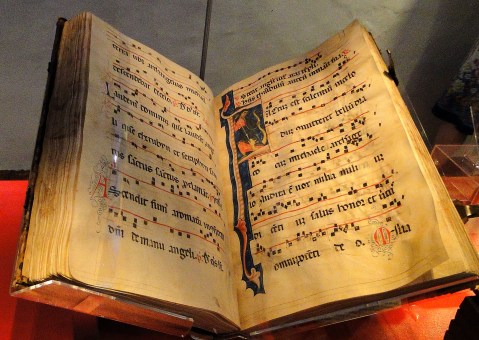
An illuminated music manuscript. Image by Richard White @Flickr CC BY-NC-SA.
This interest in semiotics is, however, not a new one; rather, it is one that has deep roots in medieval rhetoric, especially with regard to music. The two medieval writers most important to the discussion of rhetoric and music in the thirteenth century are John of Salisbury, particularly his twelfth-century work Metalogicon, and Gilbert of Crispin’s well-known debate Disputatio Iudei et Christiani from the late eleventh century. John of Salisbury’s Metalogicon, lays out the relation between symbols, sounds, and notation, writing:
Letters, that is, written symbols, in the first place represent sounds (voce). And secondly they stand for things, which they conduct into the mind through the windows of the eyes. Frequently, they even communicate, without emitting a sound, the utterances of those who are absent (Book 1, Chapter 3, 59).
John of Salisbury also links the notation of music with the notation of writing under the rubric of grammar, noting:
That such great import has existed in such tiny notations should not seem strange, for singers of music likewise indicate by a few graphic symbols numerous variations in the acuteness and gravity of tones. For which reason such characters are appropriately known as “the keys of music” (Book 1, Chapter 13, 59).
Gilbert of Crispin also considers the semiotics of visual notes. In the Disputatio Iudei et Christiani, he writes:
Just as letters stand in one way as images and notations of words, so also pictures exist as likenesses and notation of things written (qtd. in Michael Clanchy’s From Memory to Written Record 290).
Therefore what Isaiah saw, said and wrote, what Ezechiel saw, said and wrote, may after them be said and written and signified by some pictorial notation (290).
Both of these writers rework material from Isidore of Seville, and both describe correlations between reading “nota” in relation to music and images in post-Conquest Britain.
The elision between writing down letters and writing down musical notes is furthered by the slippery quality of the Latin from which the term “note” is derived. The Latin word “notare” means “to record writing,” while the second most common meaning of the noun “nota” [noter] means “to sing, to interpret musically.” The resulting duality of the term “note” survives today in both English and French, as Ardis Butterfield has pointed out in a November 2009 conference paper “A Note on a Note,” writing that “a note is both a sound and a sign.” The ambiguity of the term in Latin also indicates that the distinctions between the two meanings—“to record in writing” and “to interpret musically”—are constantly in flux.
The issues of the development of musical notation—a recording technology of sound—and the interface issues at stake in medieval manuscripts mean that our view of the medieval lyric comes primarily through the eyes. In other words, the medium—the manuscript page—in which the medieval lyric is recorded explains how our interpretations are deeply ocularcentric. However, we believe that we can think of the medieval manuscript as a flexible recording medium that allows for a “mise-en-système,” what Joanna Drucker describes as “an environment for action” in Graphesis: Visual Forms of Knowledge Production (139). A digital mise-en-système is a digital ecology in which the main question posed is how the interface can create the subject/user/reader. Interface then becomes a “border zone between cultural systems and human subjects;” it is the co-dependent space where “speaker and spoken are created. (148, 158-59).

“The Story of the Written Word” from the NY Public Library McGraw Rotunda. Photo by Wally Gobetz @Flickr CC BY-NC-SA.
Drucker tackles the theoretical stakes of digital visuality by explaining that “all images are encoded by their technologies of production and embody the qualities of the media in which they exist. These qualities are part of an image’s informations” whether this be illuminated manuscript, daguerreotype, painting, photograph, or digital image (21). The issues of layout, marginalia, paratext, columns, table of contents, indexes, chapter headings, are as Malcolm Parkes discusses in Scribes, Scripts, and Readers, a development of the medieval scholarly book (121-142). These experimental page structures became standard in printed books and eventually in digital texts.
In this series, we push back a bit on Drucker’s idea that the manuscript page is actually just a static mise-en-page. If the codex (as it developed in the Middle Ages) is one of the earlier kinds of informational “interfaces” then we should consider it as a mediating apparatus: one in which the mise-en-page and material features, its myriad graphic cues explain how to read, use, navigate, and access information in the codex book. We argue today with the example of the medieval English lyric as it emerges, that manuscripts are functionally an interactive media ecosystem, a mise-en-système where subject/user/reader can pull different threads and create and recreate meaning.
Over the next six weeks, the writers featured in our forum on Lyric Sound–Christopher Roman, Dorothy Kim, David Hadbawnik, Marla Pagán-Mattos, Katherine Jager--examine the different forms that medieval lyrics take and how the lyric is ensounded in terms of the mouth, recording medium, as well as the performance. Historical sound is always about negotiating the past through the present. Silence in the Middle Ages would not be our silence, just as music or noise today may not be defined as such then. These essays ask us to listen, create, make noise, open our senses in multimodal and multitudinous ways. We close with Andrew Albin‘s meditation on what it means to remediate medieval sounds in our contemporary moment, an intellectual call to the present as well as the future, as we will return with more on “Remediating Medieval Sounds” in April 2017. –Forum Guest Co-Editors Dorothy Kim and Christopher Roman
—
Dorothy Kim is an Assistant Professor of English at Vassar College. She is a medievalist, digital humanist, and feminist. She has been a Fulbright Fellow, a Ford Foundation Fellow, a Frankel Fellow at the University of Michigan. She has been awarded grants from the National Endowment for the Humanities, Social Science and Humanities Research Council of Canada, and the Mellon Foundation. She is a Korean American who grew up in Los Angeles in and around Koreatown.
Christopher Roman is Associate Professor of English at Kent State University His first book Domestic Mysticism in Julian of Norwich and Margery Kempe deals with the creation of queer families within mystical theology. His forthcoming book Queering Richard Rolle deals with the intersection of queer theory and theology in the work of the hermit, Richard Rolle. His research also deal with quantum theory and Bede, ecocritical theory, and medieval soundscapes. He has published on medieval anchorites, ethics in Games of Thrones, and death and the animal in the works of Geoffrey Chaucer.
—
 REWIND! . . .If you liked this post, you may also dig:
Musical Encounters and Acts of Audiencing: Listening Cultures in the American Antebellum–Daniel Cavicchi
Sounds Difficult: James Joyce and Modernism’s Recorded Legacy–Damien Keane
The Amplification of Muted Voices: Notes on a Recitation of the Adhan––David Font-Navarrete
Share this:

Mouthing the Passion: Richard Rolle’s Soundscapes


Each of the essays in this month’s “Medieval Sound” forum focuses on sound as it, according to Steve Goodman’s essay “The Ontology of Vibrational Force,” in The Sound Studies Reader, “comes to the rescue of thought rather than the inverse, forcing it to vibrate, loosening up its organized or petrified body (70). These investigations into medieval sound lend themselves to a variety of presentation methods loosening up the “petrified body” of academic presentation. Each essay challenges concepts of how to hear the Middle Ages and how the sounds of the Middle Ages continue to echo in our own soundscapes.
The posts in this series begins an ongoing conversation about medieval sound in Sounding Out!. Our opening gambit in April 2016, “Multimodality and Lyric Sound,” reframes how we consider the lyric from England to Spain, from the twelfth through the sixteenth centuries, pushing ideas of openness, flexibility, and productive creativity. We will post several follow-ups throughout the rest of 2016 focusing on “Remediating Medieval Sound.” And, HEAR YE!, in April 2017, look for a second series on Aural Ecologies of noise! –Guest Editors Dorothy Kim and Christopher Roman
—
A soundscape is an aural-based landscape, an auditory environment that surrounds a listener and constructs space. In 2009 the composer, John Luther Adams, created a music installation in Alaska that experiments with the boundaries of soundscape. Utilizing geological, meteorological, and magnetic data, Adams tuned and transformed the sounds of the landscape into electronic sound.
In his “Forward” to John Luther Adams’s composer journals compiled as The Place Where You Go to Listen, New Yorker music critic, Alex Ross comments that Adams’s work with composing with the atmospheric, geological, and ecological sounds of Alaska reveals a forbiddingly complex creation that contains a probably irresolvable philosophical contradiction. On the one hand, it lacks a will of its own; it is at the mercy of its data streams, the humors of the earth. On the other hand, it is a deeply personal work, whose material reflects Adams’s long-standing preoccupation with multiple systems of tuning, his fascination with slow-motion formal-processes, his love of foggy masses of sound in which many events unfold at independent tempos (x).
Thinking with Adam’s project and considering how sound surrounds us and can be tuned and transformed, as well as brought to the forefront of our sense perception, I turn to the medieval hermit, Richard Rolle, and his work with canor in his lyrics. In what follows, I consider the enmeshed ecology divine lyrics may invoke, and how the body—as an instrument—may experiment with, mimic, and contemplate divine sounds.

If hills could sing. Photo of Juneau Alaska by Ian D. Keating @Flickr CC BY.
In Rolle’s work, the experience of song, or canor, is one of the highest mystical gifts. As with John Luther Adams, sound unfolds in ways both translatable and ineffable. Canor creates a kind of being, one that creates place and, then, surpasses it. As he writes in the Incendium Amoris at the moment of his receiving the gifts of God:
I heard, above my head it seemed, the joyful ring of psalmody, or perhaps I should say, the singing […] I became aware of a symphony of song, and in myself I sense a corresponding harmony at one wholly delectable and heavenly (93).
In this initial receipt of canor, Rolle is made aware of aural space and the way that it is mimicked in his own biology. The space of the sacred church is transformed into an eternal space that resonates harmonically with God. In this, his first mystical experience, the musical song he hears above him transforms him internally: “my thinking turned into melodious song and my meditations became a poem, and my very prayers and psalms took up the same sound” (93). This transformation erases the boundaries between hearing external song and the translation of the internal song, and tunes Rolle into the ecology of sound, as Adams phrases it in The Place Where You Go to Listen, a “totality of the sound, the larger wholeness of the music” (1). Rolle’s body becomes a musical instrument beyond its initial sound capabilities and it resonates with the chapel space itself to become a larger harmonious work. Harmony in the form of these mystically experienced, enmeshed vibrations suggests both a local and cosmic allusion to complex systems of divine transcendence and immanence.
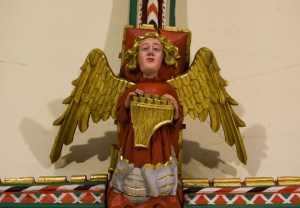
Detail of an angel with a musical instrument at All Saints’ Church on North Street in York. Image by Lawrence OP @Flickr CC BY-NC-SA.
By invoking the sounds of the Passion, conflating time and sound, and experimenting with the mouth of the lyricist to perform divine sounds, Rolle attempts to capture the panoply of emotion, action, and object surrounding his mystical experience and devotion by singing it. Invoking a queer temporality, Rolle weaves past and present, sound and sight, Jesus and singer, into an immersive, divine soundscape. The song reveals that there is no outside in the connection between the body as instrument and the God-sound.
The making of the divine into song for Rolle is a praxis, an active way to reconsider the relationship between God and man beyond visualization. Rolle’s use of the lyric is an ecological thought, what Tomothy Morton dubs a “reading practice” in The Ecological Thought that
makes you aware of the shape and size of the space around you (some forms, such as yodeling, do this deliberately). The poem organizes space […]. We will soon be accustomed to wondering what any text says about the environment even if no animals or trees or mountains appear in it (11).
In contemplating a lasting Love in , Rolle considers the gap between love and life, or, more specifically a love that is a lasting life and a love that quickly fades. This becoming-love must be separated out from other kinds of love that separate the singer from the community. Can love manifest itself in sound? Rolle exemplifies love’s abundance in the fire that “sloken may na thing” in “A Song of the Love of Jesus” (6). Love is represented as an excessive fire, one that nothing can put out and, therefore, everything is subsumed in it.
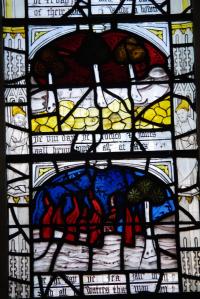
Stained glass depicting burning forests from a Richard Rolle poem at All Saints’ Church on North Street in York. Image by dvdbramhall CC BY-NC-SA.
But it is the sound of fire that Rolle connects with Love’s embrace. Rolle suggests an ecological moment, not in an apocalyptic way, but as a fire that creeps into all crevices. Nothing can “sloken” it—the sibilance of the consonant blend ‘sl’ gestures toward crepitation. It is the sound of fire touching the object as it prepares to consume—to take it into itself—as well as reveal Love’s movement in space. Rolle considers that love is created through the sound of fire (which, in his other works is an emotion he struggles with and not a visual fire).
In the lyric “Song of Love-longing to Jesus,” Rolle addresses the relationship between love and Jesus but rather than meditate on the nature of that love, as in the previous lyric, Rolle meditates on the event that causes that love: the Crucifixion. The lyric is bookended by violent acts. At the beginning, Rolle asks Christ to “take my heart intil þy hand, sett me in stabylte” (4) and “thyrl my sawule with þi spere, þat mykel luf in men has wroght” (6). In both these cases Christ’s hand and spear enter into Rolle in order to affect change. In the first line, it is to settle his heart—a theme that Rolle repeats in many of his writings. The stability of the heart allows it to open so that Christ can take up residence and, in that “indwelling,” the soul and Christ become one.
In the second piercing, the spear pierces the soul and Rolle seems to be implying that this piercing has already been done; the second piercing itself is the action that has opened the human to love. As Jesus was pierced by the lance of the Roman soldier, the soul is pierced by Jesus and in that act, love is made or “wroght.” In the second piercing, the ‘thyrl” becomes an important word because of its relationship between sonic resonance and mouth articulation. The spear pierces the soul and Rolle plays with the mouthing of the word as a kind of reverse piercing. The interdental fricative configuration of the voiced “th” in the word “thyrl” made by scraping the tongue between the teeth to form the word is like the removal of the spear from the wound itself. The lips make a wound shape and the tonguing of wounds reveals the intimacy inimical to the movement of the mouth, to sound out this pain and curl the lips to connect the lyricist with Christ.
The latter event of the poem is the scene of the Crucifixion itself. As Jesus has first pierced Rolle and in that event awoken or caused Love, we can imagine the spear as a brief linking object, something that erases the boundaries between Christ and Rolle. However, the middle third of the poem relates how Rolle lives a life of longing—and the love of Jesus will resolve this longing: “I sytt and syng of lufe-langyng, þat in my hert is bred” (29). The song is a result of the piercing; it is as if the removal of the spear has opened up a new song: that of love-longing. Rolle is lamenting the loss of the spear. The love-longing song, then, fills the hole left by the spear.

Image by .sanden. @Flickr CC BY-NC-SA.
The lyric further explores the soundscape of the Crucifixion. The meditation on the Crucifixion begins with Christ bursting forth. If the first image of the lyric is of Rolle being pierced inwardly, Christ ends the poem with a flowing out: “His bak was in betyng, and spylt hys blessed blode; þe thorn corond þe kyng, þat nailed was on þe rode” (35-36). Notice the repetition of “b” and the “th” consonant blend. The “b”’s recreate the lashes, the “th”’s repeat the piercings (the crown, the hands, the legs). The Passion is captured in two lines of sounds, but Rolle underscores the piercing of Christ as a way to show his overabundance—the flowing out of Christ in the lyric is another way to remove the boundary between singer and Christ—Christ also becomes the song as He is bound with the flowing rhyming words: fode/stode/blode/rode mimic the promise of the Passion.
Let us look closely at this stanza’s rhyme. The first and third, fode and blode, refer to the Eucharist and wine. It is out of the second and forth words: stode and rode from which we get that Eucharistic event. Jesus is beaten and Crucified; the Eucharistic feast of body and blood (or “aungel fode”) are a reminder of that event. In other words, Rolle has contained the temporal connection between Eucharist and Crucifixion in four rhyming words and the lyric becomes a witness to the sound of this event.
Rolle’s experiments with the mouthing of sound and the queer temporality of sound in his lyrics reveal Rolle’s attempt to capture canor textually. To sing God is an attempt at harmony with the divine.
—
Featured image from a mural in the Dominican friars’ chapel in the Angelicum, Rome. Photo by Lawrence OP @Flickr CC BY-NC-SA.
—
Christopher Roman is Associate Professor of English at Kent State University His first book Domestic Mysticism in Julian of Norwich and Margery Kempe deals with the creation of queer families within mystical theology. His forthcoming book Queering Richard Rolle deals with the intersection of queer theory and theology in the work of the hermit, Richard Rolle. His research also deal with quantum theory and Bede, ecocritical theory, and medieval soundscapes. He has published on medieval anchorites, ethics in Games of Thrones, and death and the animal in the works of Geoffrey Chaucer.
—
REWIND! . . .If you liked this post, you may also dig:
Introduction: Medieval Sound–Dorothy Kim and Christopher Roman
SO! Reads: Isaac Weiner’s Religion Out Loud: Religious Sound, Public Space, and American Pluralism–Jordan Musser
“I Love to Praise His Name”: Shouting as Feminine Disruption, Public Ecstasy, and Audio-Visual Pleasure–Shakira Holt
Share this:


Current Top Posts





April 2021

January 2020

November 2019

October 2019

August 2019

April 2014

November 2017

March 2015

December 2017

October 2015
 Sounding Out!
Recent Comments