
Yellow Rain and The Sound of the Matter: Kalia Yang’s Sonorous Objection to Radiolab

The critically acclaimed WNYC program Radiolab found itself embroiled in a controversy for its recent broadcast segment “Yellow Rain.” Released on September 24, 2012 as part of the episode entitled “The Fact of the Matter,” the 20 minute segment “Yellow Rain” recounted the slaughter of hundreds of thousands of the Hmong by the Viet Cong and the Pathet Lao after the United States left Vietnam and the subsequent debates surrounding the chemical weapon called “yellow rain. The episode pitted the witnessing of Eng Yang, a survivor and documenter of the genocide—whom producer Pat Walters describes as the “Hmong guy” at one point—and his niece, award-winning writer Kao Kalia Yang—referred to only as “Kalia” by hosts Robert Krulwich and Jad Abumrad—against the research of university scientists and the relentless questioning of Krulwich.
Following the episode’s broadcast, many listeners and critics argued that Radiolab’s treatment of their the Yangs was Orientalist and unethical. Jea, writing on Radiolab’s “Yellow Rain” comment page suggested “Ms. Yang and her uncle were dismissed and even reduced to pawns in the larger scheme of RadioLab’s agenda.” Others, such as Bob Collins, writing for Minnesota Public Radio worried that “the story appeared […]to invalidate the Hmong loss and suffering in Laos.” Aaron, a commentor on Current Magazine’s coverage of the controversy called Radiolab’s coverage “inexcusable science, nothing close to journalism, and if only ‘a story,’ one that cements erroneous ideas in the minds of its listeners.” Kirti Kamboj, writing for Hyphen, a magazine dedicated to Asian American arts, culture, and politics, described the episode as “heartbreaking,” “utterly infuriating,” and an exemplar of “Orientalist, ethnocentric framing” designed to privilege Western knowledge.
From my perspective as a scholar of rhetoric, communication, and debate, to call Radiolab’s game rigged would be an understatement. The interview was not conducted on an even playing field and it smacks of a white Western privilege that the writers and producers failed to fully acknowledge even in their on-air discussion following the interview. Radiolab determined the questions, edited the exchange, and retained the capacity to both frame and amend the discussion (there is a debate concerning whether or not the Yangs knew the questions prior to the interview—this discussion can be found here, Radiolab’s response here , and answer to Radiolab’s claims here.).
In addition to the whether or not Radiolab misrepresented the Yangs and downplayed the mass murder of the Hmong in their pursuit of “truth,” I find that this episode is important for the insights it contains into argumentative invention, journalism, and new media ethics, all sparked by the grain of Kalia Yang’s voice in response to Krulwich’s questions. I argue that Kalia’s sounded distress functioned as what I call a “sonorous objection,” instigating the critique of Radiolab’s tactics. Borrowing from argumentation theory, an objection describes an argument that draws the context of an argumentative exchange into view. Research on objections has most often examined the use of visual images, such as the controversy sparked by the photographs coming from of Abu Ghraib. In this short piece, I will wed prior research on objections with theories about sound to argue that Kalia used the grain of her voice to call out—and call into question—the opaque assumptions that governed the interview and its reception.
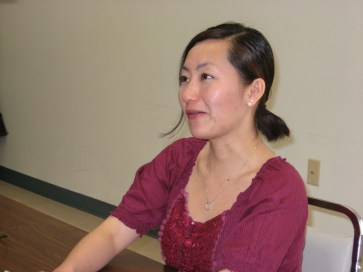
Kao Kalia Yang, Image courtesy of the Fox Cities Book Festival
“Yellow Rain” recalls the Hmong genocide following the Vietnam War. The Hmong were recruited by the CIA to help disrupt supply lines to Ho Chi Minh City (or Saigon). After American troops withdrew, the Viet Cong and the Pathet Lao persecuted the Hmong for aiding the US. The communists attacked the Hmong, eradicating villages and blanketing populations with a sticky, yellow substance. Attempting to escape systemic annihilation, the Hmong receded into the jungle, where many still reside today. Some of the Hmong that were able to escape brought with them leaves covered in the yellow stuff, which they gave to local aid workers. These workers then shipped the samples back to the United States where labs diagnosed it as a chemical agent known as “yellow rain.” A concerned Reagan administration reasoned that only the Soviet Union had the technical capacity to produce such a weapon. As a result, Reagan restarted the Unites States’ then-dormant Chemical and Biological Weapons (CBW) program. Radiolab’s hosts, Abumrad and Krulwich take issue with this narrative; troubling the assertion that yellow rain was in fact a chemical weapon and insinuating that Reagan used the Hmong incident as an excuse to start producing CBWs.
“Yellow Rain” progressed like many other segments of Radiolab. Abumrad and Krulwich began by recounting the story of the Hmong from the perspective of retired CIA agent Merle Prebbenow and the Yangs. Next, they interview Harvard professor Matthew Meselson and Cornell professor Thomas Seeley, using their testimony to suggest that “yellow rain” was actually bees releasing their bowels en masse after hibernation. Then Abumrad and Krulwich brought this provocative hypothesis to the Yangs. Here, the show intensifies, the music fades, and Krulwich begins to question the Yangs, “as if he were a cross-examining attorney” according to Bob Collins, blogger for Minnesota Public Radio. As the interview goes on, Krulwich’s tone increasingly stiffens as he repeats a similar line of questioning: “But, as far as I can tell,” Krulwich asserts, “your uncle didn’t see the bee pollen fall, your uncle didn’t see a plane, all of this is hearsay.”
Kalia’s voice beings to fray:
My uncle says for the last twenty years he didn’t know that anyone was interested in the deaths of the Hmong people. He agreed to do this interview because you were interested. What happened to the Hmong happened, and the world has been uninterested for the last twenty years. He agreed because you were interested. That the story would be heard and the Hmong deaths would be documented and recognized. That’s why he agreed to the interview, that the Hmong heart is broken and our leaders have been silenced, and what we know has been questioned again and again is not a surprise to him, or to me. I agreed to the interview for the same reason, that Radiolab was interested in the Hmong story, that they were interested in documenting the deaths that happened. There was so much that was not told. Everybody knows that chemical warfare was being used. How do you create bombs if not with chemicals? We can play the semantics game, we can, but I’m not interested, my uncle is not interested. We have lost too much heart, and too many people in the process. I, I think the interview is done [This is Kalia’s transcription of her statements, from Hyphen].
Kalia reflects on her experience with Radiolab in a post for Hyphen, characterizing the interview as more of an interrogation. I add an additional layer: that of the deliberative exchange. While it is certainly true that there was a great discrepancy between the interlocutors, both parties adduced reasons for their respective positions producing an argumentative encounter that challenged the norms that govern discourse and language.
In the above quotation, Kalia claims that Radiolab ambushed her and their meeting occurred under a pretense of telling the Hmong story. She then rhetorically situates her interlocutor within a broader history of silencing the Hmong. While it may be tempting to look at the Radiolab interview as an isolated event, Kalia’s arguments cast it as another iteration of the Hmong being discounted. We cannot, in other words, cleave “Yellow Rain” from a history of oppression.

August 2004, Image by Flickr User Awning
Additionally, Kalia chides Radiolab’s concerns, calling them a “semantics game.” Here, both the use of semantics and game is instructive. Semantics speaks to the trivial nature of Krulwich’s questions. His focus on yellow rain and its dubious status as a chemical weapon obfuscates the fact that weapons were used against the Hmong. Or, to reformulate Kalia’s argument, Radiolab is trading purely in language and ignoring the material reality of her people. The invocation of game is also important because it suggests that Krulwich does not understand the historical gravity of his actions. And, perhaps more importantly, that Radiolab is not taking the incident seriously. These arguments coalesce to trouble the assumption that the interview –and the inclusion of the Yang’s voices–was fair, equal, and inclusive. This culminates in Kalia wresting her agency from this context by ending the interview.
However, an exclusive focus on language ignores the intersecting effects of histories–personal, interpersonal and social–sounds, cultures, moods, and affects. Indeed, the grain of Kalia’s voice operates as an affective vector. Teresa Brenna, in The Transmission of Affect, explains, vocal rhythm “is a tool in the expression of agency, just as words are. It can literally convey the tone of an utterance, and in this sense, it does unite word and affect”(70). Different vocal inflictions invoke both biographic and cultural histories, as the body attempts to discern meaning. Political theorist William Connolly, in Neuropolitics, calls this space between sound and meaning the virtual register of memory. Virtual memory describes a background below conscious recollection that discerns sensory data, like sound, and renders it intelligible (24). We often see this register at work when we watch a movie, as different scenes are stored below the level of reflection and are called up to interpret a scene. Virtual memory is recursive, folding in present experiences to help guide future encounters and using previous encounters to make sense of the present. Thus the rhythm of Kalia’s voice guides the entrainment of affect by drawing on listeners’ previous encounters with similar sounds. This process infuses listeners’ perceptions and resulted in what commentators called “painful” and “emotional.”
While Kalia’s words claim Radiolab ambushed her and her uncle, the grain of her voice draws the unequal distribution of power into sharp relief. Her vocal cracks resonated with listeners, imparting an intense, visceral experience and provoking an outcry. One listener, Mathew Salesses sums up the response: “Every time I listen to this, I start to cry. Every time. About ten times now.” It demonstrates that Kalia was through reasoning with Krulwich; his use of Western science to discredit indigenous knowledge made sincere argumentation impossible. Her cry was not only an act of resistance, but also an objection that troubled Radiolab’s claims of journalistic excellence, highlighting vexing issues with editing and story construction.
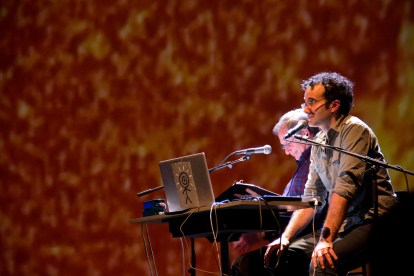
Robert Krulwich and Jad Abumrad, Image by Flickr User Carlos Gomez
In argumentation parlance, Kalia’s voice operated as an “objection.” In “Entanglements of Consumption,” argumentation scholars Kathryn M. Olson and G. Thomas Goodnight (1994) explain how an objection functions within an argumentative encounter: “absent a common agreement as to the means of reaching consensus, debate over the ‘truth’ of an asserted claim is set aside, in whole or in part, and challenges are raised as to the acceptability of the communicative context within which the argument is offered as secured”(251). That is, when deliberation occurs within a shared context—agreed upon values, goals, rules, and facts—the argument progresses smoothly. However, when there is a disjunction between interlocutors, such as in “Yellow Rain” where both parties disagree on basic facts, hegemonic beliefs take precedence. Objections function to evidence this differential, making both parties (and often an audience) aware of this gap. As such, objections are not concerned with refuting previous claims—the way that Kalia states neither she nor her uncle are interested in having a semantic debate—but questions the very context—and the conditions–of the debate itself.
Despite Radiolab’s attempts to fetishize her voice to evidence the “fact of the matter” and the “complicated nature of truth,” Kalia’s voice retained her agency. Through the invocation of the sonorous objection, she eluded capture and demonstrated the unequal terrain of the interview. Her pain enveloped the listener, leaving a resonance that Radiolab listener Cecilia Yang called “painful to listen to” in her personal blog. As Olson and Goodnight remind us, objections arise in a repressive context, when people are denied a voice. For Kalia, histories of racism and colonialism infused the argumentative encounter, making it impossible for her to “reason,” a framework she exposes as a stacked game. As such, her sonorous objection functioned to evidence this disparity, while directing the listener’s attention to her cause. Just as the pictures of prisoners coming out of Abu Ghraib incited outrage about U.S. imperialism and violence, Kalia’s sonorous objection provoked a conversation about the Hmong, Radiolab, and the ethics of journalism in the new media age.
—
Justin Eckstein is a doctoral candidate and former director of debate at the University of Denver. His work explores the intersection of listening, affect, and argumentation. Justin’s writing has appeared in Argumentation & Advocacy,Relevant Rhetoric, and Argumentation in Context. Currently, he is writing his dissertation on the micropolitics of podcasting in the post-deliberative moment.
Share this:

The Sound of Radiolab: Exploring the “Corwinesque” in 21st Century Public Radio

 Editor’s Note: Today, radio scholar Alex Russo, author of Points on the Dial: Golden Age Radio Beyond the Networks , continues our summer series “Tune In to the Past,” which explores the life and legacy of radio broadcaster Norman Lewis Corwin, the “poet laureate of radio” who died last summer at the age of 101. Sounding Out!‘s three-part exploration of his legacy by radio scholars Neil Verma (June), Shawn VanCour (July), and Russo (August) not only gives Corwin’s work new life (and critique), but also speaks to the growing vitality of radio studies itself. And now, hey everyone, you are listening to . . .Alex Russo Alright? Okay? Alright?–JSA
P.S. Look for a special bonus fall installment of the Corwin series in September!
—
Voice 1: What if you were the best in the world at something…
Multiple Voices: [background] He is the greatest….most stupendous…. most thrilling…most inventive
Voice 1: and then your entire industry collapsed.
Voice 2: [continuing and fading out] Radio[?] Writer.
Voice 1: But you kept on working?
SFX: Typewriter, continuing until coming to a dead stop when return bell rings and the carriage returns with a clunk on “pass away”
Voice 1: Outliving all your peers, until, 77 years later, you pass away?
Voice 3: Norman Corwin? Never heard of him. He defined a generation’s engagement with sound?
Voice 1: And there is no one left to eulogize you? What is your legacy?
This post is the third in a series that engages with the legacy of Norman Corwin, a – perhaps the – preeminent radio writer and producer of the late 1930s and 1940s. Specifically, it picks up on Neil Verma’s challenge back in June to consider the legacy of the “Corwin-esque.” Verma devotes considerable space to mapping the aesthetic syle of Corwin in his post and his incredibly insightful and astute book, Theater of the Mind.
The analysis that follows leans on Verma’s argument with a caveat. The question of legacy stems in part from Verma’s assertion that Corwin lived for so long, few were left to speak for his legacy. Corwin may not have the name recognition that he should within the broader public, but for radio practitioners, he is regarded with considerable reverence. In this sense, the Corwinesque style lives on by inspiring contemporary radio producers, especially, I will argue, in the aural style of the syndicated WNYC public radio program Radiolab, hosted by Jad Abumrad and Robert Krulwich. Radiolab describes itself as “a show about curiosity. Where sound illuminates ideas, and the boundaries blur between science, philosophy, and human experience.” While ostensibly a science program, designed to make complicated scientific phenomena comprehensible to a general audience, the show engages in fundamental questions about nature, being, and experience in creative ways.

Certainly, Abumrad and Krulwich regard Corwin as an inspiration, such as when Krulwich responded to a claim by This American Life‘s Ira Glass that the turn of the 21st century is the true Golden Age of Radio, by describing Corwin as “Homer in a modern form. . .a lyrical reporter who wrote and spoke like he was wearing a toga and sometimes was so spectacular you’d get dizzy listening and sometimes seems a little too old fashioned and oratorical.” In his earlier post, Verma defines Corwin’s aesthetic style through a number of formal elements, including what he describes as a kind of “overworked literary calisthenics.” Putting their own spin on Corwin’s dizzy oratory, Abumrad and Krulwich mark Radiolab with complicated and intentionally convoluted speech patterns. The program features Abumrad and Krulwich in rapid fire banter – far faster than typical public radio fare. Often, this onslaught of language crowds and overlaps, producing a highly staged simulation of conversational flow. Often, Abumrad is a voice of enthusiastic discovery, while Krulwich plays the role of skeptic, particularly in the early seasons. Abumrad’s voice is more nasal, higher pitched and, notably, recognizably younger than that of grizzled veteran Krulwich, creating a contrapuntal effect.

Radiolab Producers/Hosts Robert Krulwich (l) and Jad Abumrad (r), Image by Flickr User ThirdCoast Festival
These voices usually interact with a third voice, what typically radio documentary calls the “actuality.” However, instead of than separating “the real” from the narration’s voice of authority, Radiolab juxtaposes sentence fragments from all the voices (analysis, counter-argument, evidence) to create a conversation that proceeds dialectically, on parallel parts that intersect at points to lead to a thematic conclusion. While Radiolab’s dialogic style has been explored by other radio scholars, like Andrew Bottomley and Eleanor Patterson, its link to Corwin’s model of radio drama deserves more attention. While not exactly the same as Corwin’s signature “choral” vocal style, with voices chiming in from all directions, it performs a similar function, aurally representing a multiplicity of viewpoints.
Furthemore, Abumrad and Krulwich work hard to create a feeling of liveness and connection with Radiolab‘s listeners, much like Corwin did. Radiolab is certainly not a live program, but we must also remember that much of Corwin’s work was also developed to be recorded and sold–as Shawn VanCour discussed in his offering to this series. Although violating typical news protocols, mangled sentences, mis-matched vocal levels, and cross-talk are not removed during Radiolab‘s editing process; rather they are left in to create the feeling of spontaneity. Krulwich and Abumrad as quite conscious of this effect, with the latter noting in a New York Times profile, “It’s a funny thing, when you find yourselves laboring for weeks to create what you felt at that first moment.”

Abumrad and Krulwich, performing a live version of Radiolab, Image by Flick’r User Jared Kelly
A final connection, Abumrad and Krulwich blend two aural styles, “intimate” and “kaleidosonic,” descriptors Verma coins in Theater of the Mind as the hallmark of Corwin’s formal mastery. Verma defines broadcast intimacy through radio’s address to the listener as an individual, its placement of a program’s “audioposition” alongside the narrator, as well as its emphasis on place-centered narratives. Kaleidosonic style addresses the listener as a public, uses a multiplicity of auditing positions, and creates a broad model of engagement with narratives centered on events (70). A wonderful representative example of this combination of styles on Radiolab can be heard at several points in season two’s episode, “Detective Stories.” First, the end of the opening beat features the stylized repetition of a New York Sanitation official describing the Fresh Kills sump as a “time capsule.” As the phrase “time capsule” echoes eight times, Krulwich begins to chant “time capsule” in a lightly mocking and metallic sounding tone. Abumrad tells him, “You can stop that now.”
Later in that episode, a segment entitled “Goat on a Cow,” follows Laura Starcheski across the country as she investigates the twelve-year story behind of a box of old letters found by the side of the road.
This segment takes place at different locations, a hallmark of the intimate style. At the same time, it also uses elements of the kaleidosonic style because the narrative turns on particular events, moments where new evidence is found and new theories of the story of Ella Chase, the letters’ recipient. Throughout this segment Starcheski’s voice fades in and around those of her actualities. When she intervenes to provide context, the other voices are not stopped, they continue, telling their story under hers until at specific moment both voices say an identical phrase. This juxtaposition suggests that the letters hold different meanings for the individuals who come in contact with them: For Starcheski they are a reminder of her childhood desire to invent life stories of strangers; For Erick Gordon, an English teacher who found the letters, they are a great mystery on which he can project his own imagined histories and build a teaching curriculum; Finally, for Robert Chase, they represent a relief that he is no longer the archivist of his grandmother’s life. Like Corwin’s work, “Goat on a Cow” combines intimate and kaleidosonic styles, creating pleasures that are linked not to narrative closure but to the process of sonically representing investigation and theorization.

Letters, by Flickr user aroid
In allowing the pleasures of aural storytelling to enable the show’s narrative, Radiolab’s Corwin connection expands conceptions of the imagination. Like Corwin (and radio writers of the network-era), Abumrad sees radio as both an act of “co-authorship” and “co-imagining” between the writer/performer and the listener. However, he also sees his “job” as “put[ting] certain images and feelings in your head.” This link to discourses of the imagination is clear in the series’ opening episode, “Who Am I?” One segment in this episode, “The Story of Me,” suggests that what defines humanity is “introspective consciousness,” the ability to abstract images or events into a story of self.
Citing neuroscientist Dr. V. S. Ramachandran, Krulwich notes: “Only humans can take images from the real world, pull them into their heads, divide them into parts, and take those parts and turn them into abstractions.” To demonstrate, Krulwich leads Abrumrad through an example where the latter conjures the image purple striped red canary in his head. Ramachandran follows, noting that only humans can rearrange and manipulate “tokens” of “bird,” “striped,” and “red” to “imagine” something that doesn’t exist. The “peculiar human muscle” is that “ability to experience things and abstract them into a story. This definition is telling, while ostensibly it is about human consciousness, I would argue it could just as easily be seen as a description of the job of radio writing, taking recognizable symbolic tokens, manipulating them, and turning them into story. By equating human consciousness with radio, Krulwich and Abumrad exemplify a final theme that Verma attributes to network-era radio drama, its evolution “from being a theater in the mind to being a theater about the mind” (3).
Indeed, the segment of “The Story of Me” finishes by noting that neural actions can only be understood in a group: “Even the thought ‘I am a one’ springs from a hundred million cells connecting through a trillion synapses and that all of this multiple activity paradoxically creates the you of this moment. You are always plural.” I imagine that Corwin, no stranger to celebrations of plurality, would completely agree.
—
Featured Image by Flickr User Jared Kelly
—
Alexander Russo is an Associate Professor in the Department of Media Studies at The Catholic University of America in Washington, DC. He is the author of Points on the Dial: Golden Age Radio Beyond the Networks (Durham, NC: Duke University Press, 2010) as well as assorted articles and book chapters. His research interests include the technology and cultural form of radio and television, the aesthetics of sound, the development of “old” new media, the history of music and society, the relationship between media and space, and the history of popular culture.
Share this:


Current Top Posts





April 2021

January 2020

November 2019

October 2019

August 2019

April 2014

November 2017

March 2015

December 2017

October 2015
 Sounding Out!
Recent Comments