
As Loud As I Want To Be: Gender, Loudness, and Respectability Politics

 Editor’s Note: Here’s installment #2 of Sounding Out!‘s blog forum on gender and voice! Last week we hosted Christine Ehrick‘s selections from her forthcoming book; she introduced us to the idea of the gendered soundscape, which she uses in her analysis on women’s radio speech from the 1930s to the 1950s. In the next few weeks we’ll have SO regular writer Regina Bradley, with a look at how music is gendered in Shonda Rhimes’ hit show Scandal, A.O. Roberts with synthesized voices and gender, Art Blake with his reflections on how his experience shifting his voice from feminine to masculine as a transgender man intersects with his work on John Cage, and lastly Robin James with an analysis of how ideas of what women should sound like have roots in Greek philosophy.
As I planned for SO!’s February forum, I wondered about my own connection to the topic: how is the loudness of a voice gendered? Does it matter who we call “loud”? As a Latina, I’m familiar with the stereotypes of the loud Latina, and as a Puerto Rican I faced them at every gathering. So for this week I decided to reflect upon my experiences in a personal essay. Lean in, close your eyes, and don’t let the voices startle you.–Liana M. Silva, Managing Editor
—
I was 22 years old when someone called me deaf. I was finishing my bachelor’s degree at the University of Puerto Rico, Rio Piedras campus. After four years of living in San Juan, I still hadn’t gotten used to the class and race microaggressions I encountered regularly because I was a brown girl who grew up in the country and was going to school in the urban capital, el área metropolitana. These microaggressions were usually assumptions about who I was based on how I talked: I called pots a certain way, I referred to nickels in another way, and I couldn’t keep my voice down–all indications, according to my “urban” friends, that I grew up in the country. But being called “deaf” was a new one.
My boyfriend at the time had no cellphone, and his mother would call me regularly to see if he was on his way home from a gig or to ask him to run an errand. She and I were not close, but we were cordial. I always felt we didn’t click on some level. This particular weekend day, she had called to ask if he had left San Juan already to come visit her, and I told her I had just seen him that morning before he left. Somehow she and I went from small talk into a conversation.
In my head, I thought I was making headway with her and that this was a huge step forward in our relationship. We talked about his gig the night before, about how my family was doing, things like that. Then she asked me if my family had a medical history of people losing their hearing. “No? I don’t think so. Why do you ask?” I said in Spanish.
“Because you talk so loud, and so do your father and your sister. Your mom isn’t loud.”
That was over 10 years ago, but the comment still stings. I am certain that wasn’t the only time someone called me “loud” or pointed out the tone of my voice, but it’s the one time that still rings in my ears when I think about the intersection of gender and sound. It wasn’t just that I spoke at a high volume, it was that I was a woman who spoke at a high volume. I was the girlfriend who was loud.
Of course we’re not born loud- or soft-speakers – we learn to use the volume level that prevails in our culture, and then turn it up or lower it depending on our subculture and peer group.
-Anne Karpf, The Human Voice
What does “loud” mean, anyway? Denotations fade into connotations. As I write this, I struggle to think of how to describe loud in a way that doesn’t feel negative. Because every time I think of “loud” its negative connotations float up to the surface. Just take this Merriam-Webster online dictionary entry for “loud.” Aside from the reference to volume, “loud” also means sounds that are offensive, obtrusive—annoying.
To be fair, I’ve always been self-conscious of my voice, and not in the way most people hate the sound of their voice. I always felt my voice was not girly enough. I always felt as a teenager and a young adult not “pretty” enough, not thin enough, not “feminine” enough, so my insecurities also extended to my voice.
Growing up, I heard people tell me time and time again to keep my voice down, that I was talking too loud, that people next door could hear me, et cetera. Grandparents, cousins, parents, friends: I got it from every corner. Shush. But I don’t recall anybody saying that about the boys/men I hung out with. Add to that the comments I got about my appearance: “you’re too fat,” “your hair is too frizzy,” ‘you’re ugly.” I associated being loud with being unattractive. Just another flaw.
It’s no coincidence then that describing a woman as loud is almost never said as a compliment. Although a man can be loud—he might even be expected to have a deep, booming, commanding voice, as the above video describes—when a woman is described as loud, it’s almost never in a good light. Karpf mentions in The Human Voice: The Story of a Remarkable Talent that “Loudness certainly seems to be judged differently depending on the sex of the speaker. Talking loudly is considered an act of aggression in women, but in men as no more than they’re entitled to.” In other words, society deems men to be allowed to be loud, and by extension loudness comes off as a masculine feature. So loudness, something that at its base means high volume, ends up being constructed as more than just decibels. Women who are “loud” become noisy, rude, unapologetic, unbridled.
Mija pero que duro tu hablas.
In Puerto Rico, the word for “loud” was alto (high) but also duro (hard). I knew early on that when someone told me that I spoke duro they didn’t mean it in a kind way. The voice was described as hard, harsh, shards of glass. It hurt to be called loud. It hurt to be called hard. Especially when you understand that society accepts only certain ways of being a woman: soft, delicate, fragile, dainty. It was never meant as a compliment to have someone call your voice “hard.”
If I was listening to my mother and my aunts or cousins speaking, and then chimed in, I would get the “shhhh” or if they wanted to be discreet they would make a gesture with their hands to indicate to me that I should bring my voice down. I learned early on that a lower voice was more appealing than the loud voice hiding in my vocal box.

I am Puerto Rican, and even though I was born in New York City, I was raised in a small town on the western side of Puerto Rico. I was already well-aware of stereotypes and digs about my being born in New York, even at a young age. My cousins would tell me I was stuck up, I thought I was better than other people because I had cable, I only listened to music in English (I guess that was a bad thing to them). When I moved to San Juan, I was no longer a displaced Nuyorican but a country bumpkin. Peers, friends, and new acquaintances would not classify me as a Nuyorican but, because I was living in San Juan at the time, would categorize me as an islander, de la isla, which basically meant I was not from el “area metro.” I was, in short, a country bumpkin to them.
The loudness of my voice was not just a marker of where I came from (the country, with all of the classicism that the phrase entails) but for me became conflated with gender. I knew that even when I wasn’t living in the city, I had been called loud. It’s just that when my peers asked me to lower my voice or to not speak so “duro” it was also because they thought of me as jíbara, country.
Sometimes I would get carried away when I was telling a joke among my female roommates, or I’d be excited to share some news, and eventually someone would tell me to tone it down. Baja la voz. As I reflect upon my college years living with roommates in a crowded apartment in a crowded city, I remember that we often got together and laughed, talked over each other, shouted across the apartment. But I would get carried away and then someone would say something about it. Mira que nos van a mandar a callar. Someone’s gonna tell us to shut up.
It was in college, however, that I learned to modulate my voice. I am physically capable of whispering, but when I spoke in English in a classroom setting (I was an English major in a school whose language of instruction was Spanish) I felt even louder in English. So I made the effort to tone down my voice, literally. I equated English with career, and by extension with my professional persona.
Ultimately, English would be the language I spoke (and still speak) in academic circles; with the language came also the tone and the volume. Men in my classes seemed more often to initiate conversations in my classes, and sometimes even in the ones where they were a minority. Meanwhile, the driven graduate student that I was, I wanted to step in but not stand out because of my voice. I didn’t want to give them (or the professor for that matter) a chance to discount me because I was a loud Puerto Rican woman at an American school. Eventually I learned how to switch back and forth. So did my fellow female classmates.
I remember as a teacher modulating my voice so I would be less loud and less abrasive in a college classroom. I wanted to assert my authority. If some women resort to vocal fry in order to be taken seriously, as this 2014 article in The Atlantic (online) suggests, I resorted to modulating my voice. That was my way of passing: passing for creative elite, passing for feminine, passing for authoritative. I tried to assert my credibility as a burgeoning scholar and professor by tweaking my voice. I laughed a little softer, I spoke a little slower, I sounded a little lower. I teetered between trying to sound feminine and trying to downplay my femininity through my voice.
Was I trying to sound more like the stereotype of a woman so I could be more credible in the classroom? Was this my own version of respectability politics? “Don’t be so loud and they’ll listen to you”?
“White supremacy grants white people the ability to be understood as expressing a dynamic range; whites can legitimately shout because we hear them/ourselves as mainly normalized. At the same time, white supremacy paints black people as always-already too loud.”
-Robin James, “Some philosophical implications of the “loudness war” and its criticisms”
The negative rhetoric about women and loudness is also connected to respectability politics. Take for example the stereotype of the angry black woman (which is in the vicinity of the loud Latina). If women must be delicate and feminine, being loud would be unattractive, unseemly. Loud also means “not being silent,” in other words, speaking when not spoken to. Robin James touches upon “loudness” in contemporary music, and how the turn toward less loud tracks also has to do with racialized ideas about who can speak and who can be loud–in other words, what counts as noise and what counts as harmonious sound. She cites Goldie Taylor’s piece in The Daily Beast about how, regardless of how angry she felt about the racial injustices in the United States, she would never be able to scream and shout without consequences. Loudness is something racialized people cannot afford.
The stereotype of the angry woman points to how the notion of who is loud and what tone of voice is considered loud are constructed. Although there are studies that point out that the sound of one’s voice indicates to others that one is in a position of authority or that one’s voice can make or break one’s career, there is yet to be a study that shows how the biology of the body that produces the voice affects what one can or cannot do. In other words, the connection between voice and our abilities, or our social class, is constructed—in our heads.
Assertive, aggressive, leader: these descriptions benefit men, for the most part. Aggressiveness is seen as a masculine trait, and along with that a loud tone of voice is also seen as masculine. (This idea is also problematic, for it sets anything that isn’t aggressive and assertive as female, and therefore negative.) The opposite applies to women; the same way our society associates fragile delicate things with femininity, a fragile, soft, low tone of voice is the acceptable range for a woman. And James and Taylor’s comments point to how race also changes the equation. Damned if we speak, damned if we don’t.
***
Over the years, I’ve become more comfortable with the way I sound. I’ve also become more comfortable switching between my aural codes, like I do with English, Spanish, and Spanglish. I know that there’s a volume that I use in certain spaces. I also know that in other spaces I don’t have to watch over how loud I am. If I am in a familiar space, with people I am close to, I feel less inclined to watch myself. I feel safe, not judged. I can be as loud as I want to be. But loudness is also an accepted way of speaking around my family. If I spoke in a low tone, I’d probably be picked on for that. My father, for one, has a booming, deep, loud voice, and so do many of my family members.
For me, embracing my voice is also a kind of body acceptance. My body, plus-sized and all, takes up space. My voice takes up space too. As a teenager and an adult I was constantly shamed for the way I look (skin too brown, voice too loud, face too painted, hair too short), and for a time tweaking my voice became a way to try to fit in. But I later learned how to respond to the remarks. I learned to be sarcastic. I learned to make jokes. I learned to talk back. I didn’t find my voice; I embraced my voice.
Dear readers, let us know in the comments: have you been chastised for being loud? Or for not speaking loudly enough?
—
Featured image: property of the author.
—
Liana M. Silva is co-founder and Managing Editor of Sounding Out!.
—
 REWIND! . . .If you liked this post, you may also dig:
I Been On: BaddieBey and Beyoncé’s Sonic Masculinity–Regina Bradley
Learning to Listen Beyond Our Ears: Reflecting Upon World Listening Day—Owen Marshall
An Ear-splitting Cry: Gender, Performance, and Representations of Zaghareet in the U.S.–Meghan Drury
Share this:

The Sonic Roots of Surveillance Society: Intimacy, Mobility, and Radio


It’s an all too familiar movie trope. A bug hidden in a flower jar. A figure in shadows crouched listening at a door. The tape recording that no one knew existed, revealed at the most decisive of moments. Even the abrupt disconnection of a phone call manages to arouse the suspicion that we are never as alone as we may think. And although surveillance derives its meaning the latin “vigilare” (to watch) and French “sur-“ (over), its deep connotations of listening have all but obliterated that distinction.
Rounding out our series on surveillance, Kathleen Battles offers a historical perspective that shows how early twentieth century crime drama naturalized practices of citizen surveillance. A million eyes were activated as millions of listeners learned that the immediacy of radio and telephone allowed for an unprecedented level of participation in law enforcement. Calling all cars…Calling all cars… -AT
—
Police Headquarters, a 1932 radio crime drama, was produced in the infancy of narrative radio. Containing barely 12 minutes of narrative content, the program opened each episode with a repeating segment of call, connection, and dispatch to quickly establish both the crime committed and how the police responded to it. For example, in the “Payroll Robbery” episode it takes just over a minute and a half to hear a phone call to the titular headquarters, its connection to the proper unit, a radio call to a specific police car, and the responding officers arriving at the assigned location. Compared with the graphically and visually intense images of modern surveillance in contemporary popular culture, this brief exchange no doubt sounds quaint, simplistic, and even banal. After all, radios, cars, and telephones have served as the routine backdrop of most police dramas for some 70 years. But in 1932 the interlinking of these technologies was factually, as well as imaginatively, novel. This essay shows how radio, as “new media,” was central to imagining surveillance in sonic terms, prefiguring many features of contemporary surveillance practices.
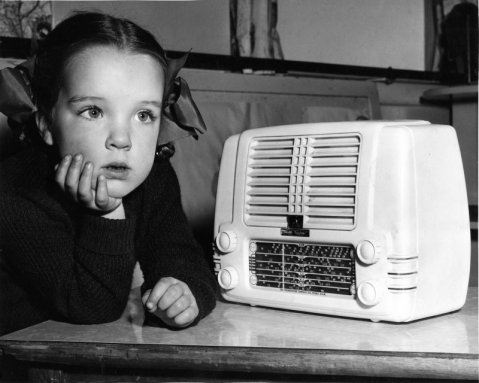
“Kindergarden of the Air,” by the Australian Broadcasting Corporation CC BY-NC-ND.
The introduction of radio and cars into police work took place in the first decades of the twentieth century, especially during the years between the two world wars that Richard Popp (2011) calls “the machine age”. He argues that this period witnessed vast transformations brought on by cars and radios, which, when combined with existing technologies like the telephone, forged new communication networks that transformed both work and leisure. These changes were central to the narratives of criminality and policing that emerged during the interwar years. Police were the focus of radio dramas, including Police Headquarters and Calling All Cars. These dramas played with the intermingling of automobility, telephony, and radio in ways that spoke to the main problems police forces saw themselves facing: organized, professional, mobile, machine-age criminals. Cars, telephones, and automobiles were not just tools to criminals, but they were also the building blocks for a machine age surveillance made possible by the sonic power of radio.
Recently, Robin James (2014) has suggested that the acousmatic is a useful metaphor for understanding the emerging practices of data based surveillance. Acousmatic surveillance listens for patterns in “ambient data environments” instead of profiling individuals in the panoptic sense. At the turn of the twentieth century, radio allowed for a panacoustic mastery of spaces that bridged both panoptic and acousmatic surveillance. Radio also speaks to another key feature of information age surveillance, what Mark Andrejevic (2011) describes as the “redoubling of tools for communication and leisure as technologies for surveillance and security.” (165-66) The technical capabilities and imaginative potentials of radio help us to consider it both as a police technology and entertainment medium. The sonic power of radio was often figured as an “Invisible Man Hunter,” whose realignment of spatial and temporal arrangements rendered criminal escape impossible. As an entertainment medium, radio’s aurality was key to understanding its imaginative potential as highly intimate and mobile: invasive and expansive.
In Police Headquarters we hear how radio’s sonic and aural qualities come together. Radio acts as the link between the telephone and car, allowing for a swift response to a citizen request. The tactical use of sound effects and narrative compression in the broadcast situate the listener inside a machine like apparatus that presents the police as always available. At their broadest level, radio crime dramas aurally situate communication and transportation technologies, like radio, as key to both the narrative organization of the story and as a plot element. In the opening to the “Stop That Car” episode of Calling All Cars, a dispatcher advises for cars to be on the lookout for a specific car involved in a hit and run, including the address of the crime and possible location of the vehicle. Overlaid with sound effects made to signify a car, these openings situate listeners as riders eavesdropping on the adventures of mobile police officers. As the program’s title suggests, each episode opened with a police radio call, often voiced by real life LAPD dispatcher, Jessie Rosenquist. The program’s sponsor was the gasoline company that supplied the fuel for LAPD patrol cars – further linking cars and radio as a key theme. In the opening to the “Two Man Crime Wave Episode,” the very ad for the product is performed as a police radio call.
The conceit of eavesdropping on a police adventure did much to link private life and the police. This theme runs tandem to radio’s sonic immediacy, which allowed listeners to imagine a seemingly instantaneous response to citizen phone calls.. For example, the “July 4th in a Radio Car” episode of Calling All Cars situates radio listeners as sonic participants, able to ride along with police from the comfort of their own living rooms. Here, cars respond to a number of calls made by private citizens that bring the policing function into daily life. There is even one call that involves domestic violence, in particular. Throughout the episode, police are situated as an available force – thanks to the telephone, radio, and automobile – to adjudicate all manner of private disputes. In these particular instances the intimacy of radio as a machine age technology is “redoubled” with radio as a police technology. Radio’s intimate address allowed the voices of police officers to enter the private space of the home. At the same time, the machinery of crime fighting required citizen participation, most often figured through the phone call from within the space of the home to the police.

“Radio Police Automation 1924,” by Robert Wade, CC BY-NC-SA.
If the intimacy of radio served to cross the divide between public and private, the spatial-temporal collapse achieved by radio made it ideal for sonically monitoring great swaths of space. Intimately linked with cars, radio was understood as especially mobile. Radio’s ability to compress the relationship between space and time is frequently dramatized. For example, in the “Crime vs. Time” episode of Calling All Cars, the host explains how radio has rendered the average response time to a police call for help only two minutes and forty seconds. The episode then proceeds to show how radio was used by the police to track and apprehend two men who robbed a movie theater. Representing phone and radio calls, while specifically referencing geographic locations, radio dramatists used radio’s aural dimensions to render radio’s sonic power of surveillance. Capable of reaching everywhere, police radio, when linked with the telephone and automobile, could be used to sonically pinpoint any somewhere that a criminal might try to escape to.
In our era of high-tech and sophisticated technologies, visually rich narratives, and algorithmically driven methods of tracking, there is certainly something simple, comforting, and even nostalgic in these tales of low-tech machine age criminal apprehension. Depression era true crime dramas certainly do not offer the kind of sophistication as information age narratives, such as The Wire. The medium’s sonic qualities were key to linking together its use as both a police instrument and as a domestic entertainment technology. With sonic forces invisibly and silently crossing the into intimate domestic spaces and covering large swaths of territory, radio became key to imagining many features that we take for granted as “new” about the information age: the control of movement across space, the constant availability of communicative connection, the promise of perfect coordination across a field of institutional actors, the marshaling of citizen participation in surveillance efforts, and the construction of increasingly intimate links between domestic life and law enforcement procedures. In serving as central node in refiguring shifting notions of space and time that existing institutions were not prepared to handle, radio’s sonic qualities remapped the meaning of police work and helped to establish a relationship between the police and citizen body that still resonates today. While not as technologically sophisticated, machine age policing and police narratives took advantage of radio’s double function as both a machine of coordination and medium of entertainment to extend the policing function into more areas of life. This reflects a sonic mode of power that allows neither the interior space of the home nor the exterior world of the road relief from police presence. This moment of technological interconnection, however, evoked the excitement and anxiety that made sonic surveillance at once thrilling and calming; a salve to soothe the woes of a world that now seemed intensely close and impossibly far flung. Is it any wonder that while some fret over the power of corporate and state dataveillance today, that some continue to find comfort in the possibility of being recognized as someone in a world of ever more intense interconnection?
—
Featured image “Radio for Backup” by Jonathan Flinchbaugh CC BY-NC-SA.
—
Kathleen Battles is Associate Professor and Graduate Director in the Department of Communication and Journalism at Oakland University. Her research focuses on radio history, especially as it relates to issues of policing, sound and surveillance, questions concerning technology and culture, and sexuality and the media. She is the author of Calling All Cars: Radio Dragnets and the Technology of Policing (University of Minnesota Press, 2010); co-editor (with Joy Hayes and Wendy Hilton-Morrow) of War of the Worlds to Social Media: Mediated Communication in Times of Crisis (Peter Lang, 2013); and co-author (with Wendy Hilton-Morrow) of Sexual Identities and the Media: An Introduction (Routledge, 2015). In addition, her work has appeared in Critical Studies in Media Communication, The Radio Journal, and the Journal of Homosexuality.
—
 REWIND!…If you liked this post, check out:
Acousmatic Surveillance and Big Data-Robin James
The Dark Side of Game Audio: The Sounds of Mimetic Control and Affective Conditioning–Aaron Trammell
À qui la rue?: On Mégaphone and Montreal’s Noisy Public Sphere-Lilian Radovac
Share this:


Current Top Posts





April 2021

January 2020

November 2019

October 2019

August 2019

April 2014

November 2017

March 2015

December 2017

October 2015
 Sounding Out!
Recent Comments