
“Cremation of senses in friendly fire”: on sound and biopolitics (via KMFDM & World War Z)

There’s a 20-year gap in chronology between KMFDM’s 1993 song “A Drug Against War” and Marc Forster’s 2013 film World War Z, but sonically and ideologically they’re very, very similar. They contain the same kinds of sounds–machine guns, military orders barked over radios, buzzing crowds–and they use these sounds in the same way: to build sonic intensity past its breaking point (a “sonic bombardment brighter than sunlight,” as the KFMDM lyrics say). Their sonic similarity is evidence of neoliberalism’s intensification in the 20 years between them: what was once avant-garde opposition is later mainstream norm.
The songs’ sonic similarity reveals the central role of sound in contemporary biopolitics. By listening closely to “A Drug Against War” and the soundscape of World War Z—a film in which Brad Pitt saves humanity from a zombie apocalypse by giving all survivors a terminal disease—I show sound as more than a privileged aesthetic domain; sound actually provides the epistemic background and the concrete mechanisms for organizing society. Just as vision and “the gaze” are the ideological and technological foundation of panopticism, sound is the ideological and technological foundation of contemporary biopolitics. Much more is at stake in this post than just a song and a film: it takes on how—and why—society is organized as it is. It’s also about a particular understanding of “the sonic”: sound as dynamic patterning.
Because “A Drug Against War” lays out, in fairly elementary form, this “biopolitical” sonic vocabulary, it makes sense to start there. But before I do that, I will briefly define what I understand as ‘biopolitics.’
Life
Like “neoliberalism,” “biopolitics” is a trendy concept whose precise meaning can get lost in loose usage. By “biopolitics,” I mean both an ideology of health and vitality and a political strategy whose medium is “life.” “Life,” here, isn’t individual health, wellness, or existence; it’s the ongoing vitality of the segment of society that counts as “society” tout court (e.g., in white supremacy, that segment would be whites). Biopolitics manages society like a living thing; for example, we often talk about the “health” of the economy, or use metrics such as obesity rates to compare different countries.

“Overweight or obese population OECD 2010” by ZH8000 – Own work. Licensed under Creative Commons Attribution-Share Alike 3.0 via Wikimedia Commons
As Foucault explains in Society Must Be Defended, biopolitics’ “basic function is to improve life, to prolong its duration, to improve its chances, to avoid accidents, and to compensate for failings” (254). But to do that, power sometimes has to kill. Pruning my raspberry bush causes more berries to sprout, for example, just as weightlifting tears all my muscle fibers so they’ll rebuild in bigger, stronger shape. Killing off the weak is a positive investment in society’s overall strength. Again, Foucault:
The fact that the other dies does not mean simply that I live in the sense that his death guarantees my safety; the death of the other, the death of the bad race, of the inferior race (or the degenerate, or the abnormal) is something that will make life in general healthier: healthier and purer. (Society, 255).
Hitler’s “final solution” is an obvious example of this biopolitical approach to killing, but this practice also informs many contemporary US policies and practices. In the US, black people as a population have significantly higher mortality rates than any other race, for example. Following Foucault, we could say it’s in the interest of white supremacist society to maintain a high mortality rate among black populations because this makes white supremacist society “healthier.” The key point here is this: biopolitics promotes and administers life by generalizing and naturalizing what Foucault calls “the relationship of war: ‘In order to live, you must destroy your enemies’” (Society 256). Biopolitical warfare is precisely what is waged in both “A Drug Against War” and World War Z, and sound emerges as a weapon of choice.
“Kill Everything”
 In its original context, KMFDM’s “A Drug Against War” used sound to counter US Presidents Reagan and Bush 1’s War on Drugs/”New World Order” thinking. Indeed, in 1993, it was hard not to hear it as a response to 1991’s Operation Desert Storm, the US’s first military action as the ‘winner’ of the Cold War. It performs, in music, the “cremation of senses in friendly fire,” that its lyrics describe. It burns out our hearing, realizing through sound the sort of “creative destruction” or “shock doctrine” that characterizes neoliberalism more generally. In this rather Nietzschean model, the only way to make something “stronger than ever, ever before” is to first kill it. Death is the means to the most vibrant life.
The lyric–“stronger than ever, ever before”–is the first line of the chorus. At the end of every verse, there’s a short drumroll that leads into it. As S. Alexander Reed notes in Assimilate: A Critical History of Industrial Music, “clocking in at “322 bpm, the eighth-note snare fills at the end of the verses fire at about eleven rounds every second–the same rate as an AK-47” (29). This flourish foreshadows the gesture that, in the song’s bridge [after the second chorus, around 2:17 in the video above], musically “cremates” our senses in friendly fire–in this case, in the rapid fire of percussion. This rapid-fire percussion is one of the sonic elements that “Drug” shares with WWZ; in fact, the chorus uses what is likely (according to Reed) a machine gun sample. The machine gun effect mimics blast drumming. As Ronald Bogue explains in Deleuze’s Wake, blast drumming is a “tactic of accelerating meters to the point of collapse,” produced through the “cut-time alteration of downbeat kick drum and offbeat snare, the accent being heard on the offbeat but felt on the downbeat” (99). “A Drug Against War”’s AK-47 rolls actually accelerate to the point of auditory collapse, i.e. to the point at which humans generally can’t distinguish individual sonic events—the aural equivalent of seeing 24 frames per second as one continuous image. The AK-47’s rolls of ‘friendly’ fire cremate our sense of hearing.
The song’s chorus includes many other sonic elements shared by World War Z: doppler effects (such as the sounds of dropping bombs or planes buzzing the ground), rubble being moved around, military orders barked over radio. In the bridge several kinds of crowd noises are introduced: first, guitars buzz like a swarm of insects; then, a call-and-response in which singer Sascha Koneitzko echoes the chorus (which reverses the usual order in which the chorus echoes the individual leader); finally, a chaotic rabble of voices builds in intensity and leads into the sense-cremating climax.

KMFDM, 1 October 2009, Image by Flickr User Axel Taferner
An extended and intensified version of the “friendly fire” at the end of each verse, “A Drug Against War”’s climax builds to a peak by layering two full measures of AK-47-style drumroll on top of sounds of rabble, evoking the image of the military firing on an unruly crowd. This roll barrels towards the point of auditory collapse–if it got much faster, we’d be unable to distinguish individual rhythmic events, and hear a constant buzz (like in the beginning of the bridge), not a series of eighth notes. The roll’s forward momentum intensifies musical energy to an apex, culminating on the downbeat of the next measure in a florid lead guitar solo.
Describing the song as “sonic bombardment brighter than sunlight,” the lyrics confirm the music (and vice versa). The song overdrives sound until it sublimates into something else–if sunlight is more intense radiation than even soundwaves, here soundwaves amplify to a state more powerful than that. Cremating our senses in friendly fire, KMFDM channels soundwaves into a revolutionary drug, a drug against war. The band presents cleansing fire meant to purify us of disease: just as a fever kills pathogens in our bodies, the song burns our senses to kill a pathogenic ideology. Overdriving mainstream musical taste, offering something so brutal, so damaging to one’s ears, that only the avant-garde can survive, KMFDM inoculates the population against its most reactionary, war-mongering elements. “A Drug Against War” uses sound to perform a biopolitical operation, one that emerges as the basis of WWZ’s plot: the only way to save the human race from the zombies is to kill everything.
WWZ
 World War Z intensifies the horrors of contemporary biopolitics to the point that the only way to recuperate from them is to intensify them even further: in order for humanity to survive, everyone must be dead on their feet. In the sci-fi universe of World War Z, zombies aren’t eating for their survival, but for the survival of the virus they carry; they only attack and eat prey that are also (and primarily) attractive hosts for the virus. Pitt’s character, protagonist Gerry Lane, discovers that terminally ill humans aren’t legible to the zombies as human—that is, as attractive hosts. They won’t live long enough and/or are too weak to aggressively spread the virus. So, he decides the best way to protect humans from zombies and the virus they carry is to infect the remaining people with a deadly but ultimately curable illness. The World Health Organization develops a vaccine that allows healthy people to ‘pass’ as terminal cases. The only difference remaining in the post apocalyptic world of WWZ is between the quasi-dead and the walking dead. Death is the drug against WWZ.
The film doesn’t represent or express the biopolitical recuperation of death visually, but sonically: to make audiences feel what the narrative depicts, WWZ cremates their sense of hearing–often with more amplified and complex versions of the same sonic elements mobilized in “Drug.” Doppler effects, crowd noises, machine guns, military orders barked over radio bombards the film’s audience as sonic “friendly fire.” Though the film’s soundtrack doesn’t actually blow out its audience’s ears (what lawsuits!), it repeatedly simulates sonic cremation; the tinitus-y buzzing one hears after auditory trauma–what one hears in lieu of hearing—functions as a constant refrain. Narratively climactic moments are composed, cinematically, as sonic overdrive. The massive car crash as everyone tries to evacuate NYC in the beginning of the film, the moment when Pitt’s character thinks he may have been infected atop the NJ apartment building, the plane crash outside the Cardiff WHO office–each of these events culminates in tinitus-y ringing. As physical and psychological trauma overwhelms the characters, the film pretends to inflict overwhelming—cremating—auditory trauma on its audience.

WWZ Screen Capture
In the WWZ universe, sound is destructive; it unleashes the zombie horde. At 49:00, a soldier says: “remember these things are drawn to sound…there’s only one way we’re getting you on that plane, and that’s quiet.” In a scene set in Jerusalem, excessive sound turns something miraculously positive—a Muslim girl and a Jewish girl leading a mixed crowd in song, a mini Arab-Israeli peace accord—Into a massacre. The sound attracts the zombie horde, leading them to swarm and overrun Jerusalem’s walls. Similarly, at the film’s end, Pitt’s character empties a soda machine so the cascade of cans will attract zombies away from the doors he needs to enter. By this point, Pitt’s character has injected himself with a deadly disease, effectively killing himself in order to preserve himself from zombification. The cascade of cans aesthetically represents this narrative point and hearkens back to KMFDM. The cans drop out of the machine at an increasingly rapid rate, mimicking “Drug”’s intensification of percussion events to and/or past the limit of human hearing. Just as Pitt’s character has crashed his body, the cascade of cans crashes our hearing.
The climax presents a narrative and the auditory convergence on the same biopolitical idea: kill everything, because then the best will bounce back, phoenix-like, from that sensory cremation, stronger than ever. Zombies can’t rebound from death, but still-living humans sure can (via immunization). Like a sonic bombardment brighter and more radiant than sunlight, this anti-zombie camouflage tactic phase-shifts death into exceptionally lively life. Just as the muted, tinitus-y moments in the film make the subsequent scenes feel comparatively more sonically rich and dynamic, intentional and carefully managed mass extinction ultimately makes the living more vibrant.
Sound & Biopolitics
Such vibrancy–that is, what Julian Henriques dubs “the dynamics of [the] periodic motion of vibrations” in Sounding Bodies: Reggae Sound Systems, Performance Techniques, and Ways of Knowing (265)–is what “life” and “sound,” as they are conceived by and function in contemporary biopolitics, have in common. “Sound,” according to Henriques is “a particular kind of periodic motion, variation and change” (247). Sound waves are dynamic patterns of intensities (pressure); they move through matter and respond in turn, both to that movement itself and the secondary sound waves (harmonics) that movement produces. WWZ treats this notion of periodic motion, variation, and change as the conceptual basis for the ideally biopolitical “life.” At around 20:00, when Pitt’s character attempts to convince the Latino family sheltering him to leave their apartment with him, he says “movement is life…Moviemento es vida.” Sedentary fortresses protect no one from zombies–we see this repeatedly in the film. The only way to survive is by rapidly adjusting to new conditions. The dynamism of adaptive flows—the ability to bounce back and recuperate (like an echoing pressure wave), to dynamically recombine (like both harmonizing frequencies and like a virus), to find signal in noise–this dynamism is life. Because it adapts to new challenges, because it moves, varies, and changes, life can bounce back from total annihilation, stronger than ever before. Only life lived like sound can be properly and sufficiently resilient. In WWZ, the zombie virus is a eugenic tool that weeds out insufficiently “sonic” life, life that is too static to respond to capitalist and biopolitical mandates for calculable motion, variation, and change.

WWZ Shooting in Glasgow, Scotland, Image by Flickr User Gerry McKay
When read through “Drug,” WWZ illustrates the epistemic and ontological importance of sound to contemporary biopolitics. We think “life” works like we think sound works. Because “life” is the object and the mechanism of biopolitical government, power works on and through us sonically. If we want to analyze, critique, and fight the institutions, structures, and practices that put power to work for white supremacy, cis/het patriarchy, and all other forms of domination, then we need to start thinking and working sonically, too.
Some theorists, such as Elizabeth Grosz and Adriana Cavarero incorrectly think this move to sound and voice is itself revolutionary and counter-hegemonic. Just as the critique posed in 1993’s “Drug” has been co-opted by 2013’s WWZ, white feminist theory’s sonic counter-modernities are the medium of biopolitical white supremacist patriarchy. When we think and work sonically, we’re working with the master’s tools; to bring down the master’s house, we have to use them critically and strategically.
—
Featured Image by Flickr User crisper fayltrash
__
Robin James is Associate Professor of Philosophy at UNC Charlotte. She is author of two books: Resilience & Melancholy: pop music, feminism, and neoliberalism will be published by Zer0 books this fall, and The Conjectural Body: gender, race and the philosophy of music was published by Lexington Books in 2010. Her work on feminism, race, contemporary continental philosophy, pop music, and sound studies has appeared in The New Inquiry, Hypatia, differences, Contemporary Aesthetics, and the Journal of Popular Music Studies. She is also a digital sound artist and musician. She blogs at its-her-factory.com and is a regular contributor to Cyborgology.
—
 REWIND!…If you liked this post, check out:
Queer Timbres, Queered Elegy: Diamanda Galás’s The Plague Mass and the First Wave of the AIDS Crisis–Airek Beauchamp
On Sound and Pleasure: Meditations on the Human Voice–Yvon Bonenfant
The Noises of Finance— N. Adriana Knouf
Share this:

The (Magic) Upper Room: Sonic Pleasure Politics in Southern Hip Hop

 After a rockin’ (and seriously informative) series of podcasts from Leonard J. Paul–a three part “Inside the Game Sound Designer’s Studio”– our summer Sound and Pleasure series keeps giving you the good stuff, this week with SO! Regular Regina Bradley, making it rain. . . with some serious knowledge. What is the connection between sound and enjoyment, and how might black women’s sexual freedom be manifested via sound? –-JS, Editor-in-Chief
—
At fifteen, while in church service, I learned how to clutch pearls after hearing a woman moan during the altar call.
It was not a “Jesus done found and saved me” moan, either. A friend forgot to turn his cell phone off for church. As the church prayed, his phone started to ring. It was not the usual digital beeping or quick calypso ring tone. His phone calls were annotated by a woman’s moan during sex. She moaned from his cell phone to pick up the call. Each ring the woman moaned louder and adamant until she hollered like she was just saved. The kids in the back snickered as the ushers – including my grandmother – silently and angrily screened each pew to see who would pick up the phone. Quaking church ladies and my grandmother’s wide-eyed glare and heaving chest suggested they were about to pass out from embarrassment. Wringing their white gloved hands and grabbing at their pearl necklaces in angst, they looked everywhere but at each other: the back of a man’s head, the cross at the front of the church, the stain glass windows. A flush of warmth entered my cheeks and neck as I tried to contain my laughter and creeping embarrassment. I was embarrassed for my grandmother and the ladies of the church because I was aware of the unspoken rule that women – especially middle-class black women – don’t do sex. Being embarrassed of sex is proper and “ladylike.”

“Dancing underwater II” by Flickr user Miss Cartier, CC BY-NC-SA 2.0
Ashon Crawley’s contextualization of the praise and worship in Black Pentecostal church as a sonic public zone is useful for using sound to complicate the church as an erotic space. Crawley’s suggestion of sound as a “vessel. . .for the exchange of ecstasy and ecstatics” collapses the more tangible notions of gender and respectability via physical displays –i.e. the quaking church ladies and clutching pearls – to recognize the overlap of moaning as a marker of sexual joy, moaning as a form of praise and worship, and moaning as an indicator of shame. Crawley’s observations bring to mind Helga Crane’s run in with the storefront church in Nella Larsen’s Quicksand. It is not the physical aspect of the church and its embodiment of respectability that draws Helga into the space. Rather, it is the singing, weeping, and moaning – the sonic elements of praise and worship–that parallel her own suppressed sexual frustrations. Her weeping is not necessarily a “come to Jesus moment” but rather a sonic release acknowledging her sexual agency.
Looking back at when this dude’s phone went off in church, I realize the bulk of discomfort in acknowledging sexual pleasure exists in how it sounds. The woman’s moan highlighted an alarming reality for the women at my church: pleasure was being presented outside of its respectable physical and sonic boundaries. I wish to identify what I call sonic pleasure politics to address new developments in 21st century southern gender identity politics. Sonic manifestations of pleasure point to a younger generation’s rearticulation of sexuality as a site of agency and self-definition in an otherwise suppressed southern experience.
![Purity-Rings.jpg by Wikimedia user Bibleknowledge, CC-BY-SA-3.0 (http://creativecommons.org/licenses/by-sa/3.0)], via Wikimedia Commons](http://commons.wikimedia.org/wiki/File:Purity-Rings.jpg)
Purity-Rings.jpg by Wikimedia user Bibleknowledge, CC-BY-SA-3.0, via Wikimedia Commons
As a southern black woman, I’ve always been struck by the anxiety sex and pleasure invoked in the women in my life. Sex and pleasure were never articulated in the same breath, as sex was a wifely duty and responsibility for procreation. Pleasure was never synonymous with sexual joy, even when I snatched whispers of conversation about sex from my elders. Moreover, I was taught that sex (or even an interest in it) would plummet my stock as a good girl and put me in the ranks of “fast-tailed” girls who used sex as a desperate plea for attention. Nope, sex – pleasurable sex – was always for men’s gratification. Aside from the abstinence manifesto – “just don’t do it, chile” – for women, enjoying sex was the devil’s work. Respectable sex was quiet, for marriage, and never discussed outside of the house.
Sound as a signifier of sexual pleasure is considered by many to be counterintuitive because of the history of sexual trauma associated with black women’s bodies in the south. Reading sex as a genesis point of southern black women’s pleasure and empowerment is a difficult undertaking. The forced silence of slave women’s rapes and other physical violence that took place on southern soil parallels the silence that is deemed to be necessary for survival in a racist society. Further, the far-reaching residual effects of black women’s inferred lacking virtue lurk in how black folks navigate their southern experience and identities. Conservative attitudes towards sex in the southern black community are no doubt associated with the constructed attempts to humanize and validate blacks outside of hypersexual scripted blackness.
However, the sonic dimension of sex and pleasure in the south goes largely without analysis even though sound is a primary space in which recognition of sexual and nonsexual pleasure takes place. Consider blues women and, more recently, women in [southern] hip hop culture. The sounds of women’s giggles and moans as representative of sexual pleasure in bass music and the heavy use of moaning in the work of Trina, Jacki-O, Khia, Erykah Badu, Beyoncé, and Missy Elliott points to a need to recognize sound as a reservoir of pleasure, raunchiness, and sexual work—what I call “sonic pleasure politics.”
Studies of sonic pleasure including those of Robin James contextualize pleasure via the technical production of sound to induce a particular set of cultural and visceral responses. However, I ground my theorization of sonic pleasure politics in the growing body of scholarship offered by the “Pleasure Ninjas” collective consisting of Joan Morgan, Brittney Cooper, Treva Lindsey, Kaila Story, Yaba Blay, and Esther Armah. They utilize pleasure as a site of healing and reclamation of black women’s identities. Morgan’s interrogation of pleasure as a form of survival, for example, is especially useful in thinking about how southern women’s sexuality stems from the trauma of the transatlantic slave trade. She suggests pleasure’s palpability as an alternative space to reclaim slaves’ humanity. The Pleasure Ninjas’ construction of pleasure lends credence to my theorization sonic pleasure politics as a space for mediating the historical implications of abusive sexual power and the use of sexual pleasure as a form of resistance in the south.
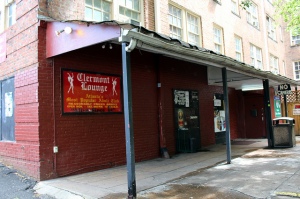
“Atlanta – Poncey-Highland: Clermont Lounge” by Flickr user Wally Gobetz, CC BY-NC-ND 2.0
Situating women’s pleasure in southern hip hop is messy as it reflects both men’s investment in women as objects of pleasure – i.e. bass music – and women’s subversion of this expectation of their sexuality a way to express themselves. For example, Lil Wayne’s lyrical affirmation of his sexual prowess via cunnilingus in songs like “Pussy Monster,” “She Will,” and “Lollipop” parallels singer Joi’s demonstration of pleasure as a form of sexual consent via the use of (presumably her) moans and sounds of cunnilingus on her popular song “Lick.” Sonic pleasure politics become a workspace for bridging the south’s historical construction of [black] women’s sexuality-as-respectability and the recent, more fluid form of younger women’s embrace of sex-as-empowerment heard in southern popular culture.
Sonic Pleasure Politics and Strip Club Culture
A primary space for teasing out the multi-layered significance of sounds and sexuality in southern hip hop is the strip club. The production of sonic and visual representations of strip clubs are inextricably linked: bass heavy musical tracks keep time with the “clapping cheeks” of exotic dancers. Further, the loudness of the strip club denotes patrons’ attempts to drown out the world while pivoting off of the fantasy of sexy women dancing, moaning, and sexually gesturing for their entertainment. The dominance of strip clubs in southern hip hop contribute to the erotic map(s) of a younger generation of southern black women. My contextualization of strip clubs as a cartographic point of interest pivots off of Kaila Story’s description of erotic maps as an entry point for recognizing black women’s sexual agency. Erotic maps are the touchstones through which people address sexual pleasure. Story uses black women’s social-historical narratives to map out black women’s use of sexuality as a measure of self-definition. These maps are complex as they are intertwined with historical-cultural biases and cultural preferences frequently outside of black women’s experiences.

“IMG_0478” by Flickr user Ferrum College, CC BY-NC-SA 2.0
Strip club anthems, like Memphis rapper Juicy J’s “Bandz a Make Her Dance,” riff on the sonic and physical components of strip club culture. The bass kicks complement what sounds like clapping hands, a signifier of strippers’ clapping butts. Juicy J talks at length about his love of the strip club, distinguishing between “real” and fake strip clubs by the amount of nakedness and strippers wrangling for high-paying patrons’ bands of money. The snapping sound of rubber bands holding wads of cash together authenticates the duality of the women’s sexual posturing as physically pleasurable for men and profitable – economically pleasurable – for women. “Bandz a Make Her Dance” is grounded in the appeal of strip clubs as spaces of empowerment for black men. From this perspective, the clapping heard across the track could also signify the snapping of rubber bands against money to sonically signify men’s power as a strip club patron. Yet the physical and sonic presence of black women’s bodies – i.e. grunting as they maneuver and climb the dancing pole – also makes strip club culture a useful space to pivot southernness and sonic pleasure.
An example of establishing black women’s sonic pleasure narratives in strip clubs is singer Rihanna’s panning of “Bandz a Make Her Dance” titled “Pour It Up.” Although Rihanna is a pop singer from the “Global” South, she sonically signifies if not subverts southern hip hop gender politics via sampling the instrumental from Juicy J’s record. The majority of “Pour It Up’s” instrumental accompaniment is a subdued if not washed out sample of “Bandz a Maker Dance” that helps highlight Rihanna’s voice. The clarity of Rihanna’s voice “garbles” the accompaniment in the sense it is background noise to her narrative of enjoying herself and taking pleasure in the bodies of other women present in the club. The accompaniment serves as a brief nod to Juicy J’s initial intentions of crafting the strip club as a sexual space but ultimately uses the track as a testament to her own pleasure narrative.
In particular, Rihanna’s sing-song holler before the chorus “All I see is signs…all I see is dollar signs,” points to a subversion of the hypermasculinity in strip club culture to establish her own pleasure in a similar space. Parallel to Juicy J’s indulging of exotic dancers via throwing bands of money, Rihanna enjoys herself at the strip club using other people’s money:
Strip clubs and dolla’ bills (Still got mo’ money)
Patron shots can I get a refill (Still got mo’ money)
Strippers going up and down that pole (Still got mo’ money)
4 o’clock and we ain’t going home (Still got mo’ money)
Bands make your girl go down (Still got mo’ money)
Lot more where that came from (Still got mo’ money)

“Rihanna – Oslo 2013” by Flickr user NRK P3, CC BY-NC-SA 2.0
In particular, Rihanna’s verse not only demonstrates an alternative viewpoint of black women’s bodies in the strip club but destabilizes the idea of the strip club – and intercedes on the understanding of southern hip hop – as a heternormative hypermasculine space. The line “bands make your girl go down” alludes to not only a possible sexual encounter by Rihanna or for the girl in question but doubly signifies upon the potential for pleasure via the strip club culture for women and the hypersexuality of Juicy J’s track. “Pour it Up” reflects the messiness of [southern] hip hop gender politics because it builds upon the reputation of the strip club as a site for men’s pleasure to excavate women’s dancing as pleasurable for their own purposes. In addition to Rihanna’s sonic signifying of strip club culture, the “Pour It Up” reveres pole dancing as an art form rather than an exploitative practice. Rihanna’s pleasure in watching the dancers perform parallels the exertion of joy – and consent – that the dancers exhibit in their movement.
Trekking back to the sexy moaning phone in church, the sonic cue of sexual pleasure and joy conflicted with the gender norms associated with southern black women’s identities. Consideration of sonic pleasure narratives stirs discussion of the unarticulated experiences of southern black womanhood that may be overlooked in favor or a larger, more conservative, and familiar narrative of sex as tool of victimization. Sonic pleasure politics makes room to remap the contemporary southern social-cultural landscape as a complex yet living space of cultural production and sexual freedom.
–
Featured Image: “RIHANNA EM BELO HORIZONTE” by Flickr user http://www.rihannafentyforum.com, CC BY-NC-SA 2.0
–
Regina Bradley recently completed her PhD at Florida State University in African American Literature. Her dissertation is titled “Race to Post: White Hegemonic Capitalism and Black Empowerment in 21st Century Black Popular Culture and Literature.” She is a regular writer for Sounding Out!
–
REWIND!…If you liked this post, you may also dig:
Thrills, Chills, and Safe Sexuality: The Sounds of Michael Jackson’s “Thriller” – Osvaldo Oyola
“I Love to Praise His Name”: Shouting as Feminine Disruption, Public Ecstasy, and Audio-Visual Pleasure – Shakira Holt
I Like the Way You Rhyme, Boy: Hip Hop Sensibility and Racial Trauma in Django Unchained – Regina Bradley
Share this:


Current Top Posts





April 2021

January 2020

November 2019

October 2019

August 2019

April 2014

November 2017

March 2015

December 2017

October 2015
 Sounding Out!
Recent Comments