Tag Archive | Sound Art

Botanical Rhythms: A Field Guide to Plant Music

Only overhead the sweet nightingale

Ever sang more sweet as the day might fail,

And snatches of its Elysian chant

Were mixed with the dreams of the Sensitive Plant

Percy Shelley, The Sensitive Plant, 1820


ROOT: Sounds from the Invisible Plant

Plants are the most abundant life form visible to us. Despite their ubiquitous presence, most of the times we still fail to notice them. The botanists James Wandersee and Elizabeth Schussler call it “plant blindness, an extremely prevalent condition characterized by the inability to see or notice the plants in one’s immediate environment. Mathew Hall, author of Plants as Persons, argues that our neglect towards plant life is partly influenced by the drive in Western thought towards separation, exclusion, and hierarchy. Our bias towards animals, or zoochauvinism–in particular toward large mammals with forward facing eyes–has been shown to have negative implications on funding towards plant conservation. Plants are as threatened as mammals according to Kew’s global assessment of the status of plant life known to science. Curriculum reforms to increase plant representation and engaging students in active learning and contact with local flora are some of the suggested measures to counter our plant blindness.

Participatory art including plants might help dissipate plants’ invisibility. Some authors argue that meaningful experiences involving a multiplicity of senses can potentially engage emotional responses and concern towards plants life. In this article, I map out a brief history of the different musical and sound art practices that incorporate plants and discuss the ethics of plant life as a performative participant.


STEM: Music to grow your plants by 

Flowers grow rhythmically.

Henry Turner Bailey, 1916

“Music for plants” is a small footnote in the history of recorded music. However, it perfectly mirrors many of the misconceptions and mainstream perceptions of plant life. By late 1950s, reports on the relationship between plants and music started to surface in popular culture and making the headlines of newspapers for the next decades: Flute Music ‘charms’ plants into growing bigger, better; Silly-looking plants that listen and really care, Drooping Plants Revived by Soothing East Indian Music. These experiments were later compiled and disseminated by the bestselling book The Secret Lives of Plants (1973) that furthered ideas of sentient plants that feel emotions and respond to human thought (what Cleve Backster called primary perception).

Cleve Backster - Primary Perception

Cleve Backster

The book reinforced the music-plant experiments of Dorothy Retallack, that famously claimed that plants exposed to classical and sitar music thrived in comparison to plants exposed to Led Zeppelin and Jimmy Hendrix’s acid rock. The scientific shortcomings of these experiments are well known. Daniel Chamovitz, author of What a Plant Knows, points out that Retallack’s experiments mainly provide a window into the cultural-political climate of the 1960s through the lens of a religious social conservative who believed that rock music was correlated with antisocial behavior among teenagers.  The alleged beneficial plant response to classical music was in many occasions used as an ideological device against youth culture.

Criticizing Music, Dr Max Rafferty, Effects of Rock Music on Plants

Musicians and record companies seized to entertain this new potted audience. Records to aid plant growth could be found in many florist stores in the US.  Their labels promised happy, healthy and fast growing plants with the help of classical and chamber music standards, electronic tunes, sine waves and spoken word. For instance, Molly Roth’s record Plant Talk (1976) gaudily speaks to several indoor plants (English Ivy, Fern, Philodendron…) while giving advice on plant care.

Molly Roth & Jim Bricker, Plant Talk/Sound Advice, 1976:


Dr. George Milstein’s record Music to Grow Plants (1970) uses high pitched tones under a Mantovani-esque orchestration to help improve the exchange of oxygen and carbon dioxide in the plants’ leaves. “The music is sugar coating for the vibrations” explains Milstein, “sound vibrations induce the stomata to remain open wider for longer periods, thus plants take in more nourishment and grow faster and sturdier.”

Dr. George Milstein, Music to Grow Plants, 1970:


Music to Grow Plants manifested the human perception of plants as passive and isolated recluses of indoor places. Some of these artists’ efforts came from the genuine struggle to grow plants in big metropolis. However, the veiled nature of plants became attached to personal narratives, tastes and social values. Plants were visible insofar as a canvas to anthropomorphic projections.


LEAF: Green Materialities and the Electrical Plant

Oats… the witching soul of music.

Kate Greenaway, The Language of Flowers, 1884


The sounding materiality of plants was appropriated by avant-garde practices interested in amplifying the noises of everyday life. The sounds produced by acts of physical contact with plants became a new ground for musical composition. Contact microphones attached to plants’ surfaces amplified their inaudible sonic proprieties. Two of John Cage’s percussion compositions Child of Tree (1975) and Branches (1976) call for amplified plant materials like cacti and rattles from a Poinciana tree. Plants provided the quality of chance and indeterminacy as they gradually deteriorate during the performance. The amplified cactus became an icon of indeterminacy music and keeps being plucked by many artists today like Jeph Jerman, So Percussion, Mark Andre, Adrienne Adar or Lindsey French. The Portuguese sound artist João Ricardo creates full soundscapes by conducting an orchestra of over twenty cacti (Cactus Workestra) performed by young students that follow his gestural directions on how to rhythmically pluck the cacti needles.


Creating music through touch and corporal proximity with plant life revitalizes human-plant relationships generating intimacy and knowledge. John Ryan poses the importance of “reaching out towards plants” to create experiences of embodied appreciation and connectivity. A close connection between body, plants and music can be found in leaf music (folded leaf whistle, gumleaf music) practiced by Australian Aboriginal societies who developed an acute ability to select and differentiate the sonic qualities of plant matter. The scholar Robin Ryan describes how leaf music is an intimate and vital part of Aboriginal societies to reflect upon the nonhuman world, as well as, a vehicle of attachment to local “music trees,” bushes, and plants. The Serbian film Unplugged (2013), directed by Mladen Kovacevic, follows two leaf players from rural eastern Serbia and an instrument builder trying to learn the art of leaf music. The simplicity of the leaf instrument deceives the extent of knowledge and practice necessary to master it.


Time and intimacy with plant matter are important components of leaf music. Artists like Annea Lockwood (Piano Transplants) and Ross Bolleter (Ruined Pianos) reversed the equation of the effects of music on plant growth and explored the effects of plant growth on musical instruments by abandoning pianos in outdoor fields and gardens. These works disregard human-time and tune in to plant-time. There’s a special acknowledgement of plant life in art works that tap into plants’ otherness.

Annea Lockwood - Piano Garden [1969-70] photo by Chris Ware

Annea Lockwood – Piano Garden [1969-70] photo by Chris Ware

In many music performances the role of the plant remains attached to an object-like position tied to the artist’s agenda. Musical practices using generative systems stemming from plants’ biological information attempt to take a step forward into the inner life of plants. Sensors attached to plants’ leaves detect bioelectrical potential changes originating from environmental variables like light, humidity, temperature and touch. These micro-electrical fluctuations are converted into MIDI signals that trigger notes and controls in synthesizers. The element of interactivity that these systems allow between public and plant via sound highlights in real time plant responses to sensorial stimuli. The Mexican artist Leslie Garcia sonically demonstrates the sensorial qualities of plants in her project Pulsu(m) Plantae (2012-13) and makes her software available for other artists to use. Similarly, the duo Scenocosme  creates interactive gardens where plants act as sensors to human touch generating cascades of sound. Creative chains linking plants, technology, music and touch can also be found in site-specific installations by Mileece and Miya Masaoka.


Plant-based generative music was pioneered by the British architect and artist John Lifton in the early 70s. Lifton created Green Music, an installation for 6 plants in an environmental chamber connected to an analogue computer and fed to a synthesizer. In 1976, the producers of the film-adaptation of Secret Life of Plants brought John Lifton to San Francisco’s Golden Gate Park to collaborate with Richard Lowenberg, Tom Zahuanec, and Jim Wiseman. The group developed a several day media-performance with sonic translations of brain waves and muscle electrical potentials of 6 dancers mixed with plant-based generative music. The film features few sequences of this performance. However, we can get a better glimpse at Tom Zahuranec’s plant generative music in an interview by Charles Amirkhanian for a KPFA’s Radio Event. Particularly, we can hear audiences’ thoughts on plant life and how widespread were new age ideas of primary perception in plants.


Charles Amirkhanian & audience members react to Tom Zahuranec’s plant music, Radio Event No. 20, KPFA, 1972


These early experiments on generative music were a main influence on the artistic collective Data Garden, which has been releasing plant music and creating immersive audio environments controlled by plants since 2011. After a successful Kickstarter campaign, Data Garden launched a biofeedback kit, the MIDI Sprout, that allows users to easily derive music from plants’ electrical changes. Joe Patitucci, founder of Data Garden, says that since the campaign they have produced 800 units and have 400 users on their forum experimenting with the technology. In parallel, Patitucci has developed an online stream called Plants.fm that continuously broadcasts music generated by a snake plant and/or a philodendron. Data Garden has also released an app that allows users to plug the MIDI Sprout to the phone and hear their plants triggering the sounds designed by the developers.


Robert Aiki Aubrey Lowe, performance with MIDI Sprout, modular synthesizer and voice


These methods of generative composition are easing the way for users to creatively relate to plants. However, it’s vital that artists don’t reduce the diversity of plant life into a single aesthetic or into a “music of the spheres” representation. In this respect, the sound ecologist Michael Prime shatters the convention of assigning melodic sounds to plants by creating alien soundscapes generated from the electrical signals of hallucinogenic plants as heard in L-Fields and in One hour as a plant.

Beyond plants’ electrical responses, some artists are using alternative parameters to translate the life of plants into sound. For instance, Christine Ödlund collaborated with Ecological Chemistry Research Group in Stockholm to create an electro-acoustic composition accompanied by a score entitled Stress Call of the Stinging Nettle in which she transposes into tones the chemical signals released by a stinging nettle when attacked by a caterpillar and how the plant communicates with its nearby plant kin (the score can be seen in more detail here). The installation “Oxygen Flute,” created by Chris Chafe and Greg Niemeyer, reveals plant and human respiration through CO2 concertation readings in a chamber filled with bamboo. The fluctuation of CO2 inside the sealed chamber is translated into bamboo flute music fostering in the visitor a heightened perception of his own breath. The sonification of these hidden relationships between plant life and animal life call attention to larger concepts like the greenhouse effect or global warming in a very physical and emotional way. They make graspable what Timothy Morton calls hyperobjects – objects massively distributed in time and space that defy our perception and comprehension.


FOREST: Plant Bioacoustics and Acoustic Ecology

Sit by the trees – what kind of tree makes what kind of sound?

Pauline Oliveros, Country Meditations, 1988


One could argue that the only sound that is ecologically relevant is the sound of the plant itself. The realm of vibrations occurring on the plants’ surfaces that manifest the plant’s own agency and connectivity to its surroundings. In short, plant bioacoustics aims to study plants’ adaptive strategies that employ the use of sound. A common example is the process of buzz pollination in which plants only release pollen when vibrating at a specific frequency by pollinator bees. Plants can also respond selectively to the mechanical vibrations generated by the chewing of insect herbivores eliciting defensive chemical responses. A study by Monica Gagliano revealed that young roots of corn grow towards the source of continuous tones and respond optimally to frequencies of 200–300 Hz, which is within the frequency range of the clicking sounds the same roots emit themselves. Also, Gagliano and her team have recently shown that the roots of pea seedlings are able to locate water sources by sensing the vibrations generated by water moving. Gagliano has been one of the forefront voices advocating for the need of more research in plant bioacoustics to understand the ecological significance of sound in plants.


Slide29


So far, it is not completely clear how plants use “sound detection,” and if sounds are used as signal or are merely by-products of their physiology. Nevertheless, is important to recognize them. These sounds have been the focus of some practices that articulate artistic and scientific points of view. Inspired by Gagliano’s studies, Sebastian Frisch created the installation Biophonic Garden that recontextualizes a lab setting where a group of corn seedlings are suspended in a water tank that grow towards a constant sine tone of 220 Hertz. A set of headphones allows one to tune into the roots’ acoustic environment amplified by two hydrophones.

biophonic_garden_bg

Photo of Biophonic Garden, with Authorization by Sebastian Frisch

Zach Poff’s project Pond Station invites us to eavesdrop on the sounds of underwater plants of a small freshwater pond in Upstate New York. During an artistic residency at Wave Farm, Poff built a floating platform that operates from dawn to evening using solar-charged batteries. The Pond Station uses hydrophones to amplify the sounds of underwater life and broadcasts them via online web stream. The underwater soundscape goes through cyclical changes according to seasons and time of day. In the mornings, Poff describes a photosynthetic chorus of bubbling as plants begin to produce oxygen. Recently, an invasion of duckweed covered the surface of the freshwater pond affecting its soundscape. I asked Zach Poff about the sonic consequences of this invasion:

Duckweed taught me a lesson about biophony as an indicator of biodiversity. For an entire year I struggled with rebuilding hydrophones and upgrading electronics, trying to get back the poly-rhythmic diversity that I heard during the first year of listening. Then I realized that the duckweed could reduce oxygen levels enough to cause fish kills, and block sunlight from reaching other aquatic plants.

Pond Station in the Morning by Zach Poff, Reproduced with Authorization

Photo of Pond Station in the Morning by Zach Poff, Reproduced with Authorization

Poff finds a parallel between the lack of density and variety in the underwater soundscape of the pond and Bernie Krause’s recordings made in California’s Lincoln Meadow before and after selective logging occurred:

From a distance the visual field was unchanged but the biophony was basically gone after the logging. The pond duckweed looks like a benign blanket of green, but all that’s left of the sound is the slow bubbling that I attribute to decaying organics on the pond bottom. It’s jarring.


FRUIT: Plant Ethics and Speculative Botany

There are many ways to love a vegetable.

M.F.K. Fisher, How to cook a wolf, 1942

The sonification and acoustic amplification of plant life evoke both a sense of connection and the realization of an ontological fracture. The translation and artistic representation of plant otherness into sound or music brings ups vital ethical considerations. Michael Marder, author of Plant-Thinking, argues that techniques applied to plants to derive meaningful information from a human standpoint occlude the meaning of the plants themselves. Once we engage with the electronic menagerie, the plant starts to disappear. Alternative ways of thinking with and of being with plants are called upon by Marder, specifically, artistic practices that vibrate with the self-expressions of vegetal life. In Grafts, the scientist Monica Gagliano states that it is inaccurate and unethical to answer the question “How do plants sound?” by transposing vegetal processes onto musical scales. The concern is the override of plants’ natural voices with familiar harmonic sounds, the same way time-lapse photography rips plants of its own temporally.

The work of the Slovenian bio-artist and researcher Špela Petrič delves into the frontiers of plant otherness and problematizes plant ethics. In 2015, Petrič performed Skotopoiesis, a durational piece in which the artist faced a germinating cress for 19 hours. The artist figure casted a shadow on the cress contributing to the etiolation (blanching, whitening) of the plants. Petrič wrote that the 19-hour period of active inactivity was her way of surrendering to the plant. I asked Špela Petrič’ about her perspective on ethics and performative plants:

I think the reason so many people started asking about the ethics of plant use stems on one hand from an increasing pool of knowledge that suggests plants are very much a complex, sentient beings, and on the other because we find ourselves in a spiraling loop of exploitation of all living beings, which provokes questions like: how did we get here and what can we possibly do to change our cosmology to be conducive of a livable world?

For Špela, plant ethics is not tied to artists’ treatment of plants but rather what kind of story the work tells to the audience. Špela confesses:

This part – the way an artwork is perceived – can be tricky and that is why I write about the trap of interfaces. I’ve struggled with it myself; in my best attempt to forefront the relationship between humans and plants I sometimes had to admit to being overpowered by the technology I used. Technology wants to tell its own narrative – the medium is the message – and we should be aware of that.

As to the risk of creating an anthropomorphic experience with plants, Špela sees an opportunity here:

I don’t think anthropomorphic experiences as a point of entry into the plant world should be a priori avoided, we might even say that anthropomorphism is one of our greatest tools for connecting with other species, but the task for artists is one of editing, of observing and of being mindful to what the artwork is saying.

Artistic practices with plants through music or sound can open the hidden territories of vibrant plant matter and an underground mesh of rhythms and patterns. The act of listening to plant life is an act of acknowledgment, a possibility for emotional identification and empathy rendering plants visible.

Featured image: “Music to Grow Plants By,” compilation by the author

Carlo Patrão is an independent radio artist based in New York City. zeppelinruc.wordpress.com

tape reel

REWIND! . . .If you liked this post, you may also dig:

Listening to the City of Light: An interview with Sound Recordist Des Coulam – Carlo Patrão

Sounding Out! Podcast #58: The Meaning of Silence – Marcella Ernest

Learning to Listen Beyond Our Ears: Reflecting Upon World Listening Day–Owen Marshall

becoming a sound artist: analytic and creative perspectives

Recently, in a Harvard graduate seminar with visiting composer-scholar George Lewis, the eminent professor asked me pointedly if I considered myself a “sound artist.” Finding myself put on the spot in a room mostly populated with white male colleagues who were New Music composers, I paused and wondered whether I had the right to identify that way. Despite having exploded many conventions through my precarious membership in New York’s improvised/creative music scene, and through my shift from identifying as a “mrudangam artist” to calling myself an “improviser,” and even, begrudgingly, a “composer” — somehow “sound artist” seemed a bit far-fetched. As I sat in the seminar, buckling under the pressure of how my colleagues probably defined sound art, Prof. Lewis gently urged me to ask: How would it change things if I did call myself a sound artist? Rather than imposing the limitations of sound art as a genre, he was inviting me to reframe my existing aesthetic intentions, assumptions, and practices by focusing on sound.

Sound art and its offshoots have their own unspoken codes and politics of membership, which is partly what Prof. Lewis was trying to expose in that teaching moment. However, for now I’ll leave aside these pragmatic obstacles — while remaining keenly aware that the question of who gets to be a sound artist is not too distant from the question of who gets to be an artist, and what counts as art. For my own analytic and creative curiosity, I would like to strip sound art down to its fundamentals: an offering of resonance or vibration, in the context of a community that might find something familiar, of aesthetic value, or socially cohesive, in the gestures and sonorities presented.
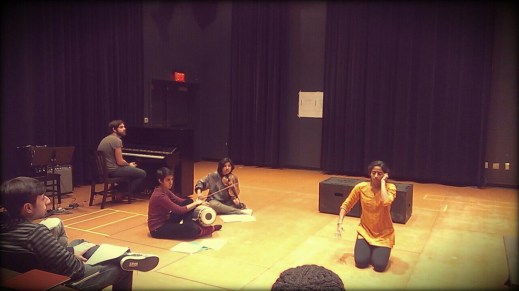
Rehearsing for “Meena’s Dream” (2013) by playwright Anu Yadav – original score by Rajna and Anjna Swaminathan and Sam McCormally.

I have spent most of my musical life wondering how the sounds I produce intersect with specific vectors of social belonging. The sounds emanating from my primary instrument — the mrudangam, a South Indian drum — are situated within a complex lattice of social difference, resonating within and across communities as disparate as the predominantly privileged-caste audiences of Chennai’s elite Karnatik sabha-s and the cosmopolitan connoisseurs who show up to find a home in New York City’s myriad intercultural and experimental music spaces. The sounds I produce are also inflected by the multivalent referentiality of my own socially situated body — as a queer, privileged-caste, Indian-American woman — simultaneously slicing through and answering to sonic environments organized around particular notions of rigor, virtuosity, and beauty.

For me, what began as a creative path rooted in the mimesis of an artistic lineage eventually settled in a versatile expressive voice, shaped by a decade of aesthetic (and ethical) nomadism. From my vantage point as a female percussionist in the South Asian diaspora, I have always been aware of the cracks in the veneer of tradition and other normative structures, and perhaps this fueled my musical vagrancy. Over time, my sound has accumulated the resonances of Karnatik music, ‘jazz’ drumming, bharatanatyam footwork, and Afro-Cuban rhythms, among others.
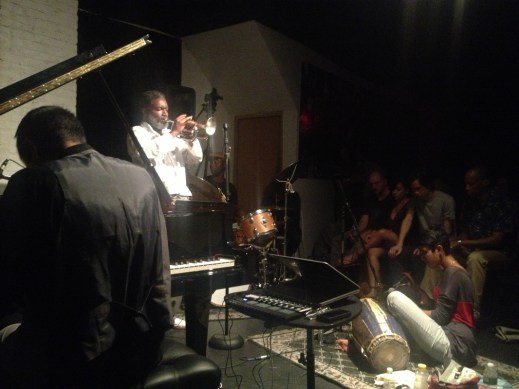
The author performing with Vijay Iyer, Graham Haynes, and Marcus Gilmore. The Stone, NYC. July 2013.

Certainly, this convergence of sonic layers is mediated by the rich specificity of interpersonal relationships and positionalities within larger networks. Power and positionality mediate the shape, audibility, and versatility of sounds as they become coupled with the implied (or actual) encounter of socially situated bodies. Yet, sounds somehow continue to exist in excess of the mechanisms and bodies that attempt to explain, produce, and contain them: idiom, tradition, space, culture, nation, race, gender, and sexuality. Therein lies their potency and mystery, and I intend to briefly explore the sensation of sonic excess in the hopes of honing a more sensitive analytic and creative perspective.

I am yet to become comfortable thinking in terms of sound, due to the longtime privileging of structure and technique in my musical upbringing. However, this is beginning to unravel as I am forced to deal with sound, particularly the sound of what Patrice Pavis and Jason Stanyek have called the “intercorporeal” aspect of intercultural performance. The predominantly improvised sounds that resonate through my mrudangam often emerge on the edge of my dynamic embodied consciousness, arranging themselves chaotically in real-time, interacting with others’ emergent soundings and sensory yearnings. Some of it may be mediated by parallel perceptual and idiomatic forms, but achieving a core interactive flow involves a fundamental immersion in sound.

Mat Maneri, feat. Rajna and Anjna Swaminathan

Tongues Series, curated by Amirtha Kidambi

ISSUE Project Room — June 18, 2016

For instance, take this impromptu piece presented by violist Mat Maneri, violinist Anjna Swaminathan (my sister), and me in 2016. It took place in the wonderfully resonant vaulted space of ISSUE Project Room, in front of an unsuspecting audience that had convened to hear the back-to-back juxtaposition of two improvisational “tongues” — a set of Maneri’s rich microtonal experiments, followed by a Karnatik concert of voice, violin, and mrudangam. However, this impromptu ludic exchange of sonic offerings — particularly Maneri’s incredible, chameleon-like ability to confound the sounds of Karnatik ornamentations with his own microtonal reflections — guided attention away from comparison and toward the sounds as they bounced eerily around the resonant architecture. Faced with the technically daunting Karnatik repertoire that Anjna and I were to play subsequently with vocalist Ashvin Bhogendra, the echoes of our interstitial collaboration allowed us to reorient ourselves and breathe a little easier.

From an analytic perspective, it is irresponsible to distill these sounds, to capture and conceptualize them as distinct from the bodies, histories, and discourses that participate in their co-creation and interpretation. Yet, riddled as they are with generations of power asymmetries and complex emotions, it is clear that these resonances have a secret life of their own. As musicians, we are not often given the opportunity to explore these clandestine, almost Baudelairean, correspondences, except perhaps when we discover them by accident. For instance, sonic ambiguities like those spun during the trio encounter play on sonic excess to spur new ways of listening and relating, with a direct ethical impact on the ensuing music.
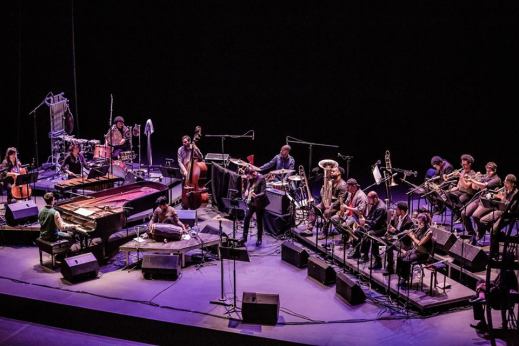
Performing in Vijay Iyer’s large ensemble project, “Open City,” named after Teju Cole’s award-winning novel. October 2013.

John Blacking’s definition of all music as “humanly organized sound” is perhaps an early articulation of this idea, although the word ‘organized’ contains a bias toward formal structure and stability. To be sure, organizing principles always exist at the local level of socially situated perception and expression, which Nina Sun Eidsheim calls the ‘figure of sound.’ However, the kind of sound art I’m proposing revels in excess, or as Eidsheim puts it — “not only aurality, but also tactile, spatial, physical, material, and vibrational sensations [that] are at the core of all music” (5). We can even turn to how Jacques Attali poetically describes composition — as “a labor on sounds, without a grammar, without a directing thought, a pretext for festival, in search of thoughts,” a practice wherein “rhythms and sounds are the supreme mode of relation between bodies once the screens of the symbolic, usage and exchange are shattered,” one that neither marks nor produces the body, but allows for “taking pleasure in it” (143). By focusing on the multi-sensory, pleasurable valences of sound, and on the ways in which sonic excess allows for new patterns of coexistence, we can outline a ‘sound art’ practice and analytic that aren’t circumscribed by Western institutional definitions and technological/perceptual biases.

Thinking in this way about sound and vibration helps to eradicate the mind-body problem that continues to plague certain areas of music studies and music making. Sound forms an elusive common denominator that doesn’t rely heavily on colonial taxonomies of form or hierarchical theories of art. It even accounts for the subversive or incommensurable resonances that tend to emerge at the unstable threshold between so-called ‘producers’ and ‘receivers’ of music. After all, sound is in the ear of the beholder, and social asymmetries are embedded in the way we hear and listen. Through the notion of vibration, we are further attuned to the visceral space in which it reverberates, and the ways in which its echoes live on in the bodies of those who experience it.
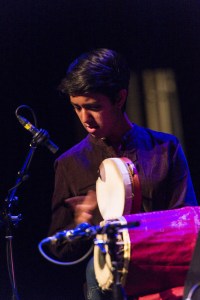
performing at the Banff International Workshop for Jazz and Creative Music. June 2013. Photo credit: Don Lee, Image courtesy of author

Finally, there is the other definition of sound in English, which indicates a level of trust and holism. Taking this path to becoming ‘sound artist’ focuses attention on the artist. I don’t intend to focus on the ‘chops’ conventional to a field of aesthetic practice. Rather, I am interested in the more obscure meaning: a ‘sound artist’ as one that ethically occupies space as an artist.

How might this emerging sound art, as analytic and creative practice, work to interrogate the very ethics and politics of art, while succumbing to the contingency and volatile excess of sound? I don’t claim to hold the answers, but if we are in any way sounding out against the grain of dominant modalities, then at some level we must attend seriously to sound: in its excess, as it overwhelms bodies and spaces, and as it stretches the realm of the known.

Featured Image: “The great Rajna Swaminathan,” from Teju Cole tweet, 5 October 2013.

Rajna Swaminathan is an accomplished mrudangam (South Indian percussion) artist, a protégé of mrudangam legend Umayalpuram K. Sivaraman. She has performed with several renowned Indian classical musicians, most notably mentor and vocalist T.M. Krishna. Since 2011, she has been studying and collaborating with eminent musicians in New York’s jazz and creative music scene, including Vijay Iyer, Steve Coleman, Miles Okazaki, and Amir ElSaffar. Since 2013, Swaminathan has led the ensemble RAJAS, which explores new textural and improvisational horizons at the nexus of multiple musical perspectives. Swaminathan is active as a composer-performer for dance and theatre works, most notably touring with the acclaimed company Ragamala Dance and collaborating with playwright/actress Anu Yadav. Swaminathan holds degrees in anthropology and French from the University of Maryland, College Park, and is currently pursuing a PhD in cross-disciplinary music studies at Harvard University.

tape reelREWIND! . . .If you liked this post, you may also dig:

Sounding Out Tarima Temporalities: Decolonial Feminista Dance Disruption–Iris C. Viveros Avendaño 

Gendered Soundscapes of India, an Introduction –Praseeda Gopinath and Monika Mehta

Tape Hiss, Compression, and the Stubborn Materiality of Sonic Diaspora–Chris Chien

“This Liquid Dream”: An Interview with Aquaphoneia Composer Navid Navab–Eshter Bourdages