
SO! Amplifies: Mendi+Keith Obadike and Sounding Race in America
 SO! Amplifies. . .a highly-curated, rolling mini-post series by which we editors hip you to cultural makers and organizations doing work we really really dig. You’re welcome!
—
Several years ago—after working on media art, myths, songs about invisible networks and imaginary places—we started a series of sound art projects about America. In making these public sound artworks about our country we ask ourselves questions about funk, austerity, debt and responsibility, aesthetics, and inheritance. We also attempt to reckon with data, that which orders so much of our lives with its presence or absence.
We are interested in how data might be understood differently once sonified or made musical. We want to explore what kinds of codes are embedded in the architecture of American culture.
Big House/Disclosure
The first sound art project in this vein that we completed in 2007 was entitled Big House / Disclosure. Northwestern University commissioned Big House / Disclosure to commemorate the 200th anniversary of the abolition of the British slave trade. We began researching Chicago’s recently (2002) issued Slavery Era Disclosure Ordinance, which states that any business seeking a city contract must publicly disclose (without penalty) its historical relationship, if any, to the slave trade. In that project we interviewed 200 citizens in the Chicago area about that city ordinance, how they (or their ancestors) arrived in this country, the origins of house music, and imaginary plantations, as well as their opinions about the legacy of slavery in their lives. Their answers were woven into a 200 hour house song & public sound installation on the Northwestern campus.
We used custom built software to trigger changes in the sound (drums, bass lines, chords, etc.) of that installation as the stock prices of companies like Lehman Brothers and Wachovia Bank (listed by this city ordinance as having profited from slave trade) rose and fell in 2007. In addition to the sound installation there were a number of performance scores and graphic scores to be performed in the project. The graphic scores were performed at the Stone (John Zorn’s music venue) by bassist Melvin Gibbs, turntablist Val Inc, percussionist Satoshi Takeshi, and pianist Shoko Nagai in New York. The book and album for this project (recorded with percussionist Guillermo Brown, cornetist Taylor Ho Bynum, cellist Okkyung Lee and percussionist Tim Feeney) were released by 1913 Press.
American Cypher

In 2012-13 we created American Cypher. This project looked at American stories about race and DNA. The stories included narratives about Barack Obama, geneticist James Watson, Oprah Winfrey, and two men in the criminal justice system. At the center of the project was a multi-channel sound installation made from a small 18th century bell that belonged to Sally Hemings (a woman enslaved by Thomas Jefferson and, as indicated by DNA testing, mother to his children). The bell was recorded and altered. It was tuned using DNA information (microsatellite STR analysis) from the Jefferson and Hemings families. That analysis gave us a pitch set that was used to compose the piece. The project was commissioned by Bucknell University’s Samek Gallery and Griot Institute. The exhibition was mounted at the Studio Museum in Harlem and later traveled to the Institute of Visual Art at the University of Milwaukee Wisconsin.
<p><a href=”http://vimeo.com/81574324″>Mendi + Keith Obadike: American Cypher – Samek Gallery and The Studio Museum in Harlem</a> from <a href=”http://vimeo.com/user12307441″>Keith Obadike</a> on <a href=”https://vimeo.com”>Vimeo</a>.</p>Free/Phase

Free/Phase is our latest project for 2014-15. This work uses the archives of Columbia College’s Center for Black Music Research (Chicago, Illinois) as its foundation. With this work we are doing conceptual remixes of African-American freedom songs found in the archives. We are thinking about how this music has been used over the past couple of centuries and all that is encoded in these songs musically, politically, and spiritually. There are three nodes to this project. These nodes will be presented and produced in several venues throughout the city of Chicago and will include audience participation.
1) Beacon
“Beacon” is made up of a distributed site-specific sound installation that “rings” morning, noon, and evening, playing a short melodic phrase from specific spirituals found in the CBMR archives. Each spiritual chosen contains musical & lyrical messages that could have been used for pre-emancipation navigation on the underground railroad or inspiration.
2) Overcome
“Overcome” is a video work that is inspired by ways that music was used during the American Civil Rights Movement.
3) Dialogue
“Dialogue” is comprised of “listening posts” throughout Chicago. A number of DJs engage audiences in a discussion about the canon of African-American freedom songs.
***
Across this series, we hope to invite new ways of thinking about the archives that hold information about our existence—the records of profit during the era of American slavery, the relationships marked in our genetic information, and the strategies for survival encoded in our music. Our work in this area reflects on the information that sometimes vanishes from view, whether because it is ephemeral or because it has been buried. We hope our sounding the archives invite new ways of listening to the past and the future at the same time.
—
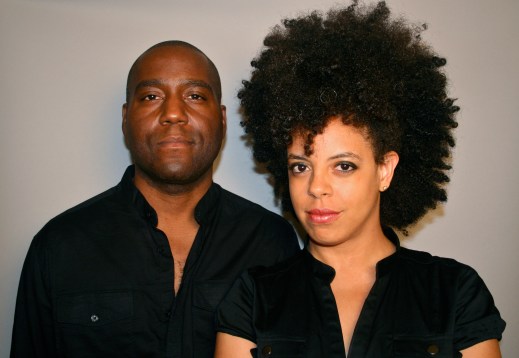
Mendi + Keith Obadike make music, art and literature. Their works include The Sour Thunder, an Internet opera (Bridge Records), Crosstalk: American Speech Music (Bridge Records), Black.Net.Art Actions, a suite of new media artworks (published in re:skin on M.I.T Press), Big House / Disclosure, a 200 hour public sound installation (Northwestern University), Phonotype, a book & CD of media artworks, and a poetry collection, Armor and Flesh (Lotus Press). They have contributed sounds/music to projects by wide range of artists including loops for soul singer D’Angelo’s first album and a score for playwright Anna Deavere Smith at the Lincoln Center Institute. You can find out more about them at http://obadike.com.
—
Featured image from authors’ website.
—
 REWIND!…If you liked this post, you may also dig:
Wayback Sound Machine: Sound Through Time, Space, and Place-Maile Colbert
SO! Amplifies: Regina Bradley’s Outkasted Conversations-Regina Bradley
Or Does it Explode?: Sounding Out the U.S. Metropolis in Hansberry’s A Raisin in the Sun-Liana Silva-Ford
Share this:

Sounding Out! Podcast #34: Sonia Li’s “Whale”
CLICK HERE TO DOWNLOAD: Sonia Li’s “Whale”
SUBSCRIBE TO THE SERIES VIA ITUNES
ADD OUR PODCASTS TO YOUR STITCHER FAVORITES PLAYLIST
Reflecting on Whale, an interactive, multichannel sound installation, this sound art piece documents how the installation came about. When designing Whale, Sonia Li used sound to communicate the often visceral emotions underlying her personal narrative.
Whale creates an environment where one experiences oneself. By laying in darkness on a subsonic vibrating bed, users openly confess their thoughts and feelings into a sonic field, which then translates their words into correlating amplitudes of whale sounds. This process of transduction prompts listeners to consider how sound works to shape a perception of themselves as they hear a distant and alien rendering of their own voice. By experiencing Whale we can consider how sound challenges our physiological and psychological perceptions of self.
–
Sonia Li is a Brooklyn based artist, designer, and creative technologist. She holds a Masters in Interactive Design from ITP/NYU, 2014, and a BFA in Interdisciplinary Sculpture/Papermaking from SUNY Purchase, 2005.
Sonia has performed with musicians, exhibited in various group shows, and has been featured on various websites such as Prosoundnetwork.com, create-hub.com, modcloth.com blog, and fashionista.com. She produced soundscapes for the Poison exhibition/iPad app at the American Museum of Natural History, worked in Art Direction for film, architectural lighting, and Art Studio Manager positions.
Sonia is currently working on designing private art storage facilities and personal projects. To find out more about her work, go to www.soniali.org/artandtech
—
 REWIND! . . .If you liked this post, you may also dig:
Toward a Civically Engaged Sound Studies, or ReSounding Binghamton – Jennifer Stoever
Sounding Out! Podcast #21: Jonathan Skinner at the Rutgers University Center for Cultural Analysis – Jonathan Skinner
Playing with Bits, Pieces, and Lightning Bolts: An Interview with Sound Artist Andrea Parkins – Maile Colbert
Share this:


Current Top Posts





April 2021

January 2020

November 2019

October 2019

August 2019

April 2014

November 2017

March 2015

December 2017

October 2015
 Sounding Out!
Recent Comments