
to follow an invisible creek: in search of a decolonial soundwalk praxis

DOI: https://doi.org/10.59350/q1v4p-tk850
i begin with an acknowledgement of the myriad of organizers, scholars, artists, and teachers that have shaped and continue to shape the way that i think and write. Édouard Glissant, Christina Sharpe, Lucille Clifton, Saidiya Hartman, Fred Moten, Sylvia Wynter, Katherine McKittrick, Dionne Brand, June Jordan, and Audre Lorde. it is through their profound reflections on questions of Blackness, place, belonging, earth, and love, that i have found meaning in and context for what follows.
—
in the context of the rapid rise of big tech in san francisco, california, the perspective of land as perpetually exploitable is ever-present. tech-sponsored development projects are always framed by the city as being motivated by care and consideration for residents, and sometimes as being motivated by environmentalism. in reality, the displacement and destruction that results from projects like these falls primarily on poor people of color, and their homes, gardens, businesses, community spaces, and schools. similarly, large-scale development projects more often than not have devastating impacts on the land – whether it’s the land that’s being built over or the sacrifice zone elsewhere. perhaps the electric cars of san francisco are thought to represent clean energy and a healthy modern city, but the manufacturing of these cars is predicated upon extensive mining and exploitative and extractive labor outside far outside the city’s borders. and these cars drive over flattened creeks and sand dunes turned to asphalt—through gentrified neighborhoods on stolen land of the Ramaytush Ohlone, people who are still alive and fighting for sovereignty on their traditional territory, and who remain stewards of the land.
these disparities are present in the sounds of the bay area. sound, quite literally, does not exist in a vacuum. the presence of sound thus implies the presence of something outside of that sound; in every sound we hear, there is also information about the context that surrounds it. and the sounds that we do hear say something about the value of the sounds that we don’t. however, i want to argue for a soundwalking praxis that does not settle for the sounds that most easily reach the ear, as in the freeway noise or the planes passing above or the white people on the street, but that reaches beyond to listen for the negative sonic space that is always present and creating itself in the spaces between what we perceive as audible. in my understanding, this is a practice of giving life to that which capitalism/white supremacy/colonialism renders dead, a practice of centering the life that is otherwise stepped on, forgotten, discarded, silenced. listening for the ecologies of the dispossessed. for proof of life, insisting. this is a decolonial soundwalk praxis.
Allie Martin describes “decolonial soundwalk praxis” as a way of listening that disrupts and disturbs dominant western understandings of sound and space, in “Hearing Change in the Chocolate City: Soundwalking as Black Feminist Method” (2019). to me, it also involves cultivating an embodied practice of centering that life which dominant pedagogies deem less than, exploitable, and extractable. in the specific geographies of the bay area, it has meant that my primary orientation while soundwalking has been to listen for the creek that runs through the land—even when the water runs dry, even when all we can see is an intersection.

the creeks i followed were mostly routed underground, culverted to run under parking lots, freeways, shopping malls, grocery stores, and other urban sites of development. the prioritizing of urban development/renewal/gentrification in the bay area over tending to the ecologies of its creeks points to the place that the land is seen to hold in so-called modern society: as a resource available to exploit as desired, as is convenient for the logistics of capitalist expansion and development. to listen in such a way, for the creek and for other forms of life forced underground and to the margins, requires methods perhaps alternative to the traditional soundwalk. we must renegotiate the categories of sound that are implied in western colonial pedagogies. we must reevaluate what constitutes a “creek sound” or a “nature sound” in the first place.
to listen for the creek when it is covered by concrete necessitates that we reach beyond thinking of a creek as something which exists in and of itself, in isolation.

∼∼∼might the sound of a creek be more than just trickling water falling through rocks? can it not be heard still in the place where it meets the ocean?∼∼∼

∼∼∼or in the rustling of the trees who drink from the same groundwater?∼∼∼
.

∼∼∼couldn’t a creek be heard in a voice that speaks of it, as in a prayer, or a promise, or a song?∼∼∼
.
if we understand space as relational, as Nigel Thrift offers in “Space: The Fundamental Stuff of Human Geography” (96), then perhaps we can reach an imagining of a creek as finding its life everywhere where water is sacred, running freely through the bodies of those that know it is there.
acknowledging the body as the point of contact between the self and the environment is an important part of a decolonial soundwalk praxis. “place is involved with embodiment” Thrift says (103), and in fact, when we truly acknowledge the body, the very boundary between the body and the environment begins to dissipate, because the body itself is constantly a part of place-making processes. if sound is a dimension through which we can understand place, then, similarly, listening for the life insisting in a place is not separate from listening for the people who are in relationship with it.
in my soundwalks, i leaned into the fact that i was experiencing every place principally through my body, and as i became more comfortable recording, i gave myself more permission to allow my experience to be subjective. what i realized is that my subjectivity, my specific presence to my body’s relationship with the places i was in, was an important orientation to be able to embody a decolonial soundwalk praxis – to be able to hear the sounds that otherwise may have been neglected.
∼∼∼while walking along lobos creek trail, for example, i noticed, growing out of the sand, plants that were familiar to me, that i had relationships with. the house finches were chirping, and my footsteps were clear∼∼∼
.
∼∼∼but the plants i recognized were not – could not be – audible to me until i spoke their names and touched their seed pods.∼∼∼
.
∼∼∼i pulled a few pods off a branch and holding them near the microphone i cracked them open, letting the seeds fall into my hands. i listened to the pods split down the middle and drop the seeds, and in their snapping i heard how much tension they were holding.∼∼∼
.
i felt how much strain it must be to make and carry all those seeds, how much release it must be to crack open and spill out of yourself, and i was grateful to bear witness. i held the seeds in my hand and some time later, i gave them to the creek. in allowing myself the trust to follow my body’s intuitive relationship with the given place, i found sounds that i otherwise would not have heard. ultimately, i found a depth of connection to and intimacy with a place that before listening to in this way, i was a stranger to.
the work of giving attention to the sounds that go unheard is necessarily an embodied exercise. it demands relationship and it demands entanglement. it demands crawling inside a mossy culvert to hear the creek talk.
curious to hear how the creek sounded differently in the tunnel, i went off the trail at piedmont park to climb inside the section where the culvert begins. with the dripping, there was a nuance to its rhythm distinct from its sounds outside of the tunnel. i was able to hear, but only by coming inside and joining the creek. we sat there together, in the dark, for a while.
it also meant sawing down a 20-foot-tall agave in order to save the seeds after the 30-something-year-old plant finally bloomed—with bright yellow flowers on branches shaped like coral—and then began to dry out and lean precariously. to keep the other plants safe, and to release some pressure from the agave, we cut its stalk and from it saved its branches, seed pods, and seeds. the pods are now hanging around the garden at the Land of Disturbance and Defiance as art.

i am principally interested in sound because i am interested in love, and when i imagine a decolonial soundwalk praxis, intimacy is surely at the center. this perspective offers a way of learning place from the position of a being who is co-creating it – not as a scientist but as a steward. a decolonial soundwalk praxis complicates traditional soundwalking’s aversion to the body. we cannot exist separate from the sonic space around us anymore than we can exist separately from the ecologies woven into our lives. to touch is to alter, and so the work here is to lean into the inevitability of connection, the impossibility of objectivity. a decolonial soundwalk praxis rejects the extraction of sound as data, pushing us instead to open our bodies/hearts/minds to receive the sounds of a place as the place is receiving us. how might we use sound to remove ourselves from the perspective of the observer? and what kind of responsibility to place does this open up? if we are a part of the places we are in and listening to, then surely we owe them reciprocity, love, conversation, patience; we must listen as we would a relative, a lover, or a friend.

i chose to record my final soundwalk at the garden on walnut and virginia street in berkeley, california, because it is a place that i know well and love dearly and i hoped to center that. the north side of the garden runs alongside strawberry creek.
rather than imposing a plan/route through the garden upon arriving, i allowed my relationship with the land to guide my movement through it. in my final mix, i layered pieces from this soundwalk together with selected excerpts from a meeting i attended with two fellow members of A.G.A.V.E., or Aspiring Gardeners Affirming Vibrant Ecologies (also Aspiring Gardeners Against Violent Extraction).in which we were trying to synthesize a manifesto using notes from previous conversations, itself a process of collective and layered creation. i chose to include portions of our conversation centered around ideas of relationship and care grounded in land, and i chose sounds from the walk that i feel hold in them intimacy and history:
∼∼∼the crows, who we feed every day and who plant seeds for us∼∼∼
∼∼∼the lock, which only those who know the land can open∼∼∼
∼∼∼and the marigolds, which we grow every year and which we harvest for offerings∼∼∼
.
these sounds are proof of relationship. small sounds that are easy enough to forget to hear, but that are important to remember – and so i try, as i would for an invisible creek.
if a decolonial soundwalk praxis is anything, it is that love is listening, and so, my promise to invisible creeks (and all quiet[ed] sounds) everywhere is to lean a little closer,
and feel your whisper on my neck,
and to listen well,
and to take notes,
and to remember,
and to conspire.
—
Featured Image: “California Pepper Tree” by Flickr user baird, CC BY-SA 2.0
—
ameia camielle smith (they/she) is an aspiring gardener, dancer, and writer based in the san francisco bay area (Ohlone land). they are of mixed Afro-Indian ancestry and are greatly shaped by the seeds/shells/lives that exist at the intersection of these diasporas. ameia’s work is anchored in cultural ecologies and Black feminist geographies, and they are most inspired by stories of survival and collaboration between people and plants.
ameia received their B.A in geography from the university of california berkeley in may 2024. they are currently traveling through the southern united states where they are exploring maroon swamp geographies, tracing the steps of Zora Neale Hurston, and listening to the swampy cicada sounds of their childhood in north-central florida.
—

REWIND! . . .If you liked this post, you may also dig:
Flâneuse>La caminanta–Amanda Gutierrez
Unsettling the World Soundscape Project: Soundscapes of Canada and the Politics of Self-Recognition–Mitchell Akiyama
Soundwalking on the Edges: Sound, Safety and Privilege in São Paulo, Brazil—Paola Cossermelli Messina
El Caracol: A Stroll through Space and Time in Mexico City–Anthony Rasmussen
Sonic Connections: Listening for Indigenous Landscapes in Kent Mackenzie’s The Exiles–Laura Sachiko Fugikawa
EPISODE 53: H. Cecilia Suhr’s “From Ancient Soul to Ether”
EPISODE 47: Finding the Lost Sounds of Kaibah–Marcella Ernest
.
Share this:

Robin Williams and the Shazbot Over the First Podcast
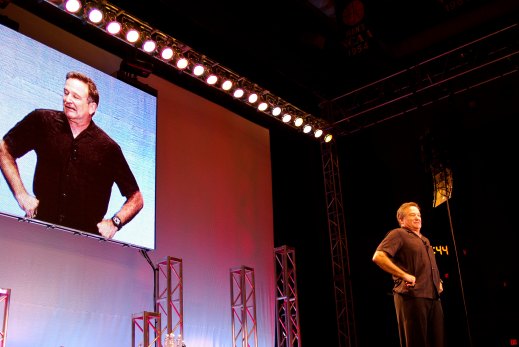
Histories of technology have politics. The way we discuss the emergence and development of media technologies implicates the priorities and interests of those telling the story, and how we understand a technology’s meaning and potential.
Among podcasters familiar with the history of the medium, Dave Winer– the developer behind the RSS feed –is usually credited as the progenitor of the form. This past summer, however, this narrative was challenged by Podnews editor James Cridland–(good naturedly, I presume)–who suggested that the comedian Robin Williams may actually have been the first podcaster, predating Winer’s RSS (“Rich Site Summary,” or “Really Simple Syndication”) distribution model by a few months. These origin stories have important technical differences that lead to political repercussions: the Winer narrative envisions podcasting as open and decentralized, and therefore theoretically an inherently emancipatory technology. The Williams narrative, in contrast, locates the birth of the medium within a closed, corporate-controlled platform – which just might mean there’s nothing inherrently open or democratic about internet-distributed audio content at all.
Though both perspectives are undoubtedly “great white man” visions of the medium’s history–or more precisely versions of Susan Douglas’s “inventor-hero”–what’s particularly interesting here is how both views implicate a politics of what podcasts are and what they ought to be. Although this quarrel was a dispute between colleagues that was ultimately abandoned, I argue it’s well worth a deeper examination, as the ideological conflict at its center isn’t just about the past, but rather competing visions of podcasting’s future – over the continued flourishing or gradual eclipse of RSS.
Indeed, debates over the technical definition of a podcast, and over who was—and who was not–the first podcaster based on that definition, reveal anxieties among long-time podcasters and developers about corporate consolidation in the industry as well as the apparent irrelevance of technical distinctions to listeners and creators who may not appreciate the way in which walled gardens negate the very thing that makes podcasting so special. Likewise, to suggest that podcasting may have first emerged as a proprietary form may retroactively justify corporate platform enclosures in the present. And, though I’m just as suspicious of corporate hegemony as the next person, nuancing the early history of the medium can help us think through the distinctions between technology and cultural form.
In the consensus version of podcasting’s history, the emergence of the medium is typically traced to software developer Dave Winer’s publication – with significant contribution from the former MTV VJ and Internet entrepreneur Adam Curry– of RSS (“Rich Site Summary,” or “Really Simple Syndication”) version 0.92 in December 2000, which allowed for the distribution of digital audio files. The first podcast feed followed in January 2001, and, with the launch of Curry’s iPodder podcast aggregator and his program Daily Source Code in 2004, podcasting began to coalesce as both technology and cultural form. In the 20-odd years since, the medium’s technical infrastructure has remained essentially unchanged: RSS continues to be the predominant format of podcast syndication.
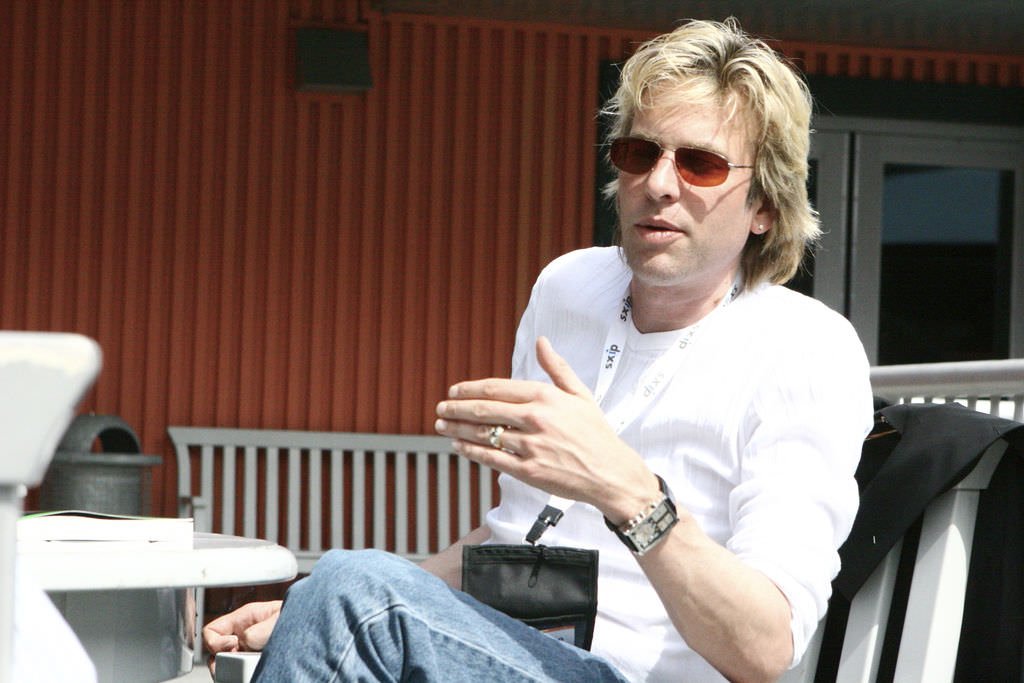
So this past July, when Podnews editor James Cridland cheekily suggested that it was not Dave Winer, nor “the podfather” Adam Curry, but comedian Robin Williams who had actually been the world’s first podcaster, industry graybeards were quick to push back on his claim.
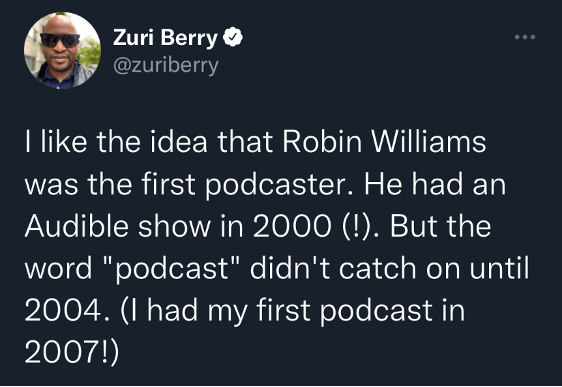
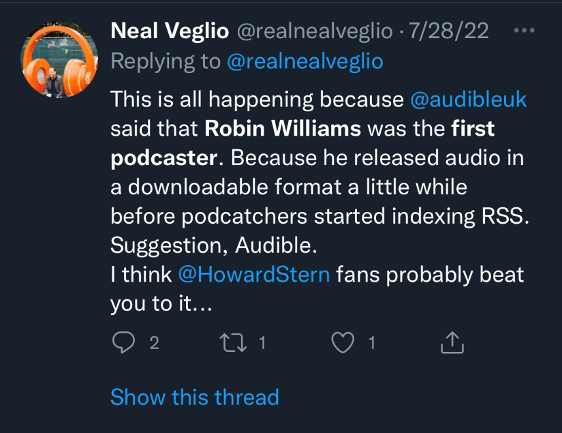
Cridland’s argument went like this: As an early investor in Audible.com, Williams launched a bi-weekly talk show called RobinWilliams@Audible in early 2000 (several months before Winer’s pioneering RSS), which listeners could download onto their mp3 players. Subscribers who owned an Audible Mobile Player could even have RobinWilliams@Audible automatically pushed to their device. “Of course, that’s what the first podcast was, too,” Cridland noted, “something you downloaded to your computer, then synched to your mp3 player.”
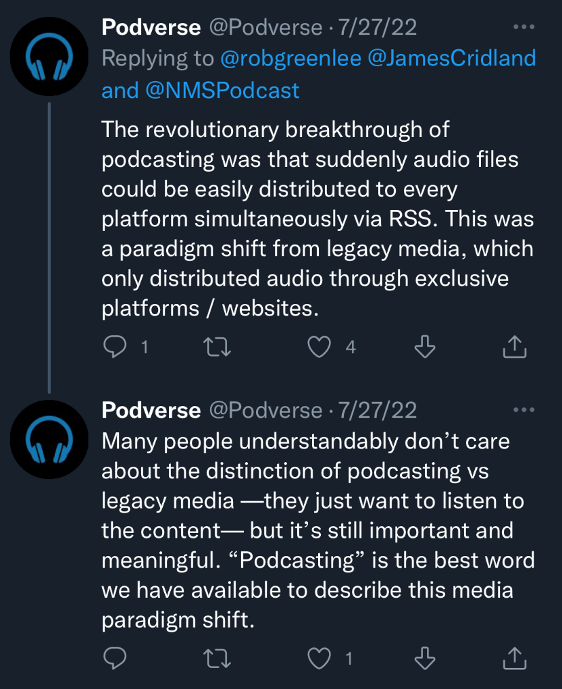
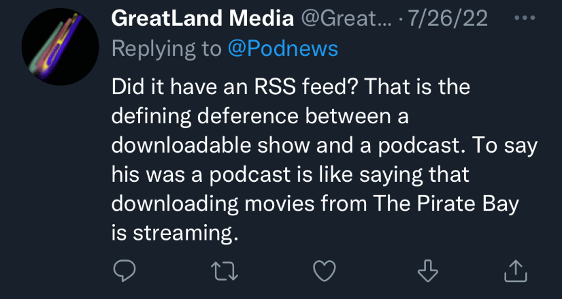
The crucial distinction, however, was that RobinWilliams@Audible was not distributed via RSS. For some, this meant that the show was definitively not a podcast – and Cridland’s claim patently absurd.
On The New Media Show, for instance, Todd Cochrane, founder-CEO of Blubrry, and Rob Greenlee, VP of Libsyn, spent nearly eighteen minutes on the subject, recounting the early history of online file sharing and concluding that a podcast could only be a podcast if it used RSS. For Audible to suggest that they had been the first in podcasting (Cridland’s post relied in part on Audible founder Don Katz as a source) was ego-driven revisionism.
On Twitter (an ancient social media app where people used to go to eviscerate each other), Cridland’s article provoked a squall of exceptions, which generally argued that downloadable audio without RSS does not a podcast make; and though Audible’s platform may have been innovative, and even shared some characteristics with podcasting, the fact that its programs were limited to the company’s proprietary platform meant that they were definitively not podcasts.
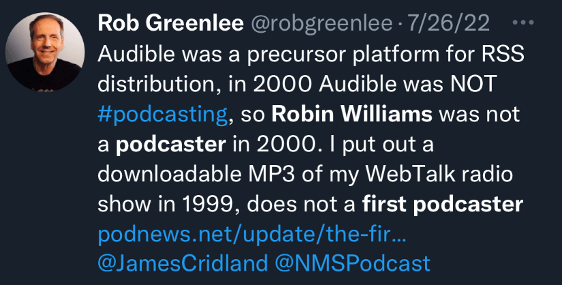
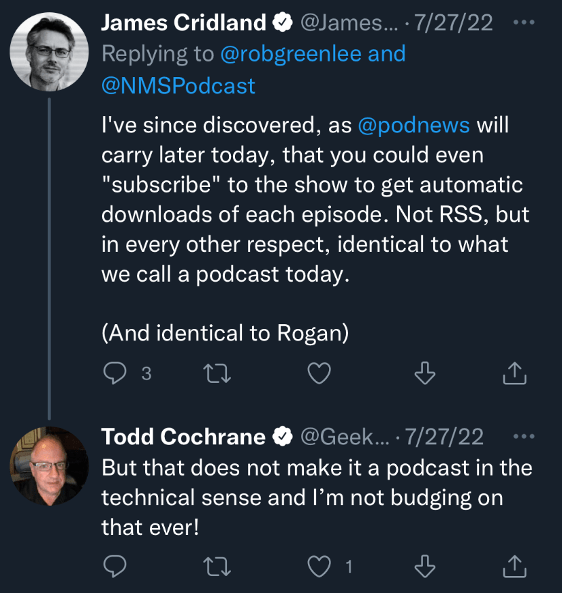
Rob Greenlee, for example, replied to Cridland’s article by clarifying that Audible was a precursor platform for RSS, but that its audio programs were definitively not podcasting. When Cridland pushed back, noting the automatic download feature on Audible, Greenlee’s co-host Todd Cochrane replied that this feature still did not make RobinWilliams@Audiblea podcast; and he insisted that he wasn’t going to budge on this point. A minor flap ensued, which ended with Cridland resignedly saying that he wished he had never written the article in the first place.In the end, even Dave Winer got involved, arguing that a piece of downloadable audio media had to have an RSS feed and be open to anyone, using any client, to qualify as a podcast.
To get a sense of the response to Cridland’s article on Twitter, and to let participants speak for themselves, I have selected a sampling of replies to Cridland’s original tweet teasing the article and reproduced them below. The conversation is arranged roughly in chronological order.
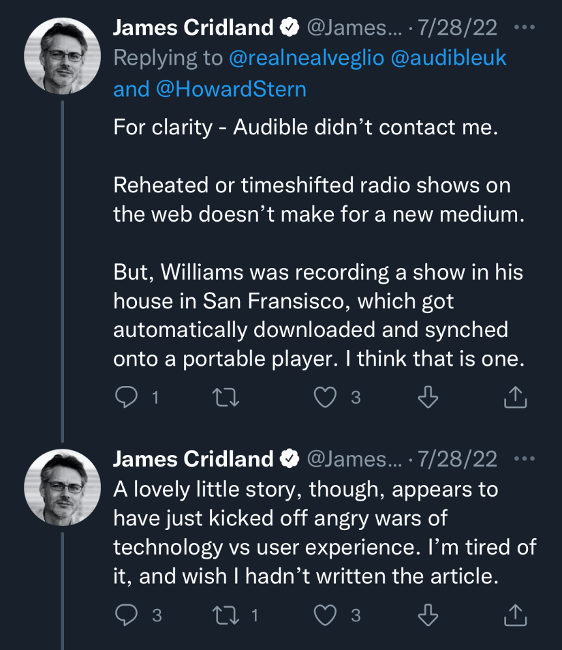
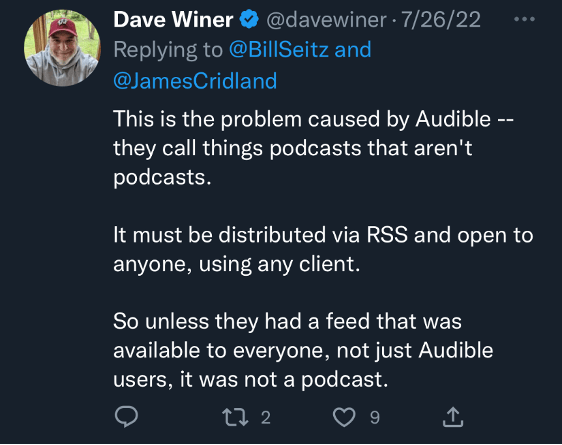
Admittedly, this was a very niche dispute – a handful of predominantly white tech dudes arguing over which white dude(s) had been the first podcaster. After a day or two, they all moved on.
But however minor (and however much Cridland may have wished he hadn’t written the article), the flap over RobinWilliams@Audible is a useful lens with which to understand contemporary debates over the future of podcasting: about whether the decentralized and open RSS-based ecosystem will long endure, or whether walled gardens—“limited set[s] of technology or media information provided to users with the intention of creating a monopoly or secured information system“—will prevail.
To better understand, however, let’s back up a bit.
By the fall of 2000, Dave Winer had earned a reputation as a pioneer of web syndication – he had been credited with launching the first blog – and someone who, according to the podcaster and author Eric Nuzum, “believed in making systems open, democratic, and easily accessible,” pushing back against the trend toward centralization and proprietary control of Internet infrastructures.

On a trip to New York that October, Winer met up with Adam Curry, who had been closely following his work. Over several hours in Curry’s hotel room, the entrepreneur attempted to convince Winer that web syndication technologies could be leveraged to distribute audio and video files – a vision of the Internet as “Everyman’s broadcast medium” – if only the so-called “last yard” problem of slow DSL connections could be resolved. By his own admission, Winer at first didn’t quite understand what Curry had in mind, but he was open experimenting with using RSS as “virtual bandwidth” that could deliver large media files during off-peak hours. In January 2001, Winer successfully used an RSS enclosure tag to distribute a single Grateful Dead song (it was U.S. Blues), inaugurating the first podcast feed – though what he had created wouldn’t become known as a “podcast” for some time.
Though interest in RSS-delivered audio files was slow to develop (indeed, even Winer and Curry pursued other projects for a time), “it was not lost on … early adopters,” as Andrew Bottomley has observed, adding “that the technology shifted power to the audience and also opened up opportunities for more democratized radio production” (111-112). The days of corporate gatekeepers exercising oligopolistic control over the production and distribution of audio content seemed numbered; no longer would broadcasting be subject to an economy of scarcity. Theoretically anyone with web hosting, a microphone, and an RSS feed could set themselves up in the radio business.
Since those early days, RSS has become “the currency of podcasting,” to borrow a phrase from Dave Jones, Adam Curry’s Podcasting 2.0 collaborator. Indeed, as Cridland himself wrote in his primer, “What is a Podcast?,” technically speaking, a “podcast” is comprised of an audio file, without DRM restrictions, that is available to download, and is “distributed via an RSS feed using an <enclosure> tag.”
But RSS is not without its detractors. Last July, for instance, Anchor.fm co-founder Michael Mignano argued that while technical standards like RSS (or HTTP, or SMTP, or SMS) provide a “common language” that allows for the rapid spread of new technologies, standardization inevitably stifles growth. “The tradeoff,” he wrote, “is that a lower barrier to entry means more products get created in a category, causing market fragmentation and ultimately, a slow pace of innovation.” The consequence of this “Standards Innovation Paradox” is that even as podcast listening apps proliferate, because they must conform to the RSS standard, the differences between them are superficial. Proprietary systems, Mignano argued, offer an alternative, allowing developers the flexibility to build – and rapidly improve – dynamic user experiences.
Naturally, Mignano pointed to Spotify – which acquired Anchor in 2019 – as an example of how closed systems could break the “curse” of standardization: When the company began to expand from music to other forms of audio content, he wrote, there was some speculation that the company would launch a dedicated podcast app. But, “if they had done so, they’d have to contend with the aforementioned ocean of podcast listening apps which were all offering users roughly the same features that were limited by the standard.” Instead, “Spotify used their existing music user base inside of the existing Spotify app to distribute podcasts to hundreds of millions of users.”
But this framing soft pedals Spotify’s aggressive attempts to steer podcasting away from RSS and toward platform enclosure. As John L. Sullivan argued in a 2019 paper, Spotify’s emphasis on exclusive releases (which has included the removal of content previously available via RSS, like The Joe Budden Podcast), and its $340 million acquisitions of Anchor and Gimlet are all part of an effort to control distribution and “maximize the ‘winner take all’ functions of platforms.” More recently, Anchor has stopped automatically generating an RSS feed at the time of publication, making it an opt-in function (meaning that creators have to know what RSS is to have their podcast distributed to directories otherthan Spotify). “We’ve been able to replace RSS for on-platform distribution,” noted one Spotify executive at a recent investor event, “which means that podcasts created on our platform are no longer held back by this outdated technology.”

Given the challenges that platform enclosure poses to RSS, its defenders’ insistence that “it’s not a podcast if it doesn’t have an RSS feed, and it’s not a podcast app if you can’t add your own RSS feeds,” as an episode title of Curry and Jones’s Podcasting 2.0 puts it, is understandable. Or, as Cochrane declared on The New Media Show, “until you tear my RSS feed through my dead hands, podcasts technically are podcasts that are delivered via RSS.”
And understandable, too, is the prickly reaction to Cridland’s alternate history: To claim that RobinWilliams@Audible may have been the first podcast is to suggest that RSS – and the open and democratic values which it represents – are inessential; and more troubling, that proprietary systems are deeply rooted in the history of the medium.

Of course, there’s also the sticky fact that RobinWilliams@Audible premiered before the word “podcast” entered the lexicon. But even this history is messy. In his original coinage, the technologist Ben Hammersley applied the term to a variety of different forms of downloadable audio media, including Audible originals like In Bed with Susie Bright. According to this early conception, in other words, podcasting described a cultural practice rather than a specific distribution infrastructure.
It is likely, too, that technological distinctions are irrelevant to listeners. Citing data from Edison Research showing that a significant percentage of listeners use Spotify and YouTube to access podcasts (even though content on these platforms don’t meet the strict technical definition of a “podcast”), Cridland has suggested that, for most people, podcasting is simply “on-demand audio. Like a radio show, but on-demand.”
Likewise, the question of whom the first podcaster was is of narrow interest. “Who cares?” an exasperated Cochrane finally concluded.
But reviewing the pre-2004 history of downloadable audio media can open up questions of the interpretive flexibility of technology (how technological artifacts come to have different meanings for different groups of users) and rhetorical closure (when the need for alternative designs diminish) that the late Trevor Pinch and Wiebe Bijker identified as key concepts in the Social Construction of Technology.
And so, rather than arguing about whether RobinWilliams@Audible – or, for that matter, Cochrane’s audio file sharing on FidoNet in the early 1990s – was the “first” podcast, further examination of this complex genealogy suggests the more interesting questions of how and why online distribution of audio files was such a desirable goal that there were severalpaths to its development.
The flap over Robin Williams and the question of the first podcaster also gives us much needed insight into current discourse about corporate influence in the podcasting space. Also It provided a way for proponents of the decentralized Podcasting 2.0 movement to make a technological distinction between a desire for freedom and a desire for control. While the scuffle itself was short-lived, its dust is far from settling.
—
Featured Image of Robin Williams (2008) by Flickr User Shameek (CC BY-NC-ND 2.0)
—
Andrew J. Salvati is an adjunct professor in the Media and Communications program at Drew University, where he teaches courses on podcasting and television studies. His research interests include media and cultural memory, television history, and mediated masculinity. He is the co-founder and occasional co-host of Inside the Box: The TV History Podcast, and Drew Archives in 10.
—
REWIND! . . .If you liked this post, you may also dig:
“I am Thinking Of Your Voice”: Gender, Audio Compression, and a Cyberfeminist Theory of Oppression: Robin James
DIY Histories: Podcasting the Past: Andrew Salvati
SO! Podcast #2: Behind the Podcast: Building Intimate Venues on the Internet – Andreas Duus Pape
Share this:




Current Top Posts





April 2021

January 2020

November 2019

October 2019

August 2019

April 2014

November 2017

March 2015

December 2017

October 2015


Recent Comments