
Learning to Listen Beyond Our Ears: Reflecting Upon World Listening Day

World Listening Day took place last week, and as I understand it, it is all about not taking sound for granted – an admirable goal indeed! But it is worth taking a moment to consider what sorts of things we might be taking for granted about sound as a concept when we decide that listening should have its own holiday.
One gets the idea that soundscapes are like giant pandas on Endangered Species Day – precious and beautiful and in need of protection. Or perhaps they are more like office workers on Administrative Professionals’ Day – crucial and commonplace, but underappreciated. Does an annual day of listening imply an interruption of the regularly scheduled three hundred and sixty four days of “looking”? I don’t want to undermine the valuable work of the folks at the World Listening Project, but I’d argue it’s equally important to consider the hazards of taking sound and listening for granted as premises of sensory experience in the first place. As WLD has passed, let us reflect upon ways we can listen beyond our ears.
At least since R. Murray Schafer coined the term, people have been living in a world of soundscapes. Emily Thompson provides a good definition of the central concept of the soundscape as “an aural landscape… simultaneously a physical environment and a way of perceiving that environment; it is both a world and a culture constructed to make sense of that world.”(117) As an historian, Thompson was interested in using the concept of soundscape as a way of describing a particular epoch: the modern “machine age” of the turn of the 20th century.

“Rock Series – Microphones” by Flickr user Stefano Tambalo, CC BY 2.0
Anthropologist Tim Ingold has argued that, though the concept that listening is primarily something that we do within, towards, or to “soundscapes” usefully counterbalanced the conceptual hegemony of sight, it problematically reified sound, focusing on “fixities of surface conformation rather than the flows of the medium” and simplifying our perceptual faculties as “playback devices” that are neatly divided between our eyes, ears, nose, skin, tongue, etc.
Stephan Helmreich took Ingold’s critique a step further, suggesting that soundscape-listening presumes a a particular kind of listener: “emplaced in space, [and] possessed of interior subjectivities that process outside objectivities.” Or, in less concise but hopefully clearer words: When you look at the huge range of ways we experience the world, perhaps we’re limiting ourselves if we confine the way we account for listening experiences with assumptions (however self-evident they might seem to some of us) that we are ‘things in space’ with ‘thinking insides’ that interact with ‘un-thinking outsides.’ Jonathan Sterne and Mitchell Akiyama, in their chapter for the Oxford Handbook of Sound Studies, put it the most bluntly, arguing that
Recent decades of sensory history, anthropology, and cultural studies have rendered banal the argument that the senses are constructed. However, as yet, sound scholars have only begun to reckon with the implications for the dissolution of our object of study as a given prior to our work of analysis.(546)
Here they are referring to the problem of the technological plasticity of the senses suggested by “audification” technologies that make visible things audible and vice-versa. SO!’s Jennifer Stoever-Ackerman has also weighed in on the social contingency of the “listening ear,” invoking Judith Butler to describe it as “a socially-constructed filter that produces but also regulates specific cultural ideas about sound.” In various ways, here, we get the sense that not only is listening a good way to gain new perspectives, but that there are many perspectives one can have concerning the question of what listening itself entails.

“listen (069/365)” by Flickr user Tim Pierce, CC BY 2.0
But interrogating the act of listening and the sounds towards which it is directed is not just about good scholarship and thinking about sound in a properly relational and antiessentialist way. It’s even less about tsk-tsking those who find “sound topics” intrinsically interesting (and thus spend inordinate amounts of time thinking about things like, say, Auto-Tune.) Rather, it’s about taking advantage of listening’s potential as a prying bar for opening up some of those black boxes to which we’ve grown accustomed to consigning our senses. Rather than just celebrating listening practices and acoustic ecologies year after year, we should take the opportunity to consider listening beyond our current conceptions of “listening” and its Western paradigms.
For example, when anthropologist Kathryn Lynn Guerts first tried to understand the sensory language of the West African Anlo-Ewe people, she found a rough but ready-enough translation for “hear” in the verb se or sese. The more she spoke with people about it, however, the more she felt the limitations of her own assumptions about hearing being, simply, the way we sense sounds through our ears. As one of her informants put it, “Sese is hearing – not hearing by the ear but a feeling type of hearing”(185). As it turns out, according to many Anlo-ewe speakers, our ability to hear the sounds of the world around us is by no means an obviously discrete element of some five-part sensorium, but rather a sub-category of a feeling-in-the-body, or seselelame. Geurts traces the ways in which the prefix se combines with other sensory modes, opening up the act of hearing as it goes along: sesetonume, for example, is a category that brings together sensations of “eating, drinking, breathing, regulation of saliva, sexual exchanges, and also speech.” Whereas English speakers are more inclined to contrast speech with listening as an act of expression rather than perception, for the Anlo-Ewe they can be joined together into a single sensory experience.

“Listening, Regent Street, London, 17 December 2011” by Flickr user John Perivolaris, CC BY-NC-ND 2.0
The ways of experiencing the world intimated by Geurts’ Anlo-Ewe interlocutors play havoc with conventionally “transitive,” western understandings of what it means to “sense” something (that is, to be a subject sensing an object) let alone what it means to listen. When you listen to something you like, Geurts might suggest to us that liking is part of the listening. Similarly, when you listen to yourself speak, who’s to say the feeling of your tongue against the inside of your mouth isn’t part of that listening? When a scream raises the hairs on the back of your neck, are you listening with your follicles? Are you listening to a song when it is stuck in your head? The force within us that makes us automatically answer “no” to questions of this sort is not a force of our bodies (they felt these things together after all), but a force of social convention. What if we tried to protest our centuries-old sensory sequestration? Give me synaesthesia or give me death!
Indeed, synaesthesia, or the bleeding-together of sensory modes in our everyday phenomenological experience, shows that we should loosen the ear’s hold on the listening act (both in a conceptual and a literal sense – see some of the great work at the intersections of disability studies and sound studies). In The Phenomenology of Perception, Maurice Merleau-Ponty put forth a bold thesis about the basic promiscuity of sensory experience:
Synaesthetic perception is the rule, and we are unaware of it only because scientific knowledge shifts the centre of gravity of experience, so that we have unlearned how to see, hear, and generally speaking, feel, in order to deduce, from our bodily organization and the world as the physicist conceives it, what we are to see, hear and feel. (266)
Merleau-Ponty, it should be said, is not anti-science so much as he’s interested in understanding the separation of the senses as an historical accomplishment. This allows us to think about and carry out the listening act in even more radical ways.
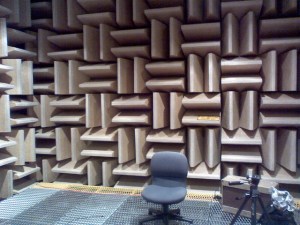
“Listening Room” by Flickr user Consumerist Dot Com, CC BY 2.0
Of course all of this synaesthetic exuberance requires a note to slow down and check our privilege. As Stoever-Ackerman pointed out:
For women and people of color who are just beginning to decolonize the act of listening that casts their alternatives as wrong/aberrant/incorrect—and working on understanding their listening, owning their sensory orientations and communicating them to others, suddenly casting away sound/listening seems a little like moving the ball, no?
To this I would reply: yes, absolutely. It is good to remember that gleefully dismantling categories is by no means always the best way to achieve wider conceptual and social openness in sound studies. There is no reason to think that a synaesthetic agenda couldn’t, in principle, turn fascistic. The point, I think, is to question the tools we use just as rigorously as the work we do with them.
—
Owen Marshall is a PhD candidate in Science and Technology Studies at Cornell University. His dissertation research focuses on the articulation of embodied perceptual skills, technological systems, and economies of affect in the recording studio. He is particularly interested in the history and politics of pitch-time correction, cybernetics, and ideas and practices about sensory-technological attunement in general.
—
Featured image: “” by Flickr user woodleywonderworks, CC-BY-2.0
—
 REWIND!…If you liked this post, you may also dig:
Snap, Crackle, Pop: The Sonic Pleasures of Food–Steph Ceraso
“HOW YOU SOUND??”: The Poet’s Voice, Aura, and the Challenge of Listening to Poetry–James Hyland
SO! Amplifies: Eric Leonardson and World Listening Day 18 July 2014–Eric Leonardson
Share this:

That Infernal Racket: Sound, Anxiety, and the IBM Computer in AMC’s Mad Men
[Warning: Spoilers Ahead for Folks Not Caught Up with Season 7, Episode 5!]
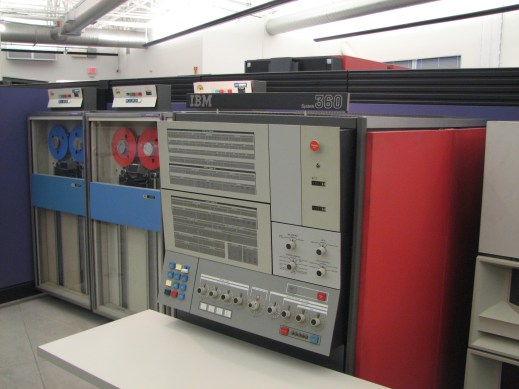
In one of the more memorable – and squirm-inducing – scenes of this season of AMC’s Mad Men, brilliant but eccentric copywriter Michael Ginsberg (Ben Feldman) presents his colleague, agency copy chief Peggy Olsen (Elisabeth Moss) with his own severed nipple, placed carefully in a gift box. Ginsberg explains to the understandably horrified Peggy that the gift is both a token of his affection and a means of relieving pressure caused by the arrival of Sterling, Cooper & Partners’ (SC&P) newest acquisition: a humming, room-sized IBM System/360 mainframe computer. Explaining his enmity for the machine and his increasingly erratic behavior, Ginsberg tells Peggy that the “waves of data” emanating from the computer were filling him up, and that the only solution was to “remove the pressure” by slicing off his “valve.”
The arrival of the IBM 360 in the idealized 1960s office space inhabited by Mad Men is obviously an unsettling presence – and not only for Ginsberg. Since its debut in Episode 4, commentators (e.g. WaPo’s Andrea Peterson, Slate’s Seth Stevenson) have meditated on the heavy-handed symbolism surrounding the machine – both in terms of its historical significance and its implications for plot and character development. Typically cued through noise (or lack thereof), it is worth reflecting upon the role of sound in establishing the computer as a source of disruption. Between the pounding and screeching of installation and the drone of the completed machine’s air conditioner and tape reels, the sonic motifs accompanying the computer underline tensions between (and roiling within) SC&P staffers grappling with the incipient digital age. Likewise, the infernal racket produced by the installation and operation of the IBM 360 adds an important dimension to the tensions resulting from its presence, which can be read as allegories for the complexities and contradictions of our relationship with technology.
.
The tone of the conflict is set even before we meet the IBM 360 toward the end of Episode 4: The Monolith – a reference to Kubrick’s 1968 classic 2001: A Space Odyssey (Slate’s Forrest Wickman ably discusses the references). Like the unnerving silence used with such great effect in that film, the absence of sound frames our first encounter with the computer – or at least its promise. Early in the episode, Don Draper (Jon Hamm), newly rehabilitated from his forced exile from the agency, arrives one morning at SC&P to find the office deserted. The ghostly sequence is clearly meant to symbolize Draper’s detachment from the firm. But as the episode progresses and tensions mount over the possibility that the IBM 360 will render jobs obsolete, the desolate office suggests a more ominous meaning – a once lively space muted by cold, impersonal automation.
In following scenes, successive stages of mainframe installation are marked by convergences of conflict and cacophony. First, there is the din of the creative team as they evacuate their beloved lounge – now earmarked as computer space – and during which a distraught Ginsberg projects his indignation onto art director Stan Rizzo, who appears more accepting. “They’re trying to erase us!” Ginsberg exclaims bitterly. Later, Draper lounges on his office couch as a clop clopping of hammers outside signifies tangible change. As if this weren’t enough of a distraction, two men in the corridor begin to chat loudly over the noise. Going out to investigate, Draper strikes up a conversation with one of the men, Lloyd Hawley, installation supervisor and founder of a small technology company competing with IBM. “Who’s winning?” Draper asks innocently, “who’s replacing more people?” Clearly irritated by Draper’s tone, Harry Crane – SC&P media director and the computer’s lead cheerleader – offers Draper a condescending apology for the loss of his “lunchroom,” assures him the change was “not symbolic.” “No, it’s quite literal,” Draper retorts. Unabated, the pounding and screeching of construction work emphasizes his point.
For the remainder of the episode, the raucous noise of construction acts as a leitmotif underscoring tensions between characters – between Peggy and Lou Avery (Draper’s priggish replacement at creative director), and between Draper and the interloper Lloyd. Finally, the end of construction is punctuated by a return to silence, as Peggy arrives one morning to see workers glide mainframe components noiselessly into the office.
Mad Men Logo. Used under the auspices of fair use for identification and critical commentary.
With this emphasis on technology as a source of symbolic, physical, and sonic disruption, Matthew Weiner and the creators of Mad Men draw upon a rich literary tradition. A relevant example contemporaneous with the show’s “present,” is literary critic Leo Marx’s 1964 text The Machine in the Garden, which examines the complicated relationships between a “pastoral ideal” and technological progress within American literature and popular imagination. Marx’s analysis reveals that sound is often used to convey the disruptive presence of technology within the bucolic landscape of the American continent. In Hawthorne’s Sleepy Hollow for example, it is the interrupting shriek of a locomotive whistle that breaks the author’s harmonious reverie: “Now tension replaces repose: the noise arouses a sense of dislocation, conflict, and anxiety” (15). In the decidedly un-pastoral modern office space, the noise of the computer installation nevertheless signifies a momentous social change and irrevocable loss. Picking out these tensions has always been one of the show’s strengths – whether it is the computer, Draper’s double identity, or the quiet endurance of women to the misogyny of midcentury work and domestic life.
Change, however, has significant consequences for Ginsberg, the young copywriter and Holocaust survivor who, as CBS’s Jessica Firger observes, has been deteriorating psychologically for some time. The proximity of the IBM 360, and the incessant drone of its mind-controlling waves eventually puts him over the edge. As Draper and Peggy enter the office early in Episode 5, Ginsberg glowers into the room housing the IBM 360. “Stop humming, you’re not happy!” he explodes. As Peggy attempts to soothe her colleague, our perspective shifts to look out at them from inside the glass-encased computer room. From here, the mainframe’s ambient noise muffles Peggy’s words, suggesting isolation between human and non-human. This play of speech and silence reoccurs later in the episode as Ginsberg, working alone on a Saturday with tissues wedged in his ears, spies Lou Avery and SC&P partner Jim Cutler inside the computer room, their voices made inaudible by the droning computer in a delicious homage to 2001 (see Vulture’s amusing gif). But the noise is clearly affecting Ginsberg. “It’s that hum at the office! It’s getting to me!” he tells Peggy later that evening. He even claims the computer has affected his sexuality.
Ginsberg’s noise complaints would have resonated in 1969 New York. In November of that year, the New York Times ran a feature on the city’s nerve-shattering noise pollution, calling it a “slow agent of death.” In addition to the myriad construction projects, subways, car horns, jet planes, and standing machinery populating the city soundscape, office workers found scant respite indoors where phones, air conditioners, “computers and typewriters and tabulators” whirred, whined, and clacked throughout the day. The article went on to report that scientists studying the impact of prolonged noise exposure on the human body had concluded a variety of ill effects on the heart and nervous system. Though no connection was made between computers and sexuality (as Ginsberg claimed), the article reported that laboratory rats under prolonged noise exposure had indeed “turned homosexual,” an opinion that underlined deterministic associations between sexuality, psychological disorder, and external stimuli.

An advertisement for the IBM 360. Borrowed from Wikimedia Commons.
As SO! editor Jennifer Stoever-Ackerman has argued, noise in midcentury New York also signified a sonic-racial politics, in which the mainstream “listening ear” recoiled at the “noise” created by Black and Puerto Rican others. In terms of Mad Men’s computer however, it is technology, economic anxiety, and mental illness, rather than ethnicity that frames sonic disruption. The basis of these tensions are similar however, and various interactions with SC&P’s IBM 360 demonstrate, as Stoever-Ackerman writes in SO!, “the ways in which Americans have been disciplined to consider some sounds as natural, normal, and desirable, while deeming alternate ways of listening and sounding as aberrant [and] dangerous.” Though similar, the conflict with technology on Mad Men does not suggest a clear us/them, or us/”it” binary. The banging of construction may be at first antagonistic, but it’s finite – eventually the computer is normalized within the SC&P office space to the extent that Peggy chides Ginsberg’s exasperation in Episode 5 by insisting “it’s just a computer!” Ginsberg’s reaction is more complex however, implicating a contradictory relationship with technology: once fully installed, has the droning computer become “natural, normal, and desirable” despite previous ambivalence? Is the keen awareness and anxiety towards technology symbolized through Ginsberg (albeit in a extreme form) suggested as the “aberrant” listening practice, or could it be Peggy’s apparent acceptance?
Like most cultural texts set in the past, it is possible to read Mad Men allegorically, as suggesting a certain ordering of meaning and values. From the perspective of those who have long since domesticated computers, the controversies and tropes activated by SC&P’s IBM 360 might strike us as familiar, even quaint. As the sociologist Bruno Latour has argued however, we would be wise to consider how technology exerts a kind of social agency that structures and impacts our daily lives. As historical symbolism, the sounds and noises of the IBM 360 on Mad Men should remind us that technological progress is not teleological, but a struggle over meaning in which anxieties (about jobs, mind-control, surveillance, subjectivity, etc.) may be variously accommodated, suppressed, or dismissed as irrational.
—
Featured image: An IBM 360 Mainframe. Borrowed from Wikimedia Commons CC 2.0
—
Andrew J. Salvati is a Media Studies Ph.D. candidate at Rutgers University. His interests include the history of television and media technologies, theory and philosophy of history, and representations of history in media contexts. Additional interests include play, authenticity, the sublime, and the absurd. Andrew has co-authored a book chapter with colleague Jonathan Bullinger titled “Selective Authenticity and the Playable Past” in the recent edited volume Playing With the Past (2013), and has written a recent blog post for Play the Past titled “The Play of History.”
—
REWIND!…If you liked this post, you may also dig:
“DIY Histories: Podcasting the Past” -Andrew J. Salvati
“The Noise of SB 1070: Or Do I Sound Illegal to You?”– Jennifer Stoever-Ackerman
“DIANE… The Personal Voice Recorder in Twin Peaks” -Tom McEnaney
Share this:


Current Top Posts





April 2021

January 2020

November 2019

October 2019

August 2019

April 2014

November 2017

March 2015

December 2017

October 2015
 Sounding Out!
Recent Comments