
I Like the Way You Rhyme, Boy: Hip Hop Sensibility and Racial Trauma in Django Unchained

Welcome to week two of our February Forum on “Sonic Borders,” a collaboration with the IASPM-US blog in connection with this year’s IASPM-US conference on Liminality and Borderlands, held in Austin, Texas from February 28 to March 3, 2013. The “Sonic Borders” forum is a Virtual Roundtable cross-blog entity that will feature six Sounding Out! writers posting on Mondays through February 25, and four writers from IASPM-US, posting on Wednesdays starting February 6th and ending February 27th. For an encore of week one of the forum, click here. And now, put your hands together for Regina Bradley!–JSA
—
I’m most haunted by a scene in the film Django Unchained (2012) where a slave and former mandingo fighter is torn to bits by dogs offscreen. After seeing the dogs begin to maim the slave, the scene rapidly cuts away to former slave and bounty hunter Django’s expression (played by Jamie Foxx) while the man hollers in pain amidst the growl of dogs in the background. The scene’s grisliness was not situated within Quentin Tarantino’s signature visual violence, but in its sound. Sound better relayed the violence imposed upon the man’s body, signifying the unavailability of literal or visual discourse to speak to the racial trauma black bodies continuously face.

“Django unchained, omaggio a Quentin Tarantino alla Cineteca di Bologna” by Flickr user Il Fatto Quotidiano under a Creative Commons 2.0 Licence
Tarantino’s use of sound in this scene and the rest of the film capitalizes on an intriguing alternative to investigating racial trauma narratives in our current popular imagination. I know folks are tired of hearing about Django Unchained, but hear me out. Er, hear Quentin Tarantino out. No, I’m not talking about interviews or dribble about how he was a slave in his last life or two but rather the way he manipulates music to present a soudscape where revenge fantasies are okay. Unlike past sonic renderings of slavery like the O’Jays’ track “Ship Ahoy,” Django retraces the slave narrative in a contemporary social-cultural moment. Tarantino’s redrawing represents how postracialism provides a scapegoat for (a)historical representations of racial trauma and violence. I am most interested in the ways that the Django Unchained soundscape provides Tarantino a way to dabble in what historian and blogger Jelani Cobb calls “racial ventriloquism” by allowing him to present a sonically revisionist representation of the intersections of slave discourse, black manhood, and trauma.
If it is true that Jamie Foxx asserted that “hip hop goes hand in hand with Quentin Tarantino” then Django reflects a type of hip hop sensibility that is situated between hip hop’s commodification as the most visible form of contemporary black culture and as the most accessible form of blackness and black expression. If I had to pinpoint it, I’d suggest Tarantino’s inclusion of two rappers, Tupac Shakur and Rick Ross, within Django is no doubt a nod toward a gangsta rap sensibility that Tarantino appropriates for his slave narrative/western. Shakur’s song “Unchained” plays in the film’s trailers; Ross’s “100 Black Coffins” plays in the movie and its rolling credits. Sampling from Tupac Shakur’s music as a member of the group Outlawz reflects the vengeful, if not nihilistic, undertones of gangsta rap that run parallel to the spaghetti western aesthetic that Django is primarily framed within. Not only is Django a badass and outlaw in the sense that he is a freed slave bounty hunter roaming the South in search of his woman, but Tupac’s song contextualizes him as a gangsta badass outlaw bounty hunter who exists in the fringes of normative society. He is not the norm, but rather the exceptionally violent Negro that we as an audience root for. We want him to be violent. Violence is not only a fantasy but a privilege we want to give Django because of the violence inflicted upon him as a former slave.
“Unchained,” a mashup of James Brown’s “The Payback” and Tupac Shakur’s posthumous release “Untouchable,” sonically corresponds to these desires, using funk and the underlying association of violence in gangsta rap to provide a backdrop to cheer for Django’s violent revenge. The song utilizes sound bytes of Django and his bounty hunter partner/emancipator King Schultz (played by Christopher Waltz) interwoven with samples of “The Payback” in order to provide the context of why Django becomes unchained and displaced from the traditional impositions of violence seen in slave narratives.
A reflection of hip hop in terms of production – sampling and blending to create a unique new sound – “Unchained” also provides its listeners with a bridge between a (revisionist) slave narrative and contemporary racial violence. As the song opens, a prominent electric guitar strums to remind the listener of its western generic context but gives way to an emphatic crescendo of the horns that introduce “The Payback.” The loudness of the horns signifies the arrival of something great–Django’s arrival. The horns demand the listener’s attention. James Brown sings “sold me out, for chump change. . .told me that they, had it all arranged” sets up Django’s literal and sonic “emancipation,” correlating “sold me out” to being sold as a slave. A sound byte of King Schultz shooting Django’s overseer immediately follows Brown’s verse, bridging Brown’s verse of “time to get ready for the big payback” with Django’s freedom in the film. Django’s change in stature is sonically affirmed by an adamant and hype Shakur, rhetorically asking in loop “Am I wrong ‘cause I wanna get it on til I die?!” Shakur’s voice over the infamous horns of “Payback” and Brown’s signature scream relay the urgency of Django’s mission and past traumas, emphasizing not only black men’s capability but willingness to be violent when threatened.

“Django unchained, omaggio a Quentin Tarantino alla Cineteca di Bologna” by Flickr user Il Fatto Quotidiano under a Creative Commons 2.0 License
Another reading of this loop suggests the inherent need for black men to be violent, an essentialized (mis)conceptualization of contemporary black men within a gangsta rap aesthetic that parallels Tarantino’s (re)vengeful intentions for Django Freeman. The call and response between Shakur and the sound byte of Foxx repeating “I love the way you die boy” loosely correlates and subverts the racial trauma that often provides the foundation for slavery discourse. Foxx’s sample comes from a scene in the film where Django has just shot and killed his former overseer. The line is an inversion of when Django previously begged for mercy for his wife Broomhilda and the overseer sneered “I like the way you beg, boy.” The triumphant rendering of Brown’s horns and the loop of Shakur, when heard in conjunction with Foxx’s sound byte, signify that Django has, indeed, got the big payback. The sound bytes of Django’s voice provides a challenge to the literal slave’s voice while the music provides a backdrop for what a slave’s revenge may sound like, subverting the racial trauma inflicted on slaves.
James Brown and Tupac Shakur reflect pivotal moments of black masculinity from soul and early renderings of commodified rap, but Rick Ross reflects a more contemporary moment of black masculinity and violence within hip hop as a multicultural space. It is significant that Django includes this moment of hip hop because it similarly frames the haziness of racial politics that contextualizes the film. Ross’s “100 Black Coffins” showcases a gruff Rick Ross spitting bars about violent repercussions and avenging himself and slave women:
The track reflects a sonic representation of the American South as a site of racial trauma as seen in the American popular imagination. There is a minute and, if unaware of the film’s homage, a quickly fleeting understanding of the black coffin as representative of the original Django’s coffin that he carried around with him as a reminder of his traumatic experience and need for revenge. The sonic feel of this track is overtly masculine, consisting of Ross’s signature grunt, a lone whistle, a wailing male chorus, and hard-hitting percussion. Ross’s demands for black coffins, black pastors, and black bibles against a sonic backdrop of wails and an unsettling bell toll inflict a similarly violent Southern cultural soundscape.
Furthermore, the understanding of blackness as pathological due to the trauma blacks experience, frames Ross’s narrative as parallel to Django’s (if he were a rapper). I’m particularly struck by “100 Black Coffins” for two reasons: Rick Ross’s beat (he never picks a lame one) and Ross’ call and response with himself. Furthermore, the urgency and depth that Ross presents in his background ad libs is a haunting reflection of black (slave) men’s inability to avenge and protect their families and themselves. Ross’ solo call and response signifies a coping mechanism for the solitary existence many slaves faced when disconnected from loved ones. Ross seamlessly interchanges ahistorical images and hip hop memes against a sonic backdrop that reflects the use of sound as a usefully ahistorical space where a ‘mash-up’ of blacks’ past and present can collide. Ross talking about slinging drugs from the block extends to blacks being sold on a slave block without a question of how the two correlate. This is undoubtedly problematic but, within the context of Django as a revenge fantasy film, is acceptable because it is part of the performance of a pseudo-slave narrative.

“12.25.12 – “Django Unchained”” by Flickr user moviesinla under a Creative Commons 2.0 License
Idealistically, critically engaging Django as a sonic discourse could provide bridges to similarly violent – yet very real – representations of sonic violence in the popular imagination like Trayvon Martin’s 911 tapes and the recent murder of Jordan Davis. It is also important to point out the existence of nonmusical cues of silence and screaming presented by Kerry Washington’s character, Broomhilda, and what they suggest about the treatment of (slave) women’s narratives and agency in a sonic space, an issue that the two hip hop tracks do not broach. Overall, however, Django pushes the envelope sonically and visually in reference to sonic borders of blackness and the usefulness of the sound of racial trauma to contextualizing black masculinity, provoking a complicated question: in what ways does music blur contemporary and historical black discourses, creating a hazy representation of not only what blackness does, but what black pathology sounds like?
—
R.N. Bradley is a PhD candidate in African American Literature at Florida State University and a regular writer for Sounding Out!
Share this:

Park Sounds: A Kansas City Soundwalk for Fall

Fall refuses to stay put in Kansas City. The past month Kansas City temperatures have skyrocketed to 70 comfortable degrees fahrenheit and plummeted to 20 chilly degrees. I decided to partake of a wonderfully mild Sunday afternoon last Thanksgiving weekend to do another one of my Kansas City soundwalks, this time the fall edition. Fortunately the weather was cooperating, and I didn’t have to worry about how long I could resist standing in the cold.
Even though the weather was wonderful for a soundwalk, I couldn’t choose where to go. I have blogged about three soundwalks so far, and for each of them the choice seemed more organic: for my first soundwalk, in 2010, I wanted to walk around my new neighborhood and begin to understand it from an aural point of view. For my second soundwalk (in 2011) I went to one of my favorite places in Kansas City, the Country Club Plaza, and provided a snapshot of the sounds of spring in this busy area of Midtown. On my personal blog, in time for World Listening Day 2011, I talked about sounds from my own porch for a summer edition of my KC Soundwalks series, in order to think about the soundscape where I live. However, for this fourth soundwalk my only requirement was that it be a place I had not been to before. I wanted to venture out to somewhere new and encounter it not just with my eyes but also with my ears. Technically, I could go anywhere in Kansas City and do a soundwalk, but that was the one thing keeping me from doing a soundwalk: I couldn’t choose.

View of Kansas City Midtown Skyline from Southwest Boulevard by Liana Silva.
Last Sunday I decided I had to just get in the car and go. I had planned (and postponed) several soundwalks up until that day (I had even tweeted that I was leaving the house, in hopes of that forcing me to commit), so that day I planned to finally take some time to do my soundwalk before I went back to work. I got in the car with my daughter, destined for the West Bottoms neighborhood. I figured I’d take the long route instead of the quick and easy highways. As we drove along the side streets, I saw a park—a park neither of us had been to before, Jarboe Park—and I figured we could stop there, play for a while, and then drive off for my soundwalk. In any case, she might be good and tired by the time we arrived at our final destination, and I could put her in the stroller while I recorded and took notes.
That’s not what happened.
Once we arrived at the park, a moment of inspiration hit when I saw some musical instruments of sorts as part of the jungle gym, something I hadn’t seen before.
LISTEN: Walking_to_Jarboe_Park._Cars_coming.
When we arrived, Jarboe Park was deserted. The bare trees didn’t make it any more inviting, but the park is in newly minted condition and full of bright colors. It showed no signs of life, or wear and tear; in fact, the jungle gym and the swings seemed new. (According to The City of Kansas City, MO’s website, this park was remodeled in 2011.) Jarboe Park is located in a residential neighborhood, across from Primitivo García Elementary School. During the semester it surely gets more use. Perhaps it was too early on a Sunday for families to be out and about at the park. Coincidentally, a family appeared about an hour after we arrived, but they went to the basketball court across the street.

Jarboe Park swings, still. Picture by Liana Silva.
LISTEN: Swings._A_Child’s_Laughter._
The first thing that caught my attention at the park was the presence of musical instruments set up at the entrance. I do not remember seeing anything similar before at a children’s jungle gym. There was a set of bells, a xylophone, some rainmakers, a whistle, and a drum set. Their presence seemed to indicate that making sounds/music/noise was also part of the experience of being in the park as well as part of the experience of growing up. Sound, specifically making sounds, became part of play, in this context.
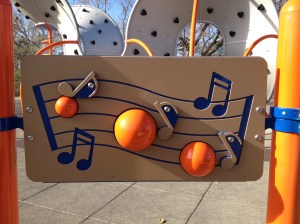
Bells. By Liana Silva
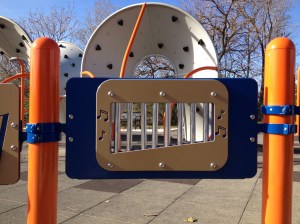
Xylophone. By Liana SIlva

Rainmaker. By Liana SIlva

Drum kit. Picture by Liana Silva
In the quietude of the noon time the sounds these instruments made felt a little sad instead of happy; the fact that there was only one child (ok, two, including myself!) playing with these instruments made their sounds stand out more, in relation to, say, the sounds of the trains and the highways (which I will discuss below). At the same time they drew attention to the fact that they were the only sounds that the park was making. If the park were busy, the sounds of the instruments would probably fade into the soundscape instead of being the loudest sound. However, the fact that we were playing with these instruments–versus playing instruments–made the park seem less lonely. We were part of the sounds, we were making sounds, and that seemed to distract me from the fact that we were the only people there making sounds. Although the plastic and metal instruments were not like traditional instruments, I wondered what their purpose in the jungle gym were. If the spider web and the swings are meant to exercise certain parts of the body and practice certain ways of socializing, what did the instruments teach? Perhaps the instruments are meant to teach children that instruments produce sounds, and they produce them in different ways. Lastly, the instruments and the act of creating sounds must use a different part of the brain–and my daughter was quite excited to play with the drum set!
LISTEN: Playing_musical_instruments_at_Jarboe_Park
Other than the sounds of the instruments, I also noticed the sounds of the highway and the train. I found a corner of the park where I could stand and record the sounds of the city:

If you look at the bottom of the V-shaped branches, you can see train cars. Picture by Liana SIlva
LISTEN: Train_whistles._Miss_E_calls._
Kansas City is intersected by train tracks, and it almost feels like if you pay close attention, you can hear a train in the distance at any corner of the city. In fact, in the dead of a lazy afternoon or the quiet of the wee hours of the night I can hear the trains’ whistles, announcing their passing through the city, from my neighborhood of Rosedale in Kansas City, Kansas. If soundwalks can be a sonic ethnography of a city, my soundwalks have so far revealed that the sound of trains are an essential part of the KC soundscape as well as a reminder of the city’s history: the Kansas City Stockyards. I could also hear the low buzzing of the cars on the highway, another sound I’ve come to recognize as uniquely Kansas Citian, or at least part of my soundsscape. The murmur of the traffic ways is like the sound of Kansas City’s blood coursing through its veins.
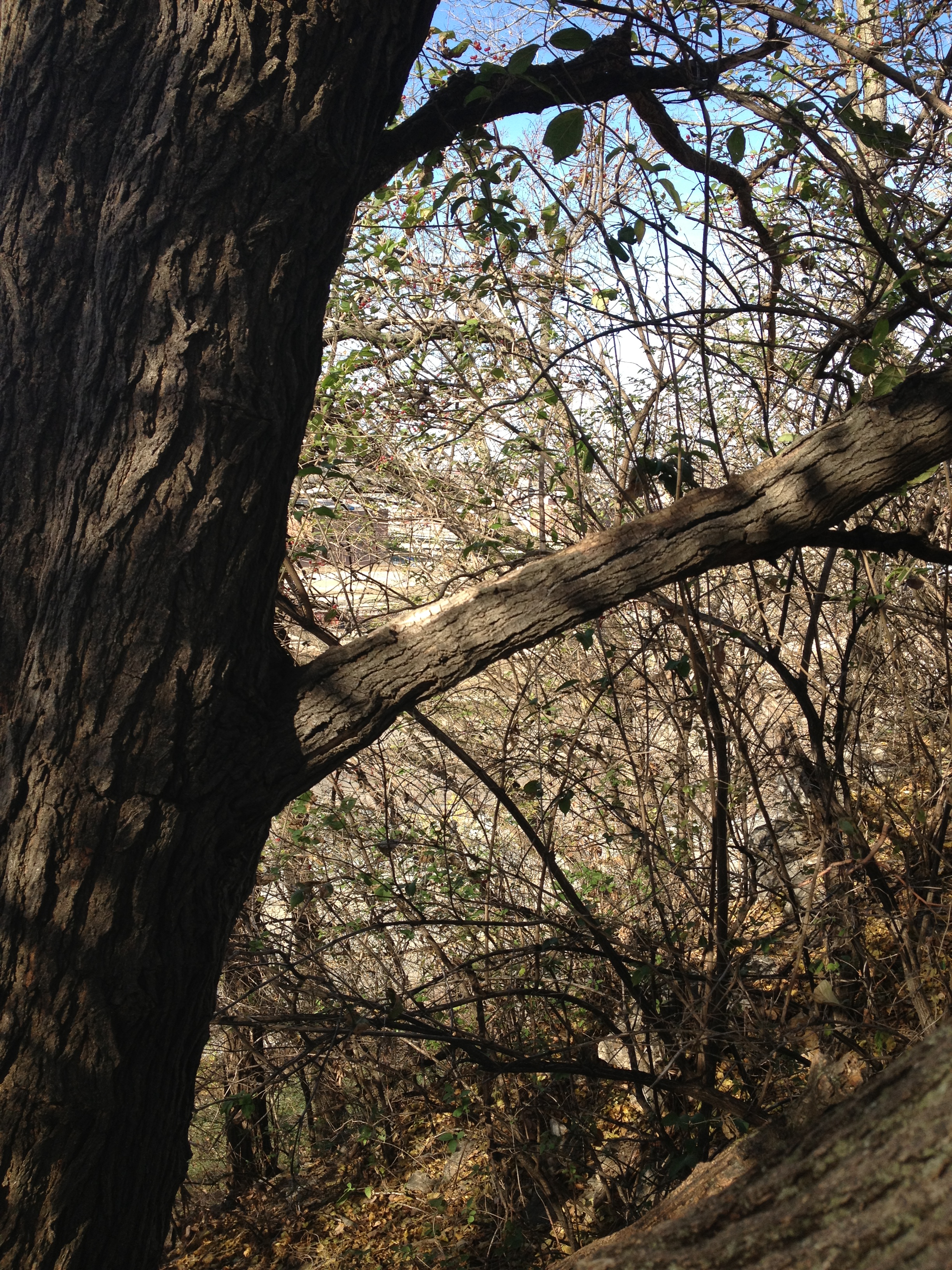
In between the branches, Interstate 670. Picture by Liana Silva.
LISTEN: Hum_of_the_highway._A_car._Train._
This spur-of-the-moment soundwalk made me think of how listening and sound can prompt reflection about the identity of a neighborhood and of a city. As I wrote down notes, I wondered: how do parks add to a community’s soundscape? The sounds add to the community’s identity as a residential area as an area that is amenable to the presence (physically and in aural terms) of other people. Soundscapes are connected to our ideas of what constitutes a neighborhood, and specifically how important common spaces like parks are, with all the sounds that may ensue. On a broader level, my Kansas City soundwalks are helping me piece together a soundscape of Kansas City, and to think through sound as a way to understanding the urban culture of this city, with its music, its fountains, its sports, and its trains, among other things. I feel like my listening practices are directly tied to my developing connection to this Midwestern city.
Postscript: I never did make it to the West Bottoms that Sunday. But it’s still on my list of KC spots to visit.
Featured Image: “Downtown from Top of Liberty2″ by Wikimedia user Hngrange, under Creative Commons 3.0 license.
–
Liana M. Silva is co-founder and Managing Editor of Sounding Out!
Share this:


Current Top Posts





April 2021

January 2020

November 2019

October 2019

August 2019

April 2014

November 2017

March 2015

December 2017

October 2015
 Sounding Out!

Recent Comments