
Listening to Tinnitus: Roles of Media When Hearing Breaks Down
 Editor’s Note: Welcome to the third installment in our month-long exploration of listening in observation of World Listening Day on July 18, 2012. For the full introduction to the series click here. To peep the previous posts, click here. Otherwise, prepare yourself to listen carefully as Mack Hagood contemplates how sound studies scholars can help tinnitus sufferers (and vice versa). –JSA
—-
One January morning in 2006, Joel Styzens woke up and life sounded different. Superimposed over the quiet ambience of his Chicago apartment was a cluster of sounds: pure, high-pitched tones like those of a hearing test. Loud, steady, and constant, they weren’t going away. He walked to the bathroom to wash his face. “As soon as I turned on the water on the faucet,” he told me in an interview, “the left ear was crackling… like, a speaker, you know, being overdriven.” Joel was 24 and a professional musician, someone who made his living through focused and detailed listening.
As days passed, he grew more fearful and depressed. For two months, he barely left the house. The air brakes of a city bus or a honking horn were painful and caused his heart to race. His sense of himself, his environment, and his identity as a musician were all undermined. This man who lived through his ears now faced the prospect of a life of tinnitus (ringing or other “phantom sounds”) and its frequent companion, hyperacusis (sound sensitivity sometimes accompanied by distortion). Joel could even identify the dominant pitch of his torment: it was A sharp.
We humanistic and qualitative sound scholars—particularly those of us focused on media and technology—can learn a lot from listening to tinnitus and the people who have it. Scholars of science and technology studies (STS) often utilize moments of technological breakdown to reveal the processes and mechanisms that constitute things we take for granted. Tinnitus and hyperacusis are, in the words of anthropologist Stefan Helmreich, “moments when hearing and listening break down” (629). Because sound scholars understand sound, hearing, and listening not only as the material effects of physics and physiology, but also as culturally and technologically emergent phenomena, we can potentially contribute much to the growing public conversation around tinnitus.
“Tinnitus” by Merrick Brown
And there is a lot at stake. Tinnitus affects 10-15% of adults and is the top service-related disability affecting U.S. veterans returning from Iraq and Afghanistan. Tinnitus and hyperacusis are also fairly common among musicians who work in loud performance and media production environments. It is perhaps ironic, then, that mediated sound and music are audiologists’ primary tools in helping people recover from these conditions.
My own study of tinnitus centers on its articulation with audio-spatial media—devices such as bedside sound machines, white noise generators, and noise-canceling headphones, all used to fabricate a desired sense of space through sound. People with tinnitus are among the most avid users of these devices, carefully mediating their aural-spatial relations as tinnitus becomes more evident in quiet spaces and hyperacusis flares up in noisy ones. During my fieldwork in audiology clinics and conferences, tinnitus support groups, and online forums, I observed that audio media were being deployed as medicine and technologies of self-care. Gradually, I came to the realization that the experience, discourse, and treatment of tinnitus is always bound up in mediation. In fact, I believe that tinnitus signals the highly mediated nature of our most intimate perceptions of sound and self. Below, I sketch just a few of the places I think aural media scholarship could go in conversation with tinnitus and hyperacusis.
The sound of media aftermath
Hearing experts do not consider subjective tinnitus to be a disease, but rather a condition in which individuals experience the normal, random neuronal firing of their auditory system as sound. Although it may be tied to various diseases and disorders, tinnitus itself is benign and does not inherently signal progressive hearing loss nor any other malignant condition.
Image by Flickr User Phil Edmonds
Nevertheless, research shows a frequent association between tinnitus and reduced auditory input, comparable to a sound engineer turning up the volume on a weak signal and thus amplifying the mixing board’s inherent noise. This “automatic gain control” theory neatly explains a classic 1953 study, in which 94 percent of “normal hearing” people experienced tinnitus in the dead silence of an anechoic chamber. Unfortunately, it also helps confirm the fear that the ringing heard after a night of loud music is due to hearing loss, known clinically as “temporary threshold shift.”
As Joel’s case suggests, when repeated, such threshold shifts lead to permanent damage. Audiologists increasingly see media-induced hearing loss and tinnitus as an epidemic, with ubiquitous earbuds often positioned as the main culprits. I have heard clinicians express dismay at encountering more young people with “old ears” in their offices, and youth education programs are beginning to proliferate. These apparent relations between aural pleasure and self-harm are an intriguing and socially significant area for sound and media scholarship, but they should also be considered within the context of moral panics that have historically accompanied the emergence of new media.
Objectifying phantom sound
For both clinicians and sufferers, one of the most frustrating and confounding aspects of tinnitus is how hard it is to objectify, either as a subject of research and treatment or as a condition worthy of empathy and activism. For both clinicians and sufferers, media are the primary tools for converting tinnitus into a manageable object.

Media marketed to protect musicians against Tinnitus, Image by Flickr User Jochen Wolters
Although media scholars haven’t yet studied it as such, the audiologist’s clinic is a center of media production and consumer electronics retail. Having audio production experience, I felt a sense of recognition on seeing the mixer-like audiometer in the control room of Joel’s audiologist, Jill Meltzer, separated by a pane of glass from the soundproofed booth where her patients sit. It was a studio where Meltzer recorded hearing rather than sound, as she attempted the tricky work of matching the pitch, volume, and sensitivity levels of tinnitus and hyperacusis. Since medication and surgery are not effective treatment options, the remedies for sale are media prosthetics and palliatives such as wearable sound generators, “fractal tone” hearing aids, Neuromonics, and sound machines that help distract, calm, and habituate patients to the ringing. Meltzer and other clinicians consistently told me that they have only two tinnitus tools at their disposal—counseling and sound.
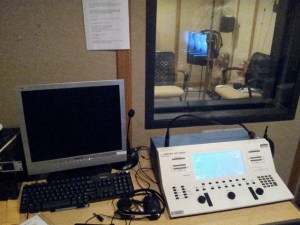
Audiometer and testing booth, Image by the author
The subjectivity of tinnitus is most frustrating for sufferers, however, who often encounter impatience and misunderstanding from family, friends, bosses, and even their doctors. Again, media serve to externalize and objectify the sound. Joel did this through music: “A Sharp,” Styzens’ first post-tinnitus composition, represents tinnitus with chordal dissonance and hyperacusis with a powerful change of dynamics on a guitar. He eventually recorded an entire album that explored his condition and raised awareness.
.
Other individuals, in an attempt to communicate the aural experience that drives their sleeplessness, depression, anxiety, or lack of concentration, create YouTube videos designed to recreate the subjective experience of tinnitus.
.
The American Tinnitus Association, an advocacy group, has used broadcast and social media to raise awareness and research funding, as we see in this PSA from 1985.
.
However, such dramatic uses of media may be in some ways too powerful. In fact, “raising awareness of tinnitus” might be as bad as it literally sounds.
Communicable dis-ease
In the process of externalizing their experience for others to hear, people with tinnitus can make their own perception of the sound grow stronger. They may also generate anxiety in others, encouraging them to notice and problematize their own, previously benign tinnitus.
Neuroscientist Pawel Jastreboff’s groundbreaking and influential neurophysiological model of tinnitus postulates that tinnitus becomes bothersome only when the auditory cortex forms networks with other areas in the brain, resulting in a vicious circle of increasing perception and fear. The implication of this model, now substantiated by clinical research, is that the way people think about tinnitus is a much greater predictor of suffering than the perceived volume of the sound. As Jastreboff told me in an interview, “Incorrect information can induce bothersome tinnitus.” Information, of course, circulates through media. It may be productive, then, to think of tinnitus suffering as a communicable dis-ease, one strengthened in circulation through networks of neurons, discourse, and media.
I think there is both a need and an opportunity in tinnitus for an applied sound studies, one that intervenes in this mediated public discourse, works against moral panic and hyperawareness, and suggests the quieting possibilities that open up when we grasp the constructed nature of our aurality. Listening to tinnitus as a networked coproduction highlights the ways in which our most subjective aural perceptions are also social, cultural, and mediated—perhaps the fundamental insight of sound studies. My hope is that by listening to tinnitus we can speak to it as well.
__
*Featured Image Credit: A representation of Tinnitus by Flickr User Jason Rogers, called “Day 642/365–Myself is against me”
Share this:

SO! L.A.: Sounding the California Story

Editor’s Note: Welcome to the second installment in our month-long exploration of listening in observation of World Listening Day on July 18, 2012. For the full introduction to the series click here. To peep the previous post, click here. Otherwise, whip out your most oversized sunglasses, kick back, and listen to Bridget Hoida’s California. –JSA
—-
STOP.
Do not read along with me “in your book.”
Resist the temptation to follow along with your eyes.
Click play. Listen.

Sunset in the San Joaquin Valley
If I had things my way, I would whisper these stories to you as we sat in mesh folding chairs on the poured concrete porch of my Central Valley childhood home. If I had things my way, I would refill your glass with lemons and gin, and we would breathe in the sweet, summer smell of rotting blackberry brambles. If I had things my way, we would wait until the sun set against a Tokay harvest, taking with it the harsh triple digit temperature and leaving us nothing but the quiet of a delta breeze and moonlight. If I had it my way, I would ask you to lean in close as I whisper with canonical voices:
“This is a story about love and death in the golden land, …”
“I remember that moment exactly, those exact words registering in my mind like the notes of a solo…”
“Bobby Gene was a tattletale he told everything he heard…”
“You must not tell anyone what I am about to tell you…”
“My history is murky, and I wanted it [ …] that way so I could be free to tell whatever I wanted. ”
“I’ll tell you what I suppose from your silences and few words and you can tell me if I’m mistaken. You’ll have to speak up with the real stories if I’ve got you wrong…”
“And so they talked and told tales of their region, and I listened. Long into the night I listened until I dropped off to sleep and my father would pick me up onto his lap as he continued to talk about the Revolution…. And every camp was different, none existing for more than six or seven weeks, then off we would go to the next harvest, where new people would gather and there would be new tales to be told and heard. I knew when I was six years old that the one thing I most wanted from life was to be a storyteller.
The storied sound of California
-All Voices
Shush…. Listen.
Linger with me on the drawn-out drawl of the stories I was raised on. Of the stories I was raised upon. For this is the sound of the California story: A myriad of voices sounding out narratives onto the page. Conflicting, concurring, spoken-over and rewrote…no one lasts longer than the next harvest, the next filmic “Action!” This is the sound of the storied terrain of interwoven melodies spoken upon the California soil that I call home.
1.
In or around 1995, I fell madly in love with Joan Didion. It’s not so much Didion the woman but rather the sound of Didion’s words that have me so hung up. My obsession began in the stacks of the Bancroft Library at UC Berkeley. I was assistant to the assistant librarian there and during my lunch hour I would take the dumb waiter up to the roof, eat a Kaiser roll with apricot jam, and read dime store copies of classic novels. I chose the roof because I like to read aloud, and in libraries at the time, reading aloud, especially to yourself, was expressly forbidden.

So there I was on the roof of Bancroft, with my roll, my jam, and my dime store copy of Play It As It Lays. I opened the page and read something about snakes and Iago. A mother died, the town of Silver Wells was won, and then lost, in much the same way a marriage slips into divorce. And then it happened. I stumbled across a line that changed the way I thought about words. Page 7, the first full sentence of the top paragraph, on the right: I might as well lay it on the line, I have trouble with as it was.
And after that line a whole lot of white space.
Beautiful, brilliant, blank white space.
As though in the silence of the rooftop, of the view, Didion was screaming to the reader, to me, something louder than words. In that white space there was sound and it was deafening.

2.
Later, when I decided to get a Ph.D. in creative writing, and although I couldn’t say as much on paper, examine, among other things, the commonality of language in California writers and the sonic devices of oral storytelling, I came across a quote from Didion, in interview, that said:
I had the technical intention to write a novel so elliptical and fast […] it would scarcely exist on the page at all…white space. Empty space. […] A white book to which the reader would have to bring his or her own bad dreams…
And although I adore everything about her I almost wished she hadn’t said it. Or that I hadn’t read it, because the thing about Didion is that statement… the part about the blank space… and the nightmare… it was already there. On the roof of the Bancroft library with my Kaiser roll and apricot jam, when the air tasted like September, I brought my own bad dreams because in that brilliant bit of white space I heard the scream.
3.
I like the white page. I prefer stories to plots. Plot for me is how the narrative moves from one space in time (from one line on the page) to the next. Story is how the narrative sounds. Story is voice. Plots are where girls meet boys and girls lose boys and girls get boys back. Stories are the shuffle and stop of scuffed shoes walking railroad levees, old men clearing phlegm, the surprise of an elastic bikini band as it snaps against the freshly burnt back of a burgeoning starlet. And the sounds of words as they smack unbridled against the page.

a traditional page by John Steinbeck

a white page by Joan Didion
4.
When I read Didion we are on my porch and I hear her voice. When we think of writing, when we imagine reading, we think of quiet moments that exist alone with fixed type on a printed page. But as a reader, and more importantly as a writer, I have never felt this way.
5.
Voice, to paraphrase Emily Dickinson, is the “slant” you bring to your version of “the truth.” Plots are recyclable. Hell, you can buy one on eBay, to be sure. But a writer’s voice is different. I don’t read a book to figure out what happens next. I read to hear the whisper of the author’s voice. If they whisper well, I turn the page.
6.
From John Steinbeck to Gertrude Stein, John Fante to Susan Straight, Larry Levis and Mary Hunter Austin to William Saroyan and Shawna Yang Ryan, there is commonality of sound and language that I’m willing to claim composes an aural palimpsest of sorts. A voicing over, both literally and figuratively of native daughters and native sons held up on the tongue of the golden state.
The cadence, the rhythm, the obsession with things past. The aching nostalgic longing. The reflection. The fear. The reclamation. The imagination. The witness of an agrarian undoing. Sleepy Hollow moments reborn—again and again on western soil. The feeling of home. The feeling of home slipping away. The feeling of self, self-made in the image of home, slipping away alongside it. There’s a certain Californianess to it.
7.
What if we found a way to consider the sound these “fixed texts” emote? What if we broke with conventional narrative structure and embraced a written technique that more adeptly mirrored the sound and cadence of spoken story telling? Then might it be possible that the very aurality that is “written over” on the read palimpsest is in fact the sound that also remains?
As a writer, a writer who believes in voice, who rejoices in sounds as the strike-like syllables against a now forgotten Olivetti key, my pursuit in writing not only a novel, but in writing a novel about California was how I could possibly enter into this conversation. How I might be able to raise my voice loud enough to embrace the crowd of such a respectable page. How I could construct my text in such a way that it would not only read, but also sound Californian.

a “docu-page” by Raymond Barrio
8.
In my struggle to voice not only my novel, So L.A., but also my protagonist Magdalena de la Cruz, I relied heavily on the patterns, soundscapes and literary devices of the collective California canon comprised of authors such as the ones I spoke of above. In So L.A. I was looking for a way to tell the story out loud while still operating within the conventional structure of a “type and text” book.
 9.
9.
My novel opens with Magdalena falling off a boat and then moves both forward and backward in time. This is how most people tell stories orally. They begin in the middle and then jump around, forgetting, amending, and calling attention to the most important parts, while the listener rarely ever exclusively listens but instead interjects and provides his or her own connections, observations and experiences. Eliminating quotations allowed me to access some of this interplay. It allowed me to question the reliability of spoken language. Spoken utterance does NOT always translate to precise hearing of the said words uttered. There is always interference—be it emotional (memory-sound triggers), psychological (felt meaning as opposed to said meaning), physical (honking cars, loud birds, eye rolls and sneezing) or linguistic (signifiers and unspoken gestures). Just because words are utter does not mean they are the same words that are heard. And not only did I want this, but I needed it on my page. Although I considered the docunovel (in the vein of Raymond Barrio), autho-interview collage (like Anna Deavere Smith) and autofictive exploration (ala Salvador Plascencia) I ultimately decided to abandon quotation marks.


a “sounded” page from The People of Paper
10.
This (“) says open. It says start.
This (”) says closed. It says stop.
But (“) and (”) also sound.
For me they sound like a particularly rough clearing of the throat. They sound like standing on a library rooftop, trying to confess your love with the passion of a librarian “with hiccups.”
“They” interrupt the eye. “They” provide visual cues for accessing character and I didn’t want Magdalena “to be seen.” I wanted her to sound.
Her voice required a fluidity and unreliability not attainable “in quotes.” Without conventional quotes I was free to wander inside the head and voice of my protagonist as I pushed the blur between what she was saying, what the listener perceived she was saying, and what other characters were voicing without visual interruption.
11.
Also important in my authorial access to sound (and the absence of sound) on the fixed and written page was the use of filmic microchapters (some only as long as a single sentence). A sentence that reads as a chapter, surrounded by all that stark and lovely white space, not only looks different from a classical bookish chapter, but it also sounds different. Read out loud, or quietly inside the reader’s head, it sounds out a particular meaning and resonated differently within the mind’s eye and ear.
12.
With so much of the present world turning virtual, author and storyteller Barry Sanders concludes, “We demand less from the historical accuracy of our stories. We even demand less of a truth. We are content with images and feelings. If it feels closer to the truth then it might as well be.” However I’d like to extend Sander’s assessment beyond image and feeling to include sound. In this newly constructed world of virtual storytelling we are again experiencing a shift (not unlike the shift from oral to written storytelling) that is also sound dependent and sonically informed. From the staccato sounds of Twitter as compared to the unconstricted and leisurely expanse of Tumblr, it is important to acknowledge that the twenty-second sound bite can be (and historically has been) used (and utilized) in fiction to make noise and call attention to lasting moments of profound revelation. Although Didion’s Maria may “have trouble with how it was” I find a certain sense of comfort in how it is provided we are all able to lean in close and listen. Listen past the interference of type, text and YouTube to the sound of words both on and upon the page as,
“These are tales told in darkness in the quiet at the end of the day’s heat…”
—
Opening Image Credit: “L.A. Sky at Sunset” by Flickr User David Vienna
Audio note: Voices used, with the exception of Bridget Hoida, are not the actual voices of the authors listed, nor are they meant to be representative of said authors.
—
Bridget Hoida is the author of So L.A. (2012). In a past life she was a librarian, a DJ, a high school teacher, and a barista. In this life she experiments with words and has taught writing at UC Irvine, the University of Southern California and is currently a professor at Saddleback College. Hoida is the recipient of an Anna Bing Arnold Fellowship and the Edward Moses prize for fiction. She was a finalist in the Joseph Henry Jackson/San Francisco Intersection for the Arts Award for a first novel and the William Faulkner Pirate’s Alley first novel contest. Her short stories have appeared in the Berkeley Fiction Review, Mary, and Faultline Journal, among others, and she was a finalist in the Iowa Review Fiction Prize and the Glimmer Train New Writer’s Short Story Contest. Her poetry has been recognized as an Academy of American Poets Prize finalist and she was a Future Professoriate Scholar at USC.
She has a BA from UC Berkeley, a MA in fiction from San Francisco State University, and a Ph.D. in Literature and Creative Writing from the University of Southern California. So L.A. is her first novel.
Share this:


Current Top Posts





April 2021

January 2020

November 2019

October 2019

August 2019

April 2014

November 2017

March 2015

December 2017

October 2015
 Sounding Out!
Recent Comments