
That Infernal Racket: Sound, Anxiety, and the IBM Computer in AMC’s Mad Men
[Warning: Spoilers Ahead for Folks Not Caught Up with Season 7, Episode 5!]
In one of the more memorable – and squirm-inducing – scenes of this season of AMC’s Mad Men, brilliant but eccentric copywriter Michael Ginsberg (Ben Feldman) presents his colleague, agency copy chief Peggy Olsen (Elisabeth Moss) with his own severed nipple, placed carefully in a gift box. Ginsberg explains to the understandably horrified Peggy that the gift is both a token of his affection and a means of relieving pressure caused by the arrival of Sterling, Cooper & Partners’ (SC&P) newest acquisition: a humming, room-sized IBM System/360 mainframe computer. Explaining his enmity for the machine and his increasingly erratic behavior, Ginsberg tells Peggy that the “waves of data” emanating from the computer were filling him up, and that the only solution was to “remove the pressure” by slicing off his “valve.”
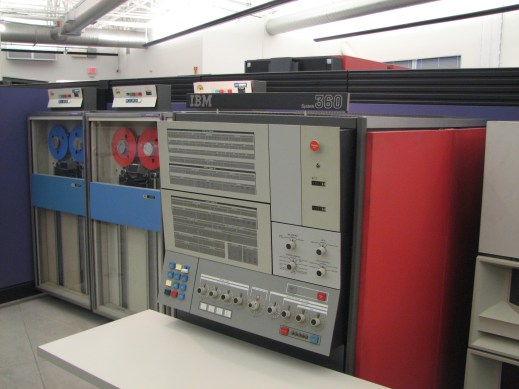
The arrival of the IBM 360 in the idealized 1960s office space inhabited by Mad Men is obviously an unsettling presence – and not only for Ginsberg. Since its debut in Episode 4, commentators (e.g. WaPo’s Andrea Peterson, Slate’s Seth Stevenson) have meditated on the heavy-handed symbolism surrounding the machine – both in terms of its historical significance and its implications for plot and character development. Typically cued through noise (or lack thereof), it is worth reflecting upon the role of sound in establishing the computer as a source of disruption. Between the pounding and screeching of installation and the drone of the completed machine’s air conditioner and tape reels, the sonic motifs accompanying the computer underline tensions between (and roiling within) SC&P staffers grappling with the incipient digital age. Likewise, the infernal racket produced by the installation and operation of the IBM 360 adds an important dimension to the tensions resulting from its presence, which can be read as allegories for the complexities and contradictions of our relationship with technology.
.
The tone of the conflict is set even before we meet the IBM 360 toward the end of Episode 4: The Monolith – a reference to Kubrick’s 1968 classic 2001: A Space Odyssey (Slate’s Forrest Wickman ably discusses the references). Like the unnerving silence used with such great effect in that film, the absence of sound frames our first encounter with the computer – or at least its promise. Early in the episode, Don Draper (Jon Hamm), newly rehabilitated from his forced exile from the agency, arrives one morning at SC&P to find the office deserted. The ghostly sequence is clearly meant to symbolize Draper’s detachment from the firm. But as the episode progresses and tensions mount over the possibility that the IBM 360 will render jobs obsolete, the desolate office suggests a more ominous meaning – a once lively space muted by cold, impersonal automation.
In following scenes, successive stages of mainframe installation are marked by convergences of conflict and cacophony. First, there is the din of the creative team as they evacuate their beloved lounge – now earmarked as computer space – and during which a distraught Ginsberg projects his indignation onto art director Stan Rizzo, who appears more accepting. “They’re trying to erase us!” Ginsberg exclaims bitterly. Later, Draper lounges on his office couch as a clop clopping of hammers outside signifies tangible change. As if this weren’t enough of a distraction, two men in the corridor begin to chat loudly over the noise. Going out to investigate, Draper strikes up a conversation with one of the men, Lloyd Hawley, installation supervisor and founder of a small technology company competing with IBM. “Who’s winning?” Draper asks innocently, “who’s replacing more people?” Clearly irritated by Draper’s tone, Harry Crane – SC&P media director and the computer’s lead cheerleader – offers Draper a condescending apology for the loss of his “lunchroom,” assures him the change was “not symbolic.” “No, it’s quite literal,” Draper retorts. Unabated, the pounding and screeching of construction work emphasizes his point.
For the remainder of the episode, the raucous noise of construction acts as a leitmotif underscoring tensions between characters – between Peggy and Lou Avery (Draper’s priggish replacement at creative director), and between Draper and the interloper Lloyd. Finally, the end of construction is punctuated by a return to silence, as Peggy arrives one morning to see workers glide mainframe components noiselessly into the office.
Mad Men Logo. Used under the auspices of fair use for identification and critical commentary.
With this emphasis on technology as a source of symbolic, physical, and sonic disruption, Matthew Weiner and the creators of Mad Men draw upon a rich literary tradition. A relevant example contemporaneous with the show’s “present,” is literary critic Leo Marx’s 1964 text The Machine in the Garden, which examines the complicated relationships between a “pastoral ideal” and technological progress within American literature and popular imagination. Marx’s analysis reveals that sound is often used to convey the disruptive presence of technology within the bucolic landscape of the American continent. In Hawthorne’s Sleepy Hollow for example, it is the interrupting shriek of a locomotive whistle that breaks the author’s harmonious reverie: “Now tension replaces repose: the noise arouses a sense of dislocation, conflict, and anxiety” (15). In the decidedly un-pastoral modern office space, the noise of the computer installation nevertheless signifies a momentous social change and irrevocable loss. Picking out these tensions has always been one of the show’s strengths – whether it is the computer, Draper’s double identity, or the quiet endurance of women to the misogyny of midcentury work and domestic life.
Change, however, has significant consequences for Ginsberg, the young copywriter and Holocaust survivor who, as CBS’s Jessica Firger observes, has been deteriorating psychologically for some time. The proximity of the IBM 360, and the incessant drone of its mind-controlling waves eventually puts him over the edge. As Draper and Peggy enter the office early in Episode 5, Ginsberg glowers into the room housing the IBM 360. “Stop humming, you’re not happy!” he explodes. As Peggy attempts to soothe her colleague, our perspective shifts to look out at them from inside the glass-encased computer room. From here, the mainframe’s ambient noise muffles Peggy’s words, suggesting isolation between human and non-human. This play of speech and silence reoccurs later in the episode as Ginsberg, working alone on a Saturday with tissues wedged in his ears, spies Lou Avery and SC&P partner Jim Cutler inside the computer room, their voices made inaudible by the droning computer in a delicious homage to 2001 (see Vulture’s amusing gif). But the noise is clearly affecting Ginsberg. “It’s that hum at the office! It’s getting to me!” he tells Peggy later that evening. He even claims the computer has affected his sexuality.
Ginsberg’s noise complaints would have resonated in 1969 New York. In November of that year, the New York Times ran a feature on the city’s nerve-shattering noise pollution, calling it a “slow agent of death.” In addition to the myriad construction projects, subways, car horns, jet planes, and standing machinery populating the city soundscape, office workers found scant respite indoors where phones, air conditioners, “computers and typewriters and tabulators” whirred, whined, and clacked throughout the day. The article went on to report that scientists studying the impact of prolonged noise exposure on the human body had concluded a variety of ill effects on the heart and nervous system. Though no connection was made between computers and sexuality (as Ginsberg claimed), the article reported that laboratory rats under prolonged noise exposure had indeed “turned homosexual,” an opinion that underlined deterministic associations between sexuality, psychological disorder, and external stimuli.

An advertisement for the IBM 360. Borrowed from Wikimedia Commons.
As SO! editor Jennifer Stoever-Ackerman has argued, noise in midcentury New York also signified a sonic-racial politics, in which the mainstream “listening ear” recoiled at the “noise” created by Black and Puerto Rican others. In terms of Mad Men’s computer however, it is technology, economic anxiety, and mental illness, rather than ethnicity that frames sonic disruption. The basis of these tensions are similar however, and various interactions with SC&P’s IBM 360 demonstrate, as Stoever-Ackerman writes in SO!, “the ways in which Americans have been disciplined to consider some sounds as natural, normal, and desirable, while deeming alternate ways of listening and sounding as aberrant [and] dangerous.” Though similar, the conflict with technology on Mad Men does not suggest a clear us/them, or us/”it” binary. The banging of construction may be at first antagonistic, but it’s finite – eventually the computer is normalized within the SC&P office space to the extent that Peggy chides Ginsberg’s exasperation in Episode 5 by insisting “it’s just a computer!” Ginsberg’s reaction is more complex however, implicating a contradictory relationship with technology: once fully installed, has the droning computer become “natural, normal, and desirable” despite previous ambivalence? Is the keen awareness and anxiety towards technology symbolized through Ginsberg (albeit in a extreme form) suggested as the “aberrant” listening practice, or could it be Peggy’s apparent acceptance?
Like most cultural texts set in the past, it is possible to read Mad Men allegorically, as suggesting a certain ordering of meaning and values. From the perspective of those who have long since domesticated computers, the controversies and tropes activated by SC&P’s IBM 360 might strike us as familiar, even quaint. As the sociologist Bruno Latour has argued however, we would be wise to consider how technology exerts a kind of social agency that structures and impacts our daily lives. As historical symbolism, the sounds and noises of the IBM 360 on Mad Men should remind us that technological progress is not teleological, but a struggle over meaning in which anxieties (about jobs, mind-control, surveillance, subjectivity, etc.) may be variously accommodated, suppressed, or dismissed as irrational.
—
Featured image: An IBM 360 Mainframe. Borrowed from Wikimedia Commons CC 2.0
—
Andrew J. Salvati is a Media Studies Ph.D. candidate at Rutgers University. His interests include the history of television and media technologies, theory and philosophy of history, and representations of history in media contexts. Additional interests include play, authenticity, the sublime, and the absurd. Andrew has co-authored a book chapter with colleague Jonathan Bullinger titled “Selective Authenticity and the Playable Past” in the recent edited volume Playing With the Past (2013), and has written a recent blog post for Play the Past titled “The Play of History.”
—
 REWIND!…If you liked this post, you may also dig:
“DIY Histories: Podcasting the Past” -Andrew J. Salvati
“The Noise of SB 1070: Or Do I Sound Illegal to You?”– Jennifer Stoever-Ackerman
“DIANE… The Personal Voice Recorder in Twin Peaks” -Tom McEnaney
Share this:

DIY Histories: Podcasting the Past

 This is article 3.0 in Sounding Out!‘s April Forum on “Sound and Technology.” Every Monday this month, you’ll be hearing new insights on this age-old pairing from the likes of Sounding Out! veteranos Aaron Trammell and Primus Luta along with new voices Andrew Salvati and Owen Marshall. These fast-forward folks will share their thinking about everything from Auto-tune to techie manifestos. Today, Salvati asks if DIY podcasts are allowing ordinary people to remix the historical record. Let’s subscribe and press play. –JS, Editor-in-Chief
—
Was Alexander the Great as bad a person as Adolph Hitler? Will our modern civilization ever fall like civilizations from past eras?
According to Dan Carlin’s website, these are the kind of speculative “outside-the-box” perspectives one might expect from his long-running Hardcore History podcast. In Carlin’s hands, the podcast is a vehicle for presenting dramatic accounts of human history that are clearly meant to entertain, and are quite distinct from what we might recognize as academic history. Carlin, a radio commentator and former journalist, would likely agree with this assessment. As he frequently emphasizes, he is a “fan” of history and not a professional. But while there are particularities of training, perspective, and resources that may distinguish professional and popular historians, an oppositional binary between these kinds of historymakers risks overlooking the plurality of historical interpretation. Instead, we might notice how history podcasters like Carlin utilize this new sonic medium to continue a tradition of oral storytelling that in the West goes back to Herodotus, and has since been the primary means of marginalized and oppressed groups to preserve cultural memory. As a way for hobbyists and amateurs to create and share their own do-it-yourself (DIY) histories, I argue that audio podcasting suggests a democratization of historical inquiry that greatly expands the possibilities for everyone, as Carl Becker once said, to become his or her own historian.

“Modified Podcast Logo with My Headphones Photoshopped On” by Flickr user Colleen AF Venable, CC BY-SA 2.0
Frequently listed among iTunes’ top society and culture podcasts, and cited by several history podcasters as the inspiration for their own creations, the popularity of Hardcore History stems from Carlin’s unconventional and dramatic recounting of notable (but sometimes obscure) historical topics, in which he will often elaborate historical-structural changes through contemporizing metaphors. Connecting the distant past to more immediate analogies of present life is the core of Carlin’s explanatory method. This form of explanation is quite distinct from the output of academic historians, who assiduously avoid this sort of “presentism.” But as the late Roy Rosenzweig (2000) has suggested, it is precisely this kind of conscious and practical engagement with the past – and not the litany of facts in dry-as-dust textbooks – that appeals to non-historians. Rosenzweig and David Thelen claim have found that most Americans perceive a close connection with the past, especially as it relates to the present, through their personal and family life. Using the medium of podcasting to talk about the past is a new way of making the past vital to the present needs and interests of most people. This is how podcasters make sense of history in their own terms. It is DIY insofar as it is distinct from professional discourse, and less encompassing (and expensive) than video methods.
Podcasts can present an alternative model for making sense of the past – one that underscores the historymaker’s interpretive imprints, and which cultivates a sense of liveness and interactivity. Admittedly, Dan Carlin’s own style can be rambling and melodramatic. But to the extent that he practices history as a kind of storytelling, and acknowledges his own interpretive interventions, Hardcore History, like other independently produced history podcasts (I am thinking about a few of my favorites – Revolutions, The History Chicks, and The British History Podcast) give their listeners the sense that history is not necessarily something that is “out there,” or distant from us in the present, but part of a living conversation in the present. Podcasters construct a dialogue about history which, when combined with the interactivity offered by website forums, draws the listener into a participatory engagement. Rosenzweig and Thelen’s explain, Americans interested in popular history are skeptical of “historical presentations that did not give them credit for their critical abilities – commercialized histories on television or textbook-driven high school classes.” Such analytic skills are precisely what we as historians and teachers aim to develop in our students. Podcasting, when it constructs a collaborative dialogue in which audience and producer explore history together, can both be a valuable supplement to traditional historiography, and a way for people to connect with the past that overcomes the abstraction of textbooks and video.

“The histomap – four thousand years of world history” by Flickr user 图表汇, CC BY-SA 2.0
But is the podcast as intellectually freeing as it might seem? Jonathan Sterne (et. al., 2008) notes that podcasting encompasses a range of technologies and practices that do not necessarily determine the liberation of content production from the dominance of established institutions and economies of scale. Indeed, there are many professional historians and media producers who have utilized audio (and sometimes video) podcasting to reach a wider audience. While the History Channel has not (yet) entered the field, one can surely imagine the implications of corporate-produced history content that homogenizes local and cultural particularities, or which present globalized capitalism as a natural or inevitable historical trajectory.
The kind of podcasts I am concerned with, however, are created by independent producers taking a DIY approach to content production and historical inquiry. While their resources and motivations may differ, podcasts produced on personal computers in the podcaster’s spare time have an intimate, handcrafted feel that I find to be more appealing than, say, a podcasted lecture. Ideally, what results is an intimate and episodic performance in which podcasters can, to use Andreas Duus Pape’s phrasing from an earlier Sounding Out! post, “whisper in the ears” of listeners. This intimacy is heightened by the means of access – when I download a particular podcast, transfer it to my iPhone, and listen on my commute, I am inviting the podcaster into my personal sonic space.
Complimenting this sense of intimacy is a DIY approach to history practiced by podcasters who are neither professional historians nor professional media producers. Relatively cheap and easy to produce (assuming the necessary equipment and leisure time), podcasting presents a low barrier of entry for history fans inspired to use new media technologies to share their passion with other history fans and the general public. Though a few podcasters acknowledge that they have had some university training in history, they are usually proud of their amateur status. The History Chicks, for example, “don’t claim to know it all,” and that any pretense toward a comprehensive history “would be kinda boring.” Podcasting and historical inquiry are hobbies, and their DIY history projects allow the relative freedom to have fun exploring and talking about their favorite subject matter – without having to conform to fussy disciplinary constraints. For Jamie Jeffers, creator of the British History podcast, most people are alienated by the way history gets taught in school. However, “almost everyone loves stories,” he says, and podcasting “allows us to reconnect to that ancient tradition of oral histories.” Others justify the hobby in more bluntly. For the History Chicks, women in history is “a perfect topic to sit down and chat about.” Talking about history, arguing about it, is something that history fans (and I include myself here) enjoy. Podcasting can broaden this conversation.
Despite my optimistic tone in this post, however, I do not want to suggest uncritically that the democratizing, DIY aspects that I have noted (among just a handful of podcasts) comprises the entire potential of the format. Nuancing a common opposition between the bottom-up potential of podcasting with the prevalent top-down (commercial) model of broadcasting for example, Sterne and others have asserted that rather than constituting a disruptive technology – as Richard Berry has suggested – podcasting realizes “an alternate cultural model of broadcasting.” Referring to earlier models of broadcasting – such as those Susan Douglas (1992) described in her classic study of early amateur radio – Sterne and company assert that analyses of podcasting should focus not on the technology itself, but on practice; not on the challenge podcasting poses to corporate dominance in broadcasting, but rather how it might offer a pluralistic model that permits both commercial/elite and DIY/amateur productions.

“Podcast in Retro” by Flickr user David Shortle, CC BY-NC 2.0
Adapting these recommendations, I argue that podcasting can help us conceptualize an alternate cultural model of history – one that invites reconsideration of what counts as historical knowledge and interpretation, and about who is empowered to construct and access historical discourse. Rather that privileging the empirical or objective histories of academic/professional historians, such an expanded model would recognize the cultural legitimacy of diverse forms of historiographical expression. In other words, that history is never “just” history, or “just” facts, but is always a contingent and situated form of knowledge, and that, as Keith Jenkins writes, “interpretations at (say) the ‘centre’ of our culture are not there because they are true or methodologically correct … but because they are aligned to the dominant discursive practices: again power/knowledge” (1991/2003, p. 79). But to reiterate Sterne’s (et. al.) caution however, such an alternative model would not necessarily determine a role-reversal between professional and DIY histories. Rather through podcasting, we might discover alternative ways of performing history as a new oral tradition – of becoming each of us our own historian.
—
Andrew J. Salvati is a Media Studies Ph.D. candidate at Rutgers University. His interests include the history of television and media technologies, theory and philosophy of history, and representations of history in media contexts. Additional interests include play, authenticity, the sublime, and the absurd. Andrew has co-authored a book chapter with colleague Jonathan Bullinger titled “Selective Authenticity and the Playable Past” in the recent edited volume Playing With the Past (2013), and has written a recent blog post for Play the Past titled “The Play of History.”
—
Featured image: “Podcasts anywhere anytime” by Flickr user Francois, CC BY 2.0
—
REWIND!…If you liked this post, you may also dig:
“Music is not Bread: A Comment on the Economics of Podcasting”-Andreas Duus Pape
“Pushing Record: Labors of Love, and the iTunes Playlist”-Aaron Trammell
“Only the Sound Itself?: Early Radio, Education, and Archives of ‘No-Sound’”-Amanda Keeler
Share this:


Current Top Posts





April 2021

January 2020

November 2019

October 2019

August 2019

April 2014

November 2017

March 2015

December 2017

October 2015
 Sounding Out!
Recent Comments