
Sound at SEM 2014

Hot on the heels of the American Musicological Society and Society for Music Theory’s joint annual meeting in Milwaukee, the Society for Ethnomusicology will hold its 59th Annual Meeting in Pittsburgh, November 13-16, 2014, hosted by the University of Pittsburgh. SEM is arguably one of the conferences most hospitable to sound studies, and several panels feature strong papers.
On Wednesday, Nov. 12, the “Music and Labor” pre-conference symposium features some fascinating papers of interest to sound scholars and includes a keynote address by Dr. Marcus Rediker, Distinguished Professor of Atlantic History at the University of Pittsburgh. With panels titled “(Re) Conceptualizing Music and Labor,” “The Labor of Music in Transitioning Economies,” “Art as Work: Defying Capitalist Hegemony and National Narrative through Musical Activism and Creative Adaptation,” and “Transformation of Music Labor Regimes in Socialist and Post-Socialist Southeastern Europe,” even the papers that aren’t especially sound studies-related have the potential to demonstrate deft interdisciplinary approaches that would be applicable (and fruitful) in sound studies research.
One of the first sound studies events of the conference program is the annual meeting of the Sound Studies Special Interest Group. Dr. Allen Roda, Jane and Morgan Whitney Research Fellow at the Metropolitan Museum of Art in New York City, and I are currently co-chairs of the SIG; anyone interested in sound studies will not want to miss our meeting on Thursday, November 13 at 12:30-1:30 PM in the Duquesne Room. This year’s meeting will mark the SIG’s 6th anniversary since it was formed in 2009. The group now has over 100 members and is represented on several panels at the 2014 conference in Pittsburgh. One co-chair seat will become vacant this year, and the group will hold elections to fill this position at the meeting; we also plan to discuss plans for more visibility online and among the academic community.
Before the meeting, come early to the 8:00-10:30 AM session in that same room to catch Molly McBride’s paper, “The Sounds of Humor: Listening to Gender in Early Barn Dance Radio,” or see a whole sound studies panel titled “Auditory Histories of the Indian Ocean: Hearing the Soundworlds of the Past” in the Alleghany Room.

“The Cathedral of Learning at UPitt” by Flickr user Carlos Hernandez, CC BY-NC-SA 2.0
If you can’t make those early panels on the first day, the convention boasts numerous, high-quality sound studies sessions, many of which convene simultaneously. There have been several sound studies-related panels and individual papers at past meetings, but the number of high-quality papers is certainly trending in favor of more sound studies.
Also, the last several annual meetings have featured a soundwalk hosted by the Sound Studies SIG. This year is no different; however, rather than having a guided walk around the host city, this year’s soundwalk will be self-guided. Using the Twitter hashtag #semsoundwalk, participants will listen to Pittsburgh, the acoustic environment of the conference itself, the coffee shop where they stop for refreshment, or wherever they happen to find themselves between 1:15 – 6:00PM on Friday, Nov. 14. Be sure to follow the hashtag – even if you’re not in Pittsburgh – to “listen” along with conference participants.
I am delighted to see that this year’s conference unites the SEM’s commitment to the study of world musics and cultures and sound studies, particularly in panels such as “Auditory Histories of the Indian Ocean: Hearing the Soundworlds of the Past,” “Contemplating Voice in Cross-Cultural Perspective,” and “Regulating Space, Regulating Sound: Musical Practice and Institutional Mediation in São Paulo, Brazil.” This year also highlights the SEM’s strong interdisciplinary bent and makes even more room at the epistemological table for the examination of technoculture and its implications for sound studies and the larger ethnomusicological community.
Because of the sheer volume of sound studies activities, rather than listing my “picks” for the conference, I’ve listed most of the relevant papers and sessions, leaving the hard decision up to you. In fact, there are so many genuine sound studies panels and papers (or papers on closely related topics) its easy to see why the blurry line that demarcates “sound studies” from “music studies” seems blurriest at SEM. For those who cannot attend the conference, some of this year’s panels will be live-streamed. The Special Interest Groups for Sound Studies and Ecomusicology are also co-hosting a roundtable on Saturday morning. For more information about the conference and to catch the live-streamed sessions, visit the conference website at http://www.indiana.edu/~semhome/2014/.
—
Michael Austin is Assistant Professor of Media, Journalism, and Film and coordinator of the Interdisciplinary Studies Program in the School of Communications at Howard University where he teaches courses in music production, sound design for film and audio production. He holds a Ph.D. in Humanities – Aesthetic Studies (with a specialization in Arts and Technology) from the University of Texas at Dallas and music degrees from UT-San Antonio and UT-Austin. He is also affiliated with the Laboratoire Musique et Informatique de Marseille, an audio/music technology and informatics lab in Marseille, France, and is co-chair of the Society for Ethnomusiciology’s Special Interest Group for Sound Studies.
—
Featured image: “Musician” by Flickr user Joanna, CC BY-NC 2.0
—

“Cathedral of learning/Stephen Foster Memorial – Painted by Light” by Flickr user Sriram Bala, CC BY-NC 2.0
WEDNESDAY, November 12
8:00 am – 8:00 pm
Ballroom 3, Wyndham Grand Pittsburgh Downtown Hotel
Pre-Conference Symposium: “Music and Labor”
THURSDAY, November 13
8:30 – 10:30 am
Duquesne Room
“The Sounds of Humor: Listening to Gender on Early Barn Dance Radio,” Molly McBride, Memorial University of Newfoundland
Alleghany Room
Session: Auditory Histories of the Indian Ocean: Hearing the Soundworlds of the Past
“Wonders and Strange Things: Practices of Auditory History before Recorded Sound,” Katherine Butler Schofield, King’s College London
“Notes in the Margins: Sumatran Religious Hybridity and the Efficacy of Sound, “ Julia Byl, King’s College London
“Contact, Contestation and Compromise: Sound and Space in 19th-Century Singapore,” Jenny McCallum, King’s College London
“A ‘Wayang of the Orang Puteh’?: Theatres, Music Halls and Audiences in High-Imperial, Calcutta, Madras, Penang and Singapore,” David Lunn, King’s College London
10:45am -12:15 pm
Sterling 3 Room
“Sounding Neoliberalism in the Richmond City Jail,” Andrew C. McGraw, University of Richmond
Heinz Room
“The Color of Sound: Timbre in Ralph Ellison’s Invisible Man,” Sydney A. Boyd, Rice University
12:30 – 1:30 pm
Duquesne Room
Special Interest Group for Sound Studies
1:45 – 3:45 pm
Sterlings 1 Room
“Radio Archives and the Art of Persuasion: Preserving Social Hierarchies in the Airwaves of Lima” Carlos Odria, Florida State University
Ft. Pitt Room
Session: Mediated Musics, Mediated Lives
“Uploading Matepe: The Role of Online Learning Communities and the Desire to Connect to Northeastern Zimbabwe,” Jocelyn A. Moon, University of Washington; Zachary Moon, Independent Scholar
“Staging Overcoming: Disability, Meritocracy, and the Envoicing of Dreams,” William Cheng, Dartmouth University
“As Time Goes By: Car Radio and Spatiotemporal Manipulations of the Travel Experience in 20th-Century America,” Sarah Messbauer, University of California, Davis
“’How Can We Live in a Country Like This?’ Music, Talk Radio, and Moral Anxiety,” Karl Haas, Boston University
Sterling 3 Room
Session: Oxide and Memory: Tape Culture and the Communal Archive
Oxide and Memory: Tape Culture and the Communal Archive
“Magnetic Tape, Materiality, and the Interpretation of Non-Commercial Cassette and Reel-to-Reel Recordings from Quebec’s Gaspé Peninsula,” Laura Risk, McGill University
“Family Sense and Family Sound: Home Recordings and Greek-American Identity,” Panayotis League, Harvard University
“The Memory of Media: Autoarchivization and Empowerment in 1970s Jazz,” Michael C. Heller, University of Massachusetts, Boston
“Reimagining the Community Sound Archive: Cultural Memory and the Case for ‘Slow’ Archiving in a Gaspesian Village,” Glenn Patterson, Memorial University of Newfoundland
4:00 – 5:30 pm
Sterlings 1 Room
Panel: Contemplating Voice in Cross-Cultural Perspective
“The Gravest of Female Voices: Women and the Alto in Sacred Harp,” Sarah E. Kahre, Florida State University
“Re-sounding Waljinah: Aging and the Voice in Indonesia,” Russ P. Skelchy, University of California, Riverside
“Katajjaq: Between Vocal Games, Place and Identity,” Raj S. Singh, York University
Sterlings 3 Room
Session: Rumors, Sound Leakages and Individual Tales: Disruptive Listening in Zones of Conflict
“From the Struggle for Citizenship to the Fragmentation of Justice: Reflections on the Place of Dinka Songs in South Sudan’s Transitional Justice Process,” Angela Impey, School of Oriental and African Studies (SOAS), University of London
“Internet Rumors and the Changing Sounds of Uyghur Religiosity: The Case of the Snake Monkey Woman,” Rachel Harris, School of Oriental and African Studies (SOAS), University of London
“The Cantor and the Muezzin’s Duet at the Western Wall: Contesting Sound Spaces on the Frayed Seams of the Israel-Palestine Conflict,” Abigail Wood, University of Haifa
Heinz Room
Session: Historiography, Historicity, and Biography
“A Sonic Historiography of Early Sample-Based Hip-Hop Recordings,” Patrick Rivers, University of New Haven
“Biography as Methodology in the Study of Okinawan Folk Song,” Kirk A. King, University of British Columbia
“Sounding the Silent Image: Uilleann Piper as Ethnographic Object in Early Hollywood Film,” Ivan Goff, New York University
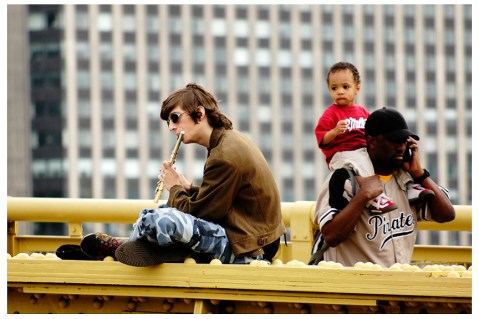
Untitled by Flickr user David Kent, CC BY-NC-ND 2.0
FRIDAY, November 14
7:00 – 8:00 am
Special Interest Group for Voice Studies
8:30 – 10:30 am
Commonwealth 1-2 Room, live streaming
Session: Sound Networks: Socio-Political Identity, Engagement, and Mobilization through Music in Cyberspace and Independent Media
*Sponsored by the Popular Music Section and Special Interest Group for Sound Studies
“Technological Factors Conditioning the Socio-Political Power of Music in Cyberspace,” Michael Frishkopf, University of Alberta
“Cyber-Mobilization, Informational Intimacy, and Musical Frames in Ukraine’s EuroMaidan Protests,” Adriana Helbig, University of Pittsburgh
“Countering Spirals of Silence: Protest Music and the Anonymity of Cyberspace in the Japanese Antinuclear Movement,” Noriko Manabe, Princeton University
“Living (and Dying) the Rock and Roll Dream: Alternative Media and the Politics of ‘Making It’ as an Iranian Underground Musician,” Farzaneh Hemmasi, University of Toronto
Sterling 1 Room
Session: Affective Environments and the Bioregional Soundscape
*Sponsored by the Special Interest Group for Ecomusicology
“’Landscape is Not Just What Your Eyes See’: Battery Radio, the Technological Soundscape, and Sonically Knowing the Battery, Kate Galloway, Memorial University of Newfoundland
“Re-sounding Caribou: Musical Posthumanism in Being Caribou,” Erin Scheffer, University of Toronto
“Cold, Crisp, and Dry: Inuit and Southern Concepts of the Northern Soundscape,” Jeffrey van den Scott, Northwestern University
Discussant, Nancy Guy, University of California, San Diego
Duquesne Room
“The Sound of Affective Fact,” Matthew Sumera, University of Minnesota
1:15 – 6:30 pm
Soundwalk: A Sonic Environmental Survey of the SEM Annual Meeting
*Sponsored by the Special Interest Groups for Sound Studies and Ecomusicology. Follow the walk on Twitter: #semsoundwalk
(Meet in Wyndham Grand main lobby at 1:15pm. Reconvene in lobby at 6:00)
1:45 – 3:45 pm
Smithfield Room
Session: Strident Voices: Material and Political Alignments
*Sponsored by the Special Interest Group for Voice Studies
“Registering Protest: Voice, Precarity, and Assertion in Crisis Portugal,”Lila Ellen Gray, University of Amsterdam
“Quiet, Racialized Vocality at Fisk University,” Marti Newland, Columbia University
“’The Rough Voice of Tenderness’: Chavela Vargas and Mexican Song,” Kelley Tatro, North Central College
Discussant: Amanda Weidman, Bryn Mawr College
4:00 – 5:30 pm
Heinz Room
Session: Celebratory Sounds and the Politics of Engagement
“Creating Zakopower in Postsocialist Poland,” Louise J. Wrazen, York University
“Merry-Making and Loyalty to the Movement: Conviviality as a Core Parameter of Traditionalism in Aysén, Chile,” Gregory J. Robinson, George Mason University
“Sounding the Carnivalesque: Changing Identities for a Sonic Icon of the Popular,” Michael S. O’Brien, College of Charleston

“Musical Mystery” by Flickr user Robert Wilhoit, CC BY-NC-SA 2.0
SATURDAY, November 15
8:30 – 10:30 am
Sterlings 1 Room
Roundtable: Sound Studies, Ecomusicology, and Post-Humanism In/For/With Ethnomusicology
*Sponsored by the Special Interests Groups for Ecomusicology and for Sound Studies
P. Allen Roda, The Metropolitan Museum of Art
Jennifer Post, University of Arizona
Mark Pedelty, University of Minnesota
Michael Silvers, University of Illinois at Urbana-Champaign
Ben Tausig, Stony Brook University
Zeynep Bulut, King’s College London
10:45 am – 12:15 pm
Benedum Room, live streaming
Musical Instruments, Material Cultures, and Sound Ecologies
“Bulgarian Acoustemological Tales: Narrativity, Agrarian Ecology, and the Kaval’s Voice,” Donna A. Buchanan, University of Illinois at Urbana-Champaign
Sterling 1 Room
Session: Theorizing Sound
“Water Sounds: Distance Swimmers and Ecomusicology,” Niko Higgins, Columbia University
“Telephone, Vacuum Cleaner, Couch: Senses and Sounds of the Everyday in Postwar Japan,” Miki Kaneda, Boston University
Discussant: Benjamin Tausig, Stony Brook University
SUNDAY, November 16
8:30 – 10:30 am
Birmingham Room
Session: Regulating Space, Regulating Sound: Musical Practice and Institutional Mediation in São Paulo, Brazil
*Sponsored by the Latin American and Caribbean Section
“Music under Control? São Paulo’s Anti-Noise Agency in Action,” Leonardo Cardoso, University of Texas at Austin
“Music Producers in São Paulo’s Cultural Policy Worlds,” Daniel Gough, University of Chicago
“’Small Universes’: The Creation of Social Intimacy through Aesthetic Infrastructures in São Paulo’s Underground,” Shannon Garland, Columbia University
Discussant, Morgan Lurker, Reed College
Heinz Room
“Hear What You Want: Sonic Politics, Blackness, and Racism-Canceling Headphones,” Alex Blue, University of California, Santa Barbara
Alleghany Room
“Sound and Silence in Festivals of the French Revolution: Sonic Analysis in History,” Rebecca D. Geoffroy-Schwinden, Duke University
10:45 am – 12:15 pm
Liberty Room
Session: Sounding Nations
“Building the Future through the Past: The Revival Movement in Iranian Classical Music and the Reconstruction of National Identity in the 1960s and the 1970s,” Hadi Milanloo, Memorial University of Newfoundland
“Sounding Citizenship in Southern Africa: Malawian Musicians and the Social Worlds of Recording Studios and Music Education Centers,” Richard M. Deja, University of Illinois
“Unity in (Spite of) Diversity: Tensions and Contradictions in Performing Surinamese National Identity,” Corinna S. Campbell, Williams College

“Music” by Flickr user Rich McPeek, CC BY-NC 2.0
Share this:

Acousmatic Surveillance and Big Data


It’s an all too familiar movie trope. A bug hidden in a flower jar. A figure in shadows crouched listening at a door. The tape recording that no one knew existed, revealed at the most decisive of moments. Even the abrupt disconnection of a phone call manages to arouse the suspicion that we are never as alone as we may think. And although surveillance derives its meaning the latin “vigilare” (to watch) and French “sur-“ (over), its deep connotations of listening have all but obliterated that distinction.
Moving on from cybernetic games to modes of surveillance that work through composition and patterns. Here, Robin James challenges us to consider the unfamiliar resonances produced by our IP addresses, search histories, credit trails, and Facebook posts. How does the NSA transform our data footprints into the sweet, sweet, music of surveillance? Shhhhhhhh! Let’s listen in. . . -AT
—
Kate Crawford has argued that there’s a “big metaphor gap in how we describe algorithmic filtering.” Specifically, its “emergent qualities” are particularly difficult to capture. This process, algorithmic dataveillance, finds and tracks dynamic patterns of relationships amongst otherwise unrelated material. I think that acoustics can fill the metaphor gap Crawford identifies. Because of its focus on identifying emergent patterns within a structure of data, rather than its cause or source, algorithmic dataveillance isn’t panoptic, but acousmatic. Algorithmic dataveillance is acousmatic because it does not observe identifiable subjects, but ambient data environments, and it “listens” for harmonics to emerge as variously-combined data points fall into and out of phase/statistical correlation.
Dataveillance defines the form of surveillance that saturates our consumer information society. As this promotional Intel video explains, big data transcends the limits of human perception and cognition – it sees connections we cannot. And, as is the case with all superpowers, this is both a blessing and a curse. Although I appreciate emails from my local supermarket that remind me when my favorite bottle of wine is on sale, data profiling can have much more drastic and far-reaching effects. As Frank Pasquale has argued, big data can determine access to important resources like jobs and housing, often in ways that reinforce and deepen social inequities. Dataveillance is an increasingly prominent and powerful tool that determines many of our social relationships.
The term dataveillance was coined in 1988 by Roger Clarke, and refers to “the systematic use of personal data systems in the investigation or monitoring of the actions or communications of one or more persons.” In this context, the person is the object of surveillance and data is the medium through which that surveillance occurs. Writing 20 years later, Michael Zimmer identifies a phase-shift in dataveillance that coincides with the increased popularity and dominance of “user-generated and user-driven Web technologies” (2008). These technologies, found today in big social media, “represent a new and powerful ‘infrastructure of dataveillance,’ which brings about a new kind of panoptic gaze of both users’ online and even their offline activities” (Zimmer 2007). Metadataveillance and algorithmic filtering, however, are not variations on panopticism, but practices modeled—both historically/technologically and metaphorically—on acoustics.
In 2013, Edward Snowden’s infamous leaks revealed the nuts and bolts of the National Security Administration’s massive dataveillance program. They were collecting data records that, according to the Washington Post, included “e-mails, attachments, address books, calendars, files stored in the cloud, text or audio or video chats and ‘metadata’ that identify the locations, devices used and other information about a target.” The most enduringly controversial aspect of NSA dataveillance programs has been the bulk collection of Americans’ data and metadata—in other words, the “big data”-veillance programs.

Borrowed from thierry ehrmann @Flickr CC BY.
Instead of intercepting only the communications of known suspects, this big dataveillance collects everything from everyone and mines that data for patterns of suspicious behavior; patterns that are consistent with what algorithms have identified as, say, “terrorism.” As Cory Doctorow writes in BoingBoing, “Since the start of the Snowden story in 2013, the NSA has stressed that while it may intercept nearly every Internet user’s communications, it only ‘targets’ a small fraction of those, whose traffic patterns reveal some basis for suspicion.” “Suspicion,” here, is an emergent property of the dataset, a pattern or signal that becomes legible when you filter communication (meta)data through algorithms designed to hear that signal amidst all the noise.
Hearing a signal from amidst the noise, however, is not sufficient to consider surveillance acousmatic. “Panoptic” modes of listening and hearing, though epitomized by the universal and internalized gaze of the guards in the tower, might also be understood as the universal and internalized ear of the confessor. This is the ear that, for example, listens for conformity between bodily and vocal gender presentation. It is also the ear of audio scrobbling, which, as Calum Marsh has argued, is a confessional, panoptic music listening practice.
Therefore, when President Obama argued that “nobody is listening to your telephone calls,” he was correct. But only insofar as nobody (human or AI) is “listening” in the panoptic sense. The NSA does not listen for the “confessions” of already-identified subjects. For example, this court order to Verizon doesn’t demand recordings of the audio content of the calls, just the metadata. Again, the Washington Post explains:
The data doesn’t include the speech in a phone call or words in an email, but includes almost everything else, including the model of the phone and the “to” and “from” lines in emails. By tracing metadata, investigators can pinpoint a suspect’s location to specific floors of buildings. They can electronically map a person’s contacts, and their contacts’ contacts.
NSA dataveillance listens acousmatically because it hears the patterns of relationships that emerge from various combinations of data—e.g., which people talk and/or meet where and with what regularity. Instead of listening to identifiable subjects, the NSA identifies and tracks emergent properties that are statistically similar to already-identified patterns of “suspicious” behavior. Legally, the NSA is not required to identify a specific subject to surveil; instead they listen for patterns in the ambience. This type of observation is “acousmatic” in the sound studies sense because the sounds/patterns don’t come from one identifiable cause; they are the emergent properties of an aggregate.

Borrowed from david @Flickr CC BY-NC.
Acousmatic listening is a particularly appropriate metaphor for NSA-style dataveillance because the emergent properties (or patterns) of metadata are comparable to harmonics or partials of sound, the resonant frequencies that emerge from a specific combination of primary tones and overtones. If data is like a sound’s primary tone, metadata is its overtones. When two or more tones sound simultaneously, harmonics emerge whhen overtones vibrate with and against one another. In Western music theory, something sounds dissonant and/or out of tune when the harmonics don’t vibrate synchronously or proportionally. Similarly, tones that are perfectly in tune sometimes create a consonant harmonic. The NSA is listening for harmonics. They seek metadata that statistically correlates to a pattern (such as “terrorism”), or is suspiciously out of correlation with a pattern (such as US “citizenship”). Instead of listening to identifiable sources of data, the NSA listens for correlations among data.
Both panopticism and acousmaticism are technologies that incite behavior and compel people to act in certain ways. However, they both use different methods, which, in turn, incite different behavioral outcomes. Panopticism maximizes efficiency and productivity by compelling conformity to a standard or norm. According to Michel Foucault, the outcome of panoptic surveillance is a society where everyone synchs to an “obligatory rhythm imposed from the outside” (151-2), such as the rhythmic divisions of the clock (150). In other words, panopticism transforms people into interchangeable cogs in an industrial machine. Methodologically, panopticism demands self-monitoring. Foucault emphasizes that panopticism functions most efficiently when the gaze is internalized, when one “assumes responsibility for the constraints of power” and “makes them play…upon himself” (202). Panopticism requires individuals to synchronize themselves with established compulsory patterns.
Acousmaticism, on the other hand, aims for dynamic attunement between subjects and institutions, an attunement that is monitored and maintained by a third party (in this example, the algorithm). For example, Facebook’s News Feed algorithm facilitates the mutual adaptation of norms to subjects and subjects to norms. Facebook doesn’t care what you like; instead it seeks to transform your online behavior into a form of efficient digital labor. In order to do this, Facebook must adjust, in part, to you. Methodologically, this dynamic attunement is not a practice of internalization, but unlike Foucault’s panopticon, big dataveillance leverages outsourcing and distribution. There is so much data that no one individual—indeed, no one computer—can process it efficiently and intelligibly. The work of dataveillance is distributed across populations, networks, and institutions, and the surveilled “subject” emerges from that work (for example, Rob Horning’s concept of the “data self”). Acousmaticism tunes into the rhythmic patterns that synch up with and amplify its cycles of social, political, and economic reproduction.

Sonic Boom! Borrowed from NASA’s Goddard Space Flight Center @Flickr CC BY.
Unlike panopticism, which uses disciplinary techniques to eliminate noise, acousmaticism uses biopolitical techniques to allow profitable signals to emerge as clearly and frictionlessly as possible amid all the noise (for more on the relation between sound and biopolitics, see my previous SO! essay). Acousmaticism and panopticism are analytically discrete, yet applied in concert. For example, certain tiers of the North Carolina state employee’s health plan require so-called “obese” and tobacco-using members to commit to weight-loss and smoking-cessation programs. If these members are to remain eligible for their selected level of coverage, they must track and report their program-related activities (such as exercise). People who exhibit patterns of behavior that are statistically risky and unprofitable for the insurance company are subject to extra layers of surveillance and discipline. Here, acousmatic techniques regulate the distribution and intensity of panoptic surveillance. To use Nathan Jurgenson’s turn of phrase, acousmaticism determines “for whom” the panoptic gaze matters. To be clear, acousmaticism does not replace panopticism; my claim is more modest. Acousmaticism is an accurate and productive metaphor for theorizing both the aims and methods of big dataveillance, which is, itself, one instrument in today’s broader surveillance ensemble.
–
Featured image “Big Brother 13/365” by Dennis Skley CC BY-ND.
–
Robin James is Associate Professor of Philosophy at UNC Charlotte. She is author of two books: Resilience & Melancholy: pop music, feminism, and neoliberalism will be published by Zer0 books this fall, and The Conjectural Body: gender, race and the philosophy of music was published by Lexington Books in 2010. Her work on feminism, race, contemporary continental philosophy, pop music, and sound studies has appeared in The New Inquiry, Hypatia, differences, Contemporary Aesthetics, and the Journal of Popular Music Studies. She is also a digital sound artist and musician. She blogs at its-her-factory.com and is a regular contributor to Cyborgology.
—
 REWIND!…If you liked this post, check out:
“Cremation of the senses in friendly fire”: on sound and biopolitics (via KMFDM & World War Z)–Robin James
The Dark Side of Game Audio: The Sounds of Mimetic Control and Affective Conditioning–Aaron Trammell
Listening to Whisperers: Performance, ASMR Community, and Fetish on YouTube–Joshua Hudelson
Share this:




Current Top Posts





April 2021

January 2020

November 2019

October 2019

August 2019

April 2014

November 2017

March 2015

December 2017

October 2015
 Sounding Out!
Recent Comments