
The Eldritch Voice: H. P. Lovecraft’s Weird Phonography

 Welcome to the last installment of Sonic Shadows, Sounding Out!’s limited series pursuing the question of what it means to have a voice. In the most recent post, Dominic Pettman encountered several traumatized birds who acoustically and uncannily mirror the human, a feedback loop that composes what he called “the creaturely voice.” This week, James Steintrager investigates the strange meaning of a “metallic” voice in the stories of H.P. Lovecraft, showing how early sound recording technology exposed an alien potential lingering within the human voice. This alien voice – between human and machine – was fodder for techniques of defamiliarizing the world of the reader.
— Guest Editor Julie Beth Napolin
—
A decade after finding itself downsized to a dwarf planet, Pluto has managed to spark wonder in the summer of 2015 as pictures of its remarkable surface features and those of its moon are delivered to us by NASA’s New Horizons space probe. As scientists begin to tentatively name these features, they have drawn from speculative fiction for what they see on the moon Charon, giving craters names including Spock, Sulu, Uhuru, and—mixing franchises—Skywalker . From Doctor Who there will be a Tardis Chasma and a Gallifrey Macula. Pluto’s features stretch back a bit further, where there will also be a Cthulhu Regio, named after the unspeakable interstellar monster-cum-god invented by H. P. Lovecraft.
We can imagine that Lovecraft would have been thrilled, since back when Pluto was first discovered in early 1930 and was the evocative edge of the solar system, he had turned the planet into the putative home of secretive alien visitors to Earth in his short story “The Whisperer in Darkness.” First published in the pulp magazine Weird Tales in 1931, “The Whisperer in Darkness” features various media of communication—telegraphs, telephones, photographs, and newspapers—as well as the possibilities of their manipulation and misconstruing. The phonograph, however, plays the starring role in this tale about gathering and interpreting the eerie and otherworldly—the eldritch, in a word—signs of possible alien presence in backwoods Vermont.
In the story, Akeley, a farmer with a degree of erudition and curiosity, captures something strange on a record. This something, when played back by the protagonist Wilmarth, a folklorist at Lovecraft’s fictional Miskatonic University, goes like this:
Iä! Shub-Niggurath! The Black Goat of the Woods with a Thousand Young! (219)
The sinister resonance of a racial epithet in what appears to be a foreign or truly alien tongue notwithstanding, this story features none of the more obvious and problematic invocations of race and ethnicity—the primitive rituals in the swamps of Louisiana of “The Call of Cthulhu” or the anti-Catholic immigrant panic of “The Horror at Red Hook”—for which Lovecraft has achieved a degree of infamy. Moreover, the understandable concern with Lovecraft’s social Darwinism and bad biology in some ways tends to miss how for the author—and for us as well—power and otherness are bound up with technology.
 The transcription of these exclamations, recorded on a “blasphemous waxen cylinder,” is prefaced with an emphatic remark about their sonic character: “A BUZZING IMITATION OF HUMAN SPEECH” (219-220). The captured voice is further described as an “accursed buzzing which had no likeness to humanity despite the human words which it uttered in good English grammar and a scholarly accent” (218). It is glossed yet again as a “fiendish buzzing… like the drone of some loathsome, gigantic insect ponderously shaped into the articulate speech of an alien species” (220). If such a creature tried to utter our tongue and to do so in our manner—both of which would be alien to it—surely we might expect an indication of the difference in vocal apparatuses: a revelatory buzzing. Lovecraft’s story figures this “eldritch sound” as it is transduced through the corporeal: as the timbral indication of something off when the human voice is embodied in a fundamentally different sort of being. It is the sound that happens when a fungoid creature from Yuggoth—the supposedly native term for Pluto—speaks our tongue with its insectile mouthparts.
Yet, reading historically, we might understand this transduction as the sound of technical mediation itself: the brazen buzz of phonography, overlaying and, in a sense, inhabiting the human voice.
For listeners to early phonographic recordings, metallic sounds—inevitable given the materials used for styluses, tone arms, diaphragms, amplifying horns—were simply part of the experience. Far from capturing “the unimaginable real” or registering “acoustic events as such,” as media theorist Friedrich Kittler once put the case about Edison’s invention, which debuted in 1877, phonography was not only technically incapable of recording anything like an ambient soundscape but also drew attention to the very noise of itself (23).
For the first several decades of the medium’s existence, patent registers and admen’s pitches show that clean capture and reproduction were elusive rather than given. An account in the Literary Digest Advertiser of Valdemar Poulsen’s Telegraphone, explains the problem:
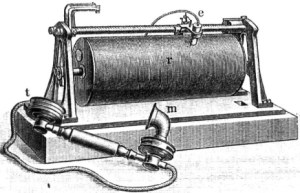 The talking-machine records sound by the action of a steel point upon some yielding substance like wax, and reproduces it by practically reversing the operation. The making of the record itself is accompanied by a necessary but disagreeably mechanical noise—that dominating drone—that ‘b-r-r-r-r’ that is never in the human voice, and always in its mechanical imitations. One hears metallic sounds from a brazen throat—uncanny and inhuman. The brittle cylinder drops on the floor, breaks—and the neighbors rejoice!
The Telegraphone, which recorded sounds “upon imperishable steel through the intangible but potent force of electromagnetism” such that no “foreign or mechanical noise is heard or is possible,” of course promised to make the neighbors happy not by breaking the cylinder but rather by taking the inhuman ‘b-r-r-r-r’ out of the phonographically reproduced voice. Nonetheless, etching sound on steel, the Telegraphone was still a metal machine and unlikely to overcome the buzz entirely.
In his account of “weird stories” and why the genre suited him best, Lovecraft explained that one of his “strongest and most persistent wishes” was “to achieve, momentarily, the illusion of some strange suspension or violation of the galling limitations of time, space, and natural law which forever imprison us and frustrate our curiosity about the infinite cosmic spaces beyond the radius of our sight and analysis.” In “The Whisperer in Darkness,” Lovecraft put to work a technology that was rapidly becoming commonplace to introduce a buzz into the fabric of the everyday. This is the eldritch effect of Lovecraft’s evocation of phonography. While we might wonder whether a photograph has been tampered with, who really sent a telegram, or with whom we are actually speaking over a telephone line—all examples from Lovecraft’s tale—the central, repeated conundrums for the scholar Wilmarth remain not only whose voice is captured on the recorded cylinder but also why it sounds that way.
 The phonograph transforms the human voice, engineers a cosmic transduction, suggesting that within our quotidian reality something strange might lurk. This juxtaposition and interplay of the increasingly ordinary and the eldritch is also glimpsed in an account of Charles Parson’s invention the Auxetophone, which used a column of pressurized air rather than the usual metallic diaphragm. Here is an account of the voice of the Auxetophone from the “Matters Musical” column of The Bystander Magazine from 1905: “Long ago reconciled to the weird workings of the phonograph, we had come to regard as inevitable the metallic nature of its inhuman voice.” The new invention might well upset our listening habits, for Mr. Parson’s invention “bids fair to modify, if not entirely to remove,” the phonograph’s “somewhat unpleasant timbre.”
What the phonograph does as a medium is to make weird. And what making weird means is that instead of merely reproducing the human voice—let alone rendering acoustic events as such—it transforms the latter into its own: an uncanny approximation, which fails to simulate perfectly with regard to timbre in particular. Phonography reveals that the materials of reproduction are not vocal chords, breath, labial and dental friction—not flesh and spirit, but vibrating metal.
Although we can only speculate in this regard, I would suggest that “The Whisperer in Darkness” was weirder for readers for whom phonographs still spoke with metallic timbre. The rasping whisper of the needle on cylinder created what the Russian Formalist Viktor Shklovsky was formulating at almost exactly the same time as the function of the literary tout court: defamiliarization or, better, estrangement. Nonetheless, leading the reader to infer an alien presence behind this voice was equally necessary for the effect. After all, if we are to take the Auxetophone as our example—an apparatus announced in 1905, a quarter of a decade before Lovecraft composed his tale, and that joined a marketplace burgeoning with metallic-voice reducing cabinets, styluses, dampers, and other devices—phonographic listeners had long since become habituated to the inhumanity of the medium. That inhumanity had to be recalled and reactivated in the context of Lovecraft’s story.
 To understand fully the nature of this reactivation, moreover, we need to know precisely what Lovecraft’s evocative phonograph was. When Akeley takes his phonograph into the woods, he adds that he brought “a dictaphone attachment and a wax blank” (209). Further, to play back the recording, Wilmarth must borrow the “commercial machine” from the college administration (217). The device most consistent with Lovecraft’s descriptions and terms is not a record player, as we might imagine, but Columbia Gramophone Company’s Dictaphone. By the time of the story’s setting, Edison Phonograph’s had long since switched to more durable celluloid cylinders (Blue Amberol Records; 1912-1929) in an effort to stave off competition from flat records. Only Dictaphones, aimed at businessmen rather than leisure listeners, still used wax cylinders, since recordings could be scraped off and the cylinder reused. The vinyl Dictabelt, which eventually replaced them, would not arrive until 1947.
Meanwhile, precisely when the events depicted in “The Whisperer in Darkness” are supposed to have taken place, phonography was experiencing a revolutionary transformation: electronic sound technologies developed by radio engineers were hybridizing the acoustic machines, and electro-acoustic phonographs were in fact becoming less metallic in tone. Yet circa 1930, as the buzz slipped toward silence, phonography was still the best means of figuring the sonic uncanny valley. It was a sort of return of the technologically repressed: a reminder of the original eeriness of sound reproduction—recalled from childhood or perhaps parental folklore—at the very moment that new technologies promised to hide such inhumanity from sensory perception. Crucially, in Lovecraft’s tale, estrangement is not merely a literary effect. Rather, the eldritch is what happens when the printed word at a given moment of technological history calls up and calls upon other media of communication, phonography not the least.
I have remarked the apparent absence of race as a concern in “The Whisperer in Darkness,” but something along the lines of class is subtly but insistently at work in the tale. The academic Wilmarth and his erudite interlocutor Akeley are set in contrast with the benighted, uncomprehending agrarians of rural Vermont. Both men also display a horrified fascination with the alien technology that will allow human brains to be fitted into hearing, seeing, and speaking machines for transportation to Yuggoth. These machines are compared to phonographs: cylinders for storing brains much like those for storing the human voice. In this regard, the fungoid creatures resemble not so much bourgeois users or consumers of technology as scientists and engineers. Moreover, they do so just as a discourse of technocracy—rule by a technologically savvy elite—was being articulated in the United States. Here we might see the discovery of Pluto as a pretext for exploring anxieties closer to home: how new technologies were redistributing power, how their improvement—the fading of the telltale buzz—was making it more difficult to determine where humanity stopped and technology began, and whether acquiescence in this changes was laudable or resistance feasible. As usual with Lovecraft, these topics are handled with disconcerting ambivalence.
—
James A. Steintrager is a professor of English, Comparative Literature, and European Languages and Studies at the University of California, Irvine. He writes on a variety of topics, including libertinism, world cinema, and auditory cultures. His translation of and introduction to Michel Chion’s Sound: An Acoulogical Treatise will be published by Duke University Press in fall of 2015.
—
Featured image: Taken from “Global Mosaic of Pluto in True Color” in NASA’s New Horizons Image Gallery, public domain. All other images courtesy of the author.
—
 REWIND! . . .If you liked this post, you may also dig:
Sound and Sanity: Rallying Against “The Voice” — Mark Brantner
DIANE… The Personal Voice Recorder in Twin Peaks — Tom McEnaney
Reproducing Traces of War: Listening to Gas Shell Bombardment, 1918 — Brían Hanrahan
Share this:

Future Memory: Womb Sound As Shared Experience Crossing Time and Space
This Month will feature a two-part post by SO! regular writer Maile Colbert. Look for Part Two on Monday, January 19th.
—
I was a child obsessed with time travel. Beyond favorites such as A Wrinkle in Time and Time Bandits, I perpetually daydreamed of the ability to pause, reverse, and fast-forward my life. I had a book on the “olden days” and it amazed me that my great-grandparents, whom I had the fortune to know, had lived them. I wanted to fast forward and see myself their current age, telling stories to the next generations of a good life lived. I used to entertain the thought that if I let my breath go and let myself sink to the bottom of a body of water, I could pause time, or at least slow it down, as the sound of the fluid world around me seemed to suggest. Whenever my family moved, I made a time capsule, and I always scanned the ocean for long lost bottled messages. These were the beginnings of my future in time-based media–both image and sound–my love for found footage, and my recent research and writing on sound back in time.
Now as a new mother, I am beginning to think about the future in a way I hadn’t before. I see my mother in my daughter, and I see her mother, and my partner’s mother. I recognize my grandfather’s eyebrow when furrowed, and her grandfather’s nose. My mouth when smiling, my partner’s mouth when in concentration.
And our ears. . .our very sensitive hearing, almost like a punch line. Our daughter is truly the daughter of sound artists. In this first post of a two part series on humans’ earliest interactions with sound, I document our work sounding and listening together, which began in a future-oriented past I am still learning about.
Womb
There was a study in which doctors gave babies only a day old pacifiers connected to tape recorders. Depending on the pattern of the new babies suck, the tape recorder would either switch on the sound of the mother’s voice, or a stranger’s.
“Within 10 to 20 minutes, the babies learned to adjust their sucking rate on the pacifier to turn on their own mother’s voice,” says the study’s coauthor William Fifer, Ph.D., an associate professor of psychiatry and pediatrics at Columbia University’s College of Physicians and Surgeons. “This not only points out a newborn’s innate love for his mother’s voice but also a baby’s unique ability to learn quickly.”
– “What Babies Learn in the Womb,” 2014, Lara Flynn Maccarthy, Parenting
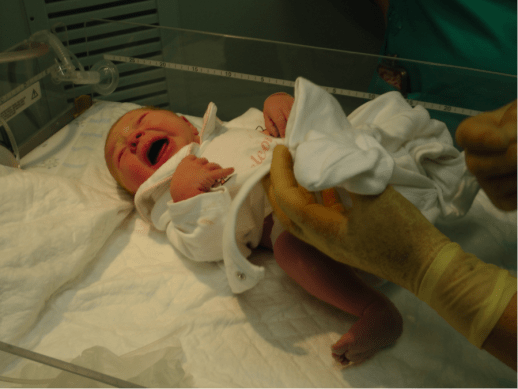
My daughter Odette knew my voice the moment she was born. In a strange, bright, cold new world, it seemed one constant she could rely upon. When she was first placed upon my chest, I started to sing to her, and she was calming, staring at me, as much as her newborn eyes would let her, with an expression of surprised recognition, as this familiar voice sang a familiar song, one I sang her often in the womb. One I knew by heart because my mother would sing it to me when I was a child.
Are you going to Scarborough Fair
Parsley, sage, rosemary and thyme
Remember me to the one who lives there
She once was a true love of mine. . .
The mother’s voice comes to the fetus not solely as ambient sound through the abdomen, as other external sounds and voices would, but also through the vocal cords’ internal vibration. There is a direct connection, a shared space. As early as the seventh month, a fetal heartbeat will slow and calm to the sound of the mother’s voice, and research has shown newborns even prefer a similar version of their mother’s voice to what they heard in the womb, muffled and low. When Odette suffered colic in her early months, one sure way to help comfort her was to sing to her while she was on my chest. Aside from the close contact of skin, the familiar smell, the warmth, it could be that hearing my voice also through the chest mimicked the womb filter.
In the tape recorder study, researchers also noted that newborns would suck more intensely to recordings of people speaking in the language of their mothers, most likely picking up on the melody and rhythm. We are beginning to understand that learning starts in the womb.
Fetal Soap Addiction
Carmen Bank found her 1985 pregnancy rather boring. So, to pass the time, she started doing something she would never have dreamed of: watching a soap opera.
Unexpectedly, she found herself hooked. And so she spent almost every morning in front of her television set, ready for the familiar theme of “Ryan’s Hope.” After Melissa was born that October, Bank bought a videocassette recorder so she could tape the show when she was too busy to watch.
Bank isn’t sure when she discovered the behavior, but, shortly after Melissa was born, Bank realized that the baby seemed to recognize the “Ryan’s Hope” theme and would stop fussing when the program began.
“She’d just sit there and watch the whole introduction and then she would start imitating what they do on the show,” Bank said. “This has been going on forever.”
-The Very Young and Restless, Do Soaps Hook the Unborn? June 28, 1988, Allan Parachini, The New York Times
My third trimester was a rough one. I was a walking swimming pool of about forty pounds of baby and amniotic fluid. My pelvis had gone completely out of line, making even that pregnancy waddle slow and difficult. Needless to say, I was less and less mobile. I was lucky that much of my remaining work was writing and studio based, but often found myself having to take mental breaks as well. My body/mind chemistry was working overtime. Something that happens with pregnancy when preparing mentally for your new, shared life is to think a lot about your own childhood. I was lucky to have a happy one, and so strong nostalgic feelings and memories would come up, particularly around the television show Dr. Who. I used to spend a happy hour with my father once a week watching reruns from the 70’s in the 80’s.
Dr. Who returned to broadcast in the 2000s, in a few new successful regenerations. The new iteration uses a lot of the classic themes, characters, and even remixes and re-masters the the original opening score written by Ron Grainer and realized by the great Delia Derbyshire for the BBC Radiophonic Workshop in 1963; the Dr. Who theme was one of the very first signature electronic music tunes, and performed well before commercial synthesizers were even available. Derbyshire used musique concrete techniques, cutting each note individually on analogue tape, speeding up and slowing down to create the notes from recordings of a single plucked string, white noise, and the simple harmonic waveforms of test-tone oscillators. (Grainer was famous for asking after hearing Derbyshire’s magic, “Did I write that?”. Derbyshire replied “Most of it.” The BBC, who kept members of the Radiophonic Workshop anonymous, prevented Grainer from giving Derbyshire a co-composer credit and a share of the royalties.)
It is a really, really catchy tune:
While Odette was in the womb, I watched all of those decades addictively, one after another. When I came across the soap opera study after she was born, I decided my obsessive Who-watching had set up a perfect laboratory to try it out myself. We started in 1963 and moved through time with the Doctor. Odette looked up in surprise and her brow furrowed in concentration. She looked around slowly at first, then faster and faster. She smiled; she cooed; she laughed. She started to flap her arms.
.
When I finally turned it off, she stopped everything and looked concerned. I turned it on again and we danced together in clear recognition of this already-shared future past sonic moment, one I had with my father and now with her. Now I understood that as I consumed Dr. Who, Odette was not only hearing, she was learning, and beginning the act of listening.
Sounds have a surprising impact upon the fetal heart rate: a five second stimulus can cause changes in heart rate and movement which last up to an hour. Some musical sounds can cause changes in metabolism. “Brahm’s Lullaby,” for example, played six times a day for five minutes in a premature baby nursery produced faster weight gain than voice sounds played on the same schedule (Chapman, 1975)
-The Fetal Sense, A Classical View, David B. Chamberlain, Birth Psychology
Wombscapes
Odette’s very first movements, her first “quickening”, was in response to David Bowie’s “Starman”. This was around 16 weeks, often the time for first movements in the fetus, and interestingly also the time when the hearing has developed. The fetus floats in a rich and complex soundscape; it is anything but quiet. The womb filter…amniotic fluid, embryonic membranes, uterus, the maternal abdomen-low frequencies, and blood in veins whooshing, then Mother’s voice and body noises such as hiccups and the gurgles of digestion and of course, the heartbeat. The Mother’s heartbeat can be as loud as a vacuum cleaner and ultra sounds as loud as a subway car arriving in a train station.We can try to mimic the womb-scape, imagining sounds being filtered through the body. We can use a hydrophone–a pressure microphone designed to be sensitive to soundwaves through fluid matter–on the abdomen to get an idea and sample for our womb-scape.
Perhaps it would sound something like this…
…reactive listening begins eight weeks before the ear is structurally complete at about 24 weeks. These findings indicate the complexity of hearing, lending support to the idea that receptive hearing begins with the skin and skeletal framework, skin being a multireceptor organ integrating input from vibrations, thermo receptors, and pain receptors. This primal listening system is then amplified with vestibular and cochlear information as it becomes available. With responsive listening proven at 16 weeks, hearing is clearly a major information channel operating for about 24 weeks before birth.
-The Fetal Sense, A classical view
Sound artist and Acoustic Ecologist Andrea Williams has been recently working on a composition for Bellybuds, for her yet born nephew. Bellybuds are “a specialized speaker system that gently adheres to your belly & safely plays memory-shaping sound directly to the womb.” Much of her work is composed with space in mind, using room sounds in a live performance situation. Williams told me it was interesting thinking about the womb as a new “venue,” with her little developing nephew as her audience. “What is he hearing?” she asked, “will he recognize me right away upon meeting him for the first time if he only hears the sound of my voice through the Bellybuds while he is a fetus?” I love the idea that she could send a “hello” from one place to her nephew in the womb in another.
The more we understand and realize about fetal hearing and processing sound, the more we understand how fetuses can detect subtle changes and process complex information. Memory starts to form around 30 weeks, and it’s possible early sound interventions at this time could help babies with detected abnormal development. Speaking and singing to the unborn fetus, allowing them to experience different soundscapes while still in the womb, helps shape their brains. This is probably why the urge to do so is there.
. . .Odette’s first dance. Odette’s first songs. . . transcending time and space.
—
dedicated to Odette Helen, and to the family, daughter, and memory of Steven Miller
—
Featured Image: Odette’s Birth Cry, photo credit Rui Costa
The album Future Memory, for Odette will be released in 2015 through Wild Silence. A dedication album to a newborn daughter…a mix of her parents’ recorded and shared sounds, memories, hopes, and dreams towards a future with her. Sounds of her womb-scape, birth, and first year…music in collaboration with friends and family across oceans and land…an album of lullabies for Odette.
—
Maile Colbert is a multi-media artist with a concentration on sound and video who relocated from Los Angeles, US to Lisbon, Portugal. She is a regular writer for Sounding Out!
—
REWIND! . . .If you liked this post, you may also dig:
On Sound and Pleasure: Meditations on the Human Voice– Yvon Bonenfant
This Is Your Body on the Velvet Underground– Jacob Smith
Sound Designing Motherhood: Irene Lusztig & Maile Colbert Open The Motherhood Archives– Maile Colbert
Share this:




Current Top Posts





April 2021

January 2020

November 2019

October 2019

August 2019

April 2014

November 2017

March 2015

December 2017

October 2015
 Sounding Out!
Recent Comments