
Chicana Radio Activists and the Sounds of Chicana Feminisms

Monica De La Torre interviews J. Kehaulani Kauanui at the Women Who Rock Conference, 2.18.2011, Image by Angelica Macklin
The power of hearing Chicana voices on the air is loud and clear. Indeed, when I heard Chicana feminist scholar Gloria Anzaldúa discussing her theory of hybridity and borderlands on the program The Mexican American Experience (1977) I was not only moved by the sound of Anzaldúa’s voice, but also by my intimate interaction with this influential feminista made possible through analog radio and digital technologies. Such experiences made me want to trace my own genealogy and find other Chicanas involved in radio production. I began to listen for Chicana radio activism on the airwaves, and document when, where and how Chicanas utilize radio not just as a tool for the transmission of sound, but also as a feminist community-building platform.
 My entry into radio came about when I joined Soul Rebel Radio—a radio collective composed of college students, environmentalists, musicians, comics, poets, and community activists in the Los Angeles area. A youth-centered radio program, Soul Rebel Radio airs monthly on KPFK 90.7 FM in Los Angeles and focuses on themes—such as the environment, war, and young women’s issues—and current events through comedy, youth voices, opinion pieces, editorials and interviews. With no prior radio or production experience, I joined the collective in October of 2007 hoping to fulfill my life long ambition of being on the radio. This experience of collective collaboration, which is both inspiring and challenging, became a cornerstone in my thinking about the empowering nature of media making, especially community radio. I cultivated the power of my voice through my participation in Soul Rebel Radio by learning how to write, edit and produce radio segments.
Now, as a Chicana feminist scholar and community radio practitioner, I am interested in collective, community-centered research projects that help transform the neoliberal, corporate institutionalization of media production and higher education. Although the content of my research is rooted in analog technologies, I work to ground the analysis of Chicana/o radio production through a digital Chicana feminista praxis, which includes the use of digital tools such as radio, digital film and open source software. This digital Chicana feminista theory and method may help uncover the ways in which community radio production constitutes an epistemological soundtrack to Chicana feminist activism, asking what are the sounds Chicana feminisms? Who are the Chicana activists of the 1970s and 1980s that utilized radio to build community, while incorporating an important aural element to their activism?
In answering these questions, I explore the ways in which digital tools can be utilized to uncover and reclaim subjugated knowledges. However, I am in no way suggesting that digital technologies should supersede or replace face-to-face community building. In fact, my current project—from which this blog post is drawn—documents and creates an archive of Chicana radio activists, including radio station managers, producers, news directors and on-air hosts. I discuss how community radio production provides Chicanas and other marginalized groups the space to harness digital technologies and engage in the process of producing traveling sounds that speak back to discriminatory and oppressive practices. While my methods include digital film production, online archive building and curation, my writing here focuses on oral history collection, particularly my documentation of Radio KDNA.
Radio KDNA
On December 19, 1979, Radio KDNA (pronounced cadena, meaning chain) transformed the airwaves becoming the first full-time Spanish-language, non-commercial radio station in the United States (Radio Bilingüe KBBF 89.1 FM, in Santa Rosa, founded by farmworkers and Sonoma State undergraduates, was the first bilingual radio station, going on air in 1973). Located in Granger, WA, Radio KDNA’s goal was to utilize the accessibility of radio to build community while serving as a resource for the mostly Mexican and tejano migrant farm workers in the Yakima Valley. The founders of Radio KDNA believed radio was an accessible tool for Mexican and Latino farm worker communities who had little access to other media. Beginning in 1942, Mexican workers entered the United States under the Bracero Program whereby mostly agribusinesses contracted Mexican workers in response to labor shortages of World War II, which in turn caused the lowering of wages. Thus, many Mexican American and tejano farmworkers migrated to places such as Idaho, Oregon and Washington. With a growing population of a Mexican Spanish-speaking community, Radio KDNA used its Spanish-language radio platform to reflect the sociopolitical needs of this shifting demographic.

The oral history I conducted with Rosa Ramón—the only female co-founder of Radio KDNA who served as the station manager from 1979 to 1984—uncovers the radio station’s historical significance within community radio production, specifically as a site of Chicana feminist activism. Rosa’s testimonio reveals the process by which many Mexican-American, and specifically tejano families migrated from the Southwest to the Northwest in search jobs, many ending up in Washington’s Yakima Valley, an area in need of labor to harvest its crops. The migration of Mexican and tejano families served not only as a vital labor force in Yakima’s fields, it also created a community that needed and greatly benefitted from a radio station that addressed the needs of this community, both in content and language. Although Rosa was born in Arizona, her Mexican mother and tejano father decided to migrate north, stopping in Arizona and California before settling down in Eastern Washington where her family purchased a small farm. As Erasmo Gamboa illustrates in his monograph Mexican Labor and World War II, “After 1948, northwestern farms used fewer braceros as they stepped up the recruitment of Mexican Americans from the Southwest” (123). Rosa’s family is one of many families that migrated to the Northwest, a region that needed and greatly benefited from their labor.

Rosa Ramón, Image by author
Although the small community where Rosa grew up was mostly comprised of Mexican and tejano families, she experienced and witnessed racism and discrimination, especially at school where she was reprimanded for speaking Spanish and mocked for eating tacos instead of bologna sandwiches. Rosa was only one of four Latinos that graduated from Grandview High School. These early experiences of marginalization and her family history served as an impetus for Rosa to work in non-profits that benefitted her community, including Northwest Rural Opportunities, a community based organization set up in 1968 to provide services to seasonal and migrant farm workers in Washington state. Here she met Ricardo Garcia, another co-founder of Radio KDNA.
In an effort to bring Spanish language radio programming to the Pacific Northwest, in particular for the migrant farm workers in Eastern Washington, Rosa and Ricardo, along with Daniel Roble, and Julio Cesar Guerrero, worked tirelessly for five years to obtain a broadcasting license for a community radio station in the Yakima Valley. However, Radio Cadena was producing radio content even before opening the doors of their Granger, Washington studio in 1979. In 1975, Northwest Rural Opportunities began a training program for farm worker youth to learn radio production skills in Linden, Washington. They also began an educational training program for Spanish-speaking individuals who were learning English. In May of 1976, Radio Cadena began broadcasting on a subcarrier signal provided by Seattle-based community radio station KRAB FM, with the assistance of its station manager Chuck Reinsch. The use of this signal meant that listeners could only tune in through a special home receiver, which limited the number of people who could actually tune-in to Radio Cadena’s programming.
Ramón’s oral history reveals the importance and central role women played in the founding and development of this station, particularly in its focus on programming for, by, and about women. Her family’s migratory trajectory is an example of how Mexican and tejano communities who moved to the Yakima valley to work in the fields established a community that needed and benefited from community radio. Radio Cadena is an example of the ways in which the migration of people created the conditions for the founding of a community radio station that traversed sonic borders and infused its airwaves with stories of resistance.
Mujer(es)
As part of its community building activities, Radio KDNA trained women, especially farmworker women, to produce radio content. As Rosa shared with me during her oral history, Radio KDNA and the show Mujer (woman) were instrumental in centering women within the radio production process, by playing music by women like Mercedes Sosa and Lydia Mendoza, interviewing local women, creating news content, and training women to actually produce radio programs. Indeed, this model of Chicana radio production was instrumental in the founding and day-to-day activity of Radio KDNA, and it represents a vital technological component of the Chicano Movement era. Chicanas such as station manager Ramón, producer Estella del Villar, and news director Berenice Zuniga, not only held positions of power at KDNA, but they also produced Mujer, which aired weekly and whose goal was to provided farm worker women with news stories, music and other informative pieces addressing their distinct subjectivities. These female producers and their audience demonstrate the transformative power of community radio production and the role of women in a movement that often downplays their contributions.

Yakima Herald Republic, 17 December 1984. From “Radio KDNA: The Voice of the Farmworker, 1975-1985” by Oscar Rosales Castañeda
By deploying Chicana historian Emma Pérez’s concept of the decolonial imaginary within Radio and Sound Studies to uncover the hidden voices of Chicanas within radio production, I document stories that compel scholars to conceive of a new framework that listens to the sound migrations of Chicana media activism, the third spaces and technological tools of the Chicano Movement not just in the Pacific Northwest, but throughout the country. The historical significance of Radio KDNA as the first full-time, Spanish language non-commercial radio station in the United States recasts Chicana/os as technologically adept and as active participants in the development of community radio. Moreover, Rosa Ramón’s oral history provides another example of the ways in which Chicana feminist activism emerged in conjunction with other social justice movements, further challenging the idea that Chicanas came to feminism after their white or African American counterparts. My historical analysis of Chicana radio production contextualizes current participation in media making, as radio can provide women of color and other marginalized groups the space to harness digital technologies to speak back and broadcast their concerns. When remixed with other components of Chicana feminisms, the sounds of Chicana radio activism constitute yet another track of resistance to the narratives that seek to silence these movements..
—
Featured Image by Angelica Macklin: Monica De La Torre interviews J. Kehaulani Kauanui at the radio kiosk, No. 2, Women Who Rock 2011 conference, Seattle University Pigott Building, February 18, 2011, From the Women Who Rock Collection, University of Washington Libraries, Special Collections Division, University of Washington Digital Libraries.
—
Monica De La Torre is a doctoral student in the Department of Gender, Women and Sexuality Studies at the University of Washington. Her scholarship bridges New Media and Sound Studies by analyzing the development of Chicana feminist epistemologies in radio and digital media production. A member of Soul Rebel Radio, a community radio collective based in Los Angeles, Monica is specifically interested in the ways in which radio and digital media production function as tools for community engagement. She is an active member of the UW Women of Color Collective and the Women Who Rock Collective. Monica earned a B.A. in Psychology and Chicana/o Studies from University of California, Davis and an M.A.in Chicana/o Studies from California State University, Northridge; her master’s thesis was entitled “Emerging Feminisms: El Teatro de las Chicanas and Chicana Feminist Identity Development.” Monica received a 2012 Ford Foundation Predoctoral Fellowship, which recognizes superior academic achievement, sustained engagement with communities that are underrepresented in the academy, and the potential to enhance the educational opportunities for diverse students.
—
 REWIND! . . .If you liked this post, you may also dig:
Eye Candy: The Absence of the Female Voice in Sports Talk Radio–Liana Silva
Listening to the Border: “’2487’: Giving Voice in Diaspora” and the Sound Art of Luz María Sánchez–Dolores Inés Casillas
Yellow Rain and The Sound of the Matter: Kalia Yang’s Sonorous Objection to Radiolab–Justin Eckstein
Share this:

An Ear-splitting Cry: Gender, Performance, and Representations of Zaghareet in the U.S.

At the opening of a recent annual “Under a Desert Moon” concert presented by Sahara Dance, a belly dance studio located in Washington, DC, one of the teachers began by telling the audience that the dancers would appreciate vocal feedback during the show. Holding a microphone with one hand and the other in front of her mouth, she demonstrated the practice known in Arabic as zaghareet, asking audience members to imitate her sound. This pedagogical interaction with an ethnically and generationally diverse audience on the campus of American University illustrates some of the complexities of translating sonic practices across cultural and economic divides. Zaghareet carries very different weight in a Palestinian wedding in the West Bank, where it is one piece of a larger formation of celebratory experience, than it does in a belly dance performance in Washington, DC, where it is used in part to generate authenticity in a tradition both geographically and culturally removed from the Middle East.
Located somewhere between singing and yelling, ululation occupies a unique position in the spectrum of human vocality. The sound is created by touching the tongue either to the sides of the mouth or the teeth in rapid succession, and it is characterized by a piercing sound quality enacted in the upper vocal register.
Having taken belly dance classes in the U.S. and seen a number of performances, I thought I had a sense of what ululation was and what it represented. The more I ran across it in the course of my dissertation research, however, the more I wanted to know about its historical background and affective meanings across contexts. In other words, what are the cultural genealogies of zaghareet in the Middle East, and how has the sound been perceived and represented in the U.S.? Although ululation is performed in a range of locations in South Asia, the Middle East and North Africa (MENA), my research is on U.S.-Middle East sonic encounters, and thus I will focus primarily on that context in this post. In particular, I became interested in why female voices typically perform zaghareet, and how its circulation in U.S. media and pop culture fit into larger narratives about the Middle East before and after 9/11.
Zaghareet is auditorally conspicuous, and in U.S. during the postwar decades before 9/11, it was often framed as a sonic encapsulation of an Arab exotic. The sound itself came to invoke elements that constitute classic Western stereotypes about the region known as the Middle East: veiling, gender oppression, desert wandering, and pre-modern ritual. Its status as a primarily female practice made it appealing as a sign of difference, since the West has been notoriously preoccupied with the status of women in the Middle East (see Chandra T. Mohanty, “Under Western Eyes: Feminist Scholarship and Colonial Discourses;” Lila Abu-Lughod, ed., Remaking Women: Feminism and Modernity in the Middle East; Leila Ahmed, Women and Gender in Islam: Historical Roots of a Modern Debate, among others). Zaghareet poses a contradiction to this orientalizing logic, as it works against the image of the oppressed Arab woman “silenced” by her surroundings. Instead, her voice takes on an uncanny resonance, indicating the tantalizing alienness of Arab culture. In a post-9/11 U.S. context, zaghareet become directly correlated with premodern barbarity, taking on more menacing anti-American associations. By taking a critical approach to the practice of zaghareet and its representations I hope to deflate some of these prevalent views and help to develop a new framework for thinking about aural exoticism.

Celebration of Egyptian revolution in DC, 2011, Image by Flicker user Collin David Anderson
Zaghareet’s combination of high pitch, loud volume, vibrato, and tongue oscillation contributes to its prominent, distinctive sound. In Jennifer Jacobs’ dissertation on ululation in the Levantine context (the term Levant refers to a region made up of Syria, Lebanon, Jordan, Palestine/Israel, and other areas in the Eastern Mediterranean), “Ululation in Levantine Society: The cultural reproduction of an affective vocalization” she points out that zaghareet typically last approximately 3 1/3 seconds, which is longer than the articulation of most words in speech, but not beyond the length of a typical speech phrase (111). Thus, though it is not speech or singing, zaghareet is related to these vocalizations in the sense that it lasts approximately the length of one breath. The practice is most often performed by women, and its acoustic intensity is remarkable considering that in an indoor setting with the performer near the microphone it can reach 85 dB, a level that can cause hearing damage with prolonged exposure. These components highlight the significance of zaghareet as a primarily female performance, making the practitioners audible at a level that isimpossible to ignore.

Woman at pro-Palestinian rally in France, Image by Flickr user lookingforpetry
Zaghareet takes place within a unique set of circumstances with a range of other sounds occurring simultaneously, and therefore should be conceptualized as part of a web of social meanings and practices, not as a discrete element to be observed on its own. The history of zaghareet (and ululation more generally) reaches back to ancient Greece, where the practice was referred to as ololuge, an onomatopoetic reference to the sound. In the 21st century Levant, zaghareet is often part of social gatherings where live music and dancing are also present. While most often situated in celebratory social settings, zaghareet can also take place in a variety of everyday circumstances, but in almost all cases it connotes farah, or joy. Performers generally do zaghareet to express their excitement, delight, and/or encouragement to others present. The practice tends to be contagious in that after hearing it others tend to join in, but the exact origins of the sound can remain mysterious due to the fact that most practitioners cover their mouths with their hands or clothing. This produces an omnipresent effect that both dislocates the listener and develops shared experience, and the collectivity of the performance magnifies its affective power. Jacobs writes, “When one person begins performing zaghareet, another person might join in; then, a third person might also join just as the first vocalist is dropping off. This overlapping of performances creates a perceptual experience of zaghareet as something layered, continuous, and emanating from different spatial locations, a haunting bodily experience, especially for a first-time listener” (75). This is complicated by broader soundscapes in which it is performed, which may include music, clapping, firing of guns, traffic, and other sounds.
In addition to performance setting, gender is a key component of zaghareet. While it is performed more often by women than men, in certain contexts and communities, men do participate. Jacobs describes one case in which men had demonstrated that they could skillfully perform zaghareet, but only minutes later jokingly denied that they knew how to do it when she asked. This emphasis on modesty is also apparent in the way that most female practitioners cover their mouths while doing zaghareet to hide the movement of the tongue, which tends to be considered immodest or impolite. In this Youtube clip, for example, the zaghareet performer covers her mouth with her hijab:
.
And as is shown in the clip, zaghareet often takes place in homosocial environments where men are not immediately present, providing space for playful exchange between women in ways that heterosocial settings may not. The homosociality of the sonic practice is related to its affective reverberations, as the sound is used to convey bonds of attachment, conviviality and mutual appreciation between women. In this sense zaghareet embodies these interpersonal connections, and also reinforces them through its aural intensity.
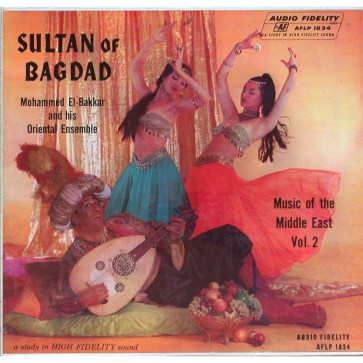
In American and European popular culture, zaghareet has played a notable role in framing depictions of the Middle East, particularly through the female body. In the years following World War II, zaghareet samples often marked the Middle East as wild and exciting. Lebanese-born singer Mohammed El Bakkar, for example, used the sound of zaghareet on his song “Yalla-Yalla” from the 1958 album The Sultan of Bagdad, one of several albums he recorded for the Audio Fidelity label in the late-1950s marketed to a mainstream American audience.
.
“Yalla-Yalla,” which translates loosely as “Come with me,” features finger cymbals, clapping, and female zaghareet, along with jovial calls from El Bakkar at the ends of phrases, conjuring a celebratory setting. All of these elements–along with the album cover photo that shows El Bakkar lounging on a cushion with two beautiful dancers standing over him–combine to create a quintessential exotic scene for many American listeners.
Although unintentionally kitschy at times, the 1962 British epic Lawrence of Arabia—a film which has the dubious distinction of having no spoken lines by a woman in its 3 1/2 hour running time—represents zaghareet quite seriously. The ululations first appear about half of the way through the film, where Lawrence and the Arab forces set off to fight the Turkish at Aqaba, and women provide blessings and encouragement.
.
Lawrence of Arabia is a classically orientalist film about the scope of British empire, and in this instance, zaghareet accentuates the majesty of the scene where Lawrence rides beside his Arab counterparts through the desert with veiled women calling from the cliffs above. Like the previous example, the women here constitute part of a foreign landscape, and their cries of encouragement serve along with the visuals to construct a multi-sensory experience of otherness.
Zaghareet has taken on more explicitly violent associations in a post-9/11 American context, where it is often coupled with Arab depravity and linked to terrorism. Zaghareet was demonstrated in a newsclip aired on CNN, Fox, and several other news networks displaying Palestinians in the West Bank “celebrating after 9/11.” One woman in the clip briefly ululates in front of the camera, connecting the sound to perceived Arab hatred for Americans.
.
The video went viral, and reactions to it exemplify the extent to which zaghareet has come to symbolize a new stereotype in the post-9/11 era: the depraved Middle Eastern Other. This formula collapses and combines the categories of “Arab” and “Muslim,” and, although it complicates the figure of the terrorist as male, since it is a woman who is shown celebrating after 9/11, it also reveals western anxieties about the power that Lawrence of Arabia represented as harnessed by colonial forces.
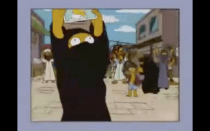
Screen shot by author
A parody of the viral news clip appeared on a 2004 The Simpsons episode entitled “Bart-Mangled Banner” in which Bart accidentally moons the American flag at a basketball game, and subsequently faces a public outcry from critics calling him anti-American. The nightly news shows the “overseas” response, in which a woman wearing niqab holds up a photo of Homer and says “Simpsons be praised! Praise be to Springfield!” and then performs zaghareet against a backdrop of celebratory gunfire. This satire hints at the absurdity of controversies over such displays, but it also reinscribes the idea of the Arab/Muslim female as a source of danger, a new element of anti-American hostility that became associated with the sound after 9/11.
Unlike previous impressions of zaghareet, which focused on the sound as part of an exotic terrain, post-9/11 visions tend to locate practitioners in a distinctly antagonistic matrix. The distinctive sonicity of zaghareet makes it particularly susceptible to portrayals that frame it as a sign of Arab barbarity. For certain performers, however, such as belly dance students in Washington, DC, zaghareet is not subject to this type of racialized logic, and is instead treated as an ethnic novelty. In American film, TV, music, and a range of other contexts, zaghareet is becoming increasingly audible, and it is a phenomenon that deserves thoughtful and critical attention.
—
Meghan Drury is a fifth-year Ph.D. candidate in the Department of American Studies at the George Washington University. She received an MA in ethnomusicology from UC Riverside in 2006. She is currently working on a dissertation tentatively titled “Aural Exotics: The Middle East in American Popular Music 1950-2011.” This project examines the interplay between popular music and American cultural representations of the Middle East from the mid-20th century to the present, illustrating how music and sound acted a means of consolidating and disseminating a range of ideas about Middle Eastern culture in the American mainstream. She is particularly interested in the way that sound increased the visibility of Arab Americans both before and after 9/11, offering a space for negotiations of identity. More broadly, Meghan’s interests include sound studies, U.S.-Middle East cultural relations, and Arab American cultural performance.
—
REWIND! . . .If you liked this post, you may also dig:
Rallying Cries as Suffering Sounds: “Allah-O-Akbar” and the Aurality of Feminized Iranian Suffering–Roshanak Kheshti
Aurally Other: Rita Moreno and the Articulation of “Latina-ness”–Priscilla Peña Ovalle
Beat-ification: British Muslim Hip Hop and Ethical Listening Practices–Jeanette Jouili
Share this:


Current Top Posts





April 2021

January 2020

November 2019

October 2019

August 2019

April 2014

November 2017

March 2015

December 2017

October 2015
 Sounding Out!
Recent Comments