
An Ear-splitting Cry: Gender, Performance, and Representations of Zaghareet in the U.S.

At the opening of a recent annual “Under a Desert Moon” concert presented by Sahara Dance, a belly dance studio located in Washington, DC, one of the teachers began by telling the audience that the dancers would appreciate vocal feedback during the show. Holding a microphone with one hand and the other in front of her mouth, she demonstrated the practice known in Arabic as zaghareet, asking audience members to imitate her sound. This pedagogical interaction with an ethnically and generationally diverse audience on the campus of American University illustrates some of the complexities of translating sonic practices across cultural and economic divides. Zaghareet carries very different weight in a Palestinian wedding in the West Bank, where it is one piece of a larger formation of celebratory experience, than it does in a belly dance performance in Washington, DC, where it is used in part to generate authenticity in a tradition both geographically and culturally removed from the Middle East.
Located somewhere between singing and yelling, ululation occupies a unique position in the spectrum of human vocality. The sound is created by touching the tongue either to the sides of the mouth or the teeth in rapid succession, and it is characterized by a piercing sound quality enacted in the upper vocal register.
Having taken belly dance classes in the U.S. and seen a number of performances, I thought I had a sense of what ululation was and what it represented. The more I ran across it in the course of my dissertation research, however, the more I wanted to know about its historical background and affective meanings across contexts. In other words, what are the cultural genealogies of zaghareet in the Middle East, and how has the sound been perceived and represented in the U.S.? Although ululation is performed in a range of locations in South Asia, the Middle East and North Africa (MENA), my research is on U.S.-Middle East sonic encounters, and thus I will focus primarily on that context in this post. In particular, I became interested in why female voices typically perform zaghareet, and how its circulation in U.S. media and pop culture fit into larger narratives about the Middle East before and after 9/11.
Zaghareet is auditorally conspicuous, and in U.S. during the postwar decades before 9/11, it was often framed as a sonic encapsulation of an Arab exotic. The sound itself came to invoke elements that constitute classic Western stereotypes about the region known as the Middle East: veiling, gender oppression, desert wandering, and pre-modern ritual. Its status as a primarily female practice made it appealing as a sign of difference, since the West has been notoriously preoccupied with the status of women in the Middle East (see Chandra T. Mohanty, “Under Western Eyes: Feminist Scholarship and Colonial Discourses;” Lila Abu-Lughod, ed., Remaking Women: Feminism and Modernity in the Middle East; Leila Ahmed, Women and Gender in Islam: Historical Roots of a Modern Debate, among others). Zaghareet poses a contradiction to this orientalizing logic, as it works against the image of the oppressed Arab woman “silenced” by her surroundings. Instead, her voice takes on an uncanny resonance, indicating the tantalizing alienness of Arab culture. In a post-9/11 U.S. context, zaghareet become directly correlated with premodern barbarity, taking on more menacing anti-American associations. By taking a critical approach to the practice of zaghareet and its representations I hope to deflate some of these prevalent views and help to develop a new framework for thinking about aural exoticism.

Celebration of Egyptian revolution in DC, 2011, Image by Flicker user Collin David Anderson
Zaghareet’s combination of high pitch, loud volume, vibrato, and tongue oscillation contributes to its prominent, distinctive sound. In Jennifer Jacobs’ dissertation on ululation in the Levantine context (the term Levant refers to a region made up of Syria, Lebanon, Jordan, Palestine/Israel, and other areas in the Eastern Mediterranean), “Ululation in Levantine Society: The cultural reproduction of an affective vocalization” she points out that zaghareet typically last approximately 3 1/3 seconds, which is longer than the articulation of most words in speech, but not beyond the length of a typical speech phrase (111). Thus, though it is not speech or singing, zaghareet is related to these vocalizations in the sense that it lasts approximately the length of one breath. The practice is most often performed by women, and its acoustic intensity is remarkable considering that in an indoor setting with the performer near the microphone it can reach 85 dB, a level that can cause hearing damage with prolonged exposure. These components highlight the significance of zaghareet as a primarily female performance, making the practitioners audible at a level that isimpossible to ignore.

Woman at pro-Palestinian rally in France, Image by Flickr user lookingforpetry
Zaghareet takes place within a unique set of circumstances with a range of other sounds occurring simultaneously, and therefore should be conceptualized as part of a web of social meanings and practices, not as a discrete element to be observed on its own. The history of zaghareet (and ululation more generally) reaches back to ancient Greece, where the practice was referred to as ololuge, an onomatopoetic reference to the sound. In the 21st century Levant, zaghareet is often part of social gatherings where live music and dancing are also present. While most often situated in celebratory social settings, zaghareet can also take place in a variety of everyday circumstances, but in almost all cases it connotes farah, or joy. Performers generally do zaghareet to express their excitement, delight, and/or encouragement to others present. The practice tends to be contagious in that after hearing it others tend to join in, but the exact origins of the sound can remain mysterious due to the fact that most practitioners cover their mouths with their hands or clothing. This produces an omnipresent effect that both dislocates the listener and develops shared experience, and the collectivity of the performance magnifies its affective power. Jacobs writes, “When one person begins performing zaghareet, another person might join in; then, a third person might also join just as the first vocalist is dropping off. This overlapping of performances creates a perceptual experience of zaghareet as something layered, continuous, and emanating from different spatial locations, a haunting bodily experience, especially for a first-time listener” (75). This is complicated by broader soundscapes in which it is performed, which may include music, clapping, firing of guns, traffic, and other sounds.
In addition to performance setting, gender is a key component of zaghareet. While it is performed more often by women than men, in certain contexts and communities, men do participate. Jacobs describes one case in which men had demonstrated that they could skillfully perform zaghareet, but only minutes later jokingly denied that they knew how to do it when she asked. This emphasis on modesty is also apparent in the way that most female practitioners cover their mouths while doing zaghareet to hide the movement of the tongue, which tends to be considered immodest or impolite. In this Youtube clip, for example, the zaghareet performer covers her mouth with her hijab:
.
And as is shown in the clip, zaghareet often takes place in homosocial environments where men are not immediately present, providing space for playful exchange between women in ways that heterosocial settings may not. The homosociality of the sonic practice is related to its affective reverberations, as the sound is used to convey bonds of attachment, conviviality and mutual appreciation between women. In this sense zaghareet embodies these interpersonal connections, and also reinforces them through its aural intensity.
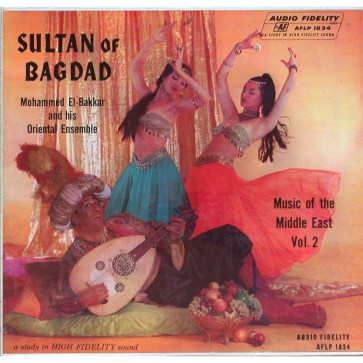
In American and European popular culture, zaghareet has played a notable role in framing depictions of the Middle East, particularly through the female body. In the years following World War II, zaghareet samples often marked the Middle East as wild and exciting. Lebanese-born singer Mohammed El Bakkar, for example, used the sound of zaghareet on his song “Yalla-Yalla” from the 1958 album The Sultan of Bagdad, one of several albums he recorded for the Audio Fidelity label in the late-1950s marketed to a mainstream American audience.
.
“Yalla-Yalla,” which translates loosely as “Come with me,” features finger cymbals, clapping, and female zaghareet, along with jovial calls from El Bakkar at the ends of phrases, conjuring a celebratory setting. All of these elements–along with the album cover photo that shows El Bakkar lounging on a cushion with two beautiful dancers standing over him–combine to create a quintessential exotic scene for many American listeners.
Although unintentionally kitschy at times, the 1962 British epic Lawrence of Arabia—a film which has the dubious distinction of having no spoken lines by a woman in its 3 1/2 hour running time—represents zaghareet quite seriously. The ululations first appear about half of the way through the film, where Lawrence and the Arab forces set off to fight the Turkish at Aqaba, and women provide blessings and encouragement.
.
Lawrence of Arabia is a classically orientalist film about the scope of British empire, and in this instance, zaghareet accentuates the majesty of the scene where Lawrence rides beside his Arab counterparts through the desert with veiled women calling from the cliffs above. Like the previous example, the women here constitute part of a foreign landscape, and their cries of encouragement serve along with the visuals to construct a multi-sensory experience of otherness.
Zaghareet has taken on more explicitly violent associations in a post-9/11 American context, where it is often coupled with Arab depravity and linked to terrorism. Zaghareet was demonstrated in a newsclip aired on CNN, Fox, and several other news networks displaying Palestinians in the West Bank “celebrating after 9/11.” One woman in the clip briefly ululates in front of the camera, connecting the sound to perceived Arab hatred for Americans.
.
The video went viral, and reactions to it exemplify the extent to which zaghareet has come to symbolize a new stereotype in the post-9/11 era: the depraved Middle Eastern Other. This formula collapses and combines the categories of “Arab” and “Muslim,” and, although it complicates the figure of the terrorist as male, since it is a woman who is shown celebrating after 9/11, it also reveals western anxieties about the power that Lawrence of Arabia represented as harnessed by colonial forces.
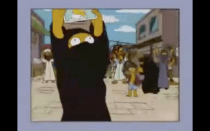
Screen shot by author
A parody of the viral news clip appeared on a 2004 The Simpsons episode entitled “Bart-Mangled Banner” in which Bart accidentally moons the American flag at a basketball game, and subsequently faces a public outcry from critics calling him anti-American. The nightly news shows the “overseas” response, in which a woman wearing niqab holds up a photo of Homer and says “Simpsons be praised! Praise be to Springfield!” and then performs zaghareet against a backdrop of celebratory gunfire. This satire hints at the absurdity of controversies over such displays, but it also reinscribes the idea of the Arab/Muslim female as a source of danger, a new element of anti-American hostility that became associated with the sound after 9/11.
Unlike previous impressions of zaghareet, which focused on the sound as part of an exotic terrain, post-9/11 visions tend to locate practitioners in a distinctly antagonistic matrix. The distinctive sonicity of zaghareet makes it particularly susceptible to portrayals that frame it as a sign of Arab barbarity. For certain performers, however, such as belly dance students in Washington, DC, zaghareet is not subject to this type of racialized logic, and is instead treated as an ethnic novelty. In American film, TV, music, and a range of other contexts, zaghareet is becoming increasingly audible, and it is a phenomenon that deserves thoughtful and critical attention.
—
Meghan Drury is a fifth-year Ph.D. candidate in the Department of American Studies at the George Washington University. She received an MA in ethnomusicology from UC Riverside in 2006. She is currently working on a dissertation tentatively titled “Aural Exotics: The Middle East in American Popular Music 1950-2011.” This project examines the interplay between popular music and American cultural representations of the Middle East from the mid-20th century to the present, illustrating how music and sound acted a means of consolidating and disseminating a range of ideas about Middle Eastern culture in the American mainstream. She is particularly interested in the way that sound increased the visibility of Arab Americans both before and after 9/11, offering a space for negotiations of identity. More broadly, Meghan’s interests include sound studies, U.S.-Middle East cultural relations, and Arab American cultural performance.
—
 REWIND! . . .If you liked this post, you may also dig:
Rallying Cries as Suffering Sounds: “Allah-O-Akbar” and the Aurality of Feminized Iranian Suffering–Roshanak Kheshti
Aurally Other: Rita Moreno and the Articulation of “Latina-ness”–Priscilla Peña Ovalle
Beat-ification: British Muslim Hip Hop and Ethical Listening Practices–Jeanette Jouili
Share this:

Living with Noise

Image by Flickr User Bill Selak
[O]ne of the chief values of living with music lies in its power to give us an orientation to time.– Ralph Ellison, “Living with Music” (1955)
Early this past fall, my wife and I moved back to Brooklyn after three years in central New York State. We spent two of those years on a back street in a mostly rural area of Cortland, NY, where are there are more dogs than people and more cows than dogs. Those dogs were probably the most intrusive neighborhood sound—a barker would get going and that’d set off a chain reaction from yard to yard, like a real life version of the “Twlight Barking” from 101 Dalmations. Still, I could get used to it, ignore it, zone out. The only other sounds that penetrated our home were the nearby freight trains, but their sounds are almost soothing—the rhythm of the clacking rails like Paul Simon singing “Everybody loves the sound of a train in the distance. . .” or a relaxation tape.
Now back in New York City, I am very aware of the different degree, frequency and quality of sounds I am subjected to while in my living space. Reconsidering living with noise put me in the mind of Ralph Ellison’s 1955 essay “Living With Music” from High Fidelity magazine. Like the living situation Ellison describes, our new place is a rear-facing apartment and we get the sound of echoing voices, car horns or yowling cats (fighting and/or making more cats) bouncing off the back wall of a garage on the next street. However, as most city-dwellers know, it is our neighbors that provide the most persistent and profound sonic disturbances. Ellison himself was disturbed at an upstairs neighbor’s overzealous singing, vocalizing “[f]rom morning until night.” In our case, another four-family apartment house abuts ours and through the two brick walls sandwiched by two layers of plaster, we can frequently hear the shrill cries of teenage anguish. The violent screaming between teenaged siblings or between one or more of them and their parents can shake the walls. It is difficult to ignore.
 The noise of children in New York City apartments was a topic of a New York Times feature a couple of years ago, but in that article the age of the children makes it easy to sympathize with the parents and to cast the complainers as insensitive villains. Little children cannot be expected to regulate their own crying or the seemingly ceaseless energy that is so easily transformed into cries of glee or the galloping of those baby shoes. In the case of my neighbors, it harder to sympathize when the sound is from near-adult children screaming about how life isn’t fair, or getting forced into frequent violent disagreements with a similarly aged sibling with which they must share a tiny part of an already tiny space—a New York City apartment.
It is easy to get angry when they get going. A teenager is not a chorus of barking dogs, a small crying child, or even some jerk honking his horn a block away who doesn’t realize how far the sound can travel, but ostensibly someone developing into a functional adult. The things they are screaming about can often seem beyond ridiculous to older people, and thus their need to scream about them is particularly offensive when I am simply trying to enjoy a evening of catching up on Mad Men or (more importantly) an afternoon writing my dissertation. As my wife often asks, “Why don’t their parents regulate?” But I try to remind her, it is the attempt to regulate their behavior that often starts the screaming matches. Like a 2-year old testing the range of her voice, these teens are exploring their own boundaries. Furthermore, unlike the class entitlement permeating the NYT Real Estate section feature, the economic reality of living in row houses in Bensonhurst changes expectations regarding the living experience.
The sonic disturbances often come when I am trying to get some writing done, so it is not hard to think about Ellison’s essay, since writing was also what he endeavored to do when bedeviled by his neighbor’s practice of “bel canto style.” The way noise can carry in these apartments creates a form of anonymous intimacy. Think of Duke Ellington’s “Harlem Airshaft,” a musical representation of just that urban intimacy.
As he said of the apartment airshaft that inspired that piece,
You hear fights, you smell dinner, you hear people making love. You hear intimate gossip floating down. You hear the radio. An air shaft is one great loudspeaker, you hear people praying, fighting and snoring.
While I don’t know my neighbors better than a polite nod of hello when I pass them sitting on the stoop, I am ear-witness to their dramas, and more than that I am sometimes drawn into them, finding myself banging the wall with a forearm and calling through the wall “enough already!” Or spending time discussing the family’s private affairs with my wife, speculating about the arguments. Similarly, Ellison’s trepidations about trying to silence his neighbor come from how her practice makes him intimately aware of her aspirations, even as that same intimacy drives him to build a stereo to blast at her in an attempt to conquer their shared sonic space.
Urban sonic intimacy is tightly tied to Ellison’s assertion regarding music and our orientation to time. However, Ellison’s observations can be expanded beyond music, because remember one person’s music is another person’s noise, as Scott Poulson-Bryant discussed in his Sounding Out! post on music and New York City apartment life in “The Noise You Make Should Be Your Own” (August 2010). A noise can likewise orient me in time: the sound of freight trains will bring me back to my time in Cortland, and more profoundly, that teenaged screaming brings me back to my own volatile adolescence, asking me to reconcile that version of me with the one I am now.
 In Ellison’s essay, he arrives at two conclusions regarding music. The first is the above-mentioned orientation to time and the second is deep sympathy that arises from that realization, as he associates his upstairs neighbor’s intrusive singing practice with his own childhood attempts to master the trumpet. The orientation to time he discusses is not only a matter of looking back and making associations with a younger self’s relationship to music, but also comes from an adult understanding that there were those “who were willing to pay in present pain for future pride. For who knows what skinny kid. . .might become the next [Louie] Armstrong?” The anonymous intimacy of city-living has made me reflective regarding these screaming matches and I have begun to develop a sympathy that lets me tolerate the disturbance, to understand it in a context of living and growing. For how do I know that those volatile teenaged emotions might not develop into the sensitive and thoughtful adult attitude I try to have in my own life? There is no need to imagine that these kids will grow into anyone special (though the world could certainly use a couple more Louis Armstrongs or Ralph Ellisons), but their noise is a signal for the need for empathy, to remember our own ability to make noise not only through simply living but in trying to grow, to become. . .
Ellison may have thought that “the enjoyment of music is always suffused with past experience,” but I think enjoyment is just the tip of an iceberg of sonic experience, because it also holds out the possibility for an affective relationship with sound that can shift from annoyance to understanding without actually having to enjoy. It is not just music, but noise that “gives significance to all those indefinable aspects of experience, which. . .help to make us what we are.” Noise transforms in the cramped urban setting from a residue of life into a connective tissue that signals a challenge to boundaries, requiring greater empathy and patience. The very noise that endangers our peace is also a reminder of how close and alike we really are. It is only time that separates me from the screaming of a teenager and it is only time that stands between me and a screaming teen of my own.
—
Osvaldo Oyola is a regular contributor to Sounding Out! and ABD in English at Binghamton University.
—
REWIND! . . .If you liked this post, you may also dig:
Summer Soundscapes, East Coast Style–Jennifer Stoever-Ackerman
The Noise You Make Should Be Your Own–Scott Poulson-Bryant
Sound-politics in São Paulo, Brazil–Leonardo Cardoso
Share this:


Current Top Posts





April 2021

January 2020

November 2019

October 2019

August 2019

April 2014

November 2017

March 2015

December 2017

October 2015
 Sounding Out!
Recent Comments