
Within a Grain of Sand: Our Sonic Environment and Some of Its Shapers
“It devolves on us now to invent a subject we might call acoustic design, an interdiscipline in which musicians, acousticians, psychologists, sociologists, and others would study the world soundscape together in order to make intelligent recommendations for its improvement.”
–R. Murray Schafer
The Soundscape, Our Sonic Environment and the Tuning of the World
With those words, and with that book, Canadian composer, writer, educator, and environmentalist R. Murray Schafer introduced the concept of the soundscape…a sound, or combination of sounds, that forms or arises from an immersive environment. What follows is an exploration of how several key field recordists define and explore the notion of soundscape.
1. What do you do?
I capture moments.
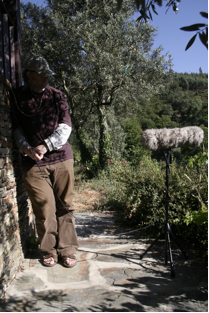
I explore environments & structures using conventional & extended field recording methods. I also use instruments & small objects. Sometimes I perform live intuitive compositions, sometimes I install work & often I compose photographic scores.
For me it is the emotive impulse that most inspires.
I listen.
2. What can that tell us?
I believe passionately that one of the most important results of an exploration of overlooked detail in daily life (in terms of sound as well as visual elements) is how it can enhance ones life. It can allow us to engage with our surrounding in different ways & appreciate what remains & what has gone before or indeed is in danger of disappearing.
it can tell us that listening is a much, much broader vista than we all understand & one can spend a lifetime exploring.
photo: carina martins
The study of the soundscape, called Acoustic Ecology, focuses on the relationship between living beings and their environment through sound. It’s a unique field in its interdisciplinary nature and beginnings, an interconnectivity between scientists, sociologists, anthropologists, and artists.
1. What do you do?
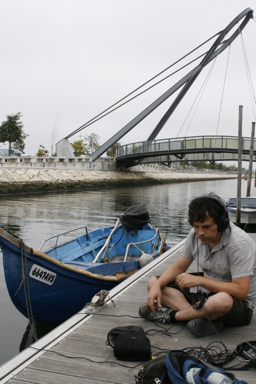
I am part of the organization Binaural/Nodar, which organizes educational and artistic creation events focused on a rural region in northern Portugal. Our creative focus is on sound and media arts that work with the natural and human environment of the region. As part of our activities, we organized a program of artist residencies dedicated to the river than passes through our region (Paiva river), which culminated in the Paivascapes festival, which took place in March this year. This was a multidisciplinary event that included a series of site-specific sound installations, a retrospective exhibition of sound and audiovisual works at a local museum, conferences on anthropological and environmental issues and nature walks. The festival had an itinerant nature, as it’s program was conceived to happen in several locations from the source to the mouth of the river.
2. What can that say?
The rural environment where we develop our activities has been inhabited for at least tens of thousands of years and each generation left their mark on the territory. So, we understand it as a infinitely complex, stratified and fragmented reality that most of the times cannot be fully comprehended if the approach is superficial, limited in time, based purely on a ‘naturalistic’ view of it that manifests itself for example on experiencing and recording the bucolic sights and sounds. It requires a more ‘relational’ approach, where what we see and listen to is mapped against other elements, stories, individual and collective memories, place names, old and new usages of the space, etc., which requires time, attention and empathy. We take these concerns on every aspect of our work such as which art projects to select, how and where to publicly present the works, how to mediate the relationship between the artists and the local communities.
-Rui Costa of Binaural/Nodar
photo credit: Binaural/Nodar
Acoustic Ecology has branched out to give birth to a movement in sound art called phonography, a neologism referring to the art of field recording. It’s also shown a spotlight upon our changing sonic environment, and has become an important tool in bioacoustics and biomusicology, which help us to understand what these changes can mean. Birds communicate mainly with sound. When their calls cannot be heard, their reproduction decreases. Scientists are working with acoustic ecologists to record and study environments in which this is happening. Some of these bird calls may someday only survive on these recordings.
1. What do you do:
I am interested in the common, the everyday and the ordinary in my art practice; and in the unnoticed, the trivial and the repetitive that constitutes daily life. The birds I am interested in have ambiguous reputations and are considered pests or nuisances but they are also loved and respected. Seagulls, crows/corvids and pigeons are all very sociable species and are often much more audible than visible and they proliferate in the favorable conditions we have provided in urban centers.
‘birdbrain’ focuses on our relationship with crows (corvids) and seagulls through voice (animal/human) and ideas about language (animal/human), including the spoken and written word. There is little philosophical discussion about animal voice, although the potential for animal language parallels current neurobiological research, which has identified that certain ‘motor and perceptual abilities’ essential for language in humans, also exist in birds.
2.What can that tell us:
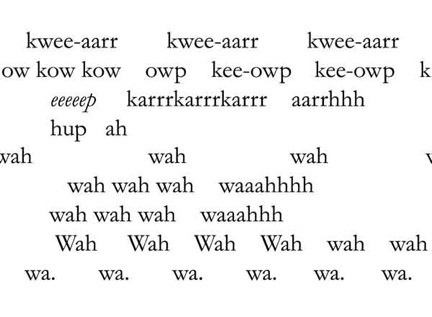
The project has a number of components including an artist’s book that is posing as a mock field guide. The field guide comprises written texts of exchanges between a group of Little Ravens that I have transcribed over the course of a year using the phonetic words from conventional field guides.
The audio works consist of field recordings, mimicry and texts spoken by people with different accents. Scientific research tells us that birds also have regional accents and dialects, and that birds change their song according to place. Birds in cities sing more loudly to cope with urban noise and these songs tend to be simplified. Also, birds that have been introduced into different countries sing a song that is a variant from their brethren back in the homeland.
still from birdbrain, catherine clover
Cymatics is the study of sound waves made visible. Sound frequencies vibrate a surface and create distinct patterns. Sound needs a medium to vibrate, and the characteristics of the medium and sound wave will inform the shape. If you place a metal plate upon a speaker head, place sand upon that plate, and play certain frequencies through the speaker, you will see the sand vibrate into different patterns. If we could see sound around us, we would see expanding spheres with a kaleidoscopic-like pattern on its surface, effecting each other and all molecules in its path.
The interconnectivity of our world is often over looked, often not thought about. It is human nature to categorize, this is part of how we think and communicate. But what is lost when we consider our categories as islands, instead of a part of a whole, a pattern of overlapping systems? There is a saying that the whole of earth and ocean is found within one grain of sand.
1. What do you do?
I am an artist and composer who focuses on listening and the environment in my work. I am often recording my life and my travels, and the recordings or my observances from the recordings end up in my compositions, art installations, and soundwalks. In 2004, I was fortunate enough to find other people interested in sound and the environment and together, we formed The New York Society for Acoustic Ecology (NYSAE), a chapter of the World Forum for Acoustic Ecology. Through various organizations like the Whitney Museum, the Electronic Music Foundation, and free103point9, we have held events, panel discussions, and performances relating to sound and urban ecology. I am often asked how I “got into sound” and I usually don’t know how to answer it as it feels like I never got out of an interest in acoustics and space. I think that my interest in sound began when I carried around a tape recorder instead of a doll as a child. Perhaps not much has changed as I feel like my compositions reveal a layer of personal narrative conveyed through field recordings that describe how I relate to my environment. Often, my soundwalks do not include sounds that I have recorded; they are about sharing with others what I discovered about listening to the acoustics of a particular place. Points of interest are carefully arranged in guided tours with conceptual elements that emerge as sub-themes.
2. What can that say?
I am mostly interested in the relationship between people the sounds of the urban environment, particularly on how nature is defined by those who live in urban environments. When we slow down to listen to all that is in-between point A and point B, I think that we can begin to enjoy the fine details, even in a noisy city environment. I’ve worked with both children and adults in educational settings in cities who didn’t realize that they had birds living on their street until they were encouraged to listen. And I’ve discovered things like some people don’t like the sounds of birds at all, and they may prefer listening to the sounds of the subway. Sound can be just as subjective and adaptable of an art material as paint.

A drop of water falls into a puddle and creates a wave. A wave is a disturbance that travels through time and space. It affects everything it touches, it creates other waves, it continues colliding and transferring energy to molecules that do the same in turn to other molecules. It can be water, it can be light, it can be sound. It can be many things that collide into our molecules, and our system translates. The water is cold, the light is bright, the sound is loud. This is passive information. But when we actively feel how cooling the water is on a very hot day, when we actively consider how strong that sun is, and when we actively enjoy how the crash of an ocean wave makes our heart race…our world becomes so much richer.
1. What do you do?
Soundscape compositions, soundwalks, listening workshops, lectures, writing, editing, some mentoring of composition students, organizing as part of the World Forum for Acoustic Ecology (WFAE) and so on…
2.What can that say?
Everything I do seems to be focused on understanding the world through the act of listening and on the desire to share this understanding with as many people as possible. I believe that every sense perception gives us valuable and important connectedness to and information about the world in which we live. Our hearing sense has been underutilized (certainly in my lifetime, in our societies, nowadays) and a re-balancing of our senses may mean a re-balancing of how we approach life, environment, culture, politics and ideas. Experience in listening and composing has shown me ever new, changing and deepening approaches to space and time. And I wish this for everyone who learns to connect more consciously and deeply to his or her listening. What can that say: listening means noticing means inspiration means energy to do and act.
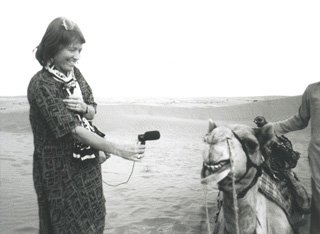
Hildegard Westkamp, Photo by Peter Grant
World Listening Day is July 18th. You can participate through the World Listening Day organization. Or just take the time, whatever you are doing, to stretch your ears and focus them on the rich acoustic world around you.
1. What do you do?
The World Listening Project maintains a website and online forum about its artistic and educational activities, including public workshops, forums, and lectures, as well as participating in exhibitions, symposiums, and festivals. Phonography and Acoustic Ecology inspired all of this. In the Chicago area, where we began, we formed the Midwest Society for Acoustic Ecology, a regional chapter of the American Society for Acoustic Ecology. We’re busy now inviting people to participate in the 2011 World Listening Day on July 18, the date of R. Murray Schafer’s birthday. If you visit our website you can learn how to celebrate. It’s quite open and last year the response was phenomenal.
2. What can that say?
Hearing tells us where to look. Wherever we are, every place on the planet has its own soundscape. From moment to moment the soundscape is always changing, often unpredictably. Depending on the time scale, dynamics, and frequency range we can choose to focus attention on. The World Listening Project suggests that listening is active, not passive: that listening means paying attention to the world. And when we do that we can begin to change it in a way conscious way. Bernie Krause has been a supporter. He’s making waves in the field of soundscape ecology. This is what Bernie says: “Western society bases most of what it knows on the visual. We actually ‘hear” what we ‘see.’ The World Listening Project aims to transform that perception in our otherwise urban centric and abstracted lives. At a time when we are facing not only a silent spring, but a silent summer, fall and winter, as well, it is clear that where a picture is worth a thousand words, a soundscape may soon be worth a thousand pictures.”
T


Share this:

Hearing Queerly: NBC’s “The Voice”

“Brittany and Santana Lesbian Kissing Scene from Glee” by Flickr user LesMedia available under Creative Commons license 2.0
Tuesday, April 26, 2011 turned out to be a red-letter day for prime time Sapphism. The Fox smash, Glee, continued its hamfisted campaign against teen bullying with a subplot about the label-averse Santana scheming to bring her lesbian (or “Lebanese”) love for Britney to fruition. Airing opposite this “Born This Way”-anchored, supersized Glee, was the debut of the vocal reality competition series, The Voice on NBC. Remarkably, not one, but two out lesbians survived the first elimination round of the show’s blind auditions: Vicci Martinez from Tacoma, WA, and Beverly McClellan from Ft. Lauderdale, FL.
The Voice pitches itself as the democratic alternative to FOX’s American Idol. Whereas Idol’s early audition rounds derive considerable schadenfreude from oddball characters excluded from the expansive realm of what is deemed “pop hot”–remember Kenneth Briggs, the infamous “Bush Baby”?–The Voice eliminates looks altogether from the audition process, including the panel’s ability to look at the singers onstage. Seated in hydraulically-controlled swivel chairs evocative of Dr. Evil’s high-backed perch, the celebrity panel of coaches (not “judges”)–Christina Aguilera, Cee Lo Green, Adam Levine of Maroon 5, and country hunk, Blake Shelton–have their backs to the stage at the beginning of each performance. Only when the singer’s voice sufficiently moves a coach does he or she press a button to swing around and face the talent. If none of the four coaches turns around before the song ends, the singer is eliminated and sent away with only two-and-a-half glorious minutes on national TV as a consolation prize.

Vicci Martinez
While latter-day Idol has increasingly focused on the “total package,” sometimes excusing vocal defects for good looks, performance prowess, and passion (“I had fun with it” is the mantra of anyone who’s suffered a tepid response from the judges, and “you look great tonight” is what a judge says when someone biffs their vocals), The Voice purports to strip away the smoke and mirrors of performance—at least in the live selection process—in order to focus exclusively on vocal talent. Furthermore, as “coaches,” the celebrity panel is meant to cultivate talent rather than simply eviscerate bad performers for the audience’s amusement. As Cee Lo opines in the premiere episode: “it’s not about the judgment; it’s about the journey.” (Has reality competition taken a critical turn from the critical turn? But that’s another topic.) Idol has been explicitly called out on the show, from Adam Levine’s reassurance to dejected contestants that “The people we are not turning our chairs around for could win American Idol,” to the sensational rehashing, ad nauseum, of Frenchie Davis’s disqualification from the Idol competition for nude photos nearly a decade ago.
As the anti or alterna-Idol, The Voice–complete with kitschy, faux Futurist set pieces–would have us believe that truly anyone from anywhere could be a vocal superstar, whether they’re fat, thin, chinless, hirsute, gorgeous, hideous, straight, gay, Mormon, or dykey. The disparate optics offered by Vicci Martinez and Beverly McClellan, the two lesbians who won the celebrity panel over with their raw-throated rock vocals (right in the pocket of what we might call the Etheridgean mode), would seem to affirm the show’s “blind” ethos. Martinez’s audition was shot so that just like the coaches, the TV audience couldn’t see the singer until she was selected. In the package leading up to her performance, we are made privy to her coming out story, offered a glimpse of her skinny jeans and boots, and invited to “listen along with our coaches and see if you would pick Vicci Martinez.”
As it turns out, Martinez is quite a little hottie: a lesbian heartthrob in the making with a cute asymmetrical shag, winning smile and sensibly curated fashion (think PacNorthwest sportif meets urban hipster enclave).
McClellan, meanwhile, offers an “edgier” look that complements her ethos of fighting–in her own words–“against the man.”
TV audiences see McClellan before hearing her, creating some element of narrative suspense: we anxiously await “the reveal” should one of the coaches select McClellan for their team, only to swivel around to confront a bald, bad-ass dyke with ample tattoos, piercings and leather wrist accoutrement, chewing on Janis Joplin’s “Piece of My Heart” with barroom tenacity.
The queer blogosphere has certainly picked up on Martinez and McClellan’s success on the show. (As of this writing, Martinez has already advanced passed the “Battle Rounds” to the live shows where audience members are are allowed to vote). After Ellen and Unicorn Booty posted items immediately, encouraging queer audiences to tune in, while After Ellen followed up with extended interviews, first with Martinez, then with McClellan. Both were asked about whether or not the format of The Voice made it “easier” for queer contestants to succeed without being judged for their appearance. Martinez famously bowed out of the Hollywood rounds of American Idol because producers asked her to buy a new wardrobe (read, “femme up” a bit), so she offered a more affirmative response in line with The Voice’s own rhetoric of leveling the playing field. McLellan, meanwhile, offered a goofy “one love” answer to the question, evoking a universal vibe of human generosity. Different as their public temperaments may be, both have been praised for amplifying lesbian visibility on network television.

Levine listens to McClellan on
Though some robust, “score two for the team” chest-bumping is surely in order after the success of these Sapphic sirens, how might we actually move past the greater frenzy for queer visibility to better grasp how lesbianism fits, or inevitably fails to fit, within the pop landscape? In other words, what would happen if we weren’t so quick to celebrate these “aren’t-we-GLAAD?” moments of prime time visibility, but instead took to heart The Voice’s premise about prioritizing listening?
Throughout the institutional life of queer studies, debates about lesbian visibility have unfurled in elaborate fugue-like variations. Rather than rehash them here, allow me to commit the theoretical heresy of constructing a binary in order to highlight some key positions. In the “real” world of mainstream LGBTQIA organizations and cultural producers, quantifying positive representations of queer folk qualifies as measuring progress. The more gays and lesbians we see on screens big and small, the logic goes, the better the world gets. In the more rarified realms of queer theory (my own habitat), this desire for representation and belonging calls forth the very crisis inherent in politicizing visibility as an end in itself. Film and media scholar, Amy Villarejo, explains this dynamic best when she remarks in Lesbian Rule that “the common sense of visibility is that it does both [parlays representation’s double meaning as ‘portrait’ and ‘proxy]: by appearing, so it would go, we belong…[but]…to present lesbian as image is to arrest the dynamism such a signifier can trigger” (14).
What, then, would be the sonic dynamism of lesbianism? Is it a transformative “grammar” that modifies the terms with which it becomes intimate? (Villarejo explores this possibility in her book.) Is it in the grain of a voice?
Far be it from me to theorize the “butch throat” here, as my dear pal and colleague Elena Glasberg already has with more eloquence and profundity than my mind can muster these days; but even if we hadn’t been primed by the show’s intro packages, might we not have heard the lesbianism in Martinez and McClellan’s throats? In their urgent, tremulous and toothsome strivings through the repertoires of “fierce females” like Adele and Janis Joplin?
There is something marked, and remarkable, in the yearning and temporal drag (see Elizabeth Freeman’s work) modeled by Martinez and McClellan’s respective vocalities, voices that could only break the surface in a format that (at least initially), thwarts the edicts of visibility: of fashion, generic niches, and the avant sensibility demanded by pop. Instead of being one step ahead, Martinez and McClellan constantly pull us back to something we’ve heard before, often in a half-empty bar that reeks of Bud and Marlboros (both Light). And for letting us hear this again, I’m willing to give The Voice the benefit of the doubt, despite its unwieldy format, liberal use of Carson Daly, and trumped up feud between Adam Levine and the real Xtina. Just maybe in this singing competition’s overdetermined relationship to blindness, we will find enough insight to hear queerly.


Share this:


Current Top Posts





April 2021

January 2020

November 2019

October 2019

August 2019

April 2014

November 2017

March 2015

December 2017

October 2015
 Sounding Out!
Recent Comments