
Playin’ Native and Other Iterations of Sonic Brownface in Hollywood Representations of Dolores Del Río
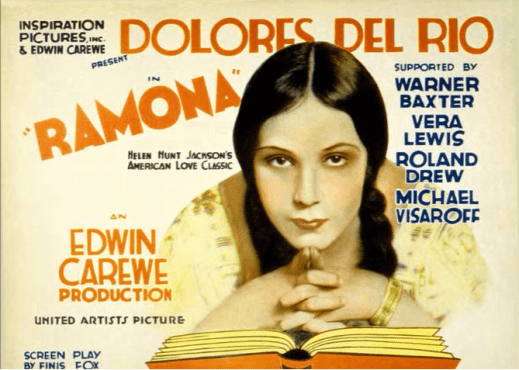
Mexican actress Dolores Del Río is admired for her ability to break ground; her dance skills allowed her to portray roles not offered to many women of color early in the 20th Century. One of her most popular roles was in the movie Ramona (1928), directed by Edwin Carewe. Her presence in the movie made me think about sonic representations of mestizaje and indigeneity through the characters portrayed by Del Río. According to Priscilla Ovalle, in Dance and the Hollywood Latina: Race, Sex and Stardom (2010), Dolores del Río was representative of Mexican nationhood while she was a rising star in Hollywood. Did her portrayals reinforce ways of hearing and viewing mestizos and First Nation people in the American imaginary? Is it sacrilegious to examine the Mexican starlet through sonic brownface? I explore these questions through two films, Ramona and Bird of Paradise (1932, directed by King Vidor), where Dolores del Río plays a mestiza and a Polynesian princess, respectively, to understand the deeper impact she had in Hollywood through expressions of sonic brownface.
Before I delve into analysis of these films and the importance of Ramona the novel and film adaptions, I wish to revisit the concept of sonic brownface I introduced here in SO! in 2013. Back then, I argued that the movie Nacho Libre and Jack Black’s characterization of “Nacho” is sonic brownface: an aural performativity of Mexicanness as imagined by non-Mexicans. Jennifer Stoever, in The Sonic Color Line (2017), postulates that how we listen to particular body(ies) are influenced by how we see them. The notion of sonic brownface facilitates a deeper examination of how ethnic and racialized bodies are not just seen but heard.
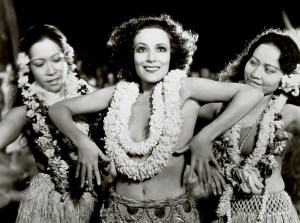
Picture of Del Rio as Luana in BIRDS OF PARADISE, available in the public domain.
Through my class lectures this past year, I realized there is more happening in the case of Dolores del Río, in that sonic brownface can also be heard in the impersonation of ethnic roles she portrayed. In the case of Dolores del Río, though Mexicana, her whiteness helps Hollywood directors to continue portraying mestizos and native people in ways that they already hear them while asserting that her portrayal helps lend authenticity due to her nationality. In the two films I discuss here, Dolores del Río helps facilitate these sonic imaginings by non-Mexicans, in this case the directors and agent who encouraged her to take on such roles. Although a case can be made that she had no choice, I imagine that she was quite astute and savvy to promote her Spanish heritage, which she credits for her alabaster skin. This also opens up other discussions about colorism prevalent within Latin America.
 First, let us focus on the appeal of Helen Hunt Jackson’s Ramona (1884), as it is here that the cohabitation of Scots, Spanish, Mestizos, and Native people are first introduced to the American public in the late 19th century. According to Evelyn I. Banning, in 1973’s Helen Hunt Jackson, the author wanted to write a novel that brought attention to the plight of Native Americans. The novel highlights the new frontier of California shortly after the Mexican American War. Though the novel was critically acclaimed, many folks were more intrigued with “… the charm of the southern California setting and the romance between a half-breed girl raised by an aristocratic Spanish family and an Indian forced off his tribal lands by white encroachers.” A year after Ramona was published, Jackson died and a variety of Ramona inspired projects that further romanticized Southern California history and its “Spanish” past surged. For example, currently in Hemet, California there is the longest running outdoor “Ramona” play performed since 1923. Hollywood was not far behind as it produced two silent-era films, starring Mary Pickford and Dolores del Río.
The charm of the novel Ramona is that it reinforces a familiar narrative of conquest with the possibility of all people co-existing together. As Philip Deloria reminds us in Playing Indian (1999), “The nineteenth-century quest for a self-identifying national literature … [spoke] the simultaneous languages of cultural fusion and violent appropriation” (5). The nation’s westward expansion and Jackson’s own life reflected the mobility and encounters settlers experienced in these territories. Though Helen Hunt Jackson had intended to bring more attention to the mistreatment of native people in the West, particularly the abuse of indigenous people by the California Missions, the fascination of the Spanish speaking people also predominated the American imaginary. To this day we still see in Southern California the preference of celebrating the regions Spanish past and subduing the native presence of the Chumash and Tongva. Underlying Jackson’s novel and other works like Maria Amparo Ruiz De Burton The Squatter and the Don (1885) is their critique of the U.S. and their involvement with the Mexican American War. An outcome of that war is that people of Mexican descent were classified as white due to the signing of Treaty of Guadalupe Hidalgo and were treated as a class apart. (See Michael Olivas’ anthology, Colored Men and Hombres Aqui from 2006 and Ignacio M. García, White but not Equal from 2008). These novels and films reflect the larger dominant narrative of whiteness and its relationship to nation building. Through Pickford’s and del Río’s portrayals of Ramona they reinforce the whiteness of mestizaje.

Screenshot from RAMONA (1910). Here, Ramona (played by Mary Pickford) finds out that she has “Indian blood.”
In 1910, Mary Pickford starred in D.W. Griffith’s short film adaptation of Ramona as the titular orphan of Spanish heritage. Henry B. Walthall played Alessandro, the Native American, in brownface to mimic physical attributes of the native Chumash of Southern California. Griffith also wanted to add authenticity by filming in Camulas, Ventura County, the land of the Chumash and where Jackson based her novel. The short is a sixteen-minute film that takes viewers through the encounter between Alessandro and Ramona and their forbidden love, as she was to be wedded to Felipe, a Californio. There is a moment in the movie when Ramona is told she has “Indian blood”. Exalted, Mary Pickford says “I’m so happy” (6:44-6:58). Their short union celebrates love of self and indigeneity that reiterates Jackson’s compassionate plea of the plight of native people. In the end, Alessandro dies fighting for his homeland, and Ramona ends up with Felipe. Alessandro, Ramona, and Felipe represent the archetypes in the Westward expansion. None had truly the power but if mestizaje is to survive best it serve whiteness.
.jpg#filelinks)
Poster of 1928’s RAMONA, under fair use
Edwin Carewe’s rendition of Ramona in 1928 was United Artists’ first film release with synchronized sound and score. Similar to the Jazz Singer in 1927, are pivotal in our understanding of sonic brownface. Through the use of synchronized scored music, Hollywood’s foray into sound allowed itself creative license to people of color and sonically match it to their imaginary of whiteness. As I mentioned in my 2013 post, the era of silent cinema allowed Mexicans in particular, to be “desirable and allowed audiences to fantasize about the man or woman on the screen because they could not hear them speak.” Ramona was also the first feature film for a 23-year-old Dolores del Río, whose beauty captivated audiences. There was much as stake for her and Carewe. Curiously, both are mestizos, and yet the Press Releases do not make mention of this, inadvertently reinforcing the whiteness of mestizaje: Del Río was lauded for her Spanish heritage (not for being Mexican), and Carewe’s Chickasaw ancestry was not highlighted. Nevertheless, the film was critically acclaimed with favorable reviews such as Mordaunt Hall’s piece in the New York Times published May 15, 1928. He writes, “This current offering is an extraordinarily beautiful production, intelligently directed and, with the exception of a few instances, splendidly acted.” The film had been lost and was found in Prague in 2005. The Library of Congress has restored it and is now celebrated as a historic film, which is celebrating its 90th anniversary on May 20th.
In Ramona, Dolores del Río shows her versatility as an actor, which garners her critical acclaim as the first Mexicana to play a starring role in Hollywood. Though Ramona is not considered a talkie, the synchronized sound comes through in the music. Carewe commissioned a song written by L. Wolfe Gillbert with music by Mabel Wayne, that was also produced as an album. The song itself was recorded as an instrumental ballad by two other musicians, topping the charts in 1928.
In the movie, Ramona sings to Allessandro. As you will read in the lyrics, it is odd that it is not her co-star Warner Baxter who sings, as the song calls out to Ramona. Del Río sounds angelic as the music creates high falsettos. The lyrics emphasize English vernacular with the use of “o’er” and “yonder” in the opening verse. There are moments in the song where it is audible that Del Río is not yet fluent speaking, let alone singing in English. This is due to the high notes, particularly in the third verse, which is repeated again after the instrumental interlude.
I dread the dawn
When I awake to find you gone
Ramona, I need you, my own
Each time she sings “Ramona” and other areas of the song where there is an “r”, she adds emphasis with a rolling “r,” as would be the case when speaking Spanish. Through the song it reinforces aspects of sonic brownface with the inaudible English words, and emphasis on the rolling “rrrr.” In some ways, the song attempts to highlight the mestiza aspects of the character. The new language of English spoken now in the region that was once a Spanish territory lends authenticity through Dolores del Río’s portrayal. Though Ramona is to be Scottish and Native, she was raised by a Spanish family named Moreno, which translates to brown or darker skin. Yes, you see the irony too.

United Artists Studio Film Still, under Fair Use
Following Del Río’s career, she plays characters from different parts of the world, usually native or Latin American. As Dolores del Río gained more popularity in Hollywood she co-starred in several movies such as Bird of Paradise (1932), directed by King Vidor, in which she plays a Polynesian Princess. Bird of Paradise focuses on the love affair between the sailor, played by Joel McCrea, and herself. The movie was controversial as it was the first time we see a kiss between a white male protagonist with a non-Anglo female, and some more skin, which caught the eye of The Motion Picture Code commission. Though I believe the writers attempted to write in Samoan, or some other language of the Polynesian islands, I find that her speech may be another articulation of sonic brownface. Beginning with the “talkies,” Hollywood continued to reiterate stereotypical representations though inaccurate music or spoken languages.
In the first encounter between the protagonists, Johnny and Luana, she greets him as if inviting him to dance. He understands her. He is so taken by her beauty that he “rescues” her to live a life together on a remote island. Though they do not speak the same language at first it does not matter because their love is enough. This begins with the first kiss. When she points to her lips emphasizing kisses, which he gives her more of. The movie follows their journey to create a life together but cannot be fully realized as she knows the sacrifice she must pay to Pele.
I do not negate the ground breaking work that Dolores del Río accomplished while in Hollywood. It led her to be an even greater star when she returned to Mexico. However, even her star role as Maria Candelaria bares some examination through sonic brownface. It is vital to examine how the media reinforces the imaginary of native people as not well spoken or inarticulate, and call out the whiteness of mestizaje as it inadvertently eliminates the presence of indigeneity and leaves us listening to sonic brownface.
—
reina alejandra prado saldivar is an art historian, curator, and adjunct lecturer in the Women, Gender and Sexuality Studies Program and Liberal Studies Department at CSULA and in the Critical Studies Program at CALArts. As a cultural activist, she focused her earlier research on Chicano cultural production and the visual arts. Prado is also a poet and performance artist known for her interactive durational work Take a Piece of my Heart as the character Santa Perversa (www.santaperversa.com) and is currently working on her first solo performance entitled Whipped!
—
Featured image: Screenshot from “Ramona (1928) – Brunswick Hour Orchestra”
—
 REWIND!…If you liked this post, you may also dig:
Afecto Caribeño / Caribbean Affect in Desi Arnaz’s “Babalú Aye” – reina alejandra prado saldivar
SO! Amplifies: Shizu Saldamando’s OUROBOROS–Jennifer Stoever
SO! Reads: Dolores Inés Casillas’s ¡Sounds of Belonging! – Monica de la Torre
Share this:

A Tradition of Free and Odious Utterance: Free Speech & Sacred Noise in Steve Waters’s Temple
**This post is co-authored by Gabriel Solomon Mindel and Alexander J. Ullman
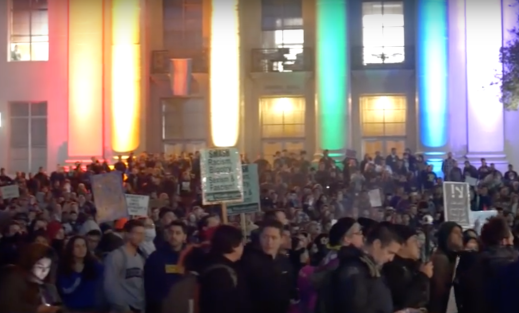
On February 2, 2017, thousands of protesters took to the University of California Berkeley’s Sproul Plaza to protest and ultimately shut down a planned talk by the right-wing provocateur Milo Yiannopoulos. Captured in real time, its dark and blurry image projected to screens across the world, this gathering dumped fuel on a fire that had been burning slowly for many years. Conservative and predominantly “white-male” resentment against the mainstreaming of “politically correct” speech had become the basis for an inchoate community via the internet and was now emerging as a socially acceptable sentiment in the era of Trump. For those protesting at Berkeley, the silencing of Yiannopoulos was not intended simply to condemn the content of his speech, but to intervene preemptively in the culture-wide “fascist creep” disguising itself as humour and taboo breaking. It called into question the actual meaning of both speech and freedom in a place that had become synonymous with the struggle for both.
Viewed by some as a riot, the militant protest tactics evoked scorn, distress, and confusion from a wide spectrum of respondents. Conservative audiences were horrified by the self-evident violence of the Left, even while enjoying a laugh with Milo at the various fails of “SJW’s” and “snowflakes”. Meanwhile Liberals couldn’t seem to fathom the expressions of anger and nihilism evinced by the black-clad mass celebrating in front of the shattered windows of the Martin Luther King Jr. Student Union, who set a fire at the very steps upon which the Free Speech Movement of 1964 had been birthed. The cancellation of Yiannopoulos’s talk has since set off a chain of rhetorical and physical confrontations resulting in the cancellation of Conservative speeches on campus and multiple “free speech” rallies which have devolved into street battles between a motley cohort of alt-right groups and various counter-protesters surrounding a park that was also named after MLK.
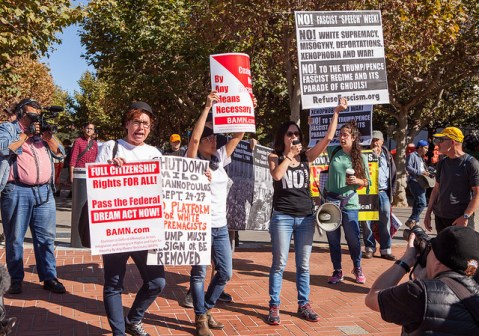
Sproul Plaza Protests, UC Berkeley, September 24, 2017, Image by Pax Ahimsa Gethen, (CC BY-NC-SA 2.0)
Coincident with the events that same spring, Berkeley’s Aurora Theatre staged Temple by British playwright Steve Waters, a revisiting of 2011’s Occupy London protests whose encampments surrounded the area of St. Paul’s Cathedral. First performed in London in 2015, the play speculates that the swirling circumstances of the ten-day period leading up to the dean’s resignation (including the cathedral’s closing on October 21; the Canon Chancellor’s abrupt resignation on the morning of October 28; and the reopening of the cathedral later that day, effectively evicting the protesters) had something to do with the church’s own struggle to reconcile its responsibility to serve both God and his people in the face of ethical contradictions.
Seeing Temple on Aurora Street, barely two weeks and two blocks from the “Patriot’s Day” melee on April 15, provoked us to consider what resonances seemed to be emerging between places and times evoked in the play and humming in the streets. Thinking comparatively between Berkeley in 2017 and Temple yields historical and political synchronicities, between protest movements and the institutions which arbitrate public space and public speech. Temple offers a critique of how the discourse of “free speech” is naturalized, even weaponized, by historical actors; yet it also imagines speech as sonic form never separate from its ethical content. The play exposes how “free speech” often serves as an empty signifier mobilized for political purposes, how it always risks being separated from its material and ethical consequences. Against this, the play pits the noise of protest as a powerful riposte to these abstractions.

“Preaching at. St. Paul’s Church”–Folkmoot
Temple’s story centers around the personal conflict of the Dean, who vacillates between support for the protests surrounding the church and for the city eager to evict them, dramatizing how London’s Occupy movement, displaced from its original encampment outside the London Stock Exchange, took refuge in the courtyards surrounding St. Paul’s Cathedral, replacing one symbolic institution of power with another. As the Dean reminds us, this debating throng gathered on the church’s doorstep is an echo of the folkmoot at St. Paul’s Cross from nearly 800 years before: “In the Reformation era firebrands would preach against usury, against merchants in the very presence of the Mayor…doubtless a riotous affair…” Thus Temple situates Occupy as not an impediment to the functioning of the Church, but a revival of “a tradition of free, even odious utterance… of untrammelled public speech” (41-42).
Despite this sympathetic gesture, the Dean struggles against the unremitting noise of the current protestors outside his window. He frequently sits on the window ledge, holding his head as he peers out toward the loud chanting in what otherwise would be moments of silence: “This drumming, the music, the occasional shout…every night this fitful rhythm of noise, shouts, cries” (34). The polyphonic mass is yet another ethically demanding voice fighting for the dean’s attention. So too the other church leaders, the city lawyer arguing for the camp’s eviction, and the Canon Chancellor’s resort to Twitter where the realm of appearances seems to dictate political decisions because “like the whispering gallery …everything we do is broadcast …amplified …reverberating around the world” (42). Should the dean re-open the church and have the protest camp removed? Should he resign? What would Jesus do?

Still from Aurora Theater’s production of Temple, Berkeley, CA, Image courtesy of authors
This interior struggle is formalized in the clash between the sound of protesters and the ritualized sounds of the church. The play compresses the drama of a three hour period into an hour and a half, and every quarter hour the bells at St. Paul’s ring, marking the ritualized time structure of the church and its domination over the city’s soundscape. R. Murray Schafer points out in The Soundscape that “time is always running out in the Christian system,” (i.e. its inevitable destiny in the apocalypse) “and the clock bell punctuates this fact” (56). The bells mark time, but they also mark power, for they are the “Sacred Noise” that Schafer claims societies “deliberately invoked as a break from the tedium of tranquility” – the silent world of the profane (51). The Church’s ability to determine time and disturb the peace is the (sound)mark of its power, yet the sound of the London protest encampment frequently disrupts its claim to sovereignty. The sonic agon of the play allegorized the one in the street: as Occupy’s cacophony challenged St. Paul’s exclusive right to make noise without censure, so too can the free speech protests be heard as a kind of sonic riposte to the institutionalized soundscape of the university, a sparse scholarly murmur punctuated by the bells of Berkeley’s Sather Tower.
Sonic ritual and sacred noise bookend Temple: the sound of a church choir opening it and the bells in closing. However, the play’s critique of such ritual occurs through constant sonic disruption and the unremitting attack on silence in the final stage direction (“the noise builds”). Therefore, as the Dean’s decision to reopen the cathedral suggests that the church’s rituals have won out, Temple insinuates that Occupy’s struggle was as much about the power to disrupt the peace with speech as it was to preserve its camp. This disruptive quality of ‘noise’ in the play calls attention to protest’s spatial capacities: the ability for sounding to extend beyond the limits of the body, to challenge the very architectures of power. We never see the protesters in the play, yet their acousmatic noise is manifest as if a distinct body were sharing space within the rectory. . Yet what are the limits of this ghostly aurality? Does the noise of the crowd simply become metaphor? We might ask the same thing of the protests at Berkeley, their proximity to the halls of power – university buildings, city hall, police stations – not compensating for their simultaneous containment in public space and exclusion from power’s internal deliberation. How does this risk metaphorizing the very material presence of these protests, the people who were using their actions and bodies to protest against the right’s usurpation of the term “free speech”?
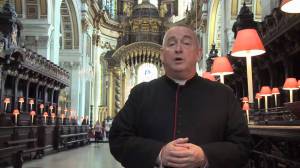
Image of Dean Knowles courtesy of authors
The contest between the pew and the street in Temple exposed how the term “free speech” is metaphorically mobilized for political and ethical convenience. In a way, Temple is a critique of the Dean Graeme Knowles’s actual homily given on October 28th, 2011, just before the church reopened and just after the diegetic time of the play closes. In this homily, Knowles appropriates the language of testimony while at the same time appealing to a more abstract notion of “free speech”:
We are called out to be witnesses, to speak out, to testify…like Simon and Jude, many of us will be anonymous, but like them, our voices need to be heard. Because of their testimony, we are here today. Without their voice, the good news of the gospel would not have reached us.
While the church’s reopening (and the concomitant removal of Occupy) may actually appear like a restriction on free speech, the dean reassures congregants that the church is itself a testament to it. “World leaders have spoken under this throne,” he says, at once emphasizing the church’s personal importance to Christians who feel silenced by the church’s closing and the political importance of an otherwise “neutral” institution.
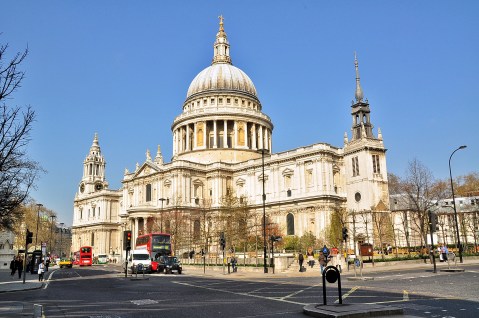
St. Paul’s Cathedral, London, England, Image courtesy of authors
Waters’s play attempts to resolve the church/streets binary by filling hollow calls to testimony with multiple voices across a political spectrum, offering a polyvocality that helps to unpack this contradiction of the church standing up for free speech while simultaneously denying it. Through the clash of sounds and the characters voices, Temple exposes how Knowles’s homily is actually covering up a historical contradiction between numerous relations: between various iterations of what “free speech” means; between who controls the soundscape; between various iterations of free speech movements throughout history. It is here that the link to what is happening in Berkeley in 2017 is most poignant, in the resonance between the church’s past and its conflicted present on the one hand, and the dissonance between the historic memory of the UC Berkeley-based Free Speech Movement (FSM) of the fall of 1964 and how the “New Free Speech Movement” of the “alt-right” has effortlessly yet inaccurately usurped its language and moral ground.
If the Church and the University are spaces of exception, institutions that are both public and private, their responsibility to democratized speech is premised on ethical and legal principles that are not the same as the constitution-bound worlds around them. It is this being of the world and not that incites the agonism around who can speak and what they can say: according to Jesus in John 15:19 “… because you do not belong to the world…therefore the world hates you.”
The Free Speech Movement of 1964 advocated for the ability to offer persuasive speech with social consequences–rather than mere talk–carried forth by an uneasy alliance of liberal and conservative students brought together by the simultaneity of the Civil Rights Movement and Republican Party election campaigns. Campus administrators and the economic and political elite of the day claimed that students were being persuaded to perform illegal activities off campus, while it was the FSM leadership’s assertion that civil disobedience and direct action of the type being developed in civil rights and labor struggles was in fact defensible “free expression.” 50 years ago tactics such as sit-ins, occupations, blocking an arrest, and transforming a police car into a stage were seen by moderate and conservative commentators as coercive and violent forms of rebellion, but for activists they paled in comparison to the everyday racist violence affecting Black people in America, the imperial violence of the Vietnam War, or the total annihilation promised by a potential nuclear war. Similarly today, Antifa accept pre-emptive and coercive violence as necessitated by the potential violence summoned by the “alt-right,” whether in the form of lone individuals inspired by their white supremacist ideology or the spectre of a large scale fascist transformation of American society.
Though protest songs provided the background music to the FSM of the 60’s, the current debate and protests over “free speech” call attention to another constitutive relationship between sound and protest, between noise and power. Behind the liberal plea to “lower the voices” and heighten the reason in political discourse is a reminder that sound has an ability to interact with consciousness in non-rational, even hypnotic ways. We see a kind of hypnosis in the very language of “free speech” today, a term invoked by the alt-right and the university to protect certain political agendas similar to the way that the term “objectivity” was deployed mid-century. Stanley Fish made a similar argument in the 1990’s amidst that moment’s culture wars, arguing that because all speech is socially constructed and ideologically asserted “there’s no such thing as Free Speech.”
Free speech, for Fish, only exists as an ideal construct outside of history in which voices are pure “noise,” separated from consequences and assertions. But his notion of “noise” and “free speech” again are too metaphorical, separated from the uneven histories of protected speech and the materiality of noisy protests. As Jonathan Sterne writes, out of the perceived noise and meaninglessness of protests there emerge rhythms and grooves that can be heard farther than they can be seen, that invite participation and resistance. In the context of Temple and the UC Berkeley protests, the “noise” created within and against the term “free speech” should not simply be dialed down or declared a realm of meaningless utterance, but unpacked as an important opening in to how power is both employed and resisted by institutions like the university and the church.

Berkeley Free Speech Protests of 1964, Image courtesy of author
The Chancellors of UC Berkeley have never been averse to using violence to correct and regulate speech on its campuses, whether it be Chancellor Strong’s eviction of the FSM’s occupation of Sproul Hall in 1964, or the brutalization of student protesters by campus police under the watchful eye of Chancellor Birgeneau in 2009. The Dean of St. Paul’s agony could give us insight into what went into Chancellor Christ’s ambivalent public letter that assures us that “free speech” and “safety” will come at a cost. In ‘64 the discourse of “free speech” became a platform for political dialogue and social transformation, not for usurping the language of testimony and personal experience while abstracting real societal power. What the “alt-right” frames as a common struggle for a moral and legal principle only disguises the balances of power that determine who can speak without the consequence of violence: white people or people of color; governments or protestors; bankers or the poor.
“Free Speech” is the domain of a particular sacred noise, one that has the power to disrupt what Martin Luther King Jr. himself described as the “appalling silence and indifference of good people who sit around saying ‘wait on time’.” In this recently discovered speech, given in London just after he spoke at St. Paul’s in December 1964, MLK goes on to say that “human progress never rolls in on the wheels of inevitability,” retroactively giving moral weight to Mario Savio’s demand that “you’ve got to put your bodies […] upon the wheels.” We can see this spirit of rebellion in the counter-rhythms of London’s anti-austerity occupations, rising up to meet the bells of St. Paul’s, and as well in the “rough music” of outraged students rising up to meet the Sather Tower Carillon as it insistently keeps time.
—
Featured Image: Still from video of Berkeley Protests, February 2017
—
Gabriel Salomon Mindel is an interdisciplinary artist and scholar whose research considers ways that people produce and struggle for space using sound to extend beyond the limits of their bodies, particularly in formal and informal modes of protest. He received an MFA in Visual Arts from Simon Fraser University where his work focused on the production of visual artworks from time-based phenomena such as sound composition, dance, social practices and protest. He has also spent nearly two decades exhibiting artwork, performing improvised music and composing for dance and film. Images, writings and recordings can be found at https://diademdiscos.com/gms/.
Alexander J. Ullman is a PhD student at UC Berkeley’s Department of English where he researches Nineteenth, Twentieth, and Twenty-first Century Literatures.
—
 REWIND! . . .If you liked this post, you may also dig:
The Sound of Hippiesomething, or Drum Circles at #OccupyWallStreet–Gina Arnold
On Ventriloquism, Dummies, and Trump’s Voice–Sarah Kessler
G.L.O.S.S., Hardcore, and the Righteous White Voice–Chris Chien
Share this:


Current Top Posts





April 2021

January 2020

November 2019

October 2019

August 2019

April 2014

November 2017

March 2015

December 2017

October 2015
 Sounding Out!
Recent Comments