
becoming a sound artist: analytic and creative perspectives

Recently, in a Harvard graduate seminar with visiting composer-scholar George Lewis, the eminent professor asked me pointedly if I considered myself a “sound artist.” Finding myself put on the spot in a room mostly populated with white male colleagues who were New Music composers, I paused and wondered whether I had the right to identify that way. Despite having exploded many conventions through my precarious membership in New York’s improvised/creative music scene, and through my shift from identifying as a “mrudangam artist” to calling myself an “improviser,” and even, begrudgingly, a “composer” — somehow “sound artist” seemed a bit far-fetched. As I sat in the seminar, buckling under the pressure of how my colleagues probably defined sound art, Prof. Lewis gently urged me to ask: How would it change things if I did call myself a sound artist? Rather than imposing the limitations of sound art as a genre, he was inviting me to reframe my existing aesthetic intentions, assumptions, and practices by focusing on sound.
Sound art and its offshoots have their own unspoken codes and politics of membership, which is partly what Prof. Lewis was trying to expose in that teaching moment. However, for now I’ll leave aside these pragmatic obstacles — while remaining keenly aware that the question of who gets to be a sound artist is not too distant from the question of who gets to be an artist, and what counts as art. For my own analytic and creative curiosity, I would like to strip sound art down to its fundamentals: an offering of resonance or vibration, in the context of a community that might find something familiar, of aesthetic value, or socially cohesive, in the gestures and sonorities presented.
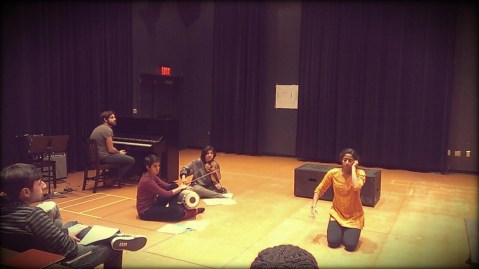
Rehearsing for “Meena’s Dream” (2013) by playwright Anu Yadav – original score by Rajna and Anjna Swaminathan and Sam McCormally.
I have spent most of my musical life wondering how the sounds I produce intersect with specific vectors of social belonging. The sounds emanating from my primary instrument — the mrudangam, a South Indian drum — are situated within a complex lattice of social difference, resonating within and across communities as disparate as the predominantly privileged-caste audiences of Chennai’s elite Karnatik sabha-s and the cosmopolitan connoisseurs who show up to find a home in New York City’s myriad intercultural and experimental music spaces. The sounds I produce are also inflected by the multivalent referentiality of my own socially situated body — as a queer, privileged-caste, Indian-American woman — simultaneously slicing through and answering to sonic environments organized around particular notions of rigor, virtuosity, and beauty.
For me, what began as a creative path rooted in the mimesis of an artistic lineage eventually settled in a versatile expressive voice, shaped by a decade of aesthetic (and ethical) nomadism. From my vantage point as a female percussionist in the South Asian diaspora, I have always been aware of the cracks in the veneer of tradition and other normative structures, and perhaps this fueled my musical vagrancy. Over time, my sound has accumulated the resonances of Karnatik music, ‘jazz’ drumming, bharatanatyam footwork, and Afro-Cuban rhythms, among others.

The author performing with Vijay Iyer, Graham Haynes, and Marcus Gilmore. The Stone, NYC. July 2013.
Certainly, this convergence of sonic layers is mediated by the rich specificity of interpersonal relationships and positionalities within larger networks. Power and positionality mediate the shape, audibility, and versatility of sounds as they become coupled with the implied (or actual) encounter of socially situated bodies. Yet, sounds somehow continue to exist in excess of the mechanisms and bodies that attempt to explain, produce, and contain them: idiom, tradition, space, culture, nation, race, gender, and sexuality. Therein lies their potency and mystery, and I intend to briefly explore the sensation of sonic excess in the hopes of honing a more sensitive analytic and creative perspective.
I am yet to become comfortable thinking in terms of sound, due to the longtime privileging of structure and technique in my musical upbringing. However, this is beginning to unravel as I am forced to deal with sound, particularly the sound of what Patrice Pavis and Jason Stanyek have called the “intercorporeal” aspect of intercultural performance. The predominantly improvised sounds that resonate through my mrudangam often emerge on the edge of my dynamic embodied consciousness, arranging themselves chaotically in real-time, interacting with others’ emergent soundings and sensory yearnings. Some of it may be mediated by parallel perceptual and idiomatic forms, but achieving a core interactive flow involves a fundamental immersion in sound.
Mat Maneri, feat. Rajna and Anjna Swaminathan
Tongues Series, curated by Amirtha Kidambi
ISSUE Project Room — June 18, 2016
For instance, take this impromptu piece presented by violist Mat Maneri, violinist Anjna Swaminathan (my sister), and me in 2016. It took place in the wonderfully resonant vaulted space of ISSUE Project Room, in front of an unsuspecting audience that had convened to hear the back-to-back juxtaposition of two improvisational “tongues” — a set of Maneri’s rich microtonal experiments, followed by a Karnatik concert of voice, violin, and mrudangam. However, this impromptu ludic exchange of sonic offerings — particularly Maneri’s incredible, chameleon-like ability to confound the sounds of Karnatik ornamentations with his own microtonal reflections — guided attention away from comparison and toward the sounds as they bounced eerily around the resonant architecture. Faced with the technically daunting Karnatik repertoire that Anjna and I were to play subsequently with vocalist Ashvin Bhogendra, the echoes of our interstitial collaboration allowed us to reorient ourselves and breathe a little easier.
From an analytic perspective, it is irresponsible to distill these sounds, to capture and conceptualize them as distinct from the bodies, histories, and discourses that participate in their co-creation and interpretation. Yet, riddled as they are with generations of power asymmetries and complex emotions, it is clear that these resonances have a secret life of their own. As musicians, we are not often given the opportunity to explore these clandestine, almost Baudelairean, correspondences, except perhaps when we discover them by accident. For instance, sonic ambiguities like those spun during the trio encounter play on sonic excess to spur new ways of listening and relating, with a direct ethical impact on the ensuing music.

Performing in Vijay Iyer’s large ensemble project, “Open City,” named after Teju Cole’s award-winning novel. October 2013.
John Blacking’s definition of all music as “humanly organized sound” is perhaps an early articulation of this idea, although the word ‘organized’ contains a bias toward formal structure and stability. To be sure, organizing principles always exist at the local level of socially situated perception and expression, which Nina Sun Eidsheim calls the ‘figure of sound.’ However, the kind of sound art I’m proposing revels in excess, or as Eidsheim puts it — “not only aurality, but also tactile, spatial, physical, material, and vibrational sensations [that] are at the core of all music” (5). We can even turn to how Jacques Attali poetically describes composition — as “a labor on sounds, without a grammar, without a directing thought, a pretext for festival, in search of thoughts,” a practice wherein “rhythms and sounds are the supreme mode of relation between bodies once the screens of the symbolic, usage and exchange are shattered,” one that neither marks nor produces the body, but allows for “taking pleasure in it” (143). By focusing on the multi-sensory, pleasurable valences of sound, and on the ways in which sonic excess allows for new patterns of coexistence, we can outline a ‘sound art’ practice and analytic that aren’t circumscribed by Western institutional definitions and technological/perceptual biases.
Thinking in this way about sound and vibration helps to eradicate the mind-body problem that continues to plague certain areas of music studies and music making. Sound forms an elusive common denominator that doesn’t rely heavily on colonial taxonomies of form or hierarchical theories of art. It even accounts for the subversive or incommensurable resonances that tend to emerge at the unstable threshold between so-called ‘producers’ and ‘receivers’ of music. After all, sound is in the ear of the beholder, and social asymmetries are embedded in the way we hear and listen. Through the notion of vibration, we are further attuned to the visceral space in which it reverberates, and the ways in which its echoes live on in the bodies of those who experience it.

performing at the Banff International Workshop for Jazz and Creative Music. June 2013. Photo credit: Don Lee, Image courtesy of author
Finally, there is the other definition of sound in English, which indicates a level of trust and holism. Taking this path to becoming ‘sound artist’ focuses attention on the artist. I don’t intend to focus on the ‘chops’ conventional to a field of aesthetic practice. Rather, I am interested in the more obscure meaning: a ‘sound artist’ as one that ethically occupies space as an artist.
How might this emerging sound art, as analytic and creative practice, work to interrogate the very ethics and politics of art, while succumbing to the contingency and volatile excess of sound? I don’t claim to hold the answers, but if we are in any way sounding out against the grain of dominant modalities, then at some level we must attend seriously to sound: in its excess, as it overwhelms bodies and spaces, and as it stretches the realm of the known.
—
Featured Image: “The great Rajna Swaminathan,” from Teju Cole tweet, 5 October 2013.
—
Rajna Swaminathan is an accomplished mrudangam (South Indian percussion) artist, a protégé of mrudangam legend Umayalpuram K. Sivaraman. She has performed with several renowned Indian classical musicians, most notably mentor and vocalist T.M. Krishna. Since 2011, she has been studying and collaborating with eminent musicians in New York’s jazz and creative music scene, including Vijay Iyer, Steve Coleman, Miles Okazaki, and Amir ElSaffar. Since 2013, Swaminathan has led the ensemble RAJAS, which explores new textural and improvisational horizons at the nexus of multiple musical perspectives. Swaminathan is active as a composer-performer for dance and theatre works, most notably touring with the acclaimed company Ragamala Dance and collaborating with playwright/actress Anu Yadav. Swaminathan holds degrees in anthropology and French from the University of Maryland, College Park, and is currently pursuing a PhD in cross-disciplinary music studies at Harvard University.
—
 REWIND! . . .If you liked this post, you may also dig:
Sounding Out Tarima Temporalities: Decolonial Feminista Dance Disruption–Iris C. Viveros Avendaño
Gendered Soundscapes of India, an Introduction –Praseeda Gopinath and Monika Mehta
Tape Hiss, Compression, and the Stubborn Materiality of Sonic Diaspora–Chris Chien
“This Liquid Dream”: An Interview with Aquaphoneia Composer Navid Navab–Eshter Bourdages
Share this:

Making His Story Their Story: Teaching Hamilton at a Minority-serving Institution
In the summer of 2016, optimistic about a full-time teaching position at a minority-serving institution, yet unsure about what the U.S. election would mean for immigrants’ rights, I played the Hamilton soundtrack daily. Lin Manuel Miranda wrote the Pulitzer-prize winning musical inspired by Ron Chernow’s biography on the United States’ founding father because, he believed, Alexander Hamilton’s life embodied hip hop. My repeated listenings urged me to assign the musical as homework in my courses.
Colleagues with whom I engage on Twitter provided resources with which to begin. A public historian, Lyra Monteiro, wrote an important review for Public History,“Race-Conscious Casting and the Erasure of the Black Past in Lin-Manuel Miranda’s Hamilton,” which provide one key angle of critique. Latinx Theater scholar and SO! writer Trevor Boffone created an online syllabus, #Syllabus4Ham, that provided important critiques of the musical, news coverage of its growing popularity, and initial scholarly analyses of the cultural historical significance of the musical’s popularity. Pedagogically, Miranda’s archival research in addition to his belief that Hamilton’s life embodied hip hop sparked an interest to bring the production to my gender and interdisciplinary studies classrooms. While colleagues works’ inspired ways to discuss the musical in class, post-election coverage and the release of the Hamilton Mixtape provided more material to discuss. Teaching children of hip hop whose lives embody the struggle that Miranda made the central force behind his re-writing of Hamilton’s contribution to United States’ history, I wanted to develop lessons drawing on those relations.
By the spring 2017, I had done preliminary reading on the syllabus Boffone provided and replaced the musical with the Mixtape as my car ride soundtrack. When organizing my syllabus, I assigned tracks from the mixtape against the musical’s soundtrack with the intent of assigning students excerpts in both both my introductory Gender Studies course and Interdisciplinary Research Methods courses, but with a unique twist for each class. Gender Studies engaged with the content contextualized by discussions of immigration and citizenship. I assigned my Research Methods course Monteiro’s critique of race-consciousness of the musical against the mixtape and the musical. While students were in solidarity with Montiero’s argument, I invited them to consider Miranda’s original intent, the mixtape, which may have informed the themes Miranda prioritized.
Few of them had heard of the musical before my class and less had heard of the mixtape. Their limited exposure necessitated historicizing both Miranda’s career and the evolution Hamilton’s, which begins with 2009 Miranda’s White House performance. Miranda, invited by President Obama to perform a song from his previous hit In the Heights, instead decided to introduce his new project, a mixtape based on Alexander Hamilton.
Through discussion, I proposed that the students consider that the production, in 2009 envisioned as an album, served as a strategic catalyst to bring attention to his forthcoming mixtape. That attention evolved into encouraging Miranda to produce the musical; it would take a few more years till the intended mixtape was produced. Even though produced later, I speculated that the mixtape thematically benefited from the popularity of the musical because the musical’s focus on Alexander Hamilton rewrites the context of the mixtape.
Teaching Hamilton the musical and the mixtape felt politically necessary at a minority serving institution in this historical moment of anti-immigrant, and anti-black sentiment. Having, in the past, worked with other youth to mobilize youth empowerment through hip hop, Hamilton provided an avenue in which I could discuss its political potential because of its popularity not only in spite of it. In breaking down Miranda’s cultural and political significance, I summarized the evolution of awards he and the musical’s cast had won as well as the preliminary cast’s reflections on participating in Hamilton, along with what it means to have the success of the musical produce a wider audience for the mixtape.
After more than a semester working with students who grow frustrated with the traditional research paper and because of my own work producing research-based fiction and poetry, teaching the musical and mixtape provided an important example of research-based art. Because some students approach interdisciplinary research methods not understanding the possibilities of the relationship between art and research and some students are unsure of how to connect learning outcomes to their aspiring performance careers, I find teaching Miranda’s work remains necessary. Further, Miranda provides an avenue through which I could relate to students because of our shared interest in music as well as our conflicted relationship with consuming hip hop.
Teaching a student population that is 25% Latinx and who are either directly or indirectly affected by immigration policies, my students related, often quite deeply and intimately, to the message of the song. I watched their faces as they listened, particularly to “Immigrants (We Get the Job Done),” and their kinesthetic responses showcased what many of us ache for our students to experience: wonder, appreciation, and the illumination of insight.
I then guided them to hone in specifically on Puerto Rican rapper Residente rapping about the Mexican immigrant struggle in Spanish, emphasizing how he sonically and rhetorically urges a Latin pan-ethnicity while using his U.S. citizenship privilege to historicize border crossing Mexicans. Residente’s lyrics create an opportunity to discuss Puerto Ricans’ cultural reality of being perceived as immigrants while being legally defined as citizens, all the while calling back to the lyrical connection to the “Battle of Yorktown” from the musical.
I highlighted Miranda’s rhetorical strategy in building a song around one line that contexts changes across either song. The “Battle of Yorktown” centers on the contributions of immigrants to gaining freedom. During the lecture, I drew connections between the lyric that would become a song and the lyric subtly referencing the lack of freedoms for black people who were enslaved in the U.S. I asked about the parallels before explaining them, using the intentionality behind creating and compelling a racially diverse cast to script a narrative about who could and who had built the United States. What does it mean to hear these voices emanating from this cast, telling this story?
Pedagogically, teaching music in either course served the intent of reimagining the purpose and potential of sound, whether from a musical or a mixtape, as a site of critical thinking. Popular musicians’ cultural authority slowly decenters the white fragility I have come to expect from difficult conversations such as the ones Hamilton and The Hamilton Mixtape allow me to have. Furthermore, the call-and-response between the mixtape and the musical work address the silence of the unrecognized, exploited, and/or enslaved labor that continues to build this country. For my students, hearing musicians they like or who perform in their favorite genre, speaking truth to power about poverty, struggle, and not being thought of as good enough shifted not only our classroom energy, but many students’ perspectives.
Teaching the Hamiltons helped my student population make sense of their “invisible” status in the U.S. and want more than what’s expected. They gained something in being able to hear their stories in the classroom—not just read them on the page—but hear them from people who look and sound like them. Hungry for more material that speaks to their disenfranchisement, my students wondered why more songs that sound the complex beauty of our resilience and struggle are not on the radio. They wanted to know how they can ask for more.
—
Featured Image: Screen capture from “Immigrants (We Get the Job Done)” remix video
—
Erika Gisela Abad, Ph.D, is a Queer Latina poet, born and raised in Chicago. She received her PhD in American Studies in 2012. Since completing her degree, she has worked as: a customer service associate and a scheduler at a phone interpreter call center, head counselor for a caddy program affiliated with a high school scholarship fund, field director for an education policy campaign, an oral historian and ethnographer. Since August 2016, she has been a full time assistant professor teaching gender studies. Twitter: @lionwanderer531; @prof_eabad
—
 REWIND!…If you liked this post, you may also dig:
“Don’t Be Self-Conchas”: Listening to Mexican Styled Phonetics in Popular Culture*–Sara V. Hinojos and Dolores Inés Casillas
“Ich kann nicht”: Hearing Racialized Language in Josh Inocéncio’s Purple Eyes (Ojos Violetas)–Trevor Boffone
Moonlight’s Orchestral Manoeuvers: A duet by Shakira Holt and Christopher Chien
The Sounds of Anti-Anti-Essentialism: Listening to Black Consciousness in the Classroom- Carter Mathes
Share this:


Current Top Posts





April 2021

January 2020

November 2019

October 2019

August 2019

April 2014

November 2017

March 2015

December 2017

October 2015
 Sounding Out!
Recent Comments