
“Ich kann nicht”: Hearing Racialized Language in Josh Inocéncio’s Purple Eyes (Ojos Violetas)

In Spring 2017, I brought Houston-based playwright/performer Josh Inocéncio to my campus—the University of Houston—to perform his solo show Purple Eyes (for more on the event, see “Campus Organizing, or How I Use Theatre to Resist”). Purple Eyes is what Inocéncio calls an “ancestral auto/biographical” performance piece which explores his upbringing as a closeted gay Chicano living in the midst of the cultural heritage of machismo. Following a legacy of solo performance storytelling aesthetics seen in John Leguizamo’s Freak and Luis Alfaro’s Downtown, Inocéncio plays with memory to understand how the United States and Mexico have influenced his family and his own identity formation. Moreover, Purple Eyes explores the intersections of queerness and Chican@ identity alongside the legacy of machismo in his family (For more on the play, see “Queering Machismo from Michoacán to Montrose”).

Still from Purple Eyes (Ojos Violetas), with permission from Josh Inocencio who retains copyright.
During my Intro to LGBT Studies course following the performance, students discussed issues of representation and how many of them had never seen a queer Latin@/x play or performance, with some of them having never seen a live play. Many students picked up on how Purple Eyes foregrounds the intersections of race, ethnicity, gender, and sexuality. While these discussions were indeed fruitful, what struck me most was how both classes harped on Inocéncio’s use of different linguistic registers. Put simply, what stayed with them was how the performance sounded. My students obsessed over the Spanish in the play, leading me to question why this group of students at a Hispanic-Serving Institution in a city that is over 40% Latin@ had so much trouble whenever Inocéncio spoke Spanish, or the sounds of Latinidad.
In what follows, I discuss how my students heard Purple Eyes. While the play is predominately in English, Inocéncio often code-switches into Spanish and German to more accurately embody particular family members. This blog adds to previous research by Dolores Inés Casillas, Sara V. Hinojos, Marci R. McMahon, Liana Silva, and Jennifer Stoever on the relationship between the Spanish language and non-Spanish speaking Americans. Indeed, my students racialized the Spanish in Purple Eyes while completely disregarding the German in the play. Why?
Drawing from sociology, racialization is the process of imposing racial identities to a social practice or group that might not have identified in such a way. Typically, the dominant group racializes the marginalized group; i.e. Latin@s in the U.S. become racialized by the mainstream. Even so, Latin@s are not a race, but are an ethnic group. Yet, I argue that non-Latin@ Americans view Latin@s through a lens of race which often becomes a sonic one, in which language becomes one of the most overt identity markers. In terms of Spanish, while many races and ethnicities speak the language, in the United States it is often viewed as a way to mark Spanish-speaking Latin@s as Other. In this way, language plays a fundamental role in shaping mainstream ideas about race. According to Dolores Inés Casillas, “For unfamiliar ears, the sounds of Spanish, the mariachi ensemble, and/or accented karaoke all work together to signal brownness, working-class,” and as Jennifer Stoever argues, the sounds of Latinidad indicate “illegality” in the U.S.
Drawing from the intersections of race, language, and racism, the relatively new academic field Raciolinguistics has emerged as a means to explain how people use language to shape their identity (For more, see Raciolinguistics: How Language Shapes Our Ideas About Race). Branching off from Raciolinguistics, I am most interested in exploring how the mainstream hears languages and racializes what they are hearing. The result is that Spanish is seen as Other, meaning that monolingual U.S. listeners hear Spanish-speakers as inherently different and a threat to a mainstream United States cultural and, more importantly, national identity.
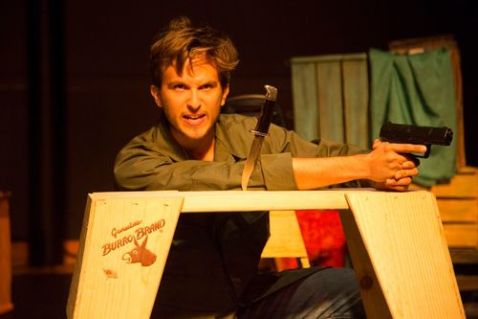
Still from Purple Eyes (Ojos Violetas), with permission from Josh Inocencio who retains copyright.
Reflecting Inocéncio’s cultural multiplicity, Purple Eyes features English, Spanish, and German strategically used at different moments in the play to reflect the temporality, positionality, and relationship to language of each character that Inocéncio inhabits. While the chapter on his father is entirely in English, the final chapter focusing on Josh himself opens with a monologue in Spanish in which the performer narrates the events of the FIFA World Cup before finally announcing to the crowd that the epilogue is Inocéncio’s journey of young love and heartbreak on his journey of queer discovery. This moment features the longest extended use of Spanish in the play. The remaining Spanish is sprinkled in as Josh code-switches between the two languages for added cultural specificity.
While some of my Spanish-speaking students appreciated hearing a play that reflected their linguistic identities, monolingual English speakers in my class claimed that the Spanish confused them and made it difficult for them to follow certain parts of the play. After several students echoed these thoughts, a student from Mexico without full fluency in English comprehension told others about how her experiences were the exact opposite. She had trouble following some of the parts in English since she is still learning the language. I then pivoted the conversation to discuss how my English-dominant students approached the play with the assumption that English is the norm and a performance on a university campus should reflect this. Case in point: several told me that the show should have been subtitled.
But what was most telling was the following exchange. After several expressed confusion over the Spanish, one particularly woke student from Nigeria raised her hand and said: “I haven’t heard anyone say anything about the German in the play and not being able to follow the play during the German part.” She then noted how, in the United States, Spanish is racialized whereas German is not. In fact, most of the students did not even recall German in the play. Admittedly, the play features far more Spanish than German, but the scene in which Inocéncio speaks German occurs while dramatizing his Austrian grandmother’s abortion. As Inocéncio (as Oma) frantically repeated “Ich kann nicht” (I can’t), my students had no trouble; to use some Millennial vernacular, it was with Spanish that they “couldn’t even.” Arguably, this is the most intense scene in the performance and one that my students wanted to discuss. That the majority of them understood this scene without fully registering the German, coupled with their confusion over lines spoken in Spanish, speaks to not only how race and ethnicity impact how languages are heard in the United States. German is viewed as familiar and accessible whereas Spanish is immediately heard as foreign, i.e. undesirable, not welcome here.
As the Latin@ population continues to grow and the Spanish language becomes an increasingly present reality in U.S. everyday life, audiences must consider possibilities not grounded in an English-only narrative. My experiences with Purple Eyes are not unique. I have witnessed and heard many stories about audiences at mainstream theatre companies who have struggled whenever a play included Spanish. While I don’t claim to have the answers to address this across the nation, as an educator, I question what tools I can give my students to help prepare them for sonic experiences outside of their comfort zone and, specifically, how they become aware of subconscious racialization practices. What will they hear? And, more importantly, how will they react?
—
Featured Image: Still from Purple Eyes (Ojos Violetas), with permission from Josh Inocencio who retains copyright.
—
Trevor Boffone is a Houston-based scholar, educator, writer, dramaturg, producer, and the founder of the 50 Playwrights Project. He is a member of the National Steering Committee for the Latinx Theatre Commons and the Café Onda Editorial Board. Trevor has a Ph.D. in Latin@ Theatre and Literature from the Department of Hispanic Studies at the University of Houston where he holds a Graduate Certificate in Women’s, Gender, & Sexuality Studies. He holds an MA in Hispanic Studies from Villanova University and a BA in Spanish from Loyola University New Orleans. Trevor researches the intersections of race, ethnicity, gender, sexuality, and community in Chican@ and Latin@ theater and performance. His first book project, Eastside Latinidad: Josefina López, Community, and Social Change in Los Angeles, examines the textual and performative strategies of contemporary Latin@ theatermakers based in Boyle Heights that use performance as a tool to expand notions of Latinidad and (re)build a community that reflects this diverse and fluid identity. He is co-editing (with Teresa Marrero and Chantal Rodriguez) an anthology of Latinx plays from the Los Angeles Theatre Center’s Encuentro 2014 (under contract with Northwestern University Press).
—
 REWIND!…If you liked this post, you may also dig:
“Don’t Be Self-Conchas”: Listening to Mexican Styled Phonetics in Popular Culture*–Sara V. Hinojos and Dolores Inés Casillas
Deaf Latin@ Performance: Listening with the Third Ear–Trevor Boffone
Moonlight’s Orchestral Manoeuvers: A duet by Shakira Holt and Christopher Chien
If La Llorona Was a Punk Rocker: Detonguing The Off-Key Caos and Screams of Alice Bag–Marlen Rios-Hernández
Share this:

The Firesign Theatre’s Wax Poetics: Overdub, Dissonance, and Narrative in the Age of Nixon

The Firesign Theatre are the only group that can claim among its devoted fans both Thom Yorke and John Ashbery; who have an album in the National Recording Registry at the Library of Congress and also coined a phrase now used as a slogan by freeform giant WFMU; and whose albums were widely distributed by tape among U.S. soldiers in Vietnam, and then sampled by the most selective classic hip hop DJs, from Steinski and DJ Premier to J Dilla and Madlib.
Formed in 1966, they began their career improvising on Los Angeles’s Pacifica station KPFK, and went on to work in numerous media formats over their four-decade career. They are best known for a series of nine albums made for Columbia Records, records that remain unparalleled for their density, complexity, and sonic range. Realizing in an astonishing way the implications of the long playing record and the multi-track recording studio, the Firesign Theatre’s Columbia albums offer unusually fertile ground for bringing techniques of literary analysis to bear upon the fields of sound and media studies (and vice versa). This is a strategy that aims to reveal the forms of political consciousness that crafted the records, as well as the politics of the once-common listening practices binding together the disparate audiences I have just named. It is no accident that the associative and referential politics of the sample in “golden age” hip hop would have recognized a similar politics of reference and association in Firesign Theatre’s sound work, in particular in the group’s pioneering use of language, time, and space.

The Firesign Theatre (wall of cables): John Rose, Image courtesy of author
The Firesign Theatre is typically understood as a comedy act from the era of “head music” — elaborate album-oriented sounds that solicited concerted, often collective and repeated, listening typically under the influence of drugs. But it may be better to understand their work as attempting to devise a future for literary writing that would be unbound from the printed page and engaged with the emergent recording technologies of the day. In this way, they may have crafted a practice more radical, but less recognizable, than that of poets —such as Allen Ginsberg or David Antin, both of whose work Firesign read on the air — who were also experimenting with writing on tape during these years (see Michael Davidson’s Ghostlier Demarcations: Modern Poetry and the Material Word, in particular 196-224). Because their work circulated almost exclusively on vinyl (secondarily on tape), it encouraged a kind of reading (in the strictest sense) with the ears; the fact that their work was distributed through the networks of popular music may also have implications for the way we understand past communities of music listeners as well.
The period of Firesign’s contract (1967-1975) with the world’s largest record company parallels exactly the recording industry’s relocation from New York to Los Angeles, the development of multitrack studios which made the overdub the dominant technique for recording pop music, and the rise of the LP as a medium in its own right, a format that rewarded, and in Firesign’s case required, repeated listening. These were all factors the Firesign Theatre uniquely exploited. Giving attention to the musicality of the group’s work, Jacob Smith has shown (in an excellent short discussion in Spoken Word: Postwar American Phonograph Cultures that is to date the only academic study of Firesign) how the group’s attention to the expansion of television, and in particular the new practice of channel-surfing, provided both a thematic and a formal focus for the group’s work: “Firesign […] uses channel surfing as the sonic equivalent of parallel editing, a kind of horizontal or melodic layering in which different themes are woven in and out of prominence until they finally merge. Firesign also adds vertical layers to the narrative in a manner analogous to musical harmony or multiple planes of cinematic superimposition” (181). But more remains to be said not only about the effect of the Firesign Theatre’s work, but about its carefully wrought semantics, in particular the way the “horizontal” and “vertical” layers that Smith identifies were used as ways of revealing the mutually implicated regimes of politics, culture, and media in the Vietnam era — at the very moment when the explosion of those media was otherwise working to disassociate those fields.
The group’s third album, Don’t Crush That Dwarf, Hand Me the Pliers is typically understood as their first extended meditation on the cultural phenomenology of television. Throughout the record, though there is much else going on, two pastiches of 1950s genre movies (High School Madness and a war film called Parallel Hell!) stream intermittently, as if through a single channel-surfing television set. The films coincide in two superimposed courtroom scenes that include all the principal characters from both films. By interpenetrating the school and the war, the record names without naming the killing of four students at Kent State and two students at Jackson State University, two events that occurred eleven days apart in May 1970 while the group was writing and recording in Los Angeles. Until this point rationalized by the framing fiction of a principal character watching both films on television, the interpenetration of the narratives is resolvable within the album’s diegesis—the master plot that accounts for and rationalizes every discrete gesture and event—only as a representation of that character’s having fallen asleep and dreaming the films together, a narrative sleight of hand that would testify to the group’s comprehension of literary modernism and the avant-garde.
The question of what may “cause” the interpenetration of the films is of interest, but the Firesign Theatre did not always require justification to elicit the most outrageous representational shifts of space (as well as of medium and persona). What is of more interest is the way rationalized space — the space implied by the “audioposition” of classic radio drama, as theorized by Neil Verma in Theater of the Mind— could be de-emphasized or even abandoned in favor of what might instead be called analytic space, an aural fiction in which the institutions of war and school can be understood as simultaneous and coterminous, and which more broadly represents the political corruptions of the Nixon administration by means of formal and generic corruption that is the hallmark of the Firesign Theatre’s approach to media (35-38).
While the techniques that produce this analytic soundscape bear some resemblance to what Verma terms the “kaleidosonic style” pioneered by radio producer Norman Corwin in the 1940s — in which the listener is moved “from place to place, experiencing shallow scenes as if from a series of fixed apertures” — even this very brief sketch indicates how radically the Firesign Theatre explored, deepened, and multiplied Corwin’s techniques in order to stage a more politically diagnostic and implicative mode of cultural interpretation. Firesign’s spaces, which are often of great depth, are rarely traversed arbitrarily; they are more typically experienced either in a relatively seamless flow (perspective and location shifting by means of an associative, critical or analytical, logic that the listener may discover), or are instead subsumed within regimes of media (a radio broadcast within a feature film which is broadcast on a television that is being watched by the primary character on the record album to which you are listening). According to either strategy the medium may be understood to be the message, but that message is one whose horizon is as critical as it is aesthetic.

Firesign Theatre (pickup truck): John Rose, Image courtesy of author
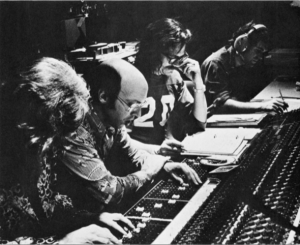
The creation of what I am terming an analytic space was directly abetted by the technological advancement of recording studios, which underwent a period of profound transformation during the years of their Columbia contract, which spanned the year of The Beatles’s Sergeant Pepper’s Lonely Hearts Club Band (arguably the world’s first concept album, recorded on four tracks) to Pink Floyd’s Wish You Were Here (arguably that band’s fourth concept album, recorded on 24 tracks). Pop music had for years availed itself of the possibilities of recording vocals and solos separately, or doubly, but the dominant convention was for such recordings to support the imagined conceit of a song being performed live. As studios’ technological advances increased the possibilities for multitracking, overdubbing, and mixing, pop recordings such as Sgt. Pepper and the Beach Boys’ Pet Sounds (1966) became more self-evidently untethered from the event of a live performance, actual or simulated. In the place of the long-dominant conceit of a recording’s indexical relation to a particular moment in time, pop music after the late 60s came increasingly to define and inhabit new conceptions of space, and especially time. Thus, when in 1970 Robert Christgau asserted that the Firesign Theatre “uses the recording studio at least as brilliantly as any rock group” (and awarding a very rare A+), he was remarking the degree to which distortions and experiments with time and space were if anything more radically available to narrative forms than they were to music.
The overdub made possible much more than the simple multiplication and manipulation of aural elements, it also added depth and richness to the soundfield. New possibilities of mixing, layering, and editing also revealed that the narrative representation of time, as well as spatial element I’ve just described, could be substantially reworked and given thematic meaning. In one knowing example, on 1969’s How Can You Be in Two Places at Once When You’re Not Anywhere at All, an accident with a time machine results in the duplication of each of the narrative’s major characters, who then fight or drink with each other.
This crisis of the unities is only averted when a pastiche of Franklin Delano Roosevelt interrupts the record’s fictional broadcast, announcing the bombing of Pearl Harbor, and his decision to surrender to Japan. On a record released the year the United States began secret bombing in Cambodia, it is not only the phenomenological, but also the social and political, implications of this kind of technologically mediated writing that are striking: the overdub enables the formal representation of “duplicity” itself, with the gesture of surrender ironically but pointedly offered as the resolution to the present crisis in Southeast Asia.
To take seriously the Firesign Theatre’s experiments with medium, sound, and language may be a way of reviving techniques of writing — as well as recording, and of listening — that have surprisingly eroded, even as technological advances (cheaper microphones, modeling software, and programs from Audacity and Garage Band to Pro Tools and Ableton Live) have taken the conditions of production out of the exclusive purview of the major recording studios. In two recent essays in RadioDoc Review called “The Arts of Amnesia: The Case for Audio Drama Part One” and “Part Two,” Verma has surveyed the recent proliferation of audio drama in the field of podcasting, and urged artists to explore more deeply the practices and traditions of the past, fearing that contemporary aversion to “radio drama” risks “fall[ing] into a determinism that misses cross-fertilization and common experiment” (Part Two, 4). Meanwhile, Chris Hoff and Sam Harnett’s live performances from their excellent World According to Sound podcast are newly instantiating a form of collective and immersive listening that bears a resemblance to the practices that were dominant among Firesign Theatre listeners in the 1960s and 70s; this fall they are hosting listening events for Firesign records in San Francisco.
The Firesign Theatre (mixing board): Bob & Robin Preston, Image courtesy of author
It is tempting to hope for a wider range of experimentation in the field of audio in the decade to come, one that either critically exploits or supersedes the hegemony of individualized listening emblematized by podcast apps and noise-cancelling headphones. But if the audio field instead remains governed by information-oriented podcasts, leavened by a subfield of relatively classical dramas like the very good first season of Homecoming, a return to the Firesign Theatre’s work can have methodological, historical, and theoretical value because it could help reveal how the experience of recorded sound had an altogether different political inflection in an earlier era. Thinking back to the remarkably heterogeneous set of Firesign Theatre fans with which I began, it is hard not to observe that the dominant era of the sample in hip hop is one where it was not the Walkman but the jambox — with its politics of contesting a shared social space through collective listening — was the primary apparatus of playback. However unwished- for, this determinist line of technological thinking would clarify the way media audiences are successively composed and decomposed, and show more clearly how, to use Nick Couldry’s words in “Liveness, ‘Reality,’ and the Mediated Habitus from Television to the Mobile Phone,” “the ‘habitus’ of contemporary societies is being transformed by mediation itself” (358).
—
Featured Image: The Firesign Theatre (ice cream baggage claim): John Rose, courtesy of author.
—
Jeremy Braddock is Associate Professor of English at Cornell University, where he specializes on the production and reception of modernist literature, media, and culture from the 1910s throughout the long twentieth century. His scholarship has examined the collective and institutional forms of twentieth-century authorship that are obscured by the romanticized figure of the individual artist. His book Collecting as Modernist Practic— a study of anthologies, archives, and private art collections — won the 2013 Modernist Studies Association book prize. Recent publications include a short essay considering the literary education of Robert Christgau and Greil Marcus and an essay on the Harlem reception of James Joyce’s Ulysses. He is currently working on a book on the Firesign Theatre.
—
REWIND! . . .If you liked this post, you may also dig:

“Radio’s “Oblong Blur”: Notes on the Corwinesque”–Neil Verma
The New Wave: On Radio Arts in the UK–Magz Hall
This is Your Body on the Velvet Underground–Jacob Smith
Share this:


Current Top Posts





April 2021

January 2020

November 2019

October 2019

August 2019

April 2014

November 2017

March 2015

December 2017

October 2015
 Sounding Out!
Recent Comments