
“Share your story” – but who will listen?
 Editor’s Note: Welcome to the second installment in the “DH and Listening” blog series for World Listening Month, our annual forum that prompts readers to reflect on what it means to listen. This year’s forum considers the role of “listening” in the digital humanities (DH, for short). We at Sounding Out! are stoked to hear about (and listen to) all the new projects out there that archive sound, but we wonder whether the digital humanities engage enough with the the notion of listening. After all, what’s a sound without someone to listen to it?
On our opening week, Jacqueline Wernimont from the Vibrant Lives team shared with us about the ethics of listening to 20th century sterilization victims’ records. Then, Emmanuelle Sonntag introduces us to a figure from a long time ago, “la soeur écoute,” a nun whose was responsible for sitting in and listening when another nun had a visitor. This week, Fabiola Hanna reflects upon what DH means when it talks about participatory practices. –Liana Silva, Managing Editor
—
Germanic and Holocaust historian and Digital Humanist Todd Presner has worked through more than 52,000 testimonies of the Shoah Foundation’s Visual History Archive, perhaps the largest archive of testimony, to investigate “the ethics of the algorithm.” The scale of this participatory archive has prompted Presner to ask: is it possible for a computer to listen to testimony?
Digital Humanities (DH) projects are, in varying degrees, led by the desire to engage with a wider public. Some often include actions such as inviting participants to share their stories, images, audio clips, drawings, and videos. In order to avoid lumping all DH works under a broad category that includes, among others, text analysis, mapping, visualization, 3D, and archiving. Below I examine DH projects that collect oral histories: memories, stories, and testimonies.
I argue that it is not enough to share stories; it is also important to recognize how these stories are shared. A majority of these living histories end up in an audio or video database displayed in full on a webpage, not unlike oral history transcripts ending up in a dusty closet. Listening as an active mode of participation can provide us with a framework that reveals the relationships, aesthetics and politics engendered by participation. Although seemingly about access (and some have started questioning whether users of such an archive should have access by default, or whether you need to be part of a community in order to access certain stories, see Mukurtu CMS), my focus is rather on the medium that these stories are circulated in, how they are displayed to the user and what the user’s participation does to these stories.
I take the space here, on the one hand, to think through participation from two fields, archives and interactive documentary (i-docs), and on the other hand to write about how sound studies, particularly an attention to listening and its aesthetics, its affordances, and its politics, can offer another approach to participation.

SO! Screen Capture from Irene Lustzig’s “The WorryBox Project”
DH + participation: steps towards making place for popular
The work of requesting participation is in itself an accomplishment. It’s only been since the 1950s/60s, and perhaps more broadly since the 1990s, that ordinary peoples’ stories have been valued in the tradition that oral historians have established. It is possible to trace the field’s origins to Augusto Boal’s Theatre of the Oppressed (itself rooted in Paolo Friere’s work), to Howard Zinn’s A People’s History of the United States, or to postmodernism, the death of the author, and the end of grand narratives. With the arrival of Web 2.0, oral history seemed like the perfect medium for the ideals of participation on the Internet, precisely because it was about the everyday and involved “anyone” (with an internet connection). Video, audio and live streaming technologies made it possible for oral history to be recorded and displayed, and social media enabled unprecedented circulation through sharing. So the recent push to preserve everyday histories online, in DH projects, follows these ideals of stories from below.
Listening to stories as a mode of engagement is fitting with regards to oral history and testimony. Making space with openness and silence for someone’s testimony, especially when difficult, is a mode of participation that we aspire to. Media scholar Wendy Chun has argued that “a politics and practice of listening [is] a necessary complement to a politics of testifying.” In the case of Holocaust testimony, for instance, many scholars have argued that there is a responsibility to listen (Laub & Felman and Henry Greenspan).
I differentiate between two types of listening:
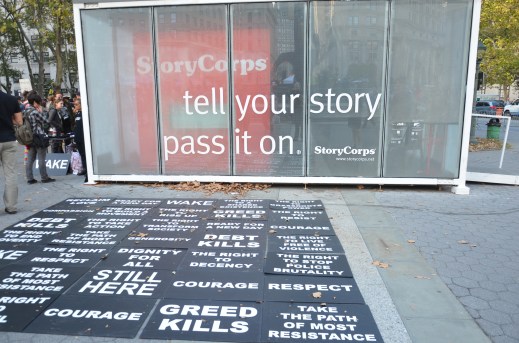
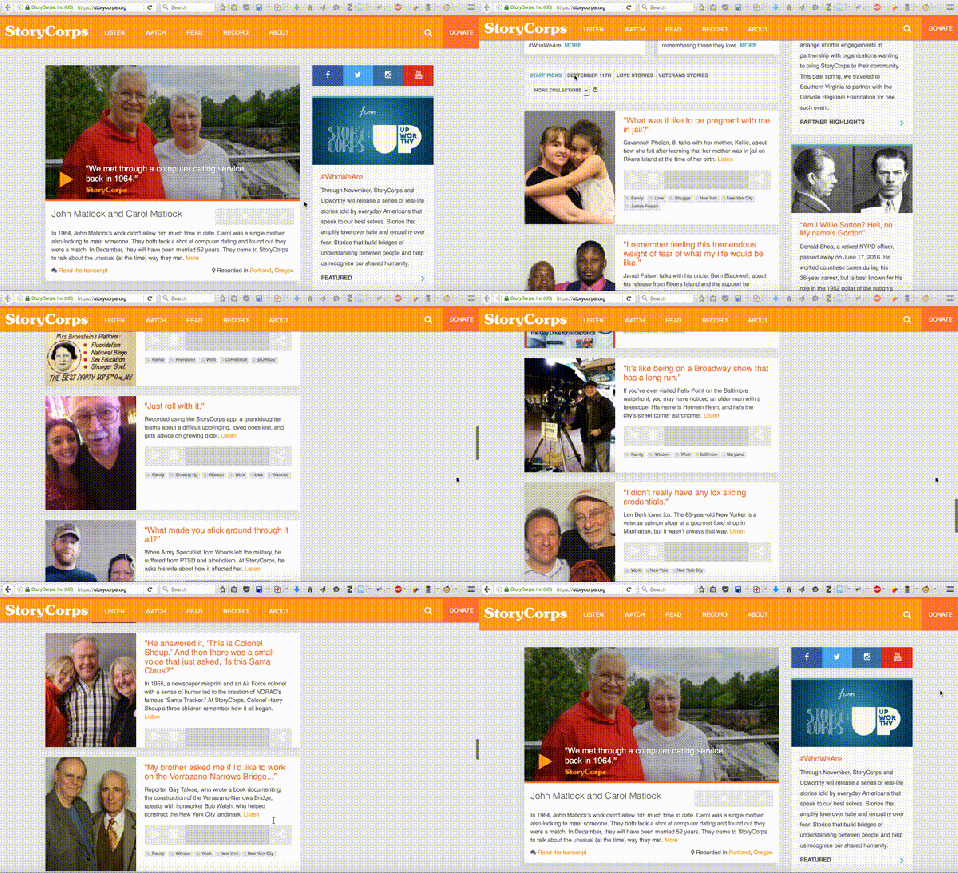
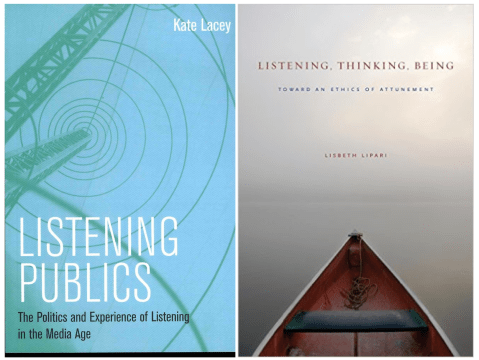
- Listening on the part of the users of these DH projects. Is it realistic to expect that users will listen to large archives of testimony? In Listening Publics, Kate Lacey writes that listening has been absent from theories of the public sphere, even where “the objective of political agency is often characterized as being to find a voice – which surely implies finding a public that will listen, and that has a will to listen” (viii). Because of their scale, these large archives of testimony pose a significant design challenge to the user, which could be resolved through curation. To build on one of the most successful digital storytelling projects, the Storycorps team knows very well that if they didn’t curate and edit together shorter versions, then no one would listen to the longer interviews in full.
- Listening on the part of the interface and its design. This involves questioning the medium and its effects on what it houses. Here I find Susan Bickford’s work very useful in her definition of listening and what it accomplishes: ‘the riskiness of listening comes partly from the possibility that what we hear will require change from us’ (1996, 149). If interfaces for stories pre-close any openness to what contributed stories could change, then listening is not being considered. This is more directly seen in the tagging of videos and their categorization without additional interpretational work. This will to not “add” to these stories seems to come from the premise that these testimonies should “speak for themselves” (I get to this point in a little bit); that no added interpretation is needed, even that any added interpretation distracts from the directness of the stories. But this often also means the medium and its effects on these stories are not carefully examined.
Contrary to Western cultural beliefs, listening can be seen as an active mode of participation in conversation. As Jodi Dean rightly argues, it is not enough to express one’s opinion, or for a message to be circulated: it is crucial to get a response to the message. Lisbeth Lipari writes that even in Dean’s formulation, however, the response as speech is still emphasized, thereby ignoring the work that happens beforehand: the listening. Apart from the major contribution of Susan Bickford, mentioned above, with the concept of political listening, little attention has been paid to listening in the field of political theory.
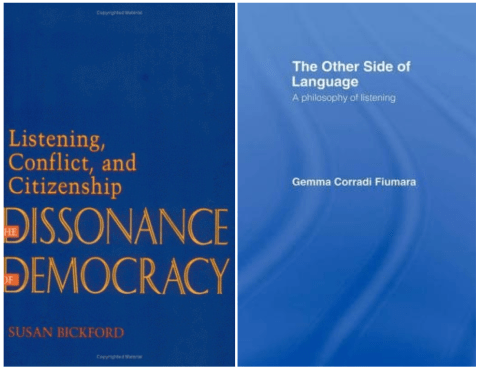
As arguably the most important philosopher on listening, Gemma Corradi Fiumara, writes: “listening involves the renunciation of a predominantly moulding and ordering activity; a giving up sustained by the expectation of a new and different quality of relationship” (as quoted by Lipari, 8). For Fiumara, listening is a mode of participation that is open and that does not pre-close potential possible contributions. Listening, therefore, as a mode of engagement can provide a useful method for thinking about participation in various contexts.
DH + Archives + i-docs
If a mission of a certain DH project is to engage with a wider public, then preservation of stories is not enough. More often than not, DH projects are already under difficult strain of resources, due to costs for developing technological projects and time for interviewing, collecting, indexing, tagging, uploading and making sense of these larger collections. DH have taken on a lot: preserving and archiving everyday stories with the mission to share with a wider public. It is useful to draw from experts who have been working through ideas of preservation and access: archivists. Archives generally have a mission of preservation, but when demands of sharing with a public arise, there are not many models from which to draw. Rick Prelinger writes that although the archive as a theoretical concept is overly theorized, its practice (in the plural form of the word) is under theorized.
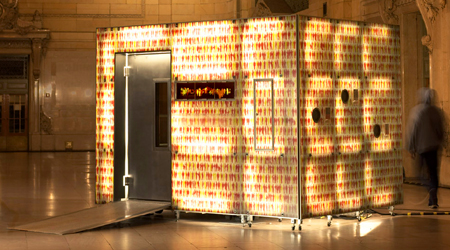
Image of StoryCorps collection area by Aaron “tango” Tang (CC BY 2.0).
Francis X Blouin and William G. Rosenberg trace the intersection of history and archives and found that Ranke, during the enlightenment, conceptualized history as a scientific endeavor in that truth could be extracted from archives through rigorous methodologies. This led to the idea that documents could “speak for themselves” (Blouin, 24). As if simply making documents available, without providing context of any sort, would reveal their inner truth. This is one of many cases where the reading of documents is taken for granted. It also ignores the effect that archivists have on the collecting, saving, and indexing of documents. Influential archivists such as Terry Cooke, Richard Brown and Brian Brothman have brought about new attitudes to repositories with an acknowledgment of the effect that archivists have on documents (as quoted by Richard J Cox, 33). This relatively recent push in archival theory, therefore, points to the flaws in the claim that documents on their own can represent themselves: that would be ignoring all the various power relationships at play, as well as the medium itself in which the stories are communicated.
In thinking about collaboration, with the unstated but implied goal of providing knowledge of a given subject, non-fiction film has experimented by inviting self-interested participants online and offline to contribute to projects. Sandra Gaudenzi makes clear that interactive documentaries, also called i-docs (documentaries designed for online or mobile viewing), are very distinct and that it is important to recognize the varying strategies employed by these digital projects: “uploading content is the most common way to collaborate in the case of online documentary, but it is definitely not the only one. […] contributions of content lead to co-creation but not to co-authorship, since the latter require a degree of intervention in the overall concept (i.e., form) of the product.” In her differentiation of co-creation and co-authorship, Gaudenzi points to the medium-limiting effect that users have in their participation. The “degree of intervention,” as a coming in between that leads to change, which Gaudenzi requires for co-authored documentaries, might be attained through listening, a listening through the work itself, such as The WorryBox Project.
Listening in The WorryBox Project
Irene Lusztig’s The WorryBox Project (2011) web-based documentary invites mothers to write their worries in an online form, which Lusztig then individually writes down on a piece of paper, rolls-up and stores in a physical box. The act of writing down in analog form what was input into a digital box goes an extra step beyond collection. It is emblematic of an extended care for these worries. The additional layer of documenting these actions, as part of the artwork itself, not only points to the embodiment of these worries but also to their representation.

Because listening has often been thought of as passive and feminine, it is also associated with a specific kind of caring, also in its passive and feminine forms. But I don’t equate that definition of care with listening, which surely the readers of this blog will question. In this case, care extends as a mode of listening because it pushes against the active/passive binary for speaking/listening. I use care in the sense it gave to curating (care is its early root), where curating points to the work of engagement and conversation. Curating as a form of listening.
This extended care would be an example of the listening I am thinking of. The work of translating the form’s digital input into the handwritten words and the documentation of that act stretch the layering of interpretation and with it the care given to these submissions. The change that occurs in this writing is definitely not an agreement or an endorsement of what is submitted but an open attitude of listening, of reception. This reinforces the notion that listening is not passive, but an active mode of participation.
This mode of listening does not imply an understanding, as the receipt of information in cybernetics theory suggested by Shannon and Weaver. Rather this mode of communication embraces the notion that listening does not necessarily mean an understanding. The audio action collaborative Ultra-Red conveys this idea perfectly: “Sound possesses a palpable promiscuity in relation to the body. One may say what one means, but somewhere between the mouth that speaks and the ear that hears, sound always exceeds its master. Politically, it may be useful to say that we hear the truth in the voice or that we listen with obedience, but sound always transgresses such duties.” So for DH storytelling projects to be participatory, it is beneficial to allow stories the space for listening, in a similar sense to Hannah Arendt’s “distancing” in order to understand. This brings me to media and communication’s scholar Lisbeth Lipari’s term for this: “listening otherwise.”

SO! Screen Capture of Irene Lustzig’s “The Worry Project”
For Lipari, in engaging with difficult stories or perhaps stories that offer different perspectives: “It is […] a listening otherwise that suspends the willfulness of self- and foreknowledge in order to receive the singularities of the alterity of the other” (185, emphasis in original). For this “listening otherwise” to work online, I argue that it is important for the employed structures, systems and processes to reflect this specific kind of participation. In other words, in addition to placing “different voices” side-by-side, it is equally critical for these different perspectives to exist in a space where the medium, whether the recording, the software, the interface and its design, listens to what these differences are. An interface designed in order not to predetermine, not to predict or preclose what others might contribute would then be an example of this listening. Anthropomorphizing aside, for a computer to listen to testimony, as Presner asks, it must be designed to be open to changing itself.
—
Fabiola Hanna is a new media artist & software designer currently working towards a PhD in Film and Digital Media at UC Santa Cruz where she also holds an MFA in Digital Arts & New Media. Her doctoral work is on building an automatic editing machine that weaves together competing narratives about the history of Lebanon, which has led her to engage with software studies & digital humanities, archives & memory and new media art activism.
Her work has been exhibited widely in California at the Museum of Art and History in Santa Cruz, the New Children’s Museum in San Diego, the SubZero Festival in San Jose, the Digital Arts Research Center in Santa Cruz, and the Maker Faire in San Mateo. She is also a 2015 fellow of the Institute for Critical Social Inquiry at the New School, New York and has previously taught at University of California, San Diego and at various maker spaces including FabLab San Diego and MakerPlace.
Her website is fabiolahanna.com and she can be reached by email fhanna {@} ucsc {dot} edu.
—
Featured Image: “Story Corps” by Steve Rhodes, (CC BY-NC-ND 2.0)
—
 REWIND!…If you liked this post, you may also dig:
What Mixtapes Can Teach Us About Noise: Reading Shannon and Weaver in 2010–Aaron Trammell
Machinic Ballads: Alan Lomax’s Global Jukebox and the Categorization of Sound Culture–Tanya Clement
“Digital Analogies: Techniques of Sonic Play“-Roger Moseley
Share this:

Listen to the Sound of My Voice
Betrayal
I first realized there was a problem with my voice on the first day of tenth grade English class. The teacher, Mrs. C, had a formidable reputation of strictness and high standards. She had us sit in alphabetical order row after row, and then insisted on calling roll aloud while she sat at her desk. Each name emerged as both a command and a threat in her firm voice.
“Kelly Barfield?”
“Here,” I mumbled quietly. I was a Honor Roll student with consistent good grades, all A’s and one B on each report card, yet I was shy and softspoken in classes. This was an excellent way to make teachers amiable but largely go unnoticed. The softness of my voice made me less visible and less recognizable.
Mrs. C repeated my name. Caught off guard, I repeated “here” a little more loudly. She rose to her feet to get a better look at me. I knew what she saw: a petite girl with long ash blonde hair, big brown eyes, and overalls embroidered with white daisies on the bib. When her gaze finally met mine, Mrs. C frowned at me and cleared her throat loudly. I curled into my desk, hoping to disappear.

“Lincoln High School 9-16-2007 008” by Flickr user Paul Horst, CC BY-NC 2.0
“Miss Barfield, did you hear me call your name twice? In this class, when I call roll, you respond.” I gave a quick nod, but Mrs. C wasn’t finished: “We use our strong voices in here, not our girly, breathy ones.” My cheeks flushed red while Mrs. C droned on about confidence and classroom expectations.
“Do you understand me?”
I stammered a “yes.” Mrs. C turned her attention back to the roll call. Her harsh words rang in my ears. I sank low in my chair, humiliated and angry. I couldn’t help that I sounded girly: I was, in fact, a girl. This was the way my voice sounded. It was not an attempt to sound like the dumb blonde she appeared to think I was.
That day I decided that I would never speak up in her class. Forget the Honor Roll. If the sound of my voice was such a problem, then my mouth would remain firmly shut in this class and all of my others. I would never speak up again.

“Listen” by Flickr user lambda_x, CC BY-ND 2.0
My vow to stop speaking lived a short life. I enjoyed Mrs. C’s serious fixation on diagramming sentences and her attempts to show sophomores that literature offered ideas and worlds we didn’t quite know. At first, I spoke up with hesitation and fear of the inevitable dismissal, but I continued to speak. Becoming louder became my method to seem confident, even when I felt anything but.
Throughout high school, my voice emerged again and again as a problem. Despite the increased volume, my voice still sounded tremulous, squeaky, hesitant, and shrill to my own ears. Other girls had these steady, warm voices that encouraged others to listen to them. Some had higher voices that were melodic and lovely. I craved a lower, more resonant voice, but I was stuck with what I had. In drama club, our director scolded me with increasing frustration about my tendency to end my lines in the form of a question. My nerves materialized as upspeak. The more he yelled at me, the more pronounced the habit became. He eventually gave up, disgusted by my inability to control my vocal patterns.

By Dvortygirl, Mysid [GFDL (http://www.gnu.org/copyleft/fdl.html) or CC-BY-SA-3.0 (http://creativecommons.org/licenses/by-sa/3.0/)%5D, via Wikimedia Commons
Meanwhile, at a big state university in my native Florida, I learned quickly that a Southern accent marks you as a dumb redneck from some rural town that no one had heard of. Students in my classes asked me to say particular words and then giggled at my pronunciations. “You sound like a Southern belle,” one student noted. This was not really a compliment. According to my peers, Southern belles didn’t have a place in the classroom. Southern belles didn’t easily match up with “college student. As a working-class girl from a trailer park, I learned that I surely didn’t sound like a college student should. I worked desperately to rid myself of any hint of twang. I dropped y’all and reckon.
I listened carefully to how other students talked. I mimicked their speech patterns by being more abrupt and deadpan, slowly killing my drawl. When I finally removed all traces of my hometown from my voice, my friends both from home and from college explained that now I sounded like an extra from Clueless. My voice was all Valley girl. I was smarter, they noted with humor, than I sounded and looked. My voice now alternated between high-pitched and fried. Occasionally, it would squeak or crack. I thought I sounded too feminine and too much like an airhead, even when I avidly tried not to. I began to hate the sound of my voice.
My voice betrayed me because it refused to sound like I thought I needed it to. It refused to sound like anyone but me.
When I started teaching and receiving student evaluations, my voice became the target for students to express their displeasure with the course and me. According to students, my voice was too high and grating. Screechy, even: one student said my voice was at a frequency that only bats could hear. In every set of evaluations, a handful of students declared that I sounded annoying. This experience, however, was not something I alone faced. Women professors and lecturers routinely face gender bias in teaching evaluations. According to the interactive chart, Gender Language in Teaching Evaluations, female professors are more likely to be called “annoying” than their male counterparts in all 25 disciplines evaluated. The sound of my voice was only part of the problem, but I couldn’t help but wonder if how I sounded was an obstacle to what I was teaching them.
Once again, I tried to fix my problematic voice. I lowered it. I listened to NPR hosts in my search for a smooth, accentless, and educated sound, and I attempted to create a sound more like them. I practiced pronouncing words like they did. I modulated my volume. I paid careful attention to the length of my vowels. I avoided my natural drawl. None of my attempts seemed to last. Some days, I dreaded lecturing in my courses. I had to speak, but I didn’t want to. I wondered if my students listened, but I wondered more about what they heard.
Sound
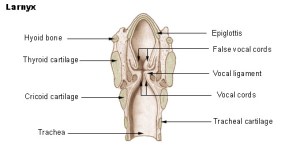
Public Domain, https://commons.wikimedia.org/w/index.php?curid=1393933
The sound of your voice is a distinct trait of each human being, created by your lungs, the length of your vocal cords, and your larnyx. Your lungs provide the air pressure to vibrate your vocal cords. The muscles of your larnyx adjust both the length and the tension of the cords to provide pitch and tone. Your voice is how you sound beyond the resonances that you hear when you speak. It is dependent on both the length and thickness of the vocal cords. Biology determines your pitch and tone. Your pitch is a result of the rate at which your vocal cords vibrate. The faster the rate, the higher your voice. Women tend to have shorter cords than men, which makes our voices higher.
Emotion also alters pitch. Fright, excitement, and nervousness all make your voice sound higher. Nerves would make a teenage girl have an even higher voice than she normally would. Her anxious adult self would too. Her voice would seem tinny because her larnyx clenched her vocal cords tight. Perhaps this is the only sound she can make. Perhaps she is trying to communicate with bats because they at least would attempt to listen.
Biology, the body, gives us the voices we have. Biology doesn’t care if we like the ways in which we sound. Biology might not care, but culture is the real asshole. Culture marks a voice as weak, grating, shrill, or hard to listen to.
“Speak” by Flickr user Megara Tegal, CC BY-NC-ND 2.0
My attempts to change my voice were always destined to fail. I fought against my body and lost. I couldn’t have won even if I tried harder. My vocal cords are determined that my voice would be high, so it is. The culture around me, however, taught me to hate myself for it. Voice and body seem to cast aspersions on intelligence or credentials. It’s the routineness of it all that wears on me. I expect the reactions now.
I wonder if I’m drawn to the quietness of writing because I don’t have to hear myself speak. I crave the silence while simultaneously bristling at it. Why is my voice a problem that I must resolve to placate others? How can I get others to hear me and not the stereotypes that have chased me for years?
Fury
My silence has become fruitful. The words I don’t say appear on the page of an essay, a post, or an article. I type them up. I read aloud what I first refused to say. I wince as I hear my voice reciting my words. I listen carefully to the cadence and tone. This separation of words and voice is why writing appeals to me. I can say what I want to say without the sound of my voice causing things to go awry.
People can read what I write, yet they can’t dismiss my voice by its sound. Instead, they read what I have to say. They imagine my voice; my actual sound can’t bother them. But, they aren’t really hearing me. They just have my words on the page. They don’t know how I wrap the sound around them. They don’t hear me.
Rebecca Solnit, in “Men Explain Things to Me,” writes “Credibility is a basic survival tool.” Solnit continues that to be credible is to be audible. We must be heard to for our credibility to be realized. This right to speak is crucial to Solnit. Too many women have been silenced. Too many men refuse to listen. To speak is essential “to survival, to dignity, and to liberty.”

“Listen” by Flickr user Emily Flores, CC BY-ND 2.0
I agree with her. I underline her words. I say them aloud. The more I engage with her argument, the more I worry. What about our right to be heard? When women speak, do people listen? Women can speak and speak and speak and never be heard. Our words dismissed because of gender and sound. Being able to speak is not enough, we need to be heard.
We get caught up in the power of speaking, but we forget that there’s power in listening too. Listening is political. It is act of compassion and empathy. When we listen, we make space for other people, their stories, their voices. We grant them room to be. We let them inhabit our world, and for a moment, we inhabit theirs. Yes, we need to be able to speak, but the world also needs to be ready to listen us.
We need to be listened to. Will you hear me? Will you hear us? Will you grant us room to be?
When I think of times I’ve been silenced and of the times I haven’t been heard, I feel the sharp pain of exclusion, of realizing that my personhood didn’t matter because of how I sounded. I remember the burning anger because no one would listen. I think of the way that silence and the policing of how I sound made me feel small, unimportant, or disposable. As a teenager, a college student, and a grown woman, I wanted to be heard, but couldn’t figure out exactly how to make that happen. I blamed my voice for a problem that wasn’t its fault. My voice wasn’t the problem at all; the problem was the failure of others to listen.
“listen” by Flickr user Jay Morrison, CC BY-NC-ND 2.0
Loss
While writing this essay on my voice, I almost lost mine, not once but twice. I caught a cold and then the flu. My throat ached, and I found it difficult to swallow. A stuffy nose gave my voice a muted quality, but then, it sounded lower and huskier. I could hear the congestion disrupting the timber of my words. My voice blipped in and out as I were radio finding and losing signal. It hurt to speak, so I was quiet.
“You sound awful,” my husband said in passing. He was right. My voice sounded unfamiliar and monstrous. I tested out this version of my voice. It was rougher and almost masculine. I can’t decide if this is the stronger, more authoritative voice I wanted all along or some crude mockery of what I can never really have. I couldn’t sing along with my favorite songs because my voice breaks at the higher register. I wheezed out words. I croaked my way through conversations. “Are you sick?” my daughter asked, “You don’t sound like you.”
Her passing comment stuck with me. You don’t sound like you. Suddenly, I missed the sound of my voice. I disliked this alien version of it. I craved that problematic voice that I’ve tried to change over the years. I wanted my voice to return.
After twenty years, I decided to acknowledge the sound of me, even if others don’t. I want to be heard, and I’m done trying to make anyone listen.
—
Featured image: “Speak” by Flickr user Ash Zing, CC BY-NC-ND 2.0
—
Kelly Baker is a freelance writer with a religious studies PhD who covers religion, higher education, gender, labor, motherhood, and popular culture. She’s also an essayist, historian, and reporter. You can find her writing at the Chronicle for Higher Education‘s Vitae project, Women in Higher Education, Killing the Buddha, and Sacred Matters. She’s also written for The Atlantic, Bearings, The Rumpus, The Manifest-Station, Religion Dispatches, Christian Century’s Then & Now, Washington Post, and Brain, Child. She’s on Twitter at @kelly_j_baker and at her website.
—
REWIND!…If you liked this post, you may also dig:
Vocal Gender and the Gendered Soundscape: At the Intersection of Gender Studies and Sound Studies — Christine Ehrick
On Sound and Pleasure: Meditations on the Human Voice– Yvon Bonefant
As Loud As I Want To Be: Gender, Loudness, and Respectability Politics — Liana Silva
Share this:


Current Top Posts





April 2021

January 2020

November 2019

October 2019

August 2019

April 2014

November 2017

March 2015

December 2017

October 2015
 Sounding Out!
Recent Comments