
Make a Noise Joyful: Cirm in the Old English Exodus


Series co-editors Dorothy Kim and Christopher Roman
When the narrator of the Old English poem Exodus declares “Gehyre se ðe wille” (Let him hear who will), what sounds is he asking us to attend to? [Note: Text from Peter Lucas’s edition, 7b. All translations are author’s own.] This post argues that the Old English noun cirm (noise, shout, outcry) challenges our conceptualization of noise. In the Anglo-Saxon corpus, cirm most often refers to the indistinguishable, non-linguistic hum of a crowd, rather than the meaningful utterance of an individual. This accords with the popular view of noise in sound studies: whether medieval or modern, noise (as opposed to meaningful sound) is associated with alterity, disruption, and violence.
However, and strikingly, in the Old English Exodus, words for noise describe not only the terrible sounds of the drowning Egyptians as the roaring waters of the Red Sea rush over them, but also the survival of the Israelites. I argue that this cirm is a mark of the Israelites’ triumphal assertion of their continued presence and plenitude, a celebration of the fact that they can still be a multitude despite captivity. That cirm may not sit easily within our definition of noise should provoke not a redefinition of cirm’s joyful use, but a reconceptualization of Anglo-Saxon noise.

‘Amalek Attacks Israel and Is Defeated’, in the Old English Hexateuch, British Library, MS Cotton Claudius B IV
What is Noise?
“Noise” has a range of meanings, but most often implies “unwanted sound” as R. Murray Schafer argues in The Soundscape (73). Following the work of Jacques Attali and Jeffrey J. Cohen, noise has been associated with alterity, difference, and monstrosity. Noise, as opposed to sound, may be non-linguistic or disordered: nonsense, babble, the roar of a jet engine. According to David Novak’s contribution to Keywords in Sound, noise is not present in nature, but is created by modern technology (129). In the modern world, noise is often considered negative: cities have rules about noise pollution, apartment buildings set quiet hours, and airplane passengers don noise-cancelling headphones. In the pre-industrial age, noise was not exempt from criticism, though the word could also be applied to more pleasant sounds, like birdsong.
In the European Middle Ages, Valerie J, Allen argues in “Broken Air,” noise was often figured as violent, transgressing boundaries, inappropriately closing the distance between sound producer and sound receiver (310 and 317-318). According to Macrobius, it was not silence that was the opposite of sound, but noise (311). Grammar, which was “devoted to the pursuance of ratio through sound,” was ethical; noise was therefore considered “a kind of audible violence; corruption [wa]s something one can hear” (305). But some medieval noises were more ambiguous: the Old English word dream (joy, joyful sound) could also be applied to the terrible sounds of Hell or the terror of Judgment Day, as in Kazutomo Karasawa’s analysis in “OE dream for Horrible Noise in the Vercelli Homilies.” Likewise, “clamor,” which originated as a (mostly) negative noise, became an important legal instrument, as discussed by Richard Barton in “Making a Clamor to the Lord: Noise, Justice and Power in Eleventh- and Twelfth-Century France.” But in general, we tend to assume medieval noise is negative, or marks its producer as other.
Noises in Exodus
The Old English Exodus, found in the c. 1000 manuscript known as Bodleian MS Junius 11, is a notoriously difficult and complex poetic adaptation of the Old Testament Exodus 12-14. The author and date of composition are unknown, though it is often considered quite early, perhaps as early as the eighth century as Paul Remley and Lucas argue. Few institutions were rich enough to own a complete Bible. The author of Exodus may have had access to a written Latin version of Exodus, or may have been exposed to the text via the liturgy, especially the liturgy of the Easter Vigil.
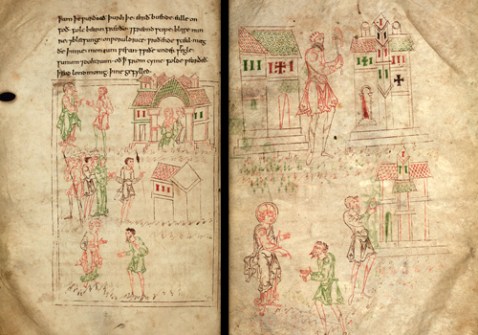
The Junius Manuscript, Oxford, Bodleian Library, MS. Junius 11, pp. 84-5
Exodus delights in sensory details, but until recently, I had always thought of Exodus as primarily visual – the gleaming of war-gear, the glittering of Egyptian spoils washed up on the shore, tents and a pillar of cloud to protect the Israelites from the desert sun, and a pillar of fire to guide them. But the poet is also attentive to the larger sensory world, including the world of sound and noise. Those who accept the poet’s opening challenge to his audience (“Gehyre se ðe wille!” [Let him hear who will!]) will recognize that the poem is in fact filled with sounds – the battle trumpets that provide order and structure to the movements of the army, the rushing and later silencing of waters, the terrible evening songs of wolves eager for battle, the awful rasping of the blade Abraham draws to sacrifice Isaac in the poem’s digression on the patriarchs, the triumphant songs produced by Israelite men and women in praise of God after the Egyptians are defeated. In what follows, I focus on the multiple deployments of a single word for noise (cirm), applied to both Israelites and Egyptians, asking what this word can reveal about Anglo-Saxon conceptions of noise.
It has often been remarked that the poet resists easy distinctions between Israelites and Egyptians, applying similar vocabulary to both, and this is certainly illustrated by the poet’s sonic play. In a climactic scene near the end of the poem, the drowning of the Egyptians in the Red Sea is accompanied by horrible noises:
Storm up gewat
heah to heofonum, herewopa mæst;
laðe cyrmdon (lyft up geswearc)
fægum stæfnum. Flod blod gewod:
randbyrig wæron rofene, rodor swipode
meredeaða mæst. Modige swulton,
cyningas on corðre. Cyrm swiðrode
wæges æt ende; wigbord scinon.
[A storm went up high to the heavens, the greatest of cries of the army; the hostile ones cried out with doomed voices (the air grew dark above). Blood pervaded the water: ramparts were broken, the greatest of sea-deaths lashed the sky. The brave ones died, kings in a troop. The noise fell silent at the end of the water; battle-boards shone. (460b-467; emphasis added)]
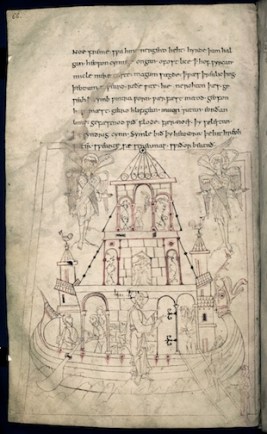
The Junius Manuscript, Oxford, Bodleian Library, MS. Junius 11, p. 66.
Cirm occurs twice in this passage, first as a verb (cyrmdon) and then as a noun (cyrm). The manuscript reading in 466b is cyre (choice). Lucas emends to cyrm because cyre is not a poetic word, and I would argue that the echo with the Israelites’ cyrm (107) must be deliberate. Even if we accept MS cyre, the passage still includes the verb cyrmdon (462a), and other sonic vocabulary (herewopa, “army’s cries” [461], and fægnum stefnum, “doomed voices” [463]). The noun occurs roughly 60 times in the corpus; the verb 17 times (DOE).
In the Old English corpus, cirm is often negative, applied to the tortures of hell or the terror of Judgment Day, and indicates a particularly loud sound (DOE, Lucas). According to the DOE, the noun means “shout, cry, shriek” or “noise of non-human origin, clamour.” The Egyptian cirm is obviously threatening, the meaningless cries of men who, like a raging storm, lash out in terror as the waters close over their heads. Even the visual horror of blood mingling with water maintains sonic affiliations: this line is a rare example of internal rhyme in Old English poetry (flod blod gewod). The end of the Egyptian threat is marked by the silencing of their voices and cirm, metaphorically a silencing of the army’s advance against the Israelites.
Given the negative associations with noise in both medieval and modern sound theory, that the Egyptian defeat is accompanied by their terrible cirm may not seem particularly surprising. Strikingly, this is not the only such noise in the poem. Near the beginning of the poem, the Israelites celebrate their initial escape from Egypt by producing not just any noise, but cirm. On the third day, after the pillar of cloud has appeared, the Israelites awaken with trumpets, and seeing the pillar,
Folc wæs on salum,
hlud herges cyrm.
[The people were joyful, loud was the noise of the army. (106b-107a; emphasis added)]
If cirm is threatening, loud noise, associated with difference and violence, why would the Israelites produce it? I would like to suggest that cirm suggests not merely loud noise, but crowd noise. The Israelites’ cirm is not an assertion of difference, or the meaningless babble of a drowning, almost non-human army, but an assertion of triumphant plenitude. Their joyful cirm is a fulfillment of God’s covenant with Abraham, which the poet will remind us of later in the poem (435-442). Just as God promised Abraham innumerable offspring, his support of the Israelites in their exodus signals that they will continue to be a multitude (as they certainly are in this battle, in which they have 600,000 fighting men (224-233).
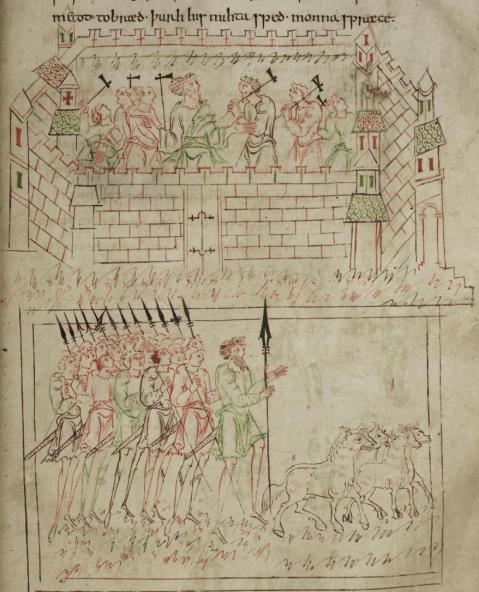
The Junius Manuscript, Oxford, Bodleian Library, MS. Junius 11, p. 81.
In fact, the Israelites’ triumphant crowd noise is echoed at the end of the poem as well. After the defeat of the Egyptians, who make terrible cirm as they perish in the Red Sea (460b-467), the Israelites issue more celebratory sound, this time transformed from crowd noise to harmonious music:
Æfter þam wordum – werod wæs on salum –
sungon sigebyman (segnas stodon),
fægerne sweg
[After these words – the troop was joyful – victorious trumpets sang a beautiful sound (battle-standards stood). (565-67a; emphasis added)]
The Israelites’ cirm (107), which they produced while on salum (joyful), is balanced and echoed by the celebratory sounds of the end of the poem, also produced by a people who are on salum (565). Whatever threat the Israelites’ assertion of plenitude and cirm may have made possible is mitigated by replacing that cirm (noise) with a beautiful sound (fægerne sweg), a harmonious, if also loud and multiple, expression.
According to Attali, music can be used to produce order, but “noise is violence: it disturbs. To make noise is to interrupt a transmission, to disconnect, to kill. It is a simulacrum of murder” (26). In this sense, the Israelites’ crowd noise in the desert is violent – it threatens the order of the Egyptians, or the hierarchy the Egyptians have sought to impose on the Israelites in their captivity. But because this story ends in the triumph of the Israelites, told from the point of view of their Christian descendants, it celebrates this assertion of communal power and communal violence without fully othering them. The true violence is inflicted on the Egyptians by God in the Red Sea, allowing the Israelites to reassert their normativity, their cohesion, their power, and their non-otherness. While the drowning Egyptians produce cirm, it is silenced because the cirm of the Israelites has conquered them. Noise, or at least cirm, is therefore not merely negative or disruptive; it is a powerful claim to be blessed by God, an assertion of belonging rather than a boundary crossing.
—
Featured Image:Detail of a miniature of the plague of hail (Exodus 9:22-25), Add MS 15277, f. 7r
—
Jordan Zweck is an assistant professor in the Department of English at the University of Wisconsin-Madison. She specializes in early medieval vernacular literature and culture, especially Old English, and is interested in documentary culture, media studies, and sound studies. She is currently completing a book on Anglo-Saxon epistolarity and early English media, examining the representation of letters in vernacular texts such as letters from heaven, hagiography, and poetry. She is also working on a second book on sound, noise, and silence in Anglo-Saxon England, a portion of which is forthcoming in Exemplaria. Zweck is a recipient of the University of Wisconsin-Madison Center for the Humanities’ First Book Award, has held a resident fellowship at the Institute for Research in the Humanities at UW-Madison, and has won several teaching awards.
—
REWIND!…If you liked this post, you may also dig:
‘A Clateryng of Knokkes’: Multimodality and Performativity in “The Blacksmith’s Lament”–Katherine Jager
Mouthing the Passion: Richard Rolle’s Soundscapes–Christopher Roman
Sounding Out! Podcast #54: The Sound of Magic-K.A. Laity
Share this:

This is What It Sounds Like . . . . . . . . On Prince (1958-2016) and Interpretive Freedom
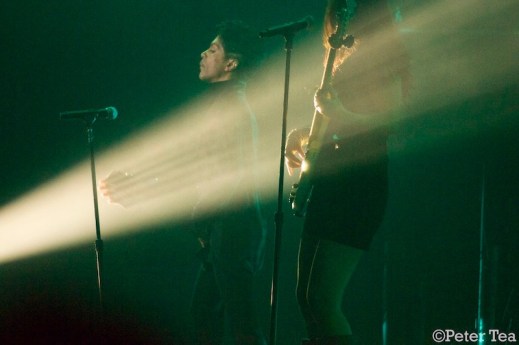
Can you imagine what would happen if young people were free to create whatever they wanted? Can you imagine what that would sound like?–Prince, in a 2015 interview by Smokey D. Fontaine
Prince leaves an invitingly “messy” catalog—a musical cosmos, really—just as rich for those who knew it well as for those encountering it with fresh ears. He avoided interviews like he avoided conventions. He made few claims. Read him as you will.
We are free to interpret Prince, but not too free. Yes, art is open, and perhaps Prince’s art especially. And yet many eulogies have described him as indescribable, as if he were untethered by the politics of his world; he wasn’t. Some remembrances assume (or imagine) that Prince was so inventive that he could escape stultifying codes and achieve liberation, both as musician and human being. For example, Prince has often been called “transcendent”—of race, of musical genre, even of humanity itself. This is overstated; he was rooted in all of these. Better to say, maybe, that he was a laureate of many poetics, some musical and some not. He responded to race, genre, and humanity, all things that he and we are stuck with. He was a living artwork, and these, by way of sound, were his media.
Prince was not transcendent. He was just too much for some to assimilate.

Since Prince’s passing last month, I’ve been struck by the idea that his career might have been, deliberately or not, an elaborate quotation of the career of Little Richard, who anachronistically has outlived him. Or, a sonic version of what Henry Louis Gates Jr. calls “signifyin(g)” in the African American artistic tradition in The Signifying Monkey: repetition with a difference, a re-vision—and, especially appropriate here—a riffing (66). Both Prince and Richard in their way defined rock music, even as rock—as a canonized form—held them at a distance. They were simultaneously rock’s inventive engine and its outer margins, but never, seemingly, its core—at least from the perspective of its self-appointed gatekeepers.

Rock and race have, to put it mildly, an awkward history. African-American rock artists rarely get their due from labels and taste-making outlets, in money or posterity, a phenomenon not at all limited to the well-known pinching of Elvis and Pat Boone. One might consider, for example, Maureen Mahon’s anthropology of the Black Rock Coalition, a group home to Greg Tate, Living Colour, and others dwelling on rock’s periphery. Canons are one way to understand how this denial works.
To be sure, some black artists have been canonized in rock, but always with a handicap, as Jack Hamilton has explained lucidly. In, for example, best-of lists (which I have browsed obsessively since Prince died, as if enshrinement there might confirm something about him; he is usually #40 or #50), there are only so many slots of color: Hendrix is the black guitar god; Little Richard the sexual sentinel rising in a repressed era; James Brown the lifeline to funk; Big Mama Thornton the grandmaternal footnote. Best-of lists published by major magazines and websites such as Rolling Stone and VH1, tend to name about 70% white artists, as well as 90-95% male ones. These lists have become just a smidgen more inclusive in the past decade or so. Still, only the Beatles and Rolling Stones are regular contenders to be named history’s greatest rock band.
We are free to interpret greatness, but not too free.
For those who care about lists enough to comment on them, much of the point is in the arguing, the freedom to declare an opinion that cannot be challenged on logical grounds. I certainly wouldn’t argue for more “correct” best-of lists, either for aesthetics or inclusivity. Lists have every right to be subjective. But they are also fascinatingly unmoored by any explicit standard for judgment. As a result, the debates that surround their ordering are full of unvarnished pronouncements of truth (and falsity), even for those who acknowledge the subjectivity of lists, which I observed first hand as I joined and posted on a Beatles forum and an Eagles forum to research this article (“…putting the Police and the Doors ahead of the Eagles is absurd, IMHO”). But why would anyone declare certainty about a question such as the best rock artist of all time, when it is so plainly open to personal interpretation?
Yes, lists are subjective. But who are the subjects that invest in them?
Prince’s career began in the late 1970s, a musical moment deeply reflective of what Robin DiAngelo calls “white fragility.” The Beatles were gone after the 1960s and guitar music stood under their long shadow. Led Zeppelin were bloated and breaking up. Disco was in ascent. Rock had somehow convinced itself that it was neither rooted in nor anchored by queer, female, and racially marked bodies, as it indeed was and in fact had always been. White male rock critics and fans were busily constructing the “rock canon” as a citadel—impenetrable to “four on the floor beats” and diva-styled vocals—and there was nothing in its blueprint to suggest that there would be a door for someone like Prince.
Just one month after Prince finished recording his breakthrough, self-titled album in July 1979—the record gave us “I Wanna Be Your Lover” and “I Feel For You,” which Chaka Khan would take to chart topping heights in 1984—Chicago “shock jock” Steve Dahl staged an infamous event at Comiskey Park called Disco Demolition Night. The fascistic spectacle, which took place between games of a White Sox doubleheader, asked fans to bring disco records, which would be demolished in an explosion and ensuing bonfire on the field.
It was a release of pent-up frustration and a wild-eyed effort to rid the world of the scourge of disco, which many listeners felt had displaced rock with plastic rhythms, as Osvaldo Oyola discussed in a 2010 SO! post “Ain’t Got the Same Soul,” a discussion of Bob Seger, who famously sang in 1979, “Don’t try to take me to a disco/you’ll never even get me out on the floor.” Excited, drunk defenders of the “rock canon” rioted around the fire. The nightcap was cancelled.
These are the subjects who invest in lists.
Many who witnessed the event, both in person and on television, experienced its personal, racially charged, and violent implications. Aspiring DJ Vince Lawrence, who worked as an usher at the Disco Demolition Night game, was later interviewed for a BBC documentary entitled Pump Up the Volume: The History of House Music: [see 9:00-10:15 of the clip below]:
It was more about blowing up all this ‘nigger music’ than, um, you know, destroying disco. Strangely enough, I was an usher, working his way towards his first synthesizer at the time, what I noticed at the gates was people were bringing records and some of those were disco records and I thought those records were kinda good, but some of them were just black records, they weren’t disco, they were just black records, R&B records. I should have taken that as a tone for what the attitudes of these people were. I know that nobody was bringing Metallica records by mistake. They might have brought a Marvin Gaye record which wasn’t a disco record, and that got accepted and blown up along with Donna Summer and Anita Ward, so it felt very racial to me.
Lawrence notes that blackness was, for rock’s canonizers, part of a mostly inseparable bundle of otherness that also included queer people, among others. Although the disco backlash is often regarded as mainly homophobic, in fact it points to even deeper reservoirs of resentment and privilege.
When music companies decided to mass-market the black, queer sound of disco, they first called it “disco-rock”; two words that American audiences eventually ripped apart, or demolished, perhaps. Black and queer people—and women too, of all races and sexualities—represented the hordes outside of rock’s new citadel, whose walls were made from the Beatles’ cheeky jokes, Mick’s rooster-strut, Robert Plant’s cucumber cock, and Elvis’s hayseed hubris.
Little Richard, for example, was black and queer like disco; what to do with him? His drummer invented the straight eight rhythm, perhaps the genre’s most enduring motif. Here’s Little Richard was rock incarnate, total frenetic energy; Richard’s brilliant, singular approach to the piano would launch a thousand rock tropes in imitation. But in canonization he could only be the nutrient-rich soil of rock—say, #36 on a best-of list—never its epitome, somehow.
I don’t know if Prince—a lifelong resident of Minneapolis, who came of age in the volatile Midwestern American milieu of white disco demolitions AND underground black electronic music culture—cared to consider this history, but he floated in it. He effectively signified on Little Richard not so much by quoting his music (though he owed a debt to him just like everyone who played rock), but by reproducing his position in the music industry. He was a queer noncomformist, never in the business of explaining himself, obsessed with control, whose blackness became a way of not flinching in the face of an industry that would never embrace him, anyway.

I interpret Prince’s musical personae as queer, not in the sense of inversion, as the anti-disco folks had it, but as a forever-exploration of sexual life. Prince’s queerness was not, strictly speaking, like Little Richard’s, but Prince took it on as an artistic possibility nonetheless. If Richard dwelled on this particular fringe as a consequence of his body, his desires, and the limits of social acceptance and religious conviction, Prince chose it as his identity. But Prince also lived and worked within limits of morality and, also like Little Richard, religion.
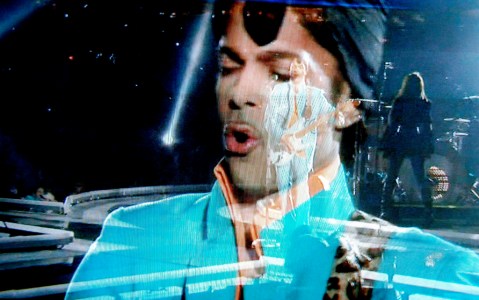
Image by Flickr User Ann Althouse, 2007
Touré writes in a New York Times obit of Prince’s “holy lust,” the “commingling” of sexuality and spirituality. Jack Hamilton writes of the doubt and moral uncertainty that coursed through songs like “Little Red Corvette.” Holy lust is arguably the central pursuit of rock; the term “rock and roll” is etymologically linked either to intercourse or worship, appropriately, emerging in both cases from African-American vernacular. Prince’s queer play with sex, sexuality identity, and religion is as rock and roll as it gets.
As punk sputtered, Simon Reynolds writes in Rip it Up and Start Again, funk appeared to rock fans as a racially tinged, politically and sexually charged savior. Bass, the heart of funk, was key to punk becoming post-punk around 1980. The instrument was suddenly charged with new symbolic and structural importance. During the same period, it is remarkable how many of Prince’s songs either have no bass, or rework bass’s role entirely. “When Doves Cry,” from Purple Rain (1984), Prince’s 6th studio album, is the best-known example of an ultra-funky track that withholds bass entirely, but “Kiss” lacks it, too, as well as “Darling Nikki.”
Earlier on Purple Rain, the bass on “Take Me with U” plays almost as a drone, buzzing like a minimalist’s organ.“Kiss,”from 1986’s Parade and Prince’s second-biggest hit —yet only #464 on the Rolling Stone list of the 500 Greatest Songs of All Time—is so tight, so locked in, so populated by alluring timbres that suggest an alien plane of instrumentation, that you forget it’s even supposed to have bass by rock top 40 convention. On much of 1980’s Dirty Mind, it is difficult to know which carefully tweaked synthesizer tone is supposed to index the bass, if any. Prince’s funk was even funkier for being counterintuitive, as Questlove notes. This gesture wasn’t rejection, of course, it didn’t “transcend” funk. Prince was still playing inarguably funky music, and the lack of bass is so unusual that it’s almost even more apparent in its absence. Free, but not too free.
Prince approached rock iconicity much as he approached bass, which is to say that he embraced clichés, but performed them inside-out, calling attention to them as both limits and possibilities, as constraint and freedom. “Raspberry Beret,” from 1985’s Around the World in a Day, is a boppy “girl group” song with sly allusions to anal sex, that uses exotic instruments and is written in an obscure mode. The virtuosic riff on “When Doves Cry,” instead of going where guitar solos go, comes right at the beginning of the track, before the drums, both seemingly isolated from the rest of the song and yet heralding it, too.
All of this worked very well, of course. His songs are just idiomatic enough to give listeners a foothold, but brave enough to evoke a world well beyond idiom. In retrospect, this is precisely what Little Richard had done. This is also what Hendrix and George Clinton and Tina Turner and OutKast have done, from where they rock out—way beyond the citadel, mastering many idioms, then extending them, at once codifying and floating away from genre.

Andre 3000 of OutKast rocking outside the box at Lollapalooza 2014, Image by Flickr User Daniel Patlán
Prince’s career calls back to the personal and artistic concerns, as well as the innovations, of Little Richard and other artists’ sonic expressions of blackness that both built rock’s house and sounded out the tall, white walls of the citadel that would exclude them. All of these artists, I suspect, find little point to hanging out near the citadel’s gates; there are other, funkier places to live. Prince himself was perfectly comfortable working athwart Warner Brothers, the press, stardom. He did more than fine.
We are free to interpret Prince, but not too free. Creative as he was, he lived in his time; he was no alien. The greatest testament to his genius is not that he escaped the world, nor that he rendered a new musical landscape from scratch, but rather that he worked in part with rock’s sclerotic structural materials to create such beautiful and fluid work.
—
Featured Image by Peter Tea, July 12, 2011, under Creative Commons license No Derivatives 4.0 International (CC BY-ND 4.0)
—
Benjamin Tausig is assistant professor of ethnomusicology at Stony Brook University, where he works on sound studies, music, and protest in Bangkok and other urban spaces. He is on Twitter @datageneral
—
 REWIND!…If you liked this post, you may also dig:
Enacting Queer Listening, or When Anzaldúa Laughs–Maria Chaves
Learning to Listen: The Velvet Underground’s “Once Lost” LPs–-Tim Anderson
Music Meant to Make You Move: Considering the Aural Kinesthetic-Imani Kai Johnson
Black Mourning, Black Movement(s): Savion Glover’s Dance for Amiri Baraka–Kristin Moriah
Share this:


Current Top Posts





April 2021

January 2020

November 2019

October 2019

August 2019

April 2014

November 2017

March 2015

December 2017

October 2015
 Sounding Out!
Recent Comments